JEE Main · Chemistry ↓ Falling

Coordination Compounds appeared 68 times across 3 years — 7.9% of Chemistry. This question is from Magnetic Properties and Enthalpy of Atomisation.

Year 2026 2025 2024 Total
Questions 19 34 15 68

The spin-only magnetic moment value of Mⁿ⁺ ion formed among Ni, Zn Mn and Cu that has the least enthalpy of atomisation is (in nearest integer) Here n is equal to the number of diamagnetic complexes among K₂[NiCl₄], [Zn(H₂O)₆]Cl₂, K₃[Mn(CN)₆] and [Cu(PPh₃)₃I]

Numerical Answer Type:
Enter a numerical value Answer: 0 to 0 +4 marks

Solution & Explanation

Related Formula
μ = nunpaired(nunpaired+2)~B.M.
Core Logic

This question requires three distinct sequential conceptual steps:

  • Determine the count n of diamagnetic complexes.
  • Identify which of the metal ions (Ni, Zn, Mn, Cu) has the lowest enthalpy of atomisation.
  • Compute the spin-only magnetic moment of that metal in its +n state.
Step 1: Count Diamagnetic Complexes to find n
  • K₂[NiCl₄]: Ni²⁺ = 3d⁸. Weak field chloride ligand leads to 2 unpaired electrons Paramagnetic.
  • [Zn(H₂O)₆]Cl₂: Zn²⁺ = 3 d¹⁰. Completely filled subshell Diamagnetic.
  • K₃[Mn(CN)₆]: Mn³⁺ = 3d⁴. Strong field cyanide ligand gives low-spin state with 2 unpaired electrons Paramagnetic.
  • [Cu(PPh₃)₃I]: Cu^+ = 3 d¹⁰. Completely filled subshell Diamagnetic.
  • Thus, there are exactly 2 diamagnetic complexes: n = 2.

Step 2: Identify Metal with Lowest Enthalpy of Atomisation

Among the transition metals of the 3d series (Ni, Zn, Mn, Cu), Zinc (Zn) has the lowest enthalpy of atomisation (126~ kJ~mol⁻¹). This is because Zinc has a fully occupied d-subshell (3 d¹⁰4s²) and lacks any unpaired d-electrons to participate in metallic bonding.

Step 3: Calculate Spin-only Magnetic Moment of M^n+

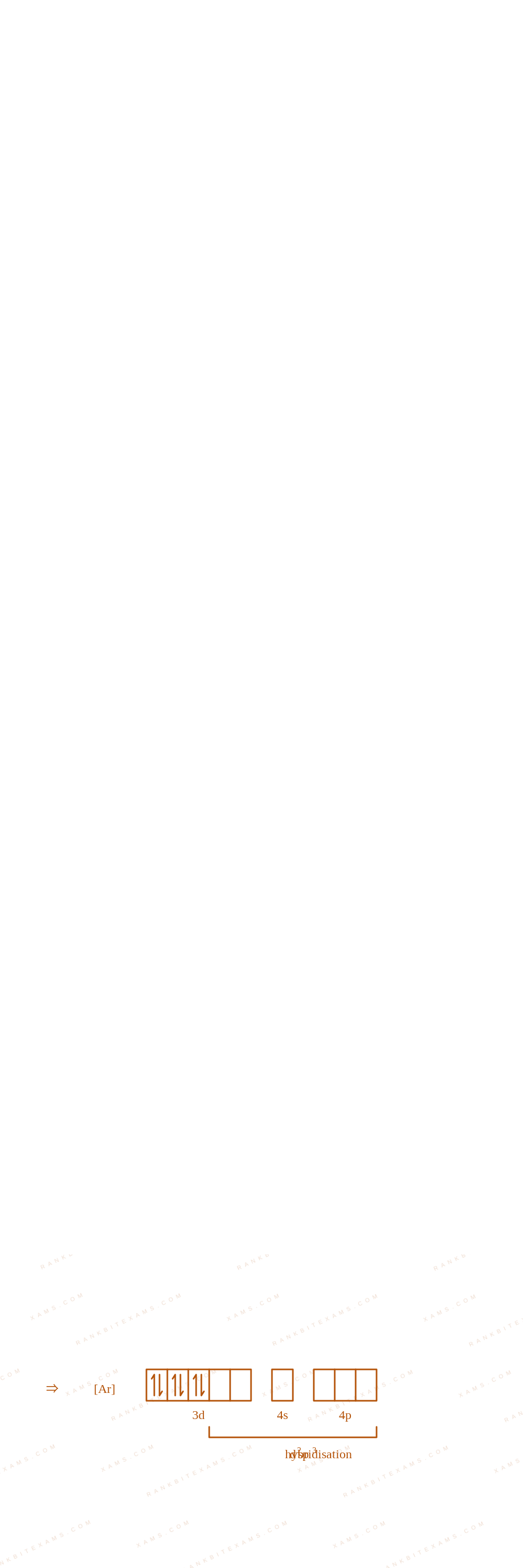
With M = Zinc and n = 2, the ion is Zn²⁺.

Electronic configuration of Zn²⁺ is [Ar]3 d¹⁰, which contains zero unpaired electrons (nunpaired = 0).

Therefore, the spin-only magnetic moment is:

μ = 0~B.M.
Pattern Recognition

Zinc is always a unique outlier in the d-block. Because it has a completely filled d¹⁰ shell in both its atomic and +2 oxidation states, it exhibits no d-orbital metallic bonding (leading to lowest melting point, boiling point, and atomisation enthalpy in the 3d series) and is always diamagnetic.

Chapter Mix

Class 12 Chemistry: Coordination Compounds Class 12 Chemistry: d- and f-Block Elements
Reference Study Guides

More Coordination Compounds Previous-Year Questions — Page 7

Q26 jee_main_2025_29_jan_evening Magnetic Properties of Coordination Compounds
The calculated spin-only magnetic moments of K₃[Fe(OH)₆] and K₄[Fe(OH)₆] respectively are: (1) 4.90 and 4.90 B.M. (2) 5.92 and 4.90 B.M. (3) 3.87 and 4.90 B.M. (4) 4.90 and 5.92 B.M.
  • A. 4.90 and 4.90 B.M.
  • B. 5.92 and 4.90 B.M.
  • C. 3.87 and 4.90 B.M.
  • D. 4.90 and 5.92 B.M.

Solution

Related Formula
mu = sqrtn(n+2) B.M.
Core Logic

In K₃[Fe(OH)₆], iron is in the +3 oxidation state (Fe³⁺ = 3d⁵). Since OH⁻ is a weak field ligand, no pairing of electrons takes place. The number of unpaired electrons (n) is 5.

mu = sqrt5(5+2) = sqrt35 approx 5.92 B.M.

In K₄[Fe(OH)₆], iron is in the +2 oxidation state (Fe²⁺ = 3d⁶). Since OH⁻ is a weak field ligand, no pairing occurs. The number of unpaired electrons (n) is 4.

mu = sqrt4(4+2) = sqrt24 approx 4.90 B.M.
Pattern Recognition

Identify the ligand field strength first. OH⁻ is a weak field ligand in the spectrochemical series, so it does not cause pairing in either Fe²⁺ or Fe³⁺ configurations.

Chapter Mix

Class 12 Chemistry: Coordination Compounds

Q37 jee_main_2025_29_jan_evening Homoleptic Complexes and Electronic Configurations
Identify the homoleptic complexes with odd number of d electrons in the central metal. (A) [FeO₄]²⁻ (B) [Fe(CN)₆]³⁻ (C) [Fe(CN)₅NO]²⁻ (D) [CoCl₄]²⁻ (E) [Co(H₂O)₃F₃] Choose the correct answer from the options given below:
  • A. (B) and (D) only
  • B. (C) and (E) only
  • C. (A), (B) and (D) only
  • D. (A), (C) and (E) only

Solution

Core Logic

A complex is homoleptic if the metal is bound to only one kind of donor ligand group.

  • (A) [FeO₄]²⁻ is homoleptic, but Fe⁺⁶ corresponds to a 3d² (even) electronic configuration.
  • (B) [Fe(CN)₆]³⁻ is homoleptic. Fe⁺³ corresponds to a 3d⁵ (odd) configuration.
  • (C) [Fe(CN)₅NO]²⁻ is heteroleptic (contains two types of ligands).
  • (D) [CoCl₄]²⁻ is homoleptic. Co⁺² corresponds to a 3d⁷ (odd) configuration.
  • (E) [Co(H₂O)₃F₃] is heteroleptic.
Pattern Recognition

Filter by 'homoleptic' first to instantly eliminate multi-ligand mixed structures like options (C) and (E).

Chapter Mix

Class 12 Chemistry: Coordination Compounds

Q46 jee_main_2025_29_jan_evening Crystal Field Theory and Colors of Complexes
Consider the following low-spin complexes K₃[Co(NO₂)₆], K₄[Fe(CN)₆], K₃[Fe(CN)₆], Cu₂[Fe(CN)₆] and Zn₂[Fe(CN)₆]. The sum of the spin-only magnetic moment values of complexes having yellow colour is ________ B.M. (answer is nearest integer)
Numerical Answer. Answer: 0 to 0

Solution

Core Logic

From the given list, the complexes exhibiting a distinct yellow color are K₃[Co(NO₂)₆] and K₄[Fe(CN)₆].

Let's calculate the spin-only magnetic moments for these low-spin configurations:

  • For K₃[Co(NO₂)₆], cobalt is in +3 oxidation state (Co³⁺ = 3d⁶).
  • In the presence of the strong ligand field (NO₂^-), all six electrons pair up completely in the t2g orbitals:

t2g⁶ eg⁰ implies n = 0 unpaired electrons implies mu = 0 BM

Crystal Field Theory and Colors of Complexes diagram for Q46 - JEE Main 2025 Evening

  • For K₄[Fe(CN)₆], iron is in +2 oxidation state (Fe²⁺ = 3d⁶).
  • In the strong field of cyanide ligands (CN^-), pairing is complete:

t2g⁶ eg⁰ implies n = 0 unpaired electrons implies mu = 0 BM

Therefore, the sum of their spin-only magnetic moments is 0 + 0 = 0.

Pattern Recognition

Low-spin d⁶ octahedral complexes always yield a fully closed-shell t2g⁶ arrangement with zero unpaired electrons, leading deterministically to a magnetic moment of 0 BM.

Chapter Mix

Class 12 Chemistry: Coordination Compounds

Q36 jee_main_2025_28_jan_morning Borax Bead Test and Crystal Field Split
The metal ion whose electronic configuration is not affected by the nature of the ligand and which gives a violet colour in non-luminous flame under hot condition in borax bead test is
  • A. Ti³⁺
  • B. Ni²⁺
  • C. Mn²⁺
  • D. Cr³⁺

Solution

Core Logic

Nickel (Ni²⁺) exhibits a d⁸ electronic profile. In regular octahedral complex splits: t2g⁶ eg² Because the lower t2g subshell is fully paired and the higher eg contains exactly 2 electrons matching Hund's rules, this orbital distribution remains configurationally identical under both strong-field and weak-field environments. Additionally, Ni²⁺ compounds produce a characteristic violet bead during hot cycles in a non-luminous flame within the qualitative borax matrix.

Pattern Recognition

Sees: Configuration invariant to ligand strength + qualitative test combination. Shortcut: A d⁸ structure in octahedral splitting always stays high-spin/low-spin identical, pointing strictly to Ni²⁺.

Chapter Mix

Class 12 Chemistry: Coordination Compounds Class 12 Chemistry: The d-and f-Block Elements

Q39 jee_main_2025_03_april_morning Crystal Field Theory and Spectrochemical Series
The correct order of the complexes [Co(NH₃)₅(H₂O)]³⁺ (A), [Co(NH₃)₆]³⁺ (B), [Co(CN)₆]³⁻ (C) and [CoCl(NH₃)₅]²⁺ (D) in terms of wavelength of light absorbed is:
  • A. D > A > B > C
  • B. C > B > D > A
  • C. D > C > B > A
  • D. C > B > A > D

Solution

Related Formula
E = Δₒ = (hc)/(λ) λ ∝ (1)/(Δₒ)
Core Logic

All complexes contain Co³⁺ ion (3d⁶). The crystal field splitting energy (CFSE, Δₒ) depends on the field strength of the ligands in the spectrochemical series:

CN^- > NH₃ > H₂O > Cl^-
Step 1: Wavelength Determination

Order of CFSE (Δₒ):

C > B > A > D

Since absorbed wavelength λ is inversely proportional to Δₒ, the wavelength order is reversed:

D > A > B > C
Pattern Recognition

Stronger ligand field arrow Larger Δₒ arrow Shorter absorbed wavelength λ.

Chapter Mix

Class 12 Chemistry: Coordination Compounds

More Coordination Compounds Questions — jee_main_2025_02_april_evening

Practice all Coordination Compounds previous-year questions →

Rankbit System
JEE Physics: Waves (+15.5%) | Electrostatics: Concentric Shells (-29.7%) | Modern Physics: Photoelectric Clones (+34.2%) | Mathematics: Definite Integrals (+18.1%) | Chemistry: Coordination Splitting (-11.4%) | JEE Physics: Waves (+15.5%) | Electrostatics: Concentric Shells (-29.7%) | Modern Physics: Photoelectric Clones (+34.2%) | Mathematics: Definite Integrals (+18.1%) | Chemistry: Coordination Splitting (-11.4%)
