JEE Main · Chemistry ↓ Falling

Coordination Compounds appeared 68 times across 3 years — 7.9% of Chemistry. This question is from Magnetic Properties and Enthalpy of Atomisation.

Year 2026 2025 2024 Total
Questions 19 34 15 68

The spin-only magnetic moment value of Mⁿ⁺ ion formed among Ni, Zn Mn and Cu that has the least enthalpy of atomisation is (in nearest integer) Here n is equal to the number of diamagnetic complexes among K₂[NiCl₄], [Zn(H₂O)₆]Cl₂, K₃[Mn(CN)₆] and [Cu(PPh₃)₃I]

Numerical Answer Type:
Enter a numerical value Answer: 0 to 0 +4 marks

Solution & Explanation

Related Formula
μ = nunpaired(nunpaired+2)~B.M.
Core Logic

This question requires three distinct sequential conceptual steps:

  • Determine the count n of diamagnetic complexes.
  • Identify which of the metal ions (Ni, Zn, Mn, Cu) has the lowest enthalpy of atomisation.
  • Compute the spin-only magnetic moment of that metal in its +n state.
Step 1: Count Diamagnetic Complexes to find n
  • K₂[NiCl₄]: Ni²⁺ = 3d⁸. Weak field chloride ligand leads to 2 unpaired electrons Paramagnetic.
  • [Zn(H₂O)₆]Cl₂: Zn²⁺ = 3 d¹⁰. Completely filled subshell Diamagnetic.
  • K₃[Mn(CN)₆]: Mn³⁺ = 3d⁴. Strong field cyanide ligand gives low-spin state with 2 unpaired electrons Paramagnetic.
  • [Cu(PPh₃)₃I]: Cu^+ = 3 d¹⁰. Completely filled subshell Diamagnetic.
  • Thus, there are exactly 2 diamagnetic complexes: n = 2.

Step 2: Identify Metal with Lowest Enthalpy of Atomisation

Among the transition metals of the 3d series (Ni, Zn, Mn, Cu), Zinc (Zn) has the lowest enthalpy of atomisation (126~ kJ~mol⁻¹). This is because Zinc has a fully occupied d-subshell (3 d¹⁰4s²) and lacks any unpaired d-electrons to participate in metallic bonding.

Step 3: Calculate Spin-only Magnetic Moment of M^n+

With M = Zinc and n = 2, the ion is Zn²⁺.

Electronic configuration of Zn²⁺ is [Ar]3 d¹⁰, which contains zero unpaired electrons (nunpaired = 0).

Therefore, the spin-only magnetic moment is:

μ = 0~B.M.
Pattern Recognition

Zinc is always a unique outlier in the d-block. Because it has a completely filled d¹⁰ shell in both its atomic and +2 oxidation states, it exhibits no d-orbital metallic bonding (leading to lowest melting point, boiling point, and atomisation enthalpy in the 3d series) and is always diamagnetic.

Chapter Mix

Class 12 Chemistry: Coordination Compounds Class 12 Chemistry: d- and f-Block Elements
Reference Study Guides

More Coordination Compounds Previous-Year Questions — Page 4

Q70 jee_main_2026_28_january_morning Magnetic Properties and Hybridization
The correct statement among the following is :
  • A. [Ni(CN)₄]²⁻ and [NiCl₄]²⁻ are diamagnetic and Ni(CO)₄ is paramagnetic.
  • B. Ni(CO)₄ and [NiCl₄]²⁻ are diamagnetic and [Ni(CN)₄]²⁻ is paramagnetic.
  • C. Ni(CO)₄ and [Ni(CN)₄]²⁻ are diamagnetic and [NiCl₄]²⁻ is paramagnetic.
  • D. Ni(CO)₄ is diamagnetic and [NiCl₄]²⁻ and [Ni(CN)₄]²⁻ are paramagnetic.

Solution

Core Logic

Analyze the oxidation state, electronic configuration, and ligand field strength for each Nickel complex: [Ni(CN)₄]²⁻: Ni²⁺ is 3d⁸. CN^- is a strong field ligand. It causes pairing of electrons, resulting in dsp² hybridization and 0 unpaired electrons (Diamagnetic). Ni(CO)₄: Ni⁰ is 3d⁸ 4s². CO is a strong field ligand, forcing the 4s electrons into the 3d subshell, resulting in a 3d¹⁰ configuration. It undergoes sp³ hybridization with 0 unpaired electrons (Diamagnetic). [NiCl₄]²⁻: Ni²⁺ is 3d⁸. Cl^- is a weak field ligand. No pairing occurs, resulting in sp³ hybridization with 2 unpaired electrons (Paramagnetic).

Final Conclusion

Ni(CO)₄ and [Ni(CN)₄]²⁻ are diamagnetic, while [NiCl₄]²⁻ is paramagnetic.

Pattern Recognition

Ni with strong ligands (CN^-, CO) collapses into paired diamagnetic states. Ni with weak halogens (Cl^-) stays paramagnetic and tetrahedral.

Chapter Mix

Class 12 Chemistry: Coordination Compounds

Q73 jee_main_2026_28_january_morning Isomerism in Coordination Compounds
X is the number of geometrical isomers exhibited by [Pt(NH₃)(H₂O)BrCl]. Y is the number of optically inactive isomer(s) exhibited by [CrCl₂(ox)₂]³⁻ Z is the number of geometrical isomers exhibited by [Co(NH₃)₃(NO₂)₃] The value of X + Y + Z is _____.
Numerical Answer. Answer: 6 to 6

Solution

Step 1: Evaluate X

[Pt(NH₃)(H₂O)BrCl] is a square planar complex of the type [Mabcd]. Such complexes exhibit exactly 3 geometrical isomers (by fixing one ligand and placing the other three opposite to it, creating two cis-like and one trans-like variations relative to the fixed ligand).\nThus, X = 3.

Step 2: Evaluate Y

[CrCl₂(ox)₂]³⁻ is an octahedral complex of the type [M(AA)₂b₂]. It has two geometrical isomers: cis and trans.\n The cis-isomer lacks a plane of symmetry and is optically active (exists as a pair of enantiomers).\n The trans-isomer has a plane of symmetry and is optically inactive (meso).\nThe question asks for the number of optically inactive isomers. Thus, Y = 1.

Step 3: Evaluate Z

[Co(NH₃)₃(NO₂)₃] is an octahedral complex of the type [Ma₃b₃]. It exhibits exactly 2 geometrical isomers: Facial (fac) and Meridional (mer).\nThus, Z = 2.

Final Conclusion

X + Y + Z = 3 + 1 + 2 = 6

Pattern Recognition

[Mabcd] planar = 3 G.I. [Ma₃b₃] octahedral = 2 G.I. (fac/mer). [M(AA)₂b₂] octahedral trans isomer = ALWAYS optically inactive.

Chapter Mix

Class 12 Chemistry: Coordination Compounds

Q69 jee_main_2026_28_january_evening Magnetic Moments Of Complexes
The correct increasing order of spin-only magnetic moment values of the complex ions [MnBr₄]²⁻ (A), [Cu(H₂O)₆]²⁺ (B), [Ni(CN₄)]²⁻ (C) and [Ni(H₂O)₆]²⁺ (D) is:
  • A. (1) A = B < C < D
  • B. (2) A = B < D < C
  • C. (3) C = D < B < A
  • D. (4) C < B < D < A

Solution

Related Formula
μ = √(n(n+2)) B.M.

where n is the number of unpaired electrons.

Core Logic

(A) [MnBr₄]²⁻: Mn²⁺ has 3d⁵ configuration. Br^- is a weak field ligand (WFL). It forms a tetrahedral complex with 5 unpaired electrons (n=5).

(B) [Cu(H₂O)₆]²⁺: Cu²⁺ has 3d⁹ configuration. It has exactly 1 unpaired electron (n=1).

(C) [Ni(CN₄)]²⁻: Ni²⁺ has 3d⁸ configuration. CN^- is a strong field ligand (SFL). It forms a square planar complex (dsp²) forcing pairing. Unpaired electrons n=0.

(D) [Ni(H₂O)₆]²⁺: Ni²⁺ has 3d⁸ configuration. H₂O is a weak field ligand (WFL). In an octahedral field, it leaves 2 unpaired electrons (n=2).

Step 1: Final Conclusion

Unpaired electrons (n): (C) = 0 (B) = 1 (D) = 2 (A) = 5 Increasing order of magnetic moment: C < B < D < A.

Pattern Recognition

Nickel + Strong Ligand (CN^-) = Square Planar, Diamagnetic (n=0). Nickel + Weak Ligand (H₂O) = Octahedral, Paramagnetic (n=2). Copper (II) is always d⁹ (n=1). Manganese (II) with WFL is high spin d⁵ (n=5).

Chapter Mix

Class 12 Chemistry: Coordination Compounds

Q75 jee_main_2026_28_january_evening Crystal Field Theory
The number of isoelectronic species among Sc³⁺, Cr²⁺, Mn³⁺, Co³⁺ and Fe³⁺ is 'n'. If 'n' moles of AgCl is formed during the reaction of complex with formula CoCl₃(en)₂NH₃ with excess of AgNO₃ solution, then the number of electrons present in the t2g orbital of the complex is ____.
Numerical Answer. Answer: 6 to 6

Solution

Core Logic

Step 1: Find 'n' (number of isoelectronic species) Electrons count: Sc³⁺ = 21 - 3 = 18 Cr²⁺ = 24 - 2 = 22 Mn³⁺ = 25 - 3 = 22 Co³⁺ = 27 - 3 = 24 Fe³⁺ = 26 - 3 = 23 The isoelectronic species are Cr²⁺ and Mn³⁺ (both have 22 electrons). So, n = 2.

Step 2: Complex formulation. Reaction produces 'n' moles of AgCl, so 2 moles of Cl^- are ionizable outside the coordination sphere. Complex formula is [Co(en)₂(NH₃)Cl]Cl₂.

Step 3: Crystal field splitting. The central metal ion is Co³⁺ (3d⁶ configuration). The ligands are en (strong field) and NH₃ (strong field), which will cause complete pairing of electrons. Cl^- inside the sphere is weak, but the overwhelming presence of en and NH₃ combined with +3 oxidation state makes it a strong field (low spin) complex. Co³⁺ (3d⁶) low spin splitting: t2g⁶ eg⁰.

Step 1: Final Conclusion

The number of electrons present in the t2g orbital of the complex is 6.

Pattern Recognition

Co³⁺ in predominantly N-donor environment forms low spin octahedral complexes.

Chapter Mix

Class 12 Chemistry: Coordination Compounds Class 11 Chemistry: Structure of Atom

Q27 jee_main_2025_02_april_evening Crystal Field Stabilization Energy
The d-orbital electronic configuration of the complex among [Co(en)₃]³⁺, [CoF₆]³⁻, [Mn(H₂O)₆]²⁺ and [Zn(H₂O)₆]²⁺ that has the highest CFSE is:
  • A. t2g⁶eg⁰
  • B. t2g⁶eg⁴
  • C. t2g³eg²
  • D. t2g⁴eg²

Solution

Related Formula
CFSE = ( -0.4 n_t2g + 0.6 n_eg ) Δₒ + nₚ P
Core Logic

Crystal Field Stabilization Energy (CFSE) is maximized (becomes most negative) when electrons populate lower-energy t2g orbitals and stay out of higher-energy eg orbitals. This is favored by strong-field ligands (SFL) that induce large Δₒ splitting, leading to low-spin configurations.

Step 1: Analyze Ligand Strength and Configuration

Let us check each of the given complexes:

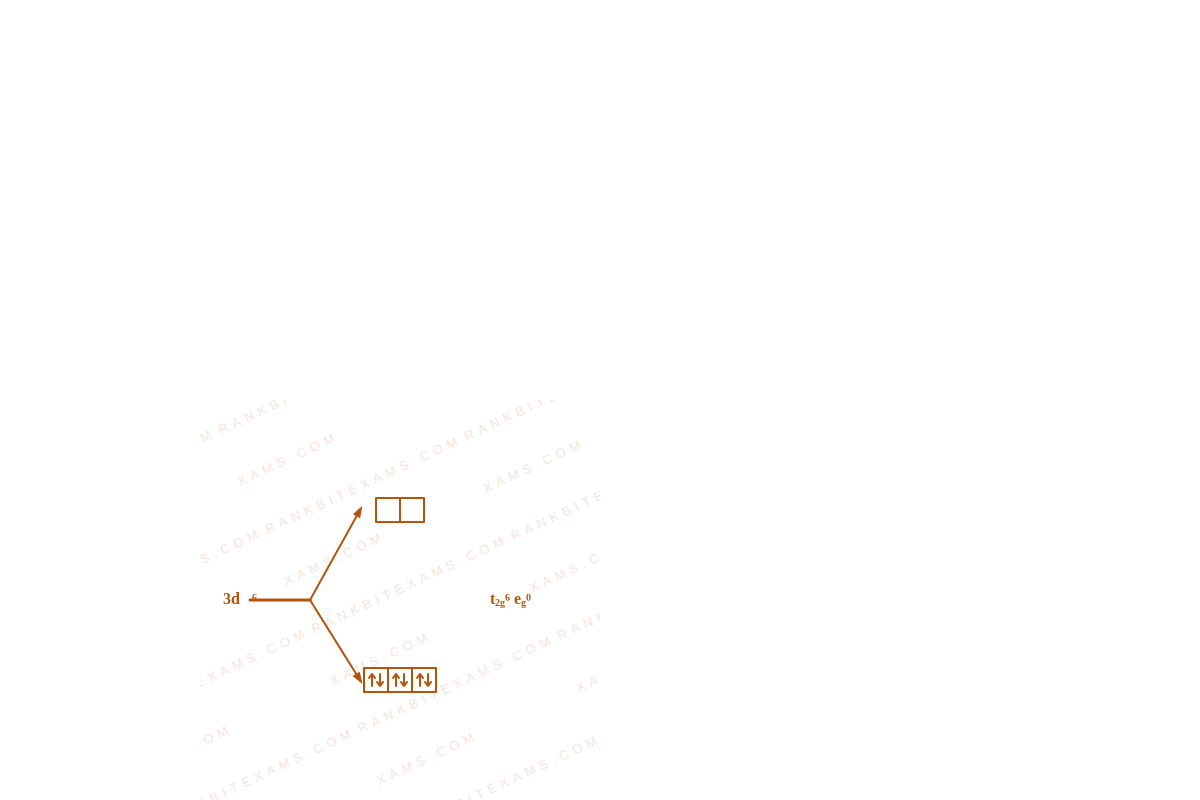
  • [Co(en)₃]³⁺: Here Co³⁺ has a 3d⁶ configuration. Since ethylenediamine (en) is a strong-field ligand, it causes pairing of all 6 electrons in the t2g subshell. The configuration is t2g⁶eg⁰.
  • d-orbital splitting diagram for low-spin Co3+ complex with t2g6 configuration
    d-orbital splitting diagram for low-spin Co3+ complex with t2g6 configuration

  • [CoF₆]³⁻: Co³⁺ is 3d⁶. Since F^- is a weak-field ligand (WFL), no pairing occurs. The configuration is t2g⁴eg².
  • [Mn(H₂O)₆]²⁺: Mn²⁺ is 3d⁵. Since H₂O is a weak-field ligand, the configuration is high-spin: t2g³eg².
  • [Zn(H₂O)₆]²⁺: Zn²⁺ is 3 d¹⁰. The d-subshell is fully filled, yielding t2g⁶eg⁴.
Step 2: Compare CFSE Values

Calculating CFSE (neglecting pairing energy term for simplicity):

  • For [Co(en)₃]³⁺: CFSE = 6 × (-0.4 Δₒ) = -2.4 Δₒ
  • For [CoF₆]³⁻: CFSE = [4(-0.4) + 2(0.6)] Δₒ = -0.4 Δₒ
  • For [Mn(H₂O)₆]²⁺: CFSE = [3(-0.4) + 2(0.6)] Δₒ = 0
  • For [Zn(H₂O)₆]²⁺: CFSE = [6(-0.4) + 4(0.6)] Δₒ = 0
  • Hence, [Co(en)₃]³⁺ has the highest crystal field stabilization energy, corresponding to the d-orbital electronic configuration t2g⁶eg⁰.

Pattern Recognition

For octahedral complexes of d⁶ metals, a low-spin configuration (t2g⁶eg⁰) achieves the theoretical maximum orbital stabilization since the eg levels are completely empty and t2g is fully filled.

Chapter Mix

Class 12 Chemistry: Coordination Compounds

More Coordination Compounds Questions — jee_main_2025_02_april_evening

Practice all Coordination Compounds previous-year questions →

Rankbit System
JEE Physics: Waves (+15.5%) | Electrostatics: Concentric Shells (-29.7%) | Modern Physics: Photoelectric Clones (+34.2%) | Mathematics: Definite Integrals (+18.1%) | Chemistry: Coordination Splitting (-11.4%) | JEE Physics: Waves (+15.5%) | Electrostatics: Concentric Shells (-29.7%) | Modern Physics: Photoelectric Clones (+34.2%) | Mathematics: Definite Integrals (+18.1%) | Chemistry: Coordination Splitting (-11.4%)
