JEE Main · Chemistry ↓ Falling

Coordination Compounds appeared 68 times across 3 years — 7.9% of Chemistry. This question is from Magnetic Properties and Enthalpy of Atomisation.

Year 2026 2025 2024 Total
Questions 19 34 15 68

The spin-only magnetic moment value of Mⁿ⁺ ion formed among Ni, Zn Mn and Cu that has the least enthalpy of atomisation is (in nearest integer) Here n is equal to the number of diamagnetic complexes among K₂[NiCl₄], [Zn(H₂O)₆]Cl₂, K₃[Mn(CN)₆] and [Cu(PPh₃)₃I]

Numerical Answer Type:
Enter a numerical value Answer: 0 to 0 +4 marks

Solution & Explanation

Related Formula
μ = nunpaired(nunpaired+2)~B.M.
Core Logic

This question requires three distinct sequential conceptual steps:

  • Determine the count n of diamagnetic complexes.
  • Identify which of the metal ions (Ni, Zn, Mn, Cu) has the lowest enthalpy of atomisation.
  • Compute the spin-only magnetic moment of that metal in its +n state.
Step 1: Count Diamagnetic Complexes to find n
  • K₂[NiCl₄]: Ni²⁺ = 3d⁸. Weak field chloride ligand leads to 2 unpaired electrons Paramagnetic.
  • [Zn(H₂O)₆]Cl₂: Zn²⁺ = 3 d¹⁰. Completely filled subshell Diamagnetic.
  • K₃[Mn(CN)₆]: Mn³⁺ = 3d⁴. Strong field cyanide ligand gives low-spin state with 2 unpaired electrons Paramagnetic.
  • [Cu(PPh₃)₃I]: Cu^+ = 3 d¹⁰. Completely filled subshell Diamagnetic.
  • Thus, there are exactly 2 diamagnetic complexes: n = 2.

Step 2: Identify Metal with Lowest Enthalpy of Atomisation

Among the transition metals of the 3d series (Ni, Zn, Mn, Cu), Zinc (Zn) has the lowest enthalpy of atomisation (126~ kJ~mol⁻¹). This is because Zinc has a fully occupied d-subshell (3 d¹⁰4s²) and lacks any unpaired d-electrons to participate in metallic bonding.

Step 3: Calculate Spin-only Magnetic Moment of M^n+

With M = Zinc and n = 2, the ion is Zn²⁺.

Electronic configuration of Zn²⁺ is [Ar]3 d¹⁰, which contains zero unpaired electrons (nunpaired = 0).

Therefore, the spin-only magnetic moment is:

μ = 0~B.M.
Pattern Recognition

Zinc is always a unique outlier in the d-block. Because it has a completely filled d¹⁰ shell in both its atomic and +2 oxidation states, it exhibits no d-orbital metallic bonding (leading to lowest melting point, boiling point, and atomisation enthalpy in the 3d series) and is always diamagnetic.

Chapter Mix

Class 12 Chemistry: Coordination Compounds Class 12 Chemistry: d- and f-Block Elements

Reference Study Guides

More Coordination Compounds Previous-Year Questions — Page 2

Q59 jee_main_2026_23_january_morning Crystal Field Splitting in Tetrahedral Complexes
Given below are two statements: Statement I: [CoBr₄]²⁻ ion will absorb light of lower energy than [CoCl₄]²⁻ ion. Statement II: In [CoI₄]²⁻ ion, the energy separation between the two set of d-orbitals is more than [CoCl₄]²⁻ ion. In the light of the above statements, choose the correct answer from the options given below :
  • A. Both Statement I and Statement II are false
  • B. Statement I is true but Statement II is false
  • C. Statement I is false but Statement II is true
  • D. Both Statement I and Statement II are true

Solution

Core Logic

Evaluate the ligand field strength from the spectrochemical series. Halide ligands are weak field ligands, with the order of their strength being I^- < Br^- < Cl^- < F^-.

Step 1: Statement I Evaluation

Since Cl^- is a stronger ligand than Br^-, the crystal field splitting energy (Δₜ) for [CoCl₄]²⁻ is greater than that of [CoBr₄]²⁻. Energy absorbed (E) is directly proportional to Δₜ. Therefore, [CoBr₄]²⁻ will absorb lower energy than [CoCl₄]²⁻. Statement I is True.

Step 2: Statement II Evaluation

Comparing [CoI₄]²⁻ and [CoCl₄]²⁻: I^- is a weaker ligand than Cl^-. Therefore, the energy separation (Δₜ) in [CoI₄]²⁻ will be less than in [CoCl₄]²⁻. Statement II states it is more, which is False.

Pattern Recognition

Spectrochemical series memorization shortcut for halides: I Brought Some Cloth (I- < Br- < S2- < Cl-).

Chapter Mix

Class 12 Chemistry: Coordination Compounds
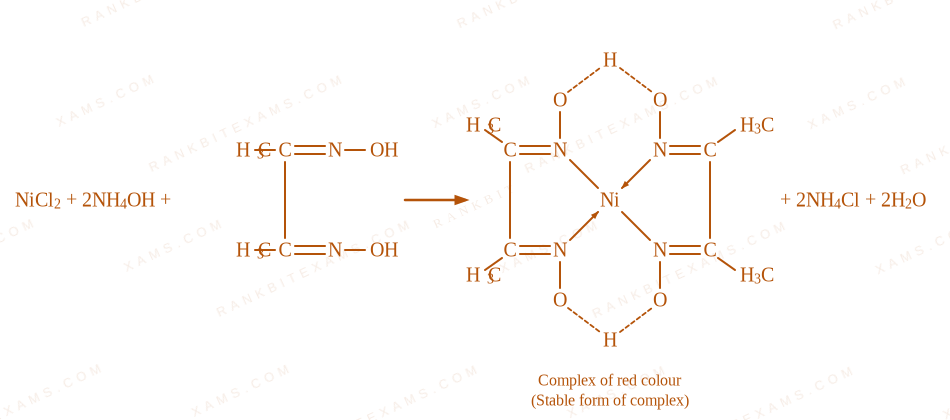
Q63 jee_main_2026_23_january_morning Nickel DMG Complex
The statements that are incorrect about the nickel (II) complex of dimethylglyoxime are: A. It is red in colour B. It has a high solubility in water at pH = 9 C. The Ni ion has two unpaired d-electrons D. The N-Ni-N bond angle is almost close to 90° E. The complex contains four five-membered metallacycles (metal containing rings) Choose the correct answer from the options given below :
  • A. C and E only
  • B. A, D and B only
  • C. B, C and E only
  • D. C and D only

Solution

Core Logic

Analyze the structural and electronic properties of the [Ni(dmg)₂] complex.

Nickel DMG Complex diagram for Q63 - JEE Main 2026 Morning

Step 1: Evaluating Each Statement

(A) It is a rosy red precipitate. (True) (B) It forms a precipitate in a basic medium (like ammonium hydroxide), indicating it is insoluble in water at pH=9. (False) (C) The Ni²⁺ ion is 3d⁸. DMG is a strong field ligand in a square planar geometry, causing electron pairing (dsp² hybridization). Number of unpaired electrons = 0. (False) (D) Square planar geometry ensures N-Ni-N bond angles are close to 90^°. (True) (E) The complex contains two 5-membered rings and two 6-membered rings formed by hydrogen bonding. (False)

Step 2: Identifying Incorrect Statements

Statements B, C, and E are incorrect.

Pattern Recognition

Ni-DMG complex = Rosy red ppt, Square Planar (dsp²), Diamagnetic (n=0), Hydrogen bonded (extra stability).

Chapter Mix

Class 12 Chemistry: Coordination Compounds Class 11 Chemistry: Chemical Bonding and Molecular Structure

Q75 jee_main_2026_23_january_morning Crystal Field Splitting Energy Calculation
The crystal field splitting energy of [Co(oxalate)₃]³⁻ complex is 'n' times that of the [Cr(oxalate)₃]³⁻ complex. Here 'n' is ____. [Assume Δ₀ gg P]
Numerical Answer. Answer: 2 to 2

Solution

Related Formula
CFSE = ( -0.4 × n_t2g + 0.6 × neg ) Δ₀

(Note: Pairing energy is neglected with respect to Δ₀ based on assumption)

Core Logic

Since Δ₀ gg P (Strong field logic / low spin complexes), electrons will pair up in the lower energy t2g orbitals before occupying the higher energy eg orbitals. Identify the oxidation state and d-electron count for the central metal in both complexes.

Step 1: Cobalt Complex Analysis

Complex: [Co(ox)₃]³⁻ Cobalt oxidation state = +3. Electronic configuration of Co³⁺: [Ar] 3d⁶. Under Δ₀ gg P, the d⁶ configuration is t2g2,2,2 eg0,0 (i.e., t2g⁶ eg⁰). CFSECo³⁺ = 6 × (-0.4 Δ₀) = -2.4 Δ₀

Step 2: Chromium Complex Analysis

Complex: [Cr(ox)₃]³⁻ Chromium oxidation state = +3. Electronic configuration of Cr³⁺: [Ar] 3d³. Configuration is t2g1,1,1 eg0,0 (i.e., t2g³ eg⁰). CFSECr³⁺ = 3 × (-0.4 Δ₀) = -1.2 Δ₀

Step 3: Calculating n

Ratio n = CFSE of Co³⁺CFSE of Cr³⁺ n = (|-2.4 Δ₀|)/(|-1.2 Δ₀|) = 2

Crystal Field Splitting Energy Calculation diagram for Q75 - JEE Main 2026 Morning

Pattern Recognition

d⁶ low-spin always gives max CFSE for octahedral (-2.4 Δ₀). d³ is strictly half of that (-1.2 Δ₀). Ratio is always 2.

Chapter Mix

Class 12 Chemistry: Coordination Compounds

Q55 jee_main_2026_23_january_evening Valence Bond Theory
Identify the CORRECT set of details from the following: A. [Co(NH₃)₆]³⁺ : Inner orbital complex; d²sp³ hybridized B. [MnCl₆]³⁻ : Outer orbital complex; sp³d² hybridized C. [CoF₆]³⁻ : Outer orbital complex; d²sp³ hybridized D. [FeF₆]³⁻ : Outer orbital complex; sp³d² hybridized E. [Ni(CN)₄]²⁻ : Inner orbital complex; sp³ hybridized Choose the correct answer from the options given below:
  • A. C & D only
  • B. A, B & D only
  • C. A, C & E only
  • D. A, B, C, D & E

Solution

Core Logic

Evaluate each complex individually using Valence Bond Theory:

(A) [Co(NH₃)₆]³⁺: Central metal is Co³⁺ (3d⁶). NH₃ acts as a strong field ligand (SFL) for Co³⁺, causing pairing. This leads to d²sp³ hybridization, forming an inner orbital complex. (Correct)

(B) [MnCl₆]³⁻: Central metal is Mn³⁺ (3d⁴). Cl⁻ is a weak field ligand (WFL), so no pairing occurs. It utilizes outer 4d orbitals for hybridization (sp³d²), forming an outer orbital complex. (Correct)

(C) [CoF₆]³⁻: Central metal is Co³⁺ (3d⁶). F⁻ is a weak field ligand (WFL), causing no pairing. It undergoes sp³d² hybridization (outer orbital complex). The statement says it is d²sp³ hybridized, which is incorrect. (Incorrect)

(D) [FeF₆]³⁻: Central metal is Fe³⁺ (3d⁵). F⁻ is a weak field ligand (WFL), leading to no pairing. It undergoes sp³d² hybridization, making it an outer orbital complex. (Correct)

(E) [Ni(CN)₄]²⁻: Central metal is Ni²⁺ (3d⁸). CN⁻ is a strong field ligand (SFL), causing pairing. It undergoes dsp² hybridization (inner orbital complex/square planar), not sp³. (Incorrect)

Step 1: Final Conclusion

Only statements A, B, and D are correct.

Pattern Recognition

Spectrochemical series dictates SFL vs WFL. Co³⁺ with NH₃ is a classic exception to memorize: NH₃ behaves as a SFL with Co³⁺ (pairing occurs), whereas it acts as a WFL with many +2 ions.

Chapter Mix

Class 12 Chemistry: Coordination Compounds

Q74 jee_main_2026_23_january_evening Crystal Field Theory
Total number of unpaired electrons present in the central metal atoms/ions of [Ni(CO)₄], [NiCl₄]²⁻, [PtCl₂(NH₃)₂], [Ni(CN₄)]²⁻ and [Pt(CN₄)]²⁻ is __.
Numerical Answer. Answer: 2 to 2

Solution

Core Logic

Let's determine the electronic configuration, oxidation state, and ligand nature for each complex:

  • [Ni(CO)₄]:
  • Oxidation state of Ni = 0. Configuration: 3d⁸ 4s². CO is a strong field ligand. The 4s electrons are pushed into the 3d orbital, making it a 3d¹⁰ configuration. It is sp³ hybridized and diamagnetic. Unpaired electrons = 0.

  • [NiCl₄]²⁻:
  • Oxidation state of Ni = +2. Configuration: 3d⁸. Cl^- is a weak field ligand, so no pairing of the d⁸ electrons occurs. The configuration is t2g⁶ eg². It is sp³ hybridized. Unpaired electrons = 2.

  • [PtCl₂(NH₃)₂]:
  • Oxidation state of Pt = +2. Configuration: 5d⁸. For 4d and 5d series metals, nearly all ligands act as strong field ligands. This causes pairing, leading to a dsp² hybridized square planar geometry. Unpaired electrons = 0.

  • [Ni(CN)₄]²⁻:
  • Oxidation state of Ni = +2. Configuration: 3d⁸. CN^- is a strong field ligand, forcing electron pairing. It becomes dsp² hybridized. Unpaired electrons = 0.

  • [Pt(CN)₄]²⁻:
  • Oxidation state of Pt = +2. Configuration: 5d⁸. As established, 5d metals strictly form low spin complexes. CN^- causes pairing (dsp²). Unpaired electrons = 0.

Step 1: Total Sum

Summing all unpaired electrons across all listed complexes: 0 + 2 + 0 + 0 + 0 = 2.

Pattern Recognition

Metals from 4d and 5d series (like Pd, Pt) ALWAYS form inner-orbital/low-spin complexes regardless of the ligand strength. So, d⁸ configurations in Pd²⁺ and Pt²⁺ will always pair up to yield zero unpaired electrons.

Chapter Mix

Class 12 Chemistry: Coordination Compounds

More Coordination Compounds Questions — jee_main_2025_02_april_evening

Practice all Coordination Compounds previous-year questions →

Rankbit System
JEE Physics: Waves (+15.5%) | Electrostatics: Concentric Shells (-29.7%) | Modern Physics: Photoelectric Clones (+34.2%) | Mathematics: Definite Integrals (+18.1%) | Chemistry: Coordination Splitting (-11.4%) | JEE Physics: Waves (+15.5%) | Electrostatics: Concentric Shells (-29.7%) | Modern Physics: Photoelectric Clones (+34.2%) | Mathematics: Definite Integrals (+18.1%) | Chemistry: Coordination Splitting (-11.4%)