Arrange the following in order of magnitude of work done by the system / on the system at constant temperature : (a) |mathrmw_mathrmreversible| for expansion in infinite stage. (b) |mathrmw_mathrmirreversible| for expansion in single stage. (c) |mathrmw_mathrmreversible| for compression in infinite stage. (d) |mathrmw_mathrmirreversible| for compression in single stage. Choose the correct answer from the options given below:

Solution & Explanation

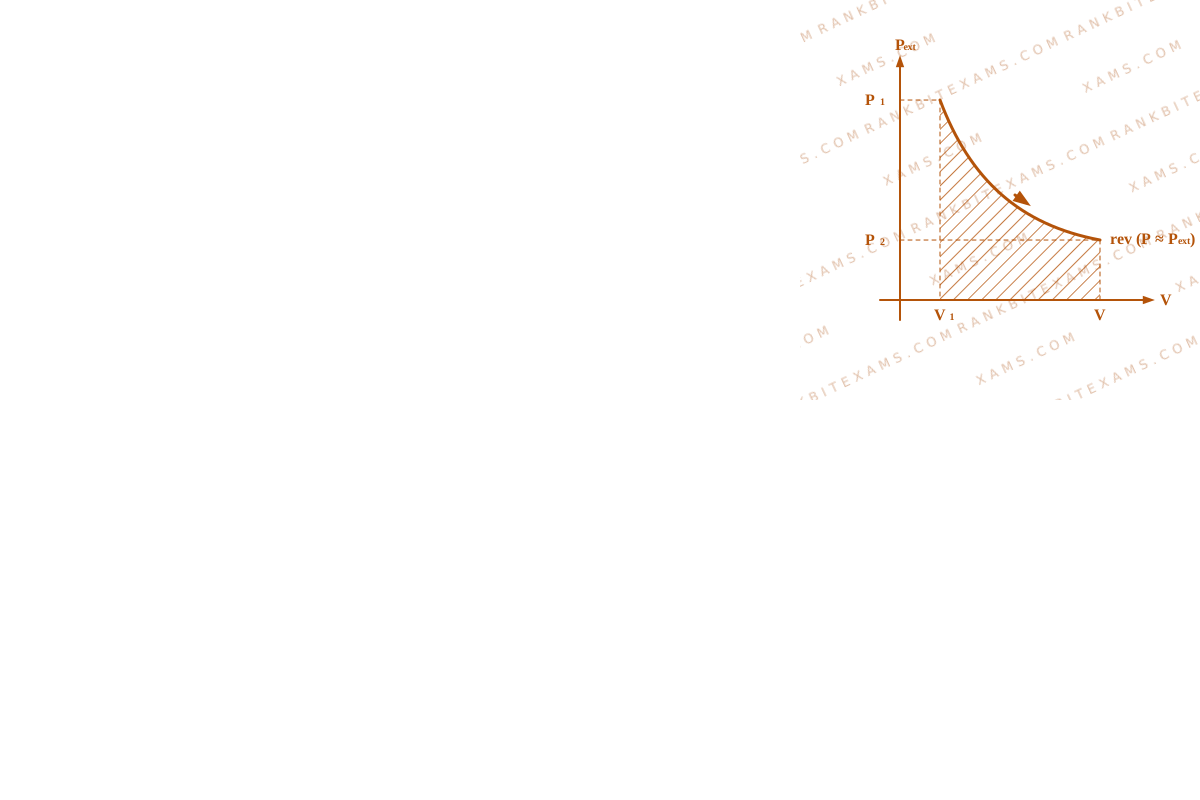
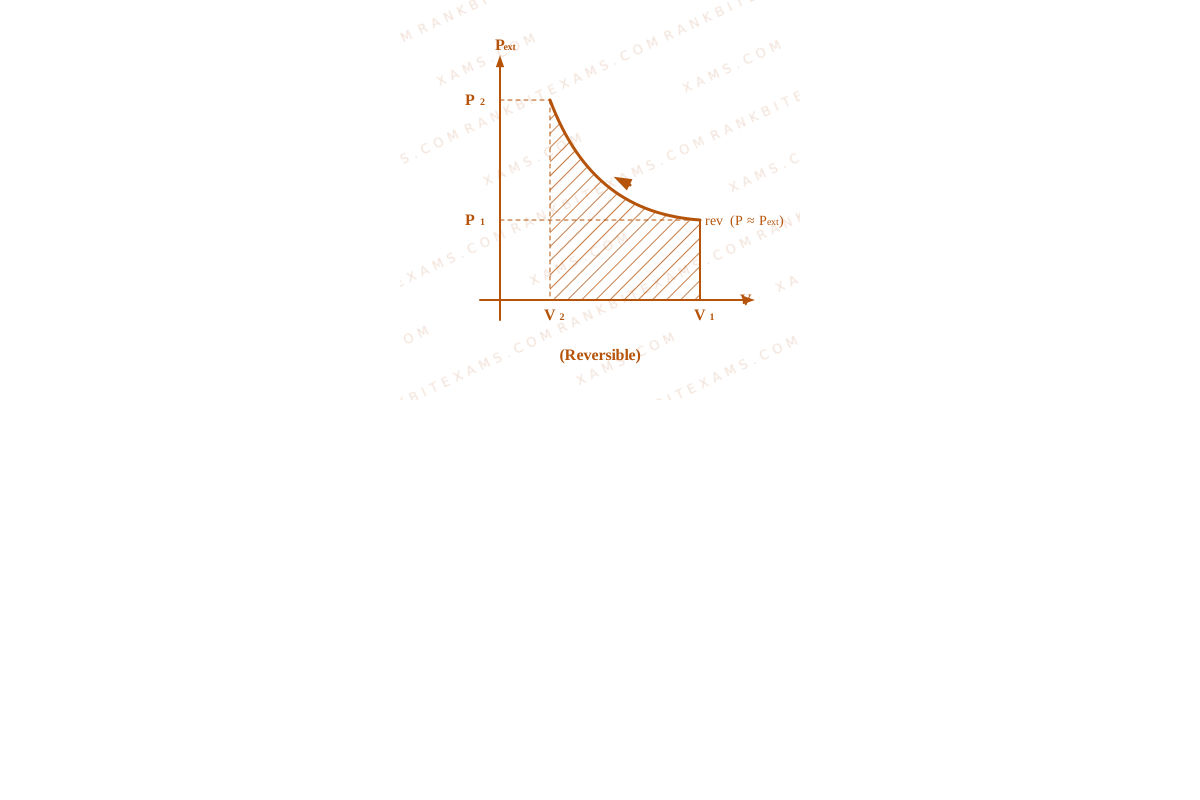
### Related Formula w_textrev = -nRT lnleft(fracV_mathrmfV_mathrmiright) w_textirrev = -P_textext left(V_mathrmf - V_mathrmiright) ### Core Logic For isothermal reversible and irreversible steps: 1. **Reversible Path**: Since a reversible compression path retraces the exact coordinates of the reversible expansion path, the magnitudes of work are equal: |w_textrev, expansion| = |w_textrev, compression| implies a = c
P-V indicator diagrams comparing reversible and irreversible expansion/compression
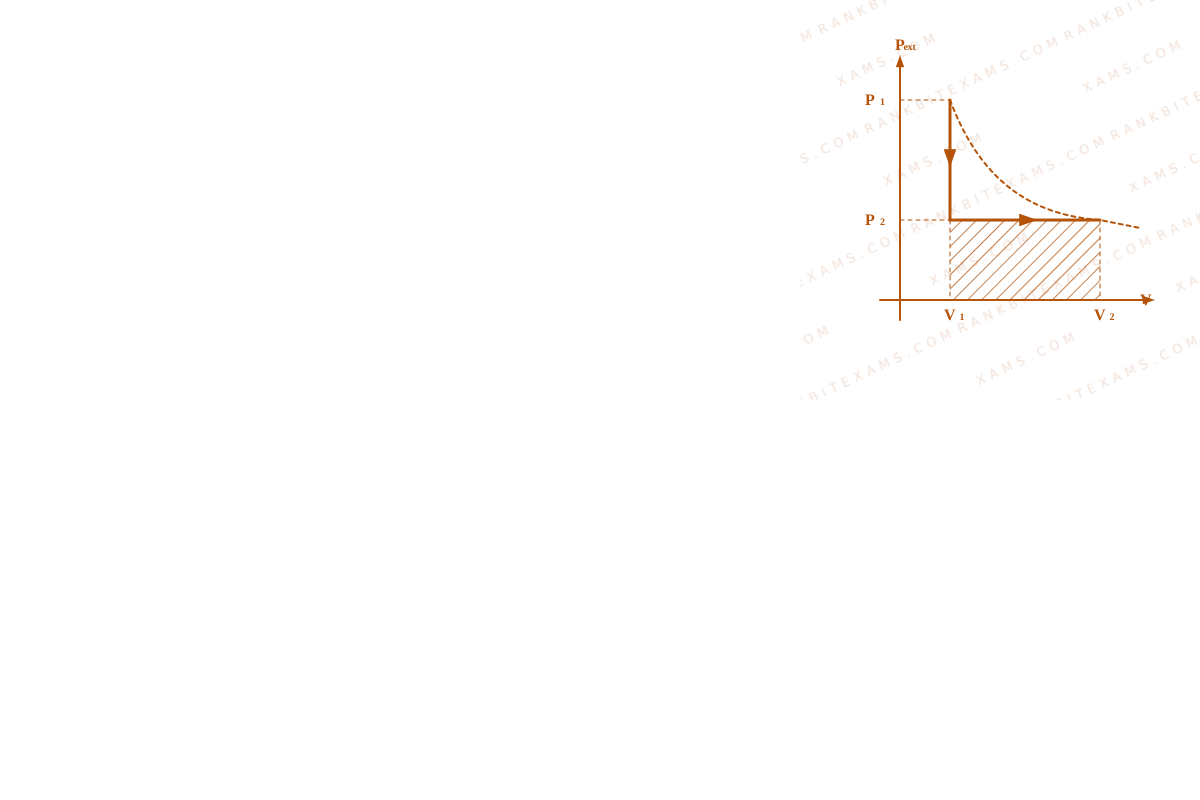
2. **Isothermal Expansion**: Reversible work magnitude is the maximum possible work. Hence, for expansion: |w_textrev, expansion| > |w_textirrev, expansion| implies a > b
P-V indicator diagrams comparing reversible and irreversible expansion/compression
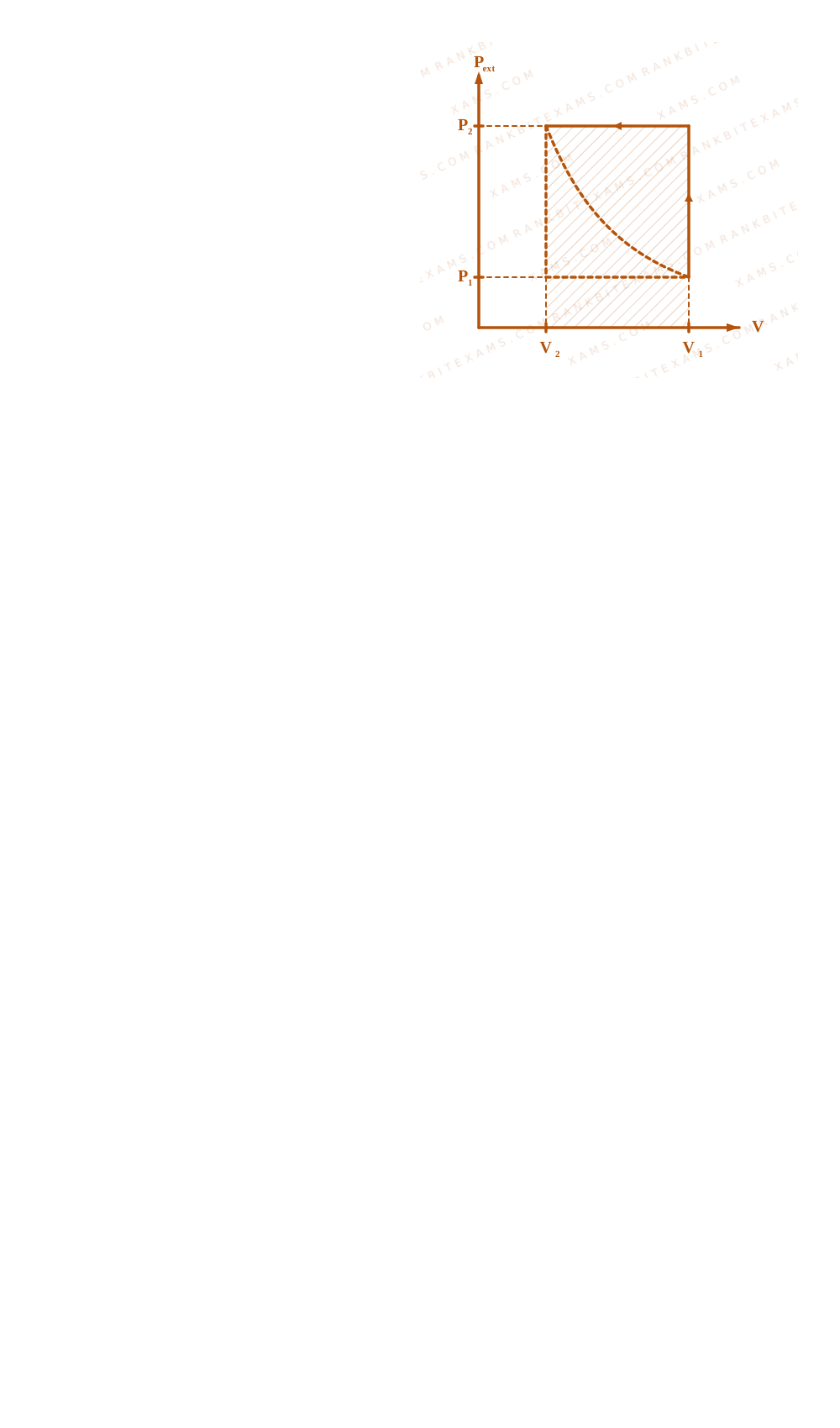
3. **Isothermal Compression**: Irreversible compression requires more work than reversible compression because of sudden pressure adjustments against the surroundings: |w_textirrev, compression| > |w_textrev, compression| implies d > c
P-V indicator diagrams comparing reversible and irreversible expansion/compression
### Step 1: Combine the inequalities Combining the results: - We have a = c - We have d > c - We have a > b This leads to the strict inequality sequence: d > c = a > b ### Pattern Recognition Thermodynamics Principle: Reversible expansion is the most efficient (gives maximum work magnitude), whereas reversible compression is the most efficient (requires minimum work magnitude). Single-stage irreversible compression is always the least efficient, demanding the absolute highest work input. ### Evaluation Rubric / Model Answer null ### Chapter Mix Class 11 Chemistry: Chemical Thermodynamics

Reference Study Guides

More Chemical Thermodynamics Previous-Year Questions — Page 4

Q37 jee_main_2025_04_april_evening Thermochemistry
Consider the given data : (a) mathrmHCl(g) + 10mathrmH_2mathrmO(l)rightarrow mathrmHCl.10H_2O quad Delta mathrm H = - 6 9. 0 1 mathrm k J mathrm m o l ^ - 1 (b) mathrmHCl(g) + 40mathrmH_2mathrmO(l)rightarrow mathrmHCl.40H_2O quad Delta mathrm H = - 7 2. 7 9 mathrm k J mathrm m o l ^ - 1 Choose the correct statement :
  • A. Dissolution of gas in water is an endothermic process
  • B. The heat of solution depends on the amount of solvent.
  • C. The heat of dilution for the HCl (mathrmHCl.10mathrmH_2mathrmO to mathrmHCl.40mathrmH_2mathrmO) is 3.78mathrmkJ mol^-1.
  • D. The heat of formation of HCl solution is represented by both (a) and (b)

Solution

### Related Formula Delta H_textdilution = Delta H_2 - Delta H_1 ### Core Logic Analyzing the thermodynamic statements: - Delta H values are negative, so the dissolution of HCl(g) is clearly exothermic, eliminating option (1). - Since the enthalpy release changes when the moles of water solvent shift from 10 to 40 (-69.01 vs -72.79), the **heat of solution depends explicitly on the amount of solvent** (Statement 2 is true). - Let's check Statement 3: By subtracting equation (a) from (b): mathrmHClcdot10H_2O + 30mathrmH_2mathrmO rightarrow mathrmHClcdot40H_2O Delta H = -72.79 - (-69.01) = -3.78 mathrm~kJcdot mol^-1 The value is negative, indicating an exothermic process, so calling it +3.78 makes option (3) incorrect. ### Pattern Recognition The standard integral enthalpy of solution varies with solvent concentration until infinite dilution is achieved. Thus, concentration dependence is a core property of partial molar solution variables. ### Evaluation Rubric / Model Answer null ### Chapter Mix Class 11 Chemistry: Chemical Thermodynamics
Q27 jee_main_2025_04_april_morning Spontaneity and Gibbs Energy
Let us consider a reversible reaction at temperature, T. In this reaction, both Delta H and Delta S were observed to have positive values. If the equilibrium temperature is T_e, then the reaction becomes spontaneous at:
  • A. T = T_e
  • B. T_e > T
  • C. T > T_e
  • D. T_e = 5T

Solution

### Related Formula Delta G = Delta H - TDelta S ### Core Logic For a reaction to be spontaneous, the change in Gibbs free energy must be negative: Delta G < 0 implies Delta H - TDelta S < 0 Given that both Delta H > 0 and Delta S > 0: Delta H < TDelta S implies T > fracDelta HDelta S At the equilibrium temperature T_e, Delta G = 0, which gives: T_e = fracDelta HDelta S Substituting this back into the inequality reveals that the reaction is spontaneous when: T > T_e ### Pattern Recognition When both Delta H and Delta S are positive, the reaction is entropy-driven and becomes spontaneous only at higher temperatures (T > T_e). ### Evaluation Rubric / Model Answer null ### Chapter Mix Class 11 Chemistry: Chemical Thermodynamics
Q30 jee_main_2025_04_april_morning Isothermal and Reversible Expansion
One mole of an ideal gas expands isothermally and reversibly from 10mathrm~dm^3 to 20mathrm~dm^3 at 300mathrm~K. Delta U, q and work done in the process respectively are: Given: R = 8.3mathrm~J~K^-1~mol^-1, ln 10 = 2.3, log 2 = 0.30, log 3 = 0.48
  • A. 0, 21.84mathrm~kJ, -1.26mathrm~kJ
  • B. 0, -17.18mathrm~kJ, 1.718mathrm~J
  • C. 0, 21.84mathrm~kJ, 21.84mathrm~kJ
  • D. 0, 1.718mathrm~kJ, -1.718mathrm~kJ

Solution

### Related Formula Delta U = n C_v Delta T w = -n R T lnleft(fracV_2V_1right) Delta U = q + w ### Core Logic Since the expansion step is strictly **isothermal** (Delta T = 0): Delta U = 0 Now compute the work command parameter w: w = -n R T lnleft(fracV_2V_1right) = -1 cdot 8.3 cdot 300 cdot lnleft(frac2010 ight) w = -2490 cdot ln(2) = -2490 cdot (2.3 cdot log 2) w = -2490 cdot (2.3 cdot 0.30) = -2490 cdot 0.69 = -1718.1mathrm~J = -1.718mathrm~kJ Applying the first law equation constraint: q = -w = +1.718mathrm~kJ Hence, Delta U = 0, q = 1.718mathrm~kJ, w = -1.718mathrm~kJ. ### Pattern Recognition Isothermal expansion of an ideal gas ALWAYS yields Delta U = 0. Work is negative (done by system) and heat exchange q matches work magnitude inversely. ### Evaluation Rubric / Model Answer null ### Chapter Mix Class 11 Chemistry: Chemical Thermodynamics
Q28 jee_main_2025_07_april_evening Lattice Enthalpy and Born-Haber Cycle
The hydration energies of textK^+ and textCl^- are -textx and -textytext kJ/mol respectively. If lattice energy of textKCl is -textztext kJ/mol, then the heat of solution of textKCl is:
  • A. +textx - texty - textz
  • B. textx + texty + textz
  • C. textz - (textx + texty)
  • D. -textz - (textx + texty)

Solution

### Related Formula Delta H_textsol = textLattice Energy (L.E.) + Delta H_texthyd(textCation) + Delta H_texthyd(textAnion) ### Core Logic According to Hess's Law, the dissolution process can be mapped as follows:
Lattice Enthalpy and Born-Haber Cycle diagram for Q28 - JEE Main 2025 Evening
Given parameters: - Lattice Energy of textKCl breaking into gaseous ions = -(-textz) = textztext kJ/mol (since lattice energy released on formation is given as -textz). - Hydration energy of textK^+ = -textxtext kJ/mol - Hydration energy of textCl^- = -textytext kJ/mol ### Step 1: Computation Substituting the values into the governing formulation: Delta H_textsol = textz + (-textx) + (-texty) Delta H_textsol = textz - textx - texty = textz - (textx + texty) ### Pattern Recognition To dissolve an ionic crystal, energy equal to the lattice energy must be supplied (endothermic step, +textz), and hydration releases energy (exothermic steps, -textx and -texty). Net heat of solution is simply the sum of these parts: textz - textx - texty. ### Evaluation Rubric / Model Answer null ### Chapter Mix Class 11 Chemistry: Chemical Thermodynamics Class 11 Chemistry: Chemical Bonding and Molecular Structure
Q33 jee_main_2025_07_april_evening Standard Enthalpy of Formation
The correct statement amongst the following is:
  • A. textThe term 'standard state' implies that the temperature is 0^circtextC
  • B. textThe standard state of pure gas is the pure gas at a pressure of 1 bar and temperature 273 K
  • C. DeltatextftextH298^thetatext is zero for O(g)
  • D. DeltatextftextH500^thetatext is zero for O2(g)

Solution

### Related Formula DeltatextfH^theta = 0 quad textfor an element in its reference/most stable standard state ### Core Logic - Standard state conditions prescribe a pressure of 1text bar. Temperature is not fixed by definition but is explicitly specified (often reference tables use 298.15text K). - Oxygen naturally and stably exists as diatomic gas molecules (textO_2(g)) at standard thresholds. - The enthalpy of formation of an element in its reference elemental state is identically zero at any reference temperature: DeltatextfH_500^theta[textO2(g)] = 0 Conversely, atomic oxygen gas (textO(g)) is not the reference phase, so its formation enthalpy is non-zero. ### Step 1: Verification of Options Statement (4) accurately aligns with thermodynamic core definitions, while statement (1) and (2) mistakenly conflate standard ambient reference states with STP conditions (273.15text K, 1text atm). ### Pattern Recognition Standard state definitions checklist: Pressure = 1text bar. Temperature is variable/assigned independently. Elements in their most stable natural form take DeltatextfH^theta = 0 at all thermal profiles. ### Evaluation Rubric / Model Answer null ### Chapter Mix Class 11 Chemistry: Chemical Thermodynamics

More Chemical Thermodynamics Questions — jee_main_2025_02_april_evening

Practice all Chemical Thermodynamics previous-year questions →

Rankbit System
JEE Physics: Waves (+15.5%) | Electrostatics: Concentric Shells (-29.7%) | Modern Physics: Photoelectric Clones (+34.2%) | Mathematics: Definite Integrals (+18.1%) | Chemistry: Coordination Splitting (-11.4%) | JEE Physics: Waves (+15.5%) | Electrostatics: Concentric Shells (-29.7%) | Modern Physics: Photoelectric Clones (+34.2%) | Mathematics: Definite Integrals (+18.1%) | Chemistry: Coordination Splitting (-11.4%)
