Consider the following reactions. From these reactions which reaction will give carboxylic acid as a major product?
(A) mathrmR - C equiv N xrightarrow[textmild condition]mathrm(i) H^+ / H_2O$\mathrm{R - C \equiv N} \xrightarrow[\text{mild condition}]{\mathrm{(i) H^+ / H_2O}}$
(B) mathrmR - MgX xrightarrow[mathrm(ii) H_3O^+]mathrm(i) CO_2$\mathrm{R - MgX} \xrightarrow[\mathrm{(ii) H_3O^+}]{{\mathrm{(i) CO_2}}}$
(C) mathrmR - C equiv N xrightarrow[mathrm(ii) H_3O^+]mathrm(i) SnCl_2 / HCl$\mathrm{R - C \equiv N} \xrightarrow[\mathrm{(ii) H_3O^+}]{{\mathrm{(i) SnCl_2 / HCl}}}$
(D) mathrmR cdot CH_2 cdot OH xrightarrowmathrmPCC$\mathrm{R \cdot CH_2 \cdot OH} \xrightarrow{\mathrm{PCC}}$
(E)Preparation of Carboxylic Acids
Choose the correct answer from the options given below:
A.textA and D only$\text{A and D only}$
B.textA, B and E only$\text{A, B and E only}$
C.textB, C and E only$\text{B, C and E only}$
D.textB and E only$\text{B and E only}$
Solution & Explanation
### Related Formula
mathrmR-MgX + CO_2 rightarrow R-COOMgX xrightarrowH_3O^+ R-COOH$$\mathrm{R-MgX + CO_2 \rightarrow R-COOMgX \xrightarrow{H_3O^+} R-COOH}$$
### Core Logic
Let's analyze each reaction path to determine the major organic product:
- **Reaction (A)**: Acidic hydrolysis of a nitrile under *mild conditions* yields an amide:
mathrmR-Cequiv N rightarrow R-CONH_2$$\mathrm{R-C\equiv N \rightarrow R-CONH_2}$$
(Full conversion to carboxylic acid requires strong conditions and extended heating).
- **Reaction (B)**: Carbonation of Grignard reagent using solid carbon dioxide (dry ice) followed by acid hydrolysis yields a carboxylic acid:
mathrmR-MgX + CO_2 rightarrow R-COOMgX xrightarrowH_3O^+ R-COOH$$\mathrm{R-MgX + CO_2 \rightarrow R-COOMgX \xrightarrow{H_3O^+} R-COOH}$$
- **Reaction (C)**: Stephen reduction converts nitrile to aldehyde:
mathrmR-Cequiv N xrightarrowSnCl_2/HCl R-CH=NH xrightarrowH_3O^+ R-CHO$$\mathrm{R-C\equiv N \xrightarrow{SnCl_2/HCl} R-CH=NH \xrightarrow{H_3O^+} R-CHO}$$
- **Reaction (D)**: Pyridinium chlorochromate (PCC) is a mild oxidising agent that converts primary alcohols selectively to aldehydes:
mathrmR-CH_2-OH xrightarrowPCC R-CHO$$\mathrm{R-CH_2-OH \xrightarrow{PCC} R-CHO}$$
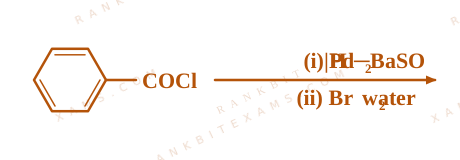
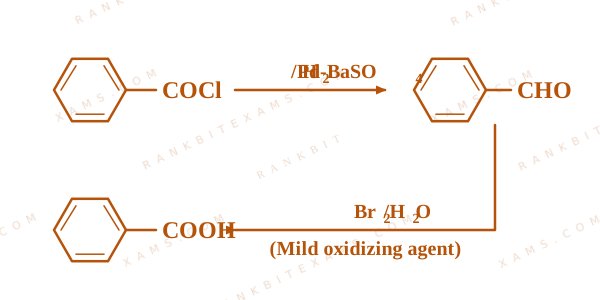
- **Reaction (E)**
Preparation of Carboxylic Acids : Rosenmund reduction reduces acid chloride to aldehyde first:
rightarrow$\rightarrow$ R-CHO
Subsequent oxidation with bromine water (which is a mild oxidising agent that selective oxidizes aldehydes but does not affect ketones) converts the aldehyde to carboxylic acid:
mathrmR-CHO xrightarrowBr_2/water R-COOH$$\mathrm{R-CHO \xrightarrow{Br_2/water} R-COOH}$$
### Step 1: Final Tally
Thus, reactions (B) and (E) successfully yield carboxylic acid as the major organic product.
### Pattern Recognition
Remember: Bromine water (mathrmBr_2/H_2O$\mathrm{Br_2/H_2O}$) is a mild, selective oxidising agent commonly used to oxidise aldoses and other aldehydes to monocarboxylic acids without degrading carbon-carbon chains.
### Evaluation Rubric / Model Answer
null
### Chapter Mix
Class 12 Chemistry: Aldehydes, Ketones and Carboxylic Acids
More Aldehydes, Ketones and Carboxylic Acids Previous-Year Questions — Page 5
Qjee_main_2025_29_jan_morningClemmensen Reduction
The product (P) formed in the following reaction is:
The structural flowchart indicates a multi-functional molecule treated with Zn-Hg/HCl.
A.
B.
C.
D.
Solution
### Related Formula
mathrmR-CO-R' xrightarrow[mathrmHCl]mathrmZn-Hg mathrmR-CH_2-R'$$\mathrm{R-CO-R'} \xrightarrow[\mathrm{HCl}]{\mathrm{Zn-Hg}} \mathrm{R-CH_2-R'}$$
### Core Logic
The provided reaction relies on classic Clemmensen Reduction reagent configurations (mathrmZn-Hg / mathrmHCl$\mathrm{Zn-Hg} / \mathrm{HCl}$). This reagent explicitly selective targets ketone/aldehyde carbonyl centers (>mathrmC=mathrmO$>\mathrm{C}=\mathrm{O}$) and converts them cleanly into methylene units (-mathrmCH_2-$-\mathrm{CH}_2-$). Any free aliphatic alcohol functionalities (-mathrmOH$-\mathrm{OH}$) located on the ring are preserved under these reductive conditions. Thus, the ketone group on the ring is cleanly converted to -mathrmCH_2-$-\mathrm{CH}_2-$, yielding option (3):
The structural flowchart indicates a multi-functional molecule treated with Zn-Hg/HCl.
### Pattern Recognition
Clemmensen routes deoxygenate carbonyl clusters selectively without compromising adjacent standalone cyclic alcohol structural components.
### Chapter Mix
Class 12 Chemistry: Aldehydes, Ketones and Carboxylic Acids
Qjee_main_2025_29_jan_morningChemical Reactions of Carbonyl Compounds
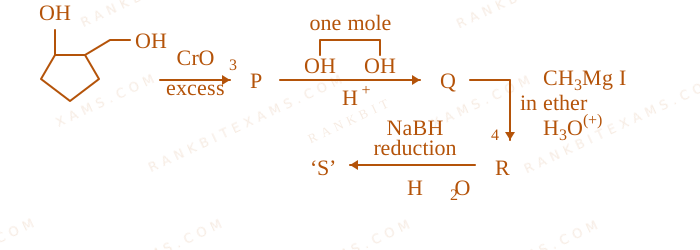
Based on the reaction sequence:
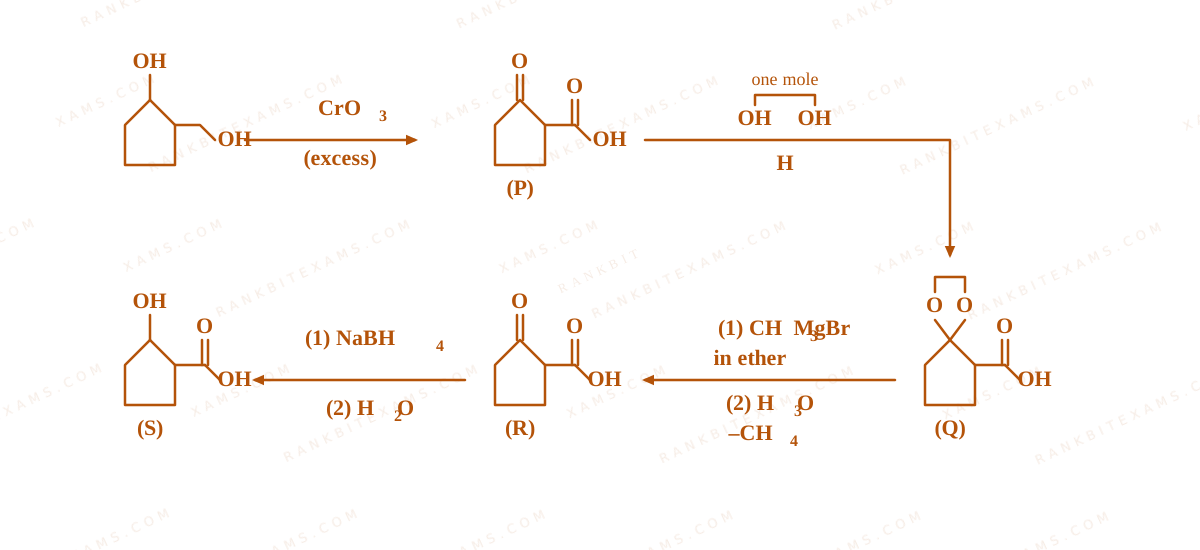
A structural flow charts the transformation of a cyclic dialcohol into final product S.
0.1 mole of compound 'S' will weigh ________ g.
(Given molar mass in mathrmg \, mol^-1$\mathrm{g \, mol^{-1}}$ C:12, H:1, O:16)
Numerical Answer.Answer: 13 to 13
Solution
### Related Formula
textMass = textMoles cdot textMolar Mass$$\text{Mass} = \text{Moles} \cdot \text{Molar Mass}$$
### Core Logic
Let us trace the reaction scheme row-by-row:
A structural flow charts the transformation of a cyclic dialcohol into final product S.
1. Reactant: 2-(hydroxymethyl)cyclopentan-1-ol.
2. Step 1: Excess mathrmCrO_3$\mathrm{CrO}_3$ (Jones oxidation) oxidizes the secondary alcohol to a ketone and the primary alcohol to a carboxylic acid rightarrow$\rightarrow$ Product P.
3. Step 2: Reaction with 1 mole of glycol protects the ketone selectively as a cyclic ketal rightarrow$\rightarrow$ Product Q.
4. Step 3: Treatment with mathrmCH_3mathrmMgI$\mathrm{CH}_3\mathrm{MgI}$ targets the free carboxylic acid (or ester equivalent) to form a methyl ketone after workup rightarrow$\rightarrow$ Product R.
5. Step 4: mathrmNaBH_4$\mathrm{NaBH}_4$ reduces the methyl ketone to a secondary alcohol, and acid workup deprotects the ketal back to the original ketone rightarrow$\rightarrow$ Compound S.
Chemical structural formula of S: 2-(1-hydroxyethyl)cyclopentan-1-one (mathrmC_7mathrmH_12mathrmO_2$\mathrm{C}_7\mathrm{H}_{12}\mathrm{O}_2$).
Molar mass of S (mathrmC_7mathrmH_12mathrmO_2$\mathrm{C}_7\mathrm{H}_{12}\mathrm{O}_2$):
M = (7 cdot 12) + (12 cdot 1) + (2 cdot 16) = 84 + 12 + 32 = 130 mathrm~g/mol$$M = (7 \cdot 12) + (12 \cdot 1) + (2 \cdot 16) = 84 + 12 + 32 = 130 \mathrm{~g/mol}$$textMass of 0.1 mole = 0.1 cdot 130 = 13 mathrm~g$$\text{Mass of 0.1 mole} = 0.1 \cdot 130 = 13 \mathrm{~g}$$
### Pattern Recognition
Ketal groups serve as stable protective masks that shield ketones, allowing selective organometallic reactions to take place elsewhere on the molecule.
### Chapter Mix
Class 12 Chemistry: Aldehydes, Ketones and Carboxylic Acids
Q69jee_main_2024_01_february_morningPreparation of Aldehydes
Identify A and B in the following sequence of reaction
The image shows a reaction scheme starting with toluene reacting with Cl2/hv to give A, followed by H2O at 373 K to give B.
A. Reaction Set 1
B. Reaction Set 2
C. Reaction Set 3
D. Reaction Set 4
Solution
### Core Logic
Step 1: Free radical side-chain halogenation of toluene.
Toluene reacts with Cl_2$Cl_2$ in the presence of light (hnu$h\nu$) to undergo substitution on the methyl group. Under typical conditions intended to yield an aldehyde later, di-chlorination occurs forming benzal chloride (A).
Step 2: Hydrolysis.
Benzal chloride upon hydrolysis with H_2O$H_2O$ at 373 K yields a gem-diol intermediate which is unstable and loses water to form Benzaldehyde (B).
C_6H_5CH_3 xrightarrowCl_2 / hnu C_6H_5CHCl_2 xrightarrowH_2O, 373K C_6H_5CHO$$C_6H_5CH_3 \xrightarrow{Cl_2 / h\nu} C_6H_5CHCl_2 \xrightarrow{H_2O, 373K} C_6H_5CHO$$
### Step 1: Identify Structures
(A) = Benzal chloride (C_6H_5CHCl_2$C_6H_5CHCl_2$)
(B) = Benzaldehyde (C_6H_5CHO$C_6H_5CHO$)
The image shows a reaction scheme starting with toluene reacting with Cl2/hv to give A, followed by H2O at 373 K to give B.
### Pattern Recognition
Toluene xrightarrowCl_2, hnu$\xrightarrow{Cl_2, h\nu}$ targets the side chain. If the next step is hydrolysis to an aldehyde, you must have stopped at the gem-dihalide stage (CHCl_2$CHCl_2$).
### Evaluation Rubric / Model Answer
null
### Chapter Mix
Class 12 Chemistry: Aldehydes, Ketones and Carboxylic Acids
Class 11 Chemistry: Hydrocarbons
Q78jee_main_2024_01_february_morningReactions of Carbonyl Compounds
### Core Logic
Let's analyze the transformation happening in each reaction:
(A) CH_3(CH_2)_5COOC_2H_5 rightarrow CH_3(CH_2)_5CHO$CH_3(CH_2)_5COOC_2H_5 \rightarrow CH_3(CH_2)_5CHO$
An ester is reduced to an aldehyde. This is a selective reduction achieved using DIBAL-H (Diisobutylaluminium hydride) followed by hydrolysis. Thus, (A) rightarrow$\rightarrow$ (IV).
(B) C_6H_5COC_6H_5 rightarrow C_6H_5CH_2C_6H_5$C_6H_5COC_6H_5 \rightarrow C_6H_5CH_2C_6H_5$
A ketone (carbonyl group >C=O$>C=O$) is fully reduced to an alkane (>CH_2$>CH_2$) methylene group. This is the Clemmensen reduction, which uses Zinc amalgam and concentrated HCl. Thus, (B) rightarrow$\rightarrow$ (II).
(C) C_6H_5CHO rightarrow C_6H_5CH(OH)CH_3$C_6H_5CHO \rightarrow C_6H_5CH(OH)CH_3$
Benzaldehyde (aldehyde) is converted into a secondary alcohol with an extra methyl group. This is a nucleophilic addition of a Grignard reagent (CH_3MgBr$CH_3MgBr$) followed by hydrolysis. Thus, (C) rightarrow$\rightarrow$ (I).
(D) CH_3COCH_2COOC_2H_5 rightarrow CH_3CH(OH)CH_2COOC_2H_5$CH_3COCH_2COOC_2H_5 \rightarrow CH_3CH(OH)CH_2COOC_2H_5$
A ketone group is reduced to a secondary alcohol while the ester group remains intact. NaBH_4$NaBH_4$ is a mild reducing agent that reduces aldehydes and ketones but generally does not touch esters. Thus, (D) rightarrow$\rightarrow$ (III).
### Pattern Recognition
Ester rightarrow$\rightarrow$ Aldehyde = DIBAL-H
Ketone rightarrow$\rightarrow$ Alkane = Clemmensen (Zn(Hg)/HCl$Zn(Hg)/HCl$) or Wolff-Kishner
Carbonyl rightarrow$\rightarrow$ Alcohol with carbon chain extension = Grignard Reagent
Ketone rightarrow$\rightarrow$ Alcohol (leaving ester intact) = NaBH_4$NaBH_4$
### Evaluation Rubric / Model Answer
null
### Chapter Mix
Class 12 Chemistry: Aldehydes, Ketones and Carboxylic Acids
Q77jee_main_2024_29_jan_morningReactions of Carbonyl Compounds
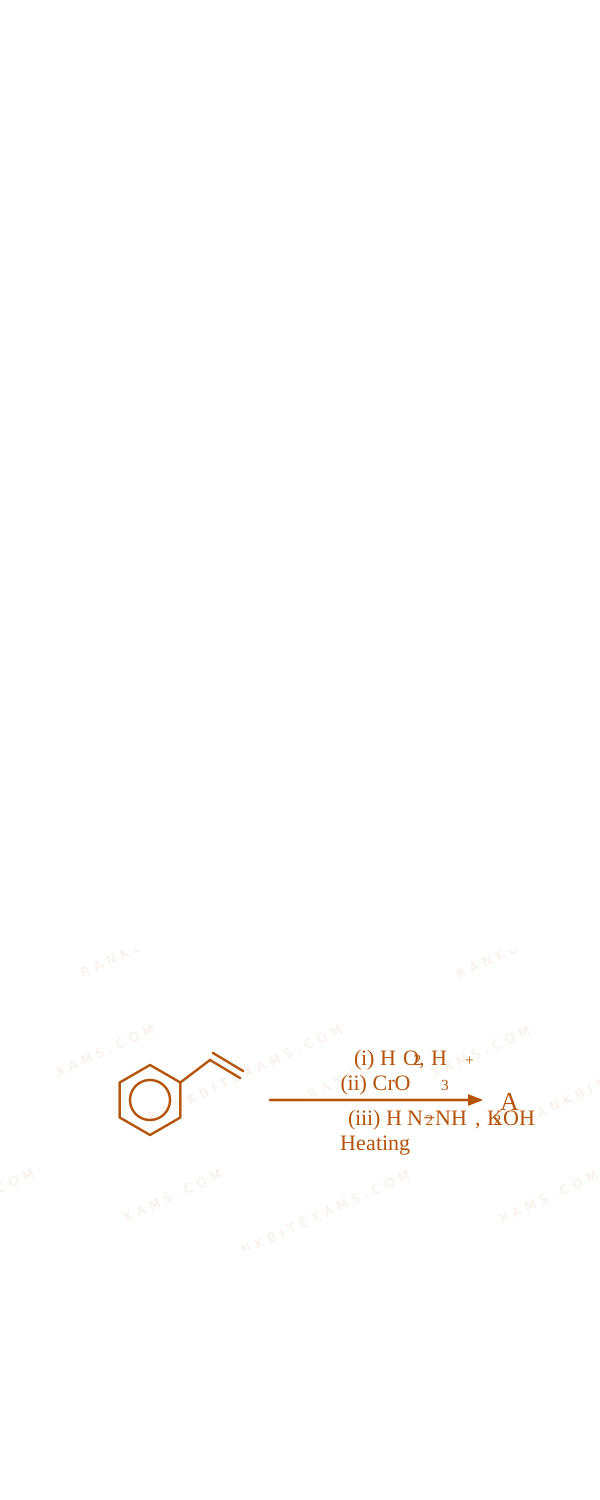
The final product A formed in the following multistep reaction sequence is
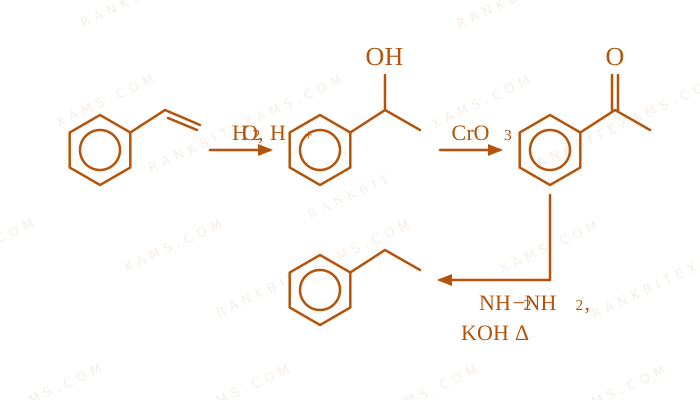
A reaction sequence starting with styrene undergoing Markovnikov hydration, followed by oxidation with CrO3, and finally reduction with hydrazine and KOH.
### Core Logic
The reaction sequence proceeds in three distinct steps from the starting material, styrene (Ph-CH=CH_2$Ph-CH=CH_2$).
**Step 1: Acid-catalyzed Hydration**
Styrene reacts with H_2O, H^+$H_2O, H^+$ to undergo electrophilic addition. Protonation yields the more stable secondary benzylic carbocation. Attack by water followed by deprotonation gives 1-phenylethanol (Ph-CH(OH)-CH_3$Ph-CH(OH)-CH_3$).
**Step 2: Oxidation**
1-phenylethanol is a secondary alcohol. Treatment with chromium trioxide (CrO_3$CrO_3$, Jones reagent condition) oxidizes the secondary alcohol to a ketone. This yields acetophenone (Ph-CO-CH_3$Ph-CO-CH_3$).
**Step 3: Wolff-Kishner Reduction**
Acetophenone is treated with hydrazine (NH_2-NH_2$NH_2-NH_2$) and a strong base (KOH$KOH$) under heating. This is the classic Wolff-Kishner reduction, which completely reduces the carbonyl group (C=O$C=O$) to a methylene group (-CH_2-$-CH_2-$). The final product is ethylbenzene (Ph-CH_2-CH_3$Ph-CH_2-CH_3$).
### Step 1: Overall Reaction Pathway
A reaction sequence starting with styrene undergoing Markovnikov hydration, followed by oxidation with CrO3, and finally reduction with hydrazine and KOH.
The final product A is ethylbenzene.
### Evaluation Rubric / Model Answer
null
### Chapter Mix
Class 11 Chemistry: Hydrocarbons
Class 12 Chemistry: Alcohols Phenols and Ethers
Class 12 Chemistry: Aldehydes Ketones and Carboxylic Acids
We Map Every Repeating Question in Competitive Exams.
Say goodbye to generic mock test fatigue. RankBit uses smart analysis to group past exam questions into their foundational Repeating Question Types. Find chapter weightage, track repeating questions, and score higher with targeted practice.
Select Your Target Exam
Choose an exam track below to find formulas per chapter and patterns.
Syncing Exam Intelligence
Mapping formulas and patterns across all tracks…
PATH A — FULL LENGTH PRACTICE
Full Mock Test Hub
Simulate real NTA exam conditions with fully tracked mocks. Time yourself against past papers.
Practice past-year questions one chapter at a time. Pick an exam → subject → chapter and get every PYQ for that topic — pulled together from all past papers — with the chapter's key formulas alongside.
.svg "Clemmensen Reduction, Carbonyl Deoxygenation, Zinc Amalgam Catalyst")
 "Clemmensen Reduction, Carbonyl Deoxygenation, Zinc Amalgam Catalyst")