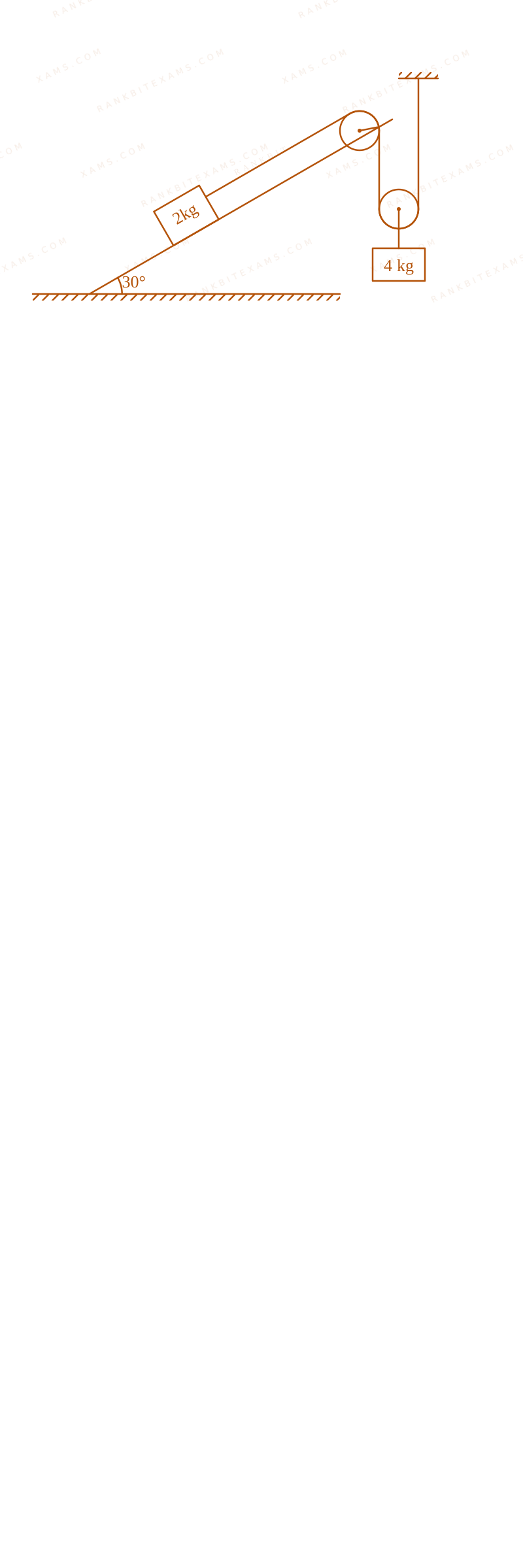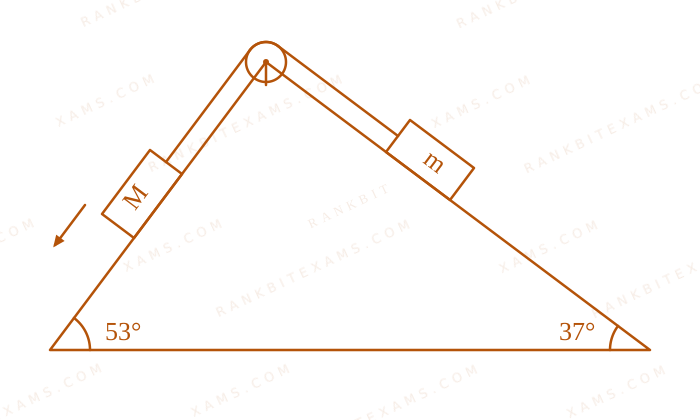
In the given arrangement of a doubly inclined plane two blocks of masses M and m are placed. The blocks are connected by a light string passing over an ideal pulley as shown. The coefficient of friction between the surface of the plane and the blocks is 0.25. The value of m, for which M = 10mathrm\ kg will move down with an acceleration of 2mathrm\ m/s^2 is : (take g = 10mathrm\ m/s^2 and tan 37^circ = 3 / 4)
Pulley And Incline Friction diagram for Q43 - JEE Main 2024 Morning
Two blocks M and m on opposite sides of a double inclined plane linked by a rope over a top pulley. M is on the 53-degree slope and moving downwards, m is on the 37-degree slope.

Solution & Explanation

### Related Formula sum F = ma f_k = mu_k N = mu_k mg costheta ### Core Logic
Pulley And Incline Friction diagram for Q43 - JEE Main 2024 Morning
Two blocks M and m on opposite sides of a double inclined plane linked by a rope over a top pulley. M is on the 53-degree slope and moving downwards, m is on the 37-degree slope.
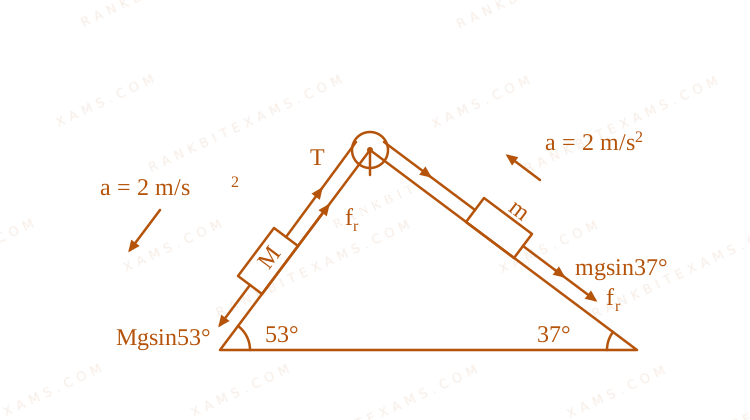
Since block M moves down the incline, kinetic friction opposes its motion (acts upwards). Block m is pulled up the incline, so kinetic friction opposes its motion (acts downwards). For M block (53^circ slope): Mg sin 53^circ - mu Mg cos 53^circ - T = Ma ### Step 1: Tension Calculation Given M = 10mathrm\,kg, a = 2mathrm\,m/s^2, mu = 0.25, g = 10mathrm\,m/s^2. sin 53^circ = 4/5 = 0.8, cos 53^circ = 3/5 = 0.6. 10(10)(0.8) - 0.25(10)(10)(0.6) - T = 10(2) 80 - 15 - T = 20 65 - T = 20 Rightarrow T = 45mathrm\,N ### Step 2: Evaluate mass m For m block (37^circ slope) moving upward: T - mg sin 37^circ - mu mg cos 37^circ = ma sin 37^circ = 3/5 = 0.6, cos 37^circ = 4/5 = 0.8. 45 - m(10)(0.6) - 0.25(m)(10)(0.8) = m(2) 45 - 6m - 2m = 2m 45 - 8m = 2m 10m = 45 Rightarrow m = 4.5mathrm\,kg ### Evaluation Rubric / Model Answer null ### Chapter Mix Class 11 Physics: Laws Of Motion

Reference Study Guides

More Laws Of Motion Previous-Year Questions — Page 6

Q47 jee_main_2024_31_jan_morning Circular Motion Friction
A coin is placed on a disc. The coefficient of friction between the coin and the disc is mu. If the distance of the coin from the center of the disc is r, the maximum angular velocity which can be given to the disc, so that the coin does not slip away, is:
  • A. fracmu gr
  • B. sqrtfracrmu g
  • C. sqrtfracmu gr
  • D. fracmusqrtrg

Solution

### Related Formula f_s leq mu_s N F_c = mromega^2 ### Core Logic
Circular Motion Friction diagram for Q47 - JEE Main 2024 Morning
To prevent the coin from slipping, the static friction must provide the necessary centripetal force for circular motion. f = momega^2 r The normal force on the flat disc is N = mg. The maximum static friction is f_textmax = mu N = mu mg. For no slipping: m r omega^2 leq mu mg omega^2 leq fracmu gr omega_textmax = sqrtfracmu gr ### Evaluation Rubric / Model Answer null ### Chapter Mix Class 11 Physics: Laws Of Motion

More Laws Of Motion Questions — jee_main_2024_31_jan_morning

Practice all Laws Of Motion previous-year questions →

Rankbit System
JEE Physics: Waves (+15.5%) | Electrostatics: Concentric Shells (-29.7%) | Modern Physics: Photoelectric Clones (+34.2%) | Mathematics: Definite Integrals (+18.1%) | Chemistry: Coordination Splitting (-11.4%) | JEE Physics: Waves (+15.5%) | Electrostatics: Concentric Shells (-29.7%) | Modern Physics: Photoelectric Clones (+34.2%) | Mathematics: Definite Integrals (+18.1%) | Chemistry: Coordination Splitting (-11.4%)