Rankbit System
JEE Physics: Waves (+15.5%) | Electrostatics: Concentric Shells (-29.7%) | Modern Physics: Photoelectric Clones (+34.2%) | Mathematics: Definite Integrals (+18.1%) | Chemistry: Coordination Splitting (-11.4%) | JEE Physics: Waves (+15.5%) | Electrostatics: Concentric Shells (-29.7%) | Modern Physics: Photoelectric Clones (+34.2%) | Mathematics: Definite Integrals (+18.1%) | Chemistry: Coordination Splitting (-11.4%)

A body of mass 2 text kg begins to move under the action of a time dependent force given by vecF = (6thati + 6t^2hatj)textN. The power developed by the force at the time t is given by:

Solution & Explanation

### Related Formula vecF = mveca veca = fracdvecvdt implies vecv = int veca dt P = vecF cdot vecv ### Core Logic First find acceleration from force and mass. Then integrate acceleration to find the velocity vector at time t (starting from rest). Finally, compute the dot product of Force and Velocity to get instantaneous power. ### Step 1: Calculate Acceleration Given vecF = (6thati + 6t^2hatj) text N and m = 2 text kg. veca = fracvecFm = frac6thati + 6t^2hatj2 veca = (3thati + 3t^2hatj) text m/s^2 ### Step 2: Calculate Velocity Assuming the body begins to move from rest (at t=0, v=0): vecv = int_0^t veca \, dt = int_0^t (3thati + 3t^2hatj) \, dt vecv = left( frac3t^22 right)hati + left( frac3t^33 right)hatj vecv = left( frac3t^22 right)hati + t^3hatj ### Step 3: Calculate Power P = vecF cdot vecv P = (6thati + 6t^2hatj) cdot left(frac3t^22hati + t^3hatjright) P = (6t) times left(frac3t^22right) + (6t^2) times (t^3) P = 9t^3 + 6t^5 text W ### Pattern Recognition When force varies as a polynomial in time t^n, acceleration does too. Velocity jumps to t^n+1. Power (F cdot v) will result in terms behaving as t^2n+1. Here t to t^3 and t^2 to t^5. ### Evaluation Rubric / Model Answer null ### Chapter Mix Class 11 Physics: Work, Energy and Power Class 11 Physics: Motion in a Plane

Reference Study Guides

More Work, Energy and Power Previous-Year Questions — Page 5

Q37 jee_main_2024_30_jan_morning Conservation of Mechanical Energy
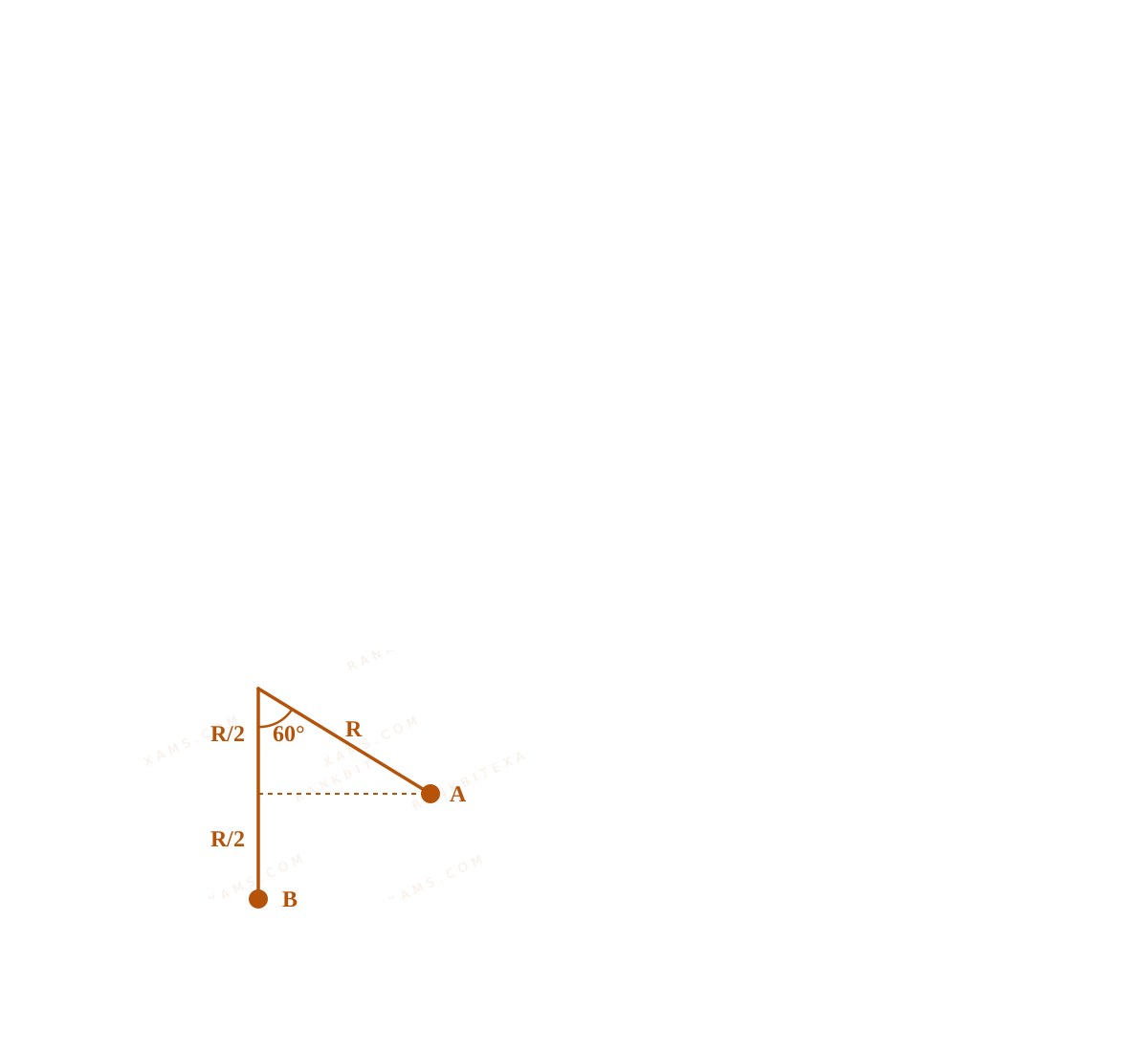
A particle is placed at the point A of a frictionless track ABC as shown in figure. It is gently pushed toward right. The speed of the particle when it reaches the point B is: (Take g = 10 mathrm~m/s^2).
Conservation of Mechanical Energy diagram for Q37 - JEE Main 2024 Morning
A particle on a frictionless track moving from height 1m at point A to 0.5m at point B.
  • A. 20 mathrm~m / s
  • B. sqrt10 mathrm~m / s
  • C. 2 sqrt10 mathrm~m / s
  • D. 10 mathrm~m / s

Solution

### Related Formula K_i + U_i = K_f + U_f frac12 m u^2 + mgh_i = frac12 m v^2 + mgh_f ### Core Logic Since the track is frictionless, mechanical energy is conserved. We can apply the Principle of Conservation of Mechanical Energy (COME) between point A and point B. ### Step 1: Apply Conservation of Energy At point A (initially pushed gently, u approx 0): textKE_A + U_A = textKE_B + U_B 0 + mg(h_A) = frac12 mv^2 + mg(h_B) Substitute the given values (h_A = 1 mathrm~m, h_B = 0.5 mathrm~m): mg(1) = frac12 mv^2 + mg(0.5) mg(0.5) = frac12 mv^2 v^2 = 2g(0.5) = g ### Step 2: Calculate Velocity Given g = 10 mathrm~m/s^2: v = sqrtg = sqrt10 mathrm~m/s ### Pattern Recognition For a mass sliding down a frictionless slope, its speed relies only on the vertical height dropped: v = sqrt2gDelta h. ### Evaluation Rubric / Model Answer null ### Chapter Mix Class 11 Physics: Work, Energy and Power
Q49 jee_main_2024_31_jan_morning Conservation Of Momentum
An artillery piece of mass M_1 fires a shell of mass M_2 horizontally. Instantaneously after the firing, the ratio of kinetic energy of the artillery and that of the shell is :
  • A. M_1 / (M_1 + M_2)
  • B. fracM_2M_1
  • C. M_2 / (M_1 + M_2)
  • D. fracM_1M_2

Solution

### Related Formula textKE = fracp^22m ### Core Logic By conservation of linear momentum (since no external horizontal force acts on the system): 0 = M_1 v_1 + M_2 v_2 |vecp_1| = |vecp_2| = p Both the artillery and the shell acquire the exact same magnitude of momentum during firing. ### Step 2: Kinetic Energy Ratio The kinetic energy is related to momentum by textKE = fracp^22m. Since p is identical for both bodies: textKE propto frac1m Therefore, the ratio of kinetic energy of the artillery (M_1) to the shell (M_2) is: fractextKE_1textKE_2 = fracfracp^22M_1fracp^22M_2 = fracM_2M_1 ### Evaluation Rubric / Model Answer null ### Chapter Mix Class 11 Physics: Work, Energy And Power

More Work, Energy and Power Questions — jee_main_2024_31_jan_evening

Practice all Work, Energy and Power previous-year questions →

YOUR FIRST PREP STEP STARTS HERE

We Map Every Repeating Question in Competitive Exams.

Say goodbye to generic mock test fatigue. RankBit uses smart analysis to group past exam questions into their foundational Repeating Question Types. Find chapter weightage, track repeating questions, and score higher with targeted practice.

Select Your Target Exam

Choose an exam track below to find formulas per chapter and patterns.

Syncing Exam Intelligence

Mapping formulas and patterns across all tracks…

PATH A — FULL LENGTH PRACTICE

Full Mock Test Hub

Simulate real NTA exam conditions with fully tracked mocks. Time yourself against past papers.

Under Development
PATH B — TARGETED PRACTICE

Topic-wise Practice Hub

Practice past-year questions one chapter at a time. Pick an exam → subject → chapter and get every PYQ for that topic — pulled together from all past papers — with the chapter's key formulas alongside.

Loading Questions... Browse Topics
Latest from the Blog
View all →

Loading articles...