Rankbit System
JEE Physics: Waves (+15.5%) | Electrostatics: Concentric Shells (-29.7%) | Modern Physics: Photoelectric Clones (+34.2%) | Mathematics: Definite Integrals (+18.1%) | Chemistry: Coordination Splitting (-11.4%) | JEE Physics: Waves (+15.5%) | Electrostatics: Concentric Shells (-29.7%) | Modern Physics: Photoelectric Clones (+34.2%) | Mathematics: Definite Integrals (+18.1%) | Chemistry: Coordination Splitting (-11.4%)

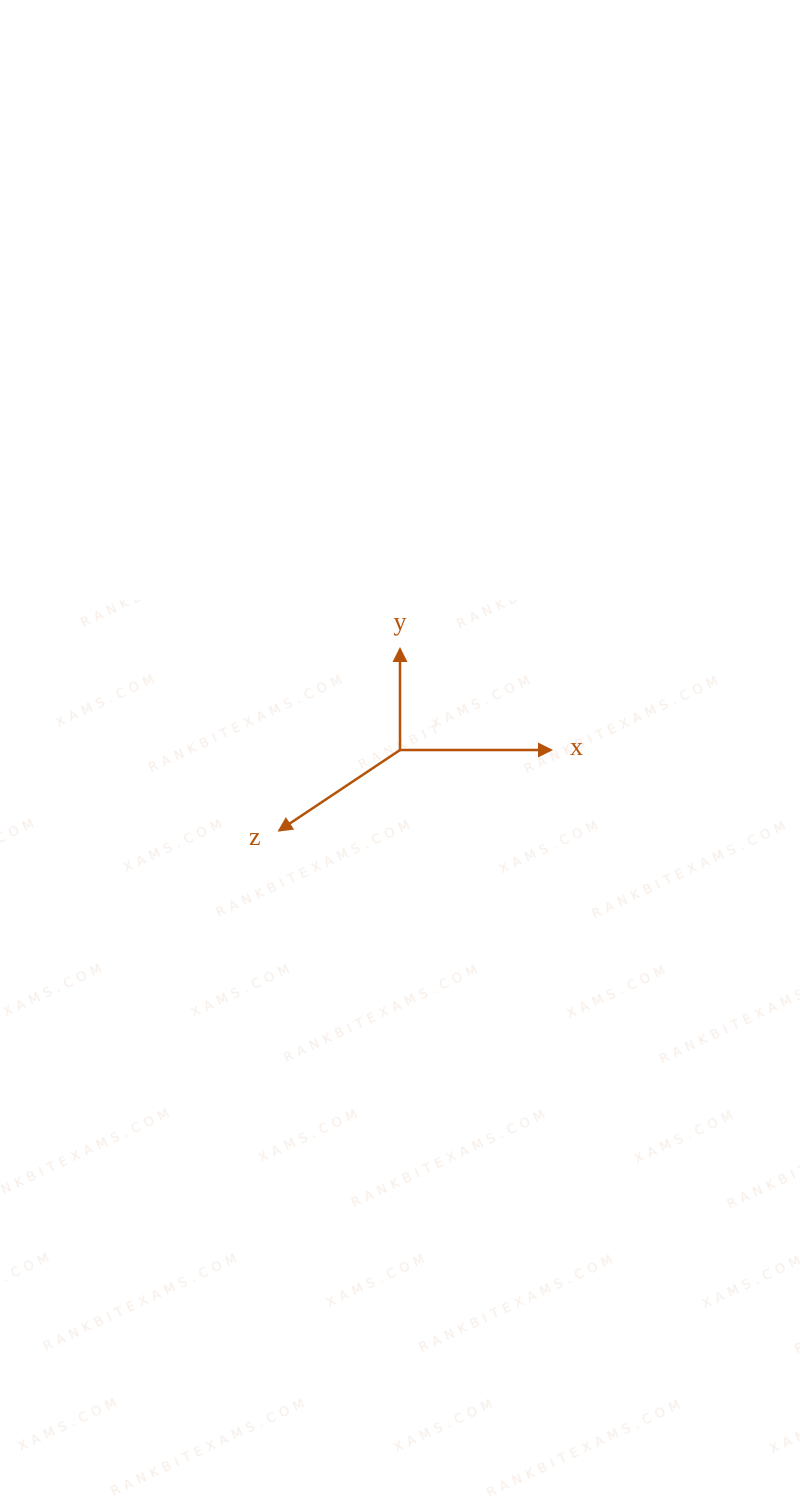
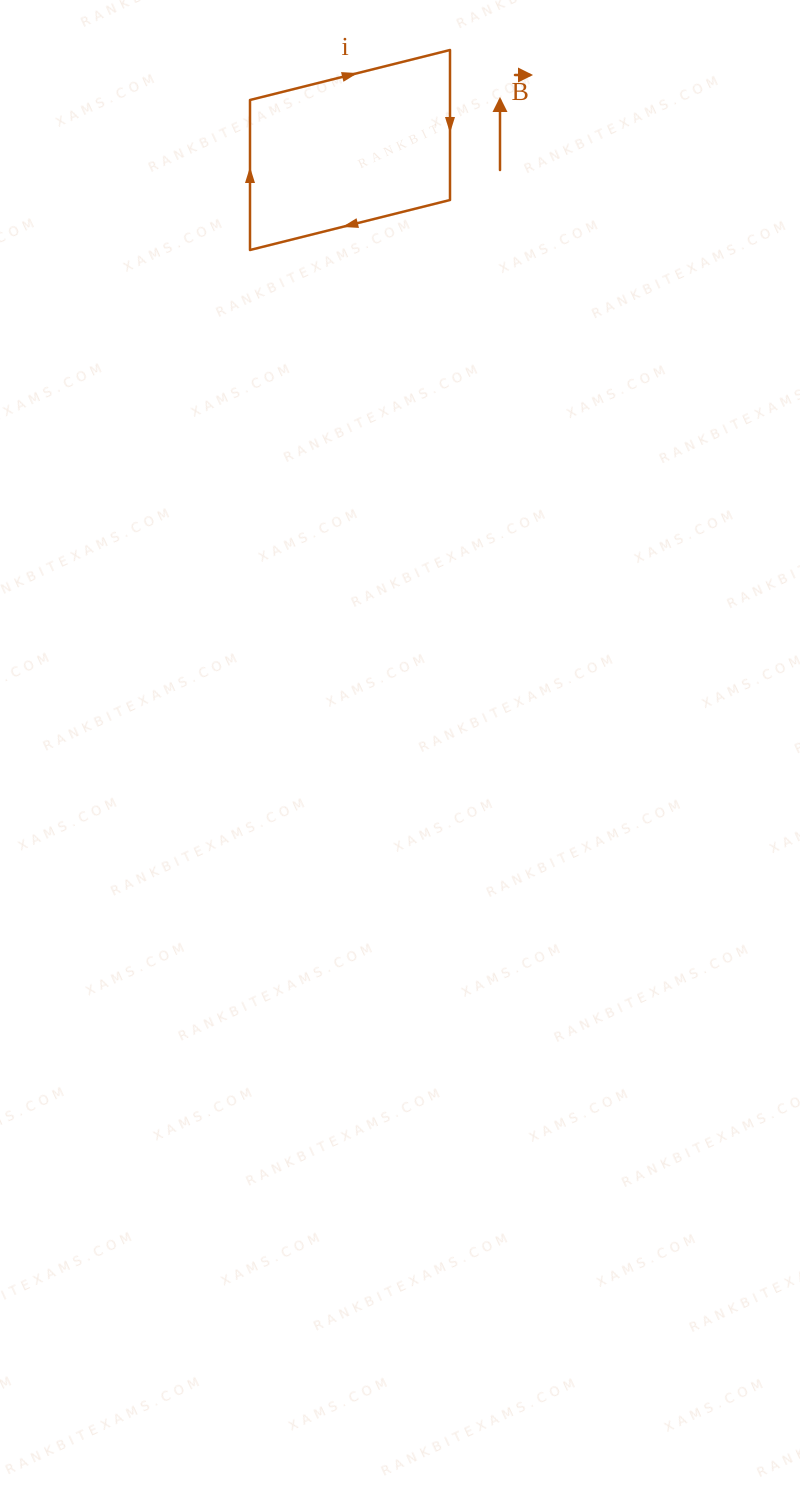
A uniform magnetic field of 2 times 10^-3 text T acts along positive Y-direction. A rectangular loop of sides 20 text cm and 10 text cm with current of 5 text A is Y-Z plane. The current is in anticlockwise sense with reference to negative X axis. Magnitude and direction of the torque is :

Solution & Explanation

### Related Formula vecM = ivecA vectau = vecM times vecB ### Core Logic The area vector vecA is perpendicular to the plane of the loop. According to the right-hand rule, an anticlockwise current observed from the negative X-axis means the area vector points in the negative X-direction.
Torque on a Current Loop diagram for Q32 - JEE Main 2024 Evening
### Step 1: Calculating Magnetic Moment Area of the loop, A = 0.2 text m times 0.1 text m = 0.02 text m^2 Magnetic moment vector: vecM = i vecA vecM = 5 times (0.2) times (0.1) (-hati) vecM = 0.1(-hati) text A m^2 ### Step 2: Calculating Torque The magnetic field is vecB = 2 times 10^-3 hatj text T. Torque on the loop: vectau = vecM times vecB vectau = 0.1(-hati) times (2 times 10^-3 hatj) vectau = 2 times 10^-4 (-hatk) text N-m ### Step 3: Final Direction The -hatk direction corresponds to the negative Z-direction. Magnitude is 2 times 10^-4 text N-m. ### Pattern Recognition Identify the plane of the loop to get the possible normal vectors. Since the loop is in the Y-Z plane, vecA must be pmhati. 'Anticlockwise from -X' fixes it as -hati. Simply apply cross product -hati times hatj = -hatk. ### Evaluation Rubric / Model Answer null ### Chapter Mix Class 12 Physics: Moving Charges and Magnetism

Reference Study Guides

More Moving Charges and Magnetism Previous-Year Questions — Page 3

Q21 jee_main_2025_24_jan_evening Solenoid
A tightly wound long solenoid carries a current of 1.5 A. An electron is executing uniform circular motion inside the solenoid with a time period of 75ns. The number of turns per metre in the solenoid is ____.
Solenoid cross section with internal electron circular orbit Q21
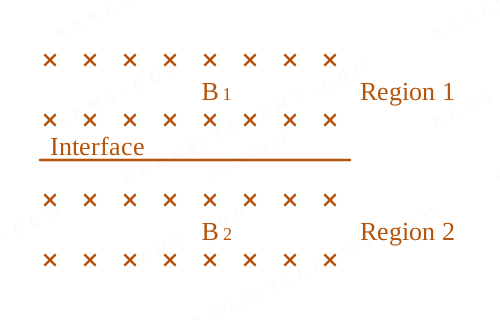
The figure details a thick solenoid cylinder with a internal cross section displaying a charge tracking loop.
[Take mass of electron m_e = 9 times 10^-31 kg, charge of electron |q_e| = 1.6 times 10^-19 C, mu_0 = 4pi times 10^-7 fracNA^2, 1 text ns = 10^-9 text s]
Numerical Answer. Answer: 250 to 250

Solution

### Related Formula Time period of a revolving charge in a magnetic field: T = frac2pi mqB Magnetic field inside a long solenoid: B = mu_0 n I ### Core Logic Combining the expressions to isolate n (turns per meter): T = frac2pi mq(mu_0 n I) Substituting the given constants: 75 times 10^-9 = frac2pi times 9 times 10^-311.6 times 10^-19 times 4pi times 10^-7 times n times 1.5 Simplifying terms: 75 times 10^-9 = frac18pi times 10^-319.6pi times 10^-26 times n = frac1.875 times 10^-5n n = frac1.875 times 10^-575 times 10^-9 = 250 ### Pattern Recognition The circular motion time period depends exclusively on the field magnitude B, completely independent of the orbit's velocity or radius. ### Evaluation Rubric / Model Answer null ### Chapter Mix Class 12 Physics: Moving Charges and Magnetism
Q24 jee_main_2025_24_jan_morning Magnetic Field due to a Current Element
A current of 5A exists in a square loop of side frac1sqrt2text m Then the magnitude of the magnetic field B at the centre of the square loop will be ptimes10^-6text T where, value of p is [Take mu_0=4pitimes10^-7text T mA^-1].
Numerical Answer. Answer: 8 to 8

Solution

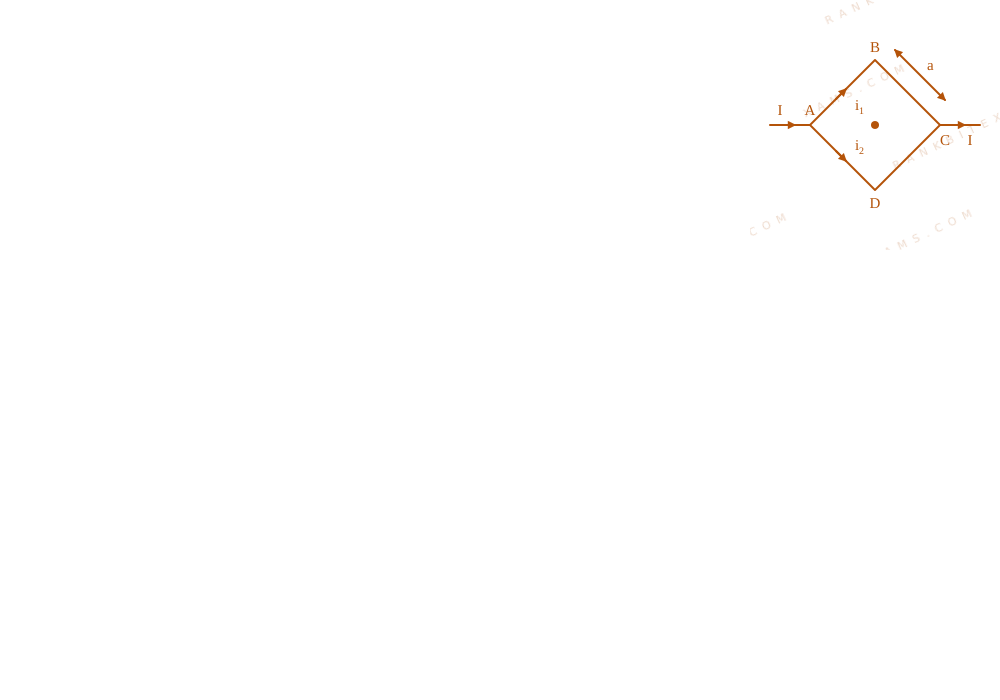
### Related Formula The magnetic field B_1 produced by a straight wire segment carrying current I at a perpendicular distance d is given by the Biot-Savart relation: B_1 = fracmu_0I4pi d(sintheta_1 + sintheta_2) ### Core Logic As shown in the square geometric layout
Magnetic Field due to a Current Element diagram for Q24 - JEE Main 2025 Morning
, the perpendicular distance from any side to the central origin point is exactly half the total side length : d = fraca2 = frac12sqrt2text m Connecting the ends of a side to the center forms internal angles of theta_1 = theta_2 = 45^circ. ### Step 1: Summing the Contributions Calculate the magnetic field contribution from a single side : B_1 = frac10^-7 times 5frac12sqrt2 left(sin 45^circ + sin 45^circ ight) = 10^-7 times 10sqrt2 times left(frac2sqrt2 ight) = 2 times 10^-6text T Since the current flows in the same rotational direction along all four sides, their individual magnetic fields add constructively at the center : B_textnet = 4 times B_1 = 4 times (2 times 10^-6text T) = 8 times 10^-6text T Comparing this with p times 10^-6text T , we get: p = 8 ### Pattern Recognition The magnetic field at the center of any square loop simplifies to the standard formula: B = frac2sqrt2mu_0Ipi a. ### Evaluation Rubric / Model Answer null ### Chapter Mix Class 12 Physics: Moving Charges and Magnetism
Q jee_main_2025_29_jan_morning Ampere\'s Circuital Law
Consider a long straight wire of a circular cross-section (radius a) carrying a steady current I. The current is uniformly distributed across this cross-section. The distances from the centre of the wire\'s cross-section at which the magnetic field [inside the wire, outside the wire] is half of the maximum possible magnetic field, any where due to the wire, will be
  • A. left[mathrma / 4,3mathrma / 2right]
  • B. left[mathrma / 2,2mathrma ight]
  • C. [mathrma / 2,3mathrma]
  • D. [mathrma / 4,2mathrma]

Solution

### Related Formula B_max = fracmu_0 I2pi a B_textin = fracmu_0 I r2pi a^2, quad B_textout = fracmu_0 I2pi r ### Core Logic The maximum magnetic field occurs right at the wire\'s outer boundary surface (r=a) : B_max = fracmu_0 I2pi a We need positions where B = fracB_max2 = fracmu_0 I4pi a. ### Step 1: Calculate Inside Distance fracmu_0 I r2pi a^2 = fracmu_0 I4pi a implies r = fraca2 ### Step 2: Calculate Outside Distance fracmu_0 I2pi r = fracmu_0 I4pi a implies r = 2a ### Pattern Recognition Inside the wire, field scales linearly with radius; outside, it falls inversely with radius. ### Chapter Mix Class 12 Physics: Moving Charges and Magnetism
Q40 jee_main_2024_01_february_morning Galvanometer Conversion
A galvanometer has a resistance of 50mathrm~Omega and it allows maximum current of 5mathrm~mA. It can be converted into voltmeter to measure upto 100mathrm~V by connecting in series a resistor of resistance:
  • A. 5975mathrm~Omega
  • B. 20050mathrm~Omega
  • C. 19950mathrm~Omega
  • D. 19500mathrm~Omega

Solution

### Related Formula Voltmeter series conversion formula: V = I_g(R_g + R) R = fracVI_g - R_g ### Core Logic Given data: R_g = 50mathrm~Omega, I_g = 5mathrm~mA = 5 times 10^-3mathrm~A, target voltage range V = 100mathrm~V. Substitute values: R = frac1005 times 10^-3 - 50 ### Step 1: Complete Arithmetic Evaluation R = 20000 - 50 = 19950mathrm~Omega ### Pattern Recognition Voltmeter resistance is always high because it is connected in parallel to circuits to prevent current drawing leaks. ### Evaluation Rubric / Model Answer null ### Chapter Mix Class 12 Physics: Moving Charges and Magnetism Class 12 Physics: Current Electricity
Q51 jee_main_2024_01_february_morning Magnetic Field due to a Current Element
A regular polygon of 6 sides is formed by bending a wire of length 4pi meter. If an electric current of 4pisqrt3mathrm~A is flowing through the sides of the polygon, the magnetic field at the centre of the polygon would be x times 10^-7mathrm~T. The value of x is:
Numerical Answer. Answer: 72 to 72

Solution

### Related Formula Magnetic field due to a straight wire segment of length 2L at distance r: B_1 = fracmu_0 I4pi r(sintheta_1 + sintheta_2) Total field for a regular hexagon (n=6): B = 6 times B_1 ### Core Logic Total perimeter = 6 cdot a = 4pi implies textside length a = frac4pi6 = frac2pi3mathrm~m. For a regular hexagon segment, the interior angles relative to the normal vector are theta_1 = theta_2 = 30^circ. The normal distance r from the center to a side is: r = fraca2 cot(30^circ) = frac4pi2 times 6 times sqrt3 = fracsqrt3pi3 = fracpisqrt3mathrm~m ### Step 1: Calculate Total Magnetic Field Substitute r and I = 4pisqrt3mathrm~A into the hexagon configuration: B = 6 times left[ fracmu_0 I4pi r (sin(30^circ) + sin(30^circ)) right] B = 6 times left[ frac10^-7 times 4pisqrt3left(fracsqrt3pi3right) times (0.5 + 0.5) right] B = 6 times left[ frac10^-7 times 4pisqrt3 times 3sqrt3pi times 1 right] B = 6 times [ 4 times 3 times 10^-7 ] = 6 times 12 times 10^-7 = 72 times 10^-7mathrm~T Thus, x = 72. ### Pattern Recognition For regular polygons, the normal distance r to the side is always r = fraca2cot(fracpin). The contribution from all n symmetric segments adds up constructively. ### Evaluation Rubric / Model Answer null ### Chapter Mix Class 12 Physics: Moving Charges and Magnetism

More Moving Charges and Magnetism Questions — jee_main_2024_31_jan_evening

Practice all Moving Charges and Magnetism previous-year questions →

YOUR FIRST PREP STEP STARTS HERE

We Map Every Repeating Question in Competitive Exams.

Say goodbye to generic mock test fatigue. RankBit uses smart analysis to group past exam questions into their foundational Repeating Question Types. Find chapter weightage, track repeating questions, and score higher with targeted practice.

Select Your Target Exam

Choose an exam track below to find formulas per chapter and patterns.

Syncing Exam Intelligence

Mapping formulas and patterns across all tracks…

PATH A — FULL LENGTH PRACTICE

Full Mock Test Hub

Simulate real NTA exam conditions with fully tracked mocks. Time yourself against past papers.

Under Development
PATH B — TARGETED PRACTICE

Topic-wise Practice Hub

Practice past-year questions one chapter at a time. Pick an exam → subject → chapter and get every PYQ for that topic — pulled together from all past papers — with the chapter's key formulas alongside.

Loading Questions... Browse Topics
Latest from the Blog
View all →

Loading articles...