Q
jee_main_2024_31_jan_morning
Projectile Motion
A body starts falling freely from height H hits an inclined plane in its path at height h. As a result of this perfectly elastic impact, the direction of the velocity of the body becomes horizontal. The value of (H)/(h) for which the body will take the maximum time to reach the ground is
Numerical Answer. Answer: 2 to 2
Solution
Related Formula
t = √((2d)/(g))Core Logic
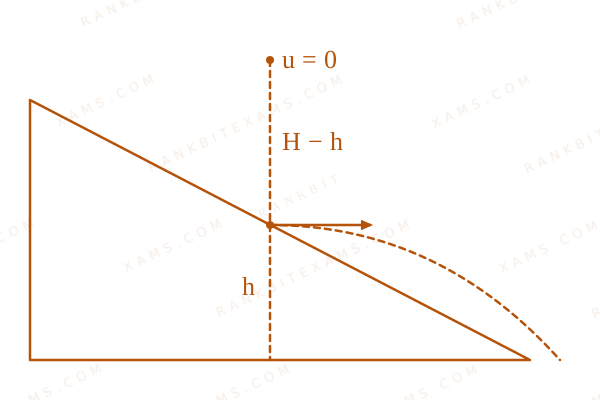
The body falls freely from height H to height h. The distance fallen is (H - h). Time taken to fall this distance:
t₁ = √((2(H - h))/(g))After elastic impact, the vertical velocity becomes zero (the entire velocity is directed horizontally). From height h, it now acts as a horizontal projectile. The time taken to reach the ground vertically from height h is:
t₂ = √((2h)/(g))Total time of flight T = t₁ + t₂:
T = √((2(H - h))/(g)) + √((2h)/(g))Step 2: Maximizing Time
To find the maximum time T, differentiate T with respect to h and equate to zero:
(dT)/(dh) = √((2)/(g)) ( -12√(H - h) + 12√(h) ) = 0 12√(h) = 12√(H - h) √(H - h) = √(h)Squaring both sides: H - h = h H = 2h
(H)/(h) = 2Chapter Mix
Class 11 Physics: Kinematics
