JEE Main · Physics ↓ Falling

Mechanical Properties of Solids appeared 21 times across 3 years — 2.4% of Physics. This question is from Young's Modulus and Strain.

Year 2026 2025 2024 Total
Questions 4 9 8 21

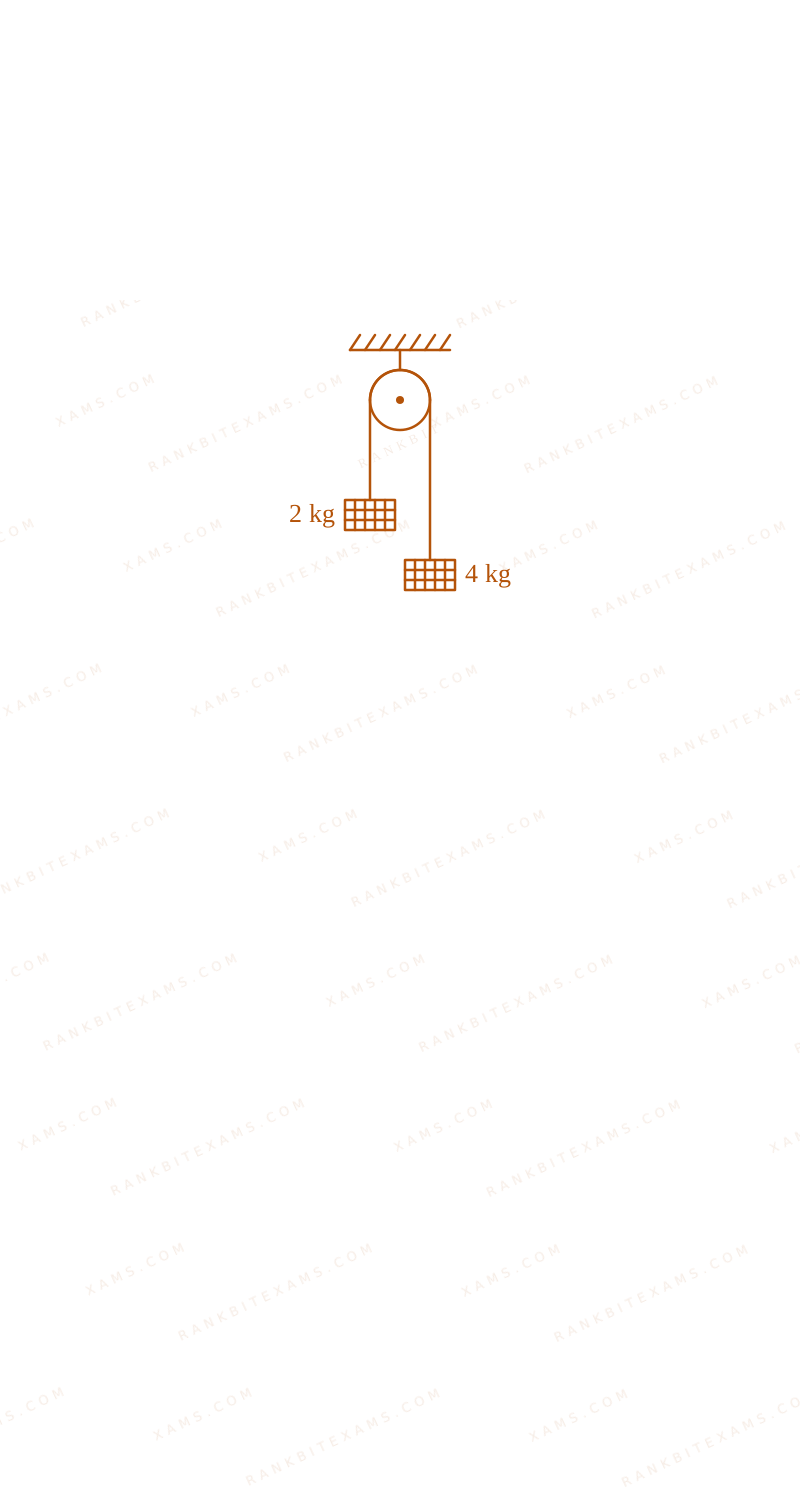
Two blocks of mass 2 kg and 4 kg are connected by a metal wire going over a smooth pulley as shown in figure. The radius of wire is 4.0 × 10⁻⁵ m and Young's modulus of the metal is 2.0 × 10¹¹ N/m². The longitudinal strain developed in the wire is (1)/(α π). The value of α is _______. [Use g = 10 m/s²]
Young's Modulus and Strain diagram for Q54 - JEE Main 2024 Evening
The image shows a standard Atwood machine with a wire holding 2 kg and 4 kg masses.

Numerical Answer Type:
Enter a numerical value Answer: 12 to 12 +4 marks

Solution & Explanation

Related Formula
T = (2 m₁ m₂)/(m₁ + m₂) g Strain = (Δ )/( ) = (F)/(A Y) = (T)/(A Y)
Core Logic

First, determine the tension T in the wire produced by the accelerating system (Atwood machine). Then, apply the formula for longitudinal strain using the calculated tension, cross-sectional area, and Young's Modulus.

Step 1: Calculate Tension
T = ( (2 × 2 × 4)/(2 + 4) ) g = ( (16)/(6) ) × 10 = (160)/(6) = (80)/(3) N
Step 2: Calculate Area

Given radius r = 4.0 × 10⁻⁵ m.

A = π r² = π (4 × 10⁻⁵)² = 16π × 10⁻¹⁰ m²
Step 3: Calculate Strain
Strain = (T)/(A Y) = 80/3(16π × 10⁻¹⁰) × (2 × 10¹¹) Strain = (80/3)/(32π × 10) = (80)/(3 × 320π) = (1)/(12π)
Step 4: Extract Alpha

Comparing with (1)/(α π): α = 12

Pattern Recognition

Linkage problem: Mechanics (Atwood tension) → Solids (Strain). Memorize Atwood tension T = 2m₁m₂g/(m₁+m₂) to skip drawing free body diagrams during exams.

Chapter Mix

Class 11 Physics: Mechanical Properties of Solids Class 11 Physics: Laws of Motion

Reference Study Guides

More Mechanical Properties of Solids Previous-Year Questions — Page 5

Q58 jee_main_2024_31_jan_morning Bulk Modulus
The depth below the surface of sea to which a rubber ball be taken so as to decrease its volume by 0.02% is ________ m. (Take density of sea water = 10³ kgm⁻³, Bulk modulus of rubber = 9 × 10⁸ Nm⁻², and g = 10 ms⁻²)
Numerical Answer. Answer: 18 to 18

Solution

Related Formula
β = (-Δ P)/((Δ V)/(V)) Δ P = ρ g h
Core Logic

The change in pressure Δ P is the hydrostatic pressure at depth h.

Δ P = -β (Δ V)/(V) ρ g h = -β (Δ V)/(V)
Step 2: Calculation

Given values: ρ = 10³ kg/m³ g = 10 m/s² β = 9 × 10⁸ N/m² (Δ V)/(V) = -0.02% = -(0.02)/(100)

Substitute into the equation:

10³ × 10 × h = - (9 × 10⁸) × (-(0.02)/(100)) 10⁴ × h = 9 × 10⁸ × 2 × 10⁻⁴ 10⁴ h = 18 × 10⁴ h = 18 m
Chapter Mix

Class 11 Physics: Mechanical Properties Of Solids Class 11 Physics: Mechanical Properties Of Fluids

More Mechanical Properties of Solids Questions — jee_main_2024_31_jan_evening

Practice all Mechanical Properties of Solids previous-year questions →

Rankbit System
JEE Physics: Waves (+15.5%) | Electrostatics: Concentric Shells (-29.7%) | Modern Physics: Photoelectric Clones (+34.2%) | Mathematics: Definite Integrals (+18.1%) | Chemistry: Coordination Splitting (-11.4%) | JEE Physics: Waves (+15.5%) | Electrostatics: Concentric Shells (-29.7%) | Modern Physics: Photoelectric Clones (+34.2%) | Mathematics: Definite Integrals (+18.1%) | Chemistry: Coordination Splitting (-11.4%)