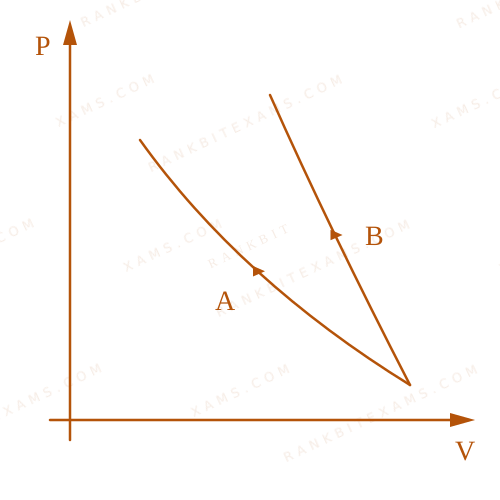
Choose the correct statement for processes A$\mathrm{A}$ & B$\mathrm{B}$ shown in figure.
A Pressure vs Volume (P-V) graph showing two expansion curves starting from the same initial state. Curve B is steeper than Curve A.
A.PVγ = k for process B and PV = k for process A$\mathrm{PV}^{\gamma} = \mathrm{k} \text{ for process } \mathrm{B} \text{ and } \mathrm{PV} = \mathrm{k} \text{ for process } \mathrm{A}$
B.PV = k for process B and A$\mathrm{PV} = \mathrm{k} \text{ for process } \mathrm{B} \text{ and } \mathrm{A}$
C.Pγ - 1Tγ = k for process B and T = k for process A$\frac{\mathrm{P}^{\gamma - 1}}{\mathrm{T}^{\gamma}} = \mathrm{k} \text{ for process } \mathrm{B} \text{ and } \mathrm{T} = \mathrm{k} \text{ for process } \mathrm{A}$
D.TγPγ - 1 = k for process A and PV = k for process B$\frac{\mathrm{T}^{\gamma}}{\mathrm{P}^{\gamma - 1}} = \mathrm{k} \text{ for process } \mathrm{A} \text{ and } \mathrm{PV} = \mathrm{k} \text{ for process } \mathrm{B}$
In a P-V$P-V$ diagram starting from the same initial state and undergoing expansion, the adiabatic curve is steeper than the isothermal curve.
Looking at the graph, Curve (B) is steeper, so it represents an adiabatic process. Curve (A) is less steep, so it represents an isothermal process.
Step 1: Check Options
Process A (Isothermal): PV = k$PV = k$ or T = k$T = k$.
Process B (Adiabatic): PVγ = k$PV^{\gamma} = k$.
Option (1) states: PVγ = k$PV^{\gamma} = k$ for B and PV = k$PV = k$ for A. This is entirely correct.
Note: For an adiabatic process, Tγ P1-γ = k$T^{\gamma} P^{1-\gamma} = k$, which can be written as TγPγ-1 = k$\frac{T^{\gamma}}{P^{\gamma-1}} = k$. Option (3) proposes Pγ-1Tγ = k$\frac{P^{\gamma-1}}{T^{\gamma}} = k$ for B, which is mathematically equivalent, but Option (1) is the standard and most direct NTA choice.
Pattern Recognition
Slope of isothermal = -P/V$= -P/V$. Slope of adiabatic = -γ P/V$= -\gamma P/V$. Since γ > 1$\gamma > 1$, adiabatic is always steeper. In expansions, adiabatic lies below isothermal.
Water falls from a height of 200~m$200\mathrm{~m}$ into a pool. Calculate the rise in temperature of the water assuming no heat dissipation from the water in the pool. (Take g = 10~m/s²$g = 10\mathrm{~m/s}^{2}$, specific heat of water = 4200~J/(kg· K)$= 4200\mathrm{~J/(kg\cdot K)}$)
A.0.23~K$0.23\mathrm{~K}$
B.0.36~K$0.36\mathrm{~K}$
C.0.14~K$0.14\mathrm{~K}$
D.0.48~K$0.48\mathrm{~K}$
Solution
Related Formula
Δ U = mgh and Q = msΔ T$$\Delta U = mgh \quad \text{and} \quad Q = ms\Delta T$$
By conservation of energy (assuming all potential energy goes into heating the water):
mgh = msΔ T Δ T = (gh)/(s)$$mgh = ms\Delta T \implies \Delta T = \frac{gh}{s}$$
where,
g$g$ = acceleration due to gravity
h$h$ = height of the fall
s$s$ = specific heat of water
Δ T$\Delta T$ = rise in temperature
Core Logic
Given parameters:
h = 200~m$h = 200\mathrm{~m}$
g = 10~m/s²$g = 10\mathrm{~m/s}^{2}$
s = 4200~J/(kg· K)$s = 4200\mathrm{~J/(kg\cdot K)}$
Substitute the values to find Δ T$\Delta T$:
Δ T = (10 × 200)/(4200) = (2000)/(4200)$$\Delta T = \frac{10 \times 200}{4200} = \frac{2000}{4200}$$Δ T = (10)/(21) ≈ 0.476~K ≈ 0.48~K$$\Delta T = \frac{10}{21} \approx 0.476\mathrm{~K} \approx 0.48\mathrm{~K}$$
Pattern Recognition
Sees: "Water falling from height h$h$ raises temperature" → Mass cancels out. Δ T = (gh)/(s)$\Delta T = \frac{gh}{s}$.
Shortcut: Always use SI units (swater = 4200~J/kg· K$s_{\text{water}} = 4200\mathrm{~J/kg\cdot K}$ is given; if given in cal/g·^° C$\mathrm{cal/g\cdot^\circ C}$, convert using 1~cal = 4.184~J$1\mathrm{~cal} = 4.184\mathrm{~J}$). ✓
Chapter Mix
Class 11 Physics: Thermodynamics
Class 11 Physics: Work, Energy and Power

A monoatomic gas having γ = (5)/(3)$\gamma = \frac{5}{3}$ is stored in a thermally insulated container and the gas is suddenly compressed to ((1)/(8))th$\left(\frac{1}{8}\right)^{\mathrm{th}}$ of its initial volume. The ratio of final pressure and initial pressure is:
(γ$\gamma$ is the ratio of specific heats of the gas at constant pressure and at constant volume)
Sees: "suddenly compressed" or "thermally insulated container" → Adiabatic process.
Shortcut: P V^γ = constant$P V^\gamma = \text{constant}$. Since the volume goes down by 8$8$ times, the pressure increases by 8γ = 85/3 = 32$8^{\gamma} = 8^{5/3} = 32$ times. ✓
Chapter Mix
Class 11 Physics: Thermodynamics
Qjee_main_2025_29_jan_eveningIsothermal and Adiabatic Processes
Given below are two statements. One is labelled as Assertion (A) and the other is labelled as Reason (R).
**Assertion** (A): With the increase in the pressure of an ideal gas, the volume falls off more rapidly in an isothermal process in comparison to the adiabatic process.
Reason (R): In isothermal process, PV = constant$PV = \text{constant}$, while in adiabatic process PVγ = constant$PV^{\gamma} = \text{constant}$. Here γ$\gamma$ is the ratio of specific heats, P$P$ is the pressure and V$V$ is the volume of the ideal gas.
In the light of the above statements, choose the correct answer from the options given below:
A.Both (A) and (R) are true but (R) is NOT the correct explanation of (A)$\text{Both (A) and (R) are true but (R) is NOT the correct explanation of (A)}$
B.(A) is true but (R) is false$\text{(A) is true but (R) is false}$
C.Both (A) and (R) are true and (R) is the correct explanation of (A)$\text{Both (A) and (R) are true and (R) is the correct explanation of (A)}$
D.(A) is false but (R) is true$\text{(A) is false but (R) is true}$
Isothermal and Adiabatic Processes diagram for Q2 - JEE Main 2025 Evening
When pressure increases (compression), the volume drops. Because the adiabatic curve is steeper, the pressure rises more rapidly for a given drop in volume, or conversely, for a specified increase in pressure, the volume falls off more rapidly in the isothermal process than the adiabatic process. Hence, Assertion (A) is true.
Reason (R) states the governing equations PV = C$PV = C$ and PVγ = C$PV^{\gamma} = C$, which directly lead to these slope expressions via differentiation. Thus, Reason (R) is true and correctly explains Assertion (A).
Pattern Recognition
Adiabatic curves are steeper than isothermal curves on a P-V$P-V$ diagram because γ > 1$\gamma > 1$. For any expansion or compression process, remember that slope magnitude satisfies Slopeadi = γ · Slopeᵢₛₒ$\text{Slope}_{\text{adi}} = \gamma \cdot \text{Slope}_{\text{iso}}$.
Chapter Mix
Class 11 Physics: Thermodynamics
Q6jee_main_2025_29_jan_eveningHeat and Work in Thermodynamic Processes
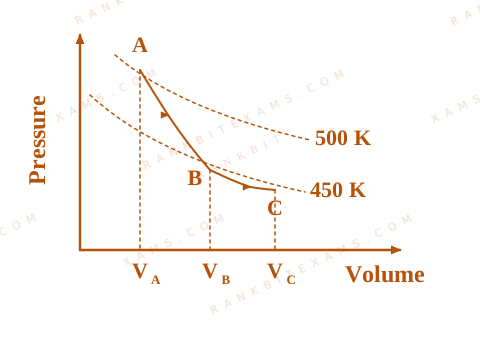
A poly-atomic molecule (CV = 3R, CP = 4R$C_V = 3R, C_P = 4R$, where R$R$ is gas constant) goes from phase space point A(PA = 10⁵~Pa, VA = 4 × 10⁻⁶~m³)$A(P_A = 10^5\mathrm{~Pa}, V_A = 4 \times 10^{-6}\mathrm{~m}^3)$ to point B(PB = 5 × 10⁴~Pa, VB = 6 × 10⁻⁶~m³)$B(P_B = 5 \times 10^4\mathrm{~Pa}, V_B = 6 \times 10^{-6}\mathrm{~m}^3)$ to point C(PC = 10⁴~Pa, VC = 8 × 10⁻⁶~m³)$C(P_C = 10^4\mathrm{~Pa}, V_C = 8 \times 10^{-6}\mathrm{~m}^3)$. A$A$ to B$B$ is an adiabatic path and B$B$ to C$C$ is an isothermal path. The net heat absorbed per unit mole by the system is:
The graph depicts a pressure vs volume plot indicating paths from state A to B (adiabatic) and from B to C (isothermal).
For path A arrow B$A \rightarrow B$:
Since it is given as an adiabatic path:
Δ QAB = 0$$\Delta Q_{AB} = 0$$
For path B arrow C$B \rightarrow C$:
Since it is given as an isothermal path, the change in internal energy Δ UBC = 0$\Delta U_{BC} = 0$. From the first law of thermodynamics, heat absorbed equals work done:
Wait, let's express it in terms of the gas constant R$R$ for a single mole (n=1$n=1$) using temperature data directly provided in the original figure labels (TB = 450~K$T_B = 450\mathrm{~K}$):
Δ QBC = (1) · R · (450) · ln( 8 × 10⁻⁶6 × 10⁻⁶)$$\Delta Q_{BC} = (1) \cdot R \cdot (450) \cdot \ln\left(\frac{8 \times 10^{-6}}{6 \times 10^{-6}}\right)$$Δ QBC = 450 R ln((4)/(3)) = 450 R (ln 4 - ln 3)$$\Delta Q_{BC} = 450 R \ln\left(\frac{4}{3}\right) = 450 R (\ln 4 - \ln 3)$$
Thus, the total net heat absorbed per unit mole is:
Δ Q = 0 + 450 R (ln 4 - ln 3) = 450 R (ln 4 - ln 3)$$\Delta Q = 0 + 450 R (\ln 4 - \ln 3) = 450 R (\ln 4 - \ln 3)$$
Pattern Recognition
Adiabatic paths have zero heat exchange by baseline definition. The calculation boils down directly to the work done during the isothermal stage B arrow C$B \rightarrow C$ matching RT ln(Vf/Vᵢ)$RT \ln(V_f/V_i)$.
Chapter Mix
Class 11 Physics: Thermodynamics
Q7jee_main_2025_28_jan_morningCarnot Engine and Efficiency
A Carnot engine (E) is working between two temperatures 473K and 273K. In a new system two engines - engine E₁$\mathrm{E}_1$ works between 473K to 373K and engine E₂$\mathrm{E}_2$ works between 373K to 273K. If η₁₂$\eta_{12}$ , η₁$\eta_1$ and η₂$\eta_2$ are the efficiencies of the engines E, E₁$\mathrm{E}_1$ and E₂$\mathrm{E}_2$ , respectively, then
A.η₁₂ < η₁ + η₂$\eta_{12} < \eta_1 + \eta_2$
B.η₁₂ = η₁η₂$\eta_{12} = \eta_1\eta_2$
C.η₁₂ = η₁ + η₂$\eta_{12} = \eta_{1} + \eta_{2}$
D.η₁₂ ≥ η₁ + η₂$\eta_{12} \geq \eta_1 + \eta_2$
Solution
Related Formula
η = 1 - TLTH$$\eta = 1 - \frac{\mathrm{T}_L}{\mathrm{T}_H}$$
Core Logic
Let's compute the efficiency parameters explicitly:
Practice past-year questions one chapter at a time. Pick an exam → subject → chapter and get every PYQ for that topic — pulled together from all past papers — with the chapter's key formulas alongside.