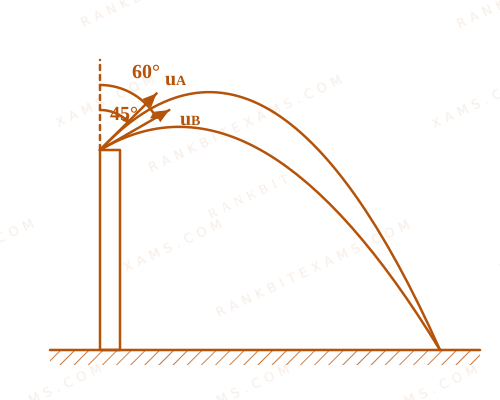
Projectiles A$\mathrm{A}$ and B$\mathrm{B}$ are thrown at angles of 45°$45^{\circ}$ and 60°$60^{\circ}$ with vertical respectively from top of a 400 ~m$400 \mathrm{~m}$ high tower. If their ranges and times of flight are same, the ratio of their speeds of projection vA: vB$\mathrm{v_A}: \mathrm{v_B}$ is:
A.1: √(3)$1: \sqrt{3}$
B.√(2):1$\sqrt{2}:1$
C.1:2$1:2$
D.1:√(2)$1:\sqrt{2}$
Solution & Explanation
Core Logic
Projectile Motion from a Tower diagram for Q50 - JEE Main 2024 Evening
For two projectiles launched from the same height to have the same time of flight (T$T$), their vertical components of velocity must be equal.
Since the angles given are with the vertical, the vertical components are vA (45°)$v_A \cos(45^{\circ})$ and vB (60°)$v_B \cos(60^{\circ})$.
If TA = TB$T_A = T_B$, then vAy = vBy$v_{Ay} = v_{By}$.
For the ranges to be the same while having the same time of flight, their horizontal components of velocity must also be equal: vAx = vBx$v_{Ax} = v_{Bx}$.
This yields a contradiction. It is impossible for both the ranges and the times of flight to be simultaneously equal for different angles of projection from a tower.
Step 2: Conclusion
The question contains inconsistent data and is technically a Bonus question. However, if one arbitrarily equates only the time of flight (or if NTA intended a different scenario), the ratio (vA)/(vB) = 1√(2)$\frac{v_A}{v_B} = \frac{1}{\sqrt{2}}$ matches option (4), which was the officially provided key before corrections.
Pattern Recognition
Be wary of over-constrained physics problems. If a question specifies both range AND time of flight are identical for two different angles, check if the math yields a contradiction. NTA often accepts the result of one partial constraint
By NTA 4
BY Rankbit (Bonus).
Chapter Mix
Class 11 Physics: Motion in a Plane
More Motion in a Plane Previous-Year Questions — Page 8
Q44jee_main_2024_31_jan_eveningVector Algebra
If two vectors A$\vec{A}$ and B$\vec{B}$ having equal magnitude R$R$ are inclined at an angle θ$\theta$, then
Checking options, only | A + B| = 2R ((θ)/(2))$|\vec{A} + \vec{B}| = 2R \cos \left(\frac{\theta}{2}\right)$ is correctly paired in the choice list.
Pattern Recognition
Standard geometry shortcut: Addition of two equal vectors yields a cosine half-angle dependency. Subtraction yields a sine half-angle dependency. (+ → )$(+ \to \cos)$, (- → )$(- \to \sin)$.
Chapter Mix
Class 11 Physics: Motion in a Plane

Qjee_main_2024_31_jan_morningProjectile Motion
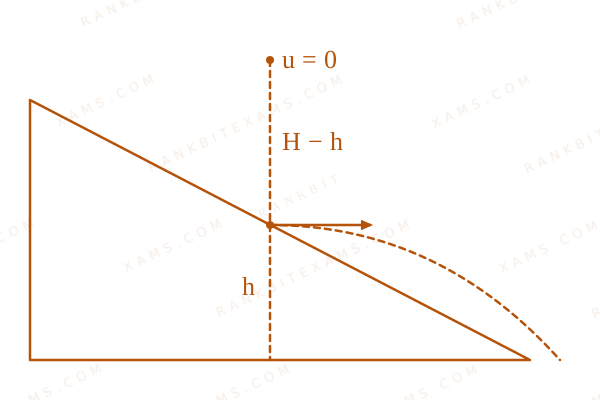
A body starts falling freely from height H$H$ hits an inclined plane in its path at height h$h$. As a result of this perfectly elastic impact, the direction of the velocity of the body becomes horizontal. The value of (H)/(h)$\frac{H}{h}$ for which the body will take the maximum time to reach the ground is
Numerical Answer.Answer: 2 to 2
Solution
Related Formula
t = √((2d)/(g))$$t = \sqrt{\frac{2d}{g}}$$
Core Logic
Projectile Motion diagram for Q55 - JEE Main 2024 Morning
The body falls freely from height H$H$ to height h$h$. The distance fallen is (H - h)$(H - h)$.
Time taken to fall this distance:
After elastic impact, the vertical velocity becomes zero (the entire velocity is directed horizontally). From height h$h$, it now acts as a horizontal projectile.
The time taken to reach the ground vertically from height h$h$ is:
Squaring both sides:
H - h = h$H - h = h$H = 2h$H = 2h$
(H)/(h) = 2$$\frac{H}{h} = 2$$
Chapter Mix
Class 11 Physics: Kinematics
Q33jee_main_2024_31_jan_morningDifferentiation In Kinematics
The relation between time 't$t$' and distance 'x$x$' is t = α x² + β x$t = \alpha x^2 + \beta x$, where α$\alpha$ and β$\beta$ are constants. The relation between acceleration (a$a$) and velocity (v$v$) is:
Standard kinematic shortcut: Whenever t = Ax² + Bx$t = Ax^2 + Bx$, v = (2Ax+B)⁻¹$v = (2Ax+B)^{-1}$ and a = -2A v³$a = -2A v^3$. Memorizing this directly saves derivation time during the exam.
Chapter Mix
Class 11 Physics: Kinematics
More Motion in a Plane Questions — jee_main_2024_30_january_evening
Practice past-year questions one chapter at a time. Pick an exam → subject → chapter and get every PYQ for that topic — pulled together from all past papers — with the chapter's key formulas alongside.