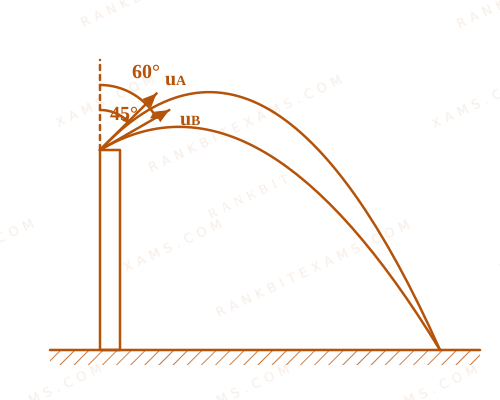
Projectiles A$\mathrm{A}$ and B$\mathrm{B}$ are thrown at angles of 45°$45^{\circ}$ and 60°$60^{\circ}$ with vertical respectively from top of a 400 ~m$400 \mathrm{~m}$ high tower. If their ranges and times of flight are same, the ratio of their speeds of projection vA: vB$\mathrm{v_A}: \mathrm{v_B}$ is:
A.1: √(3)$1: \sqrt{3}$
B.√(2):1$\sqrt{2}:1$
C.1:2$1:2$
D.1:√(2)$1:\sqrt{2}$
Solution & Explanation
Core Logic
Projectile Motion from a Tower diagram for Q50 - JEE Main 2024 Evening
For two projectiles launched from the same height to have the same time of flight (T$T$), their vertical components of velocity must be equal.
Since the angles given are with the vertical, the vertical components are vA (45°)$v_A \cos(45^{\circ})$ and vB (60°)$v_B \cos(60^{\circ})$.
If TA = TB$T_A = T_B$, then vAy = vBy$v_{Ay} = v_{By}$.
For the ranges to be the same while having the same time of flight, their horizontal components of velocity must also be equal: vAx = vBx$v_{Ax} = v_{Bx}$.
This yields a contradiction. It is impossible for both the ranges and the times of flight to be simultaneously equal for different angles of projection from a tower.
Step 2: Conclusion
The question contains inconsistent data and is technically a Bonus question. However, if one arbitrarily equates only the time of flight (or if NTA intended a different scenario), the ratio (vA)/(vB) = 1√(2)$\frac{v_A}{v_B} = \frac{1}{\sqrt{2}}$ matches option (4), which was the officially provided key before corrections.
Pattern Recognition
Be wary of over-constrained physics problems. If a question specifies both range AND time of flight are identical for two different angles, check if the math yields a contradiction. NTA often accepts the result of one partial constraint
By NTA 4
BY Rankbit (Bonus).
Chapter Mix
Class 11 Physics: Motion in a Plane
More Motion in a Plane Previous-Year Questions — Page 5
Q8jee_main_2025_24_jan_eveningVelocity and Acceleration
The position vector of a moving body at any instant of time is given as r = (5t² i - 5t j)m$\vec{\mathrm{r}} = (5\mathrm{t}^2\hat{\mathrm{i}} - 5\mathrm{t}\hat{\mathrm{j}})\mathrm{m}$. The magnitude and direction of velocity at t = 2s$t = 2s$ is,
A.5√(15)$5\sqrt{15}$ m/s, making an angle of ⁻¹4$\tan^{-1}4$ with -ve Y axis
B.5√(15)$5\sqrt{15}$ m/s, making an angle of ⁻¹4$\tan^{-1}4$ with +ve X axis
C.5√(17)$5\sqrt{17}$ m/s, making an angle of ⁻¹4$\tan^{-1}4$ with -ve Y axis
D.5√(17)$5\sqrt{17}$ m/s, making an angle of ⁻¹4$\tan^{-1}4$ with +ve X axis
Solution
Related Formula
v = d rdt$$\vec{v} = \frac{d\vec{r}}{dt}$$
Core Logic
Given position vector:
r = 5t² i - 5t j$$\vec{r} = 5t^2\hat{i} - 5t\hat{j}$$
Differentiating with respect to t$t$:
v = 10t i - 5 j$$\vec{v} = 10t\hat{i} - 5\hat{j}$$
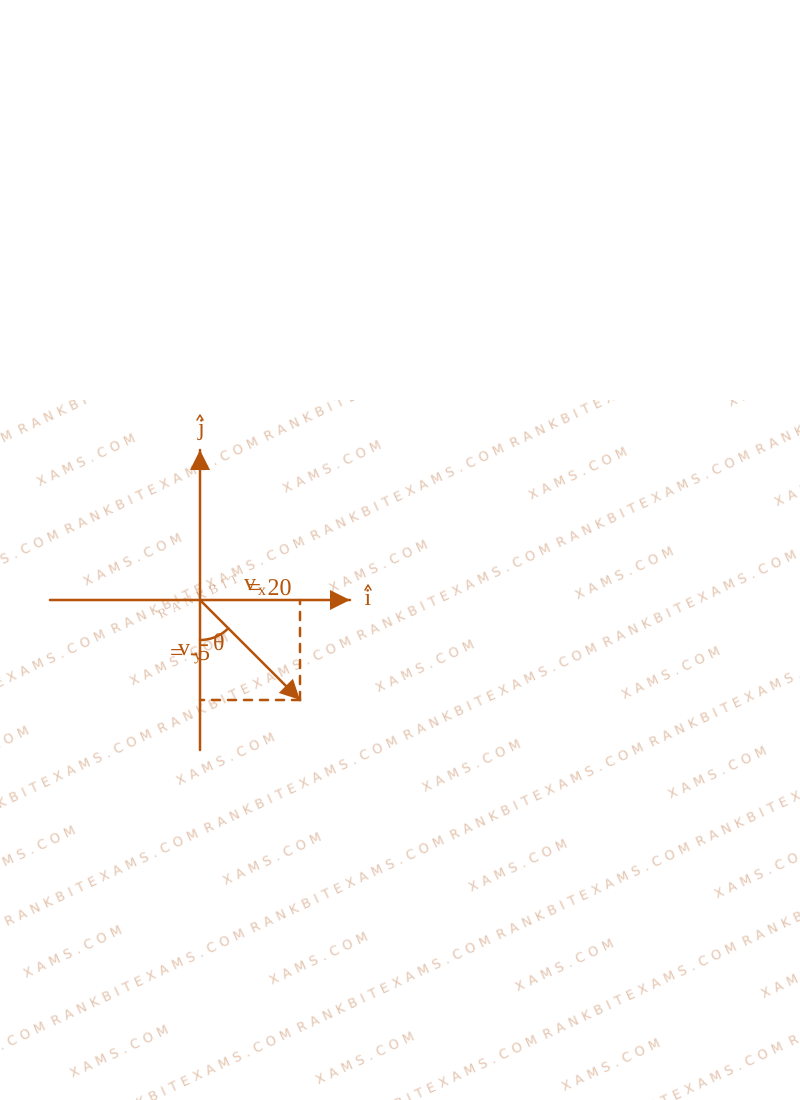
Direction analysis: Velocity vector components angle calculation Q8vₓ = 20$v_x = 20$ along +x$+x$ axis, vy = -5$v_y = -5$ along -y$-y$ axis.
Let θ$\theta$ be the angle made with the negative Y$Y$-axis:
Always read the reference axis carefully in direction questions. Here, the angle is measured from the negative Y$Y$-axis, making θ = vₓ / |vy|$\tan\theta = v_x / |v_y|$.
Chapter Mix
Class 11 Physics: Motion in a Plane
Q9jee_main_2025_28_jan_eveningVelocity Time Graphs
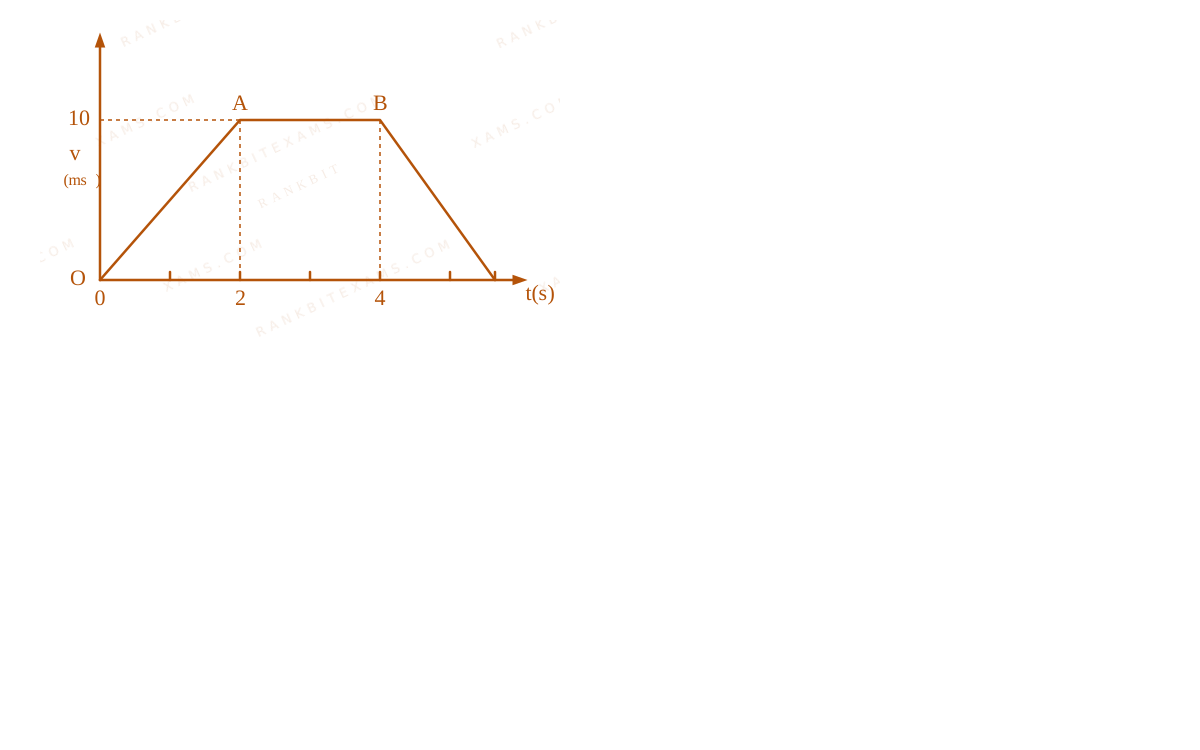
The velocity-time graph of an object moving along a straight line is shown in figure. What is the distance covered by the object between t = 0$t = 0$ to t = 4s$t = 4s$ ?
The velocity-time profile tracking motion across consecutive geometric shapes up to 4 seconds.
A.30m$30\mathrm{m}$
B.10m$10\mathrm{m}$
C.13m$13\mathrm{m}$
D.11m$11\mathrm{m}$
Solution
Related Formula
The distance traveled by an object equals the total area enclosed under its velocity-time (v-t$v-t$) plot along the time axis, treating all regional boundaries as strictly positive metrics:
From the geometric grid profile between t = 0$t = 0$ and t = 4 s$t = 4\text{ s}$:
First Region (t=0$t=0$ to t=2 s$t=2\text{ s}$): Forms a \right-angled \triangle with base = 2 s$= 2\text{ s}$ and peak height = 10 ms⁻¹$= 10\text{ ms}^{-1}$.
Second Region (t=2$t=2$ to t=4 s$t=4\text{ s}$): Forms a standard rectangle with width = (4 - 2) = 2 s$= (4 - 2) = 2\text{ s}$ and height = 10 ms⁻¹$= 10\text{ ms}^{-1}$.
Always differentiate between distance and displacement on graph tracks. Displacement treats components below the axis as negative fields, while distance calculates absolute geometric magnitudes without direction.
Chapter Mix
Class 11 Physics: Motion in a Straight Line
Qjee_main_2025_29_jan_morningProjectile Motion
Two projectiles are fired with same initial speed from same point on ground at angles of (45° - α)$(45^{\circ} - \alpha)$ and (45° + α)$(45^{\circ} + \alpha)$ , respectively, with the horizontal direction. The ratio of their maximum heights attained is :
For complementary angles shifted symmetric to 45°$45^{\circ}$, ratios simplify cleanly via 2α$\sin 2\alpha$ identities.
Chapter Mix
Class 11 Physics: Motion in a Plane
Qjee_main_2025_29_jan_morningRelative Motion
The maximum speed of a boat in still water is 27 km/h$27 \, \text{km/h}$ . Now this boat is moving downstream in a river flowing at 9 km/h$9 \, \text{km/h}$ . A man in the boat throws a ball vertically upwards with speed of 10 m/s$10 \, \text{m/s}$ . Range of the ball as observed by an observer at rest on the river bank, is ________ cm. (Take g = 10 m/s²$g = 10 \, \text{m/s}^2$ )
Numerical Answer.Answer: 2000 to 2000
Solution
Related Formula
T = (2uy)/(g), R = vₓ · T$$T = \frac{2u_y}{g}, \quad R = v_x \cdot T$$
Core Logic
Relative range tracking frame vector
The total horizontal velocity components combine due to downstream motion addition
A particle moving in a circle of radius R$R$ with uniform speed takes time T$T$ to complete one revolution. If this particle is projected with the same speed at an angle θ$\theta$ to the horizontal, the maximum height attained by it is equal to 4R$4R$. The angle of projection θ$\theta$ is then given by:
Connect circular metrics directly to projectile parameters via velocity matching. Keeping terms unsimplified makes it easy to cancel common elements later.
Chapter Mix
Class 11 Physics: Motion in a Plane
More Motion in a Plane Questions — jee_main_2024_30_january_evening
Practice past-year questions one chapter at a time. Pick an exam → subject → chapter and get every PYQ for that topic — pulled together from all past papers — with the chapter's key formulas alongside.
.svg)
