JEE Main · Mathematics ↓ Falling

Integral Calculus appeared 62 times across 3 years — 7.2% of Mathematics. This question is from Definite Integration.

Year 2026 2025 2024 Total
Questions 18 26 18 62

Let f: R → R be a function defined f(x) = x(1 + x⁴)1/4 and g(x) = f(f(f(f(x)))). Then 18∫₀^ 2√(5) x² g(x) dx is

Solution & Explanation

Related Formula
Composite sequence relation: fⁿ(x) = x(1 + n x⁴)1/4
Core Logic

Evaluate the composition function step-by-step:

f(f(x)) = f(x)(1 + f(x)⁴)1/4 = x(1+x⁴)1/4(1 + (x⁴)/(1+x⁴))1/4 = x(1 + 2x⁴)1/4

Continuing this pattern n times yields:

fⁿ(x) = x(1 + nx⁴)1/4

Thus, g(x) = f(f(f(f(x)))) = f⁴(x) = x(1 + 4x⁴)1/4.

Step 1: Setting up the Integral

The required integral is:

I = 18∫₀^ 2√(5) x³(1 + 4x⁴)1/4 dx

We use substitution to solve this. Let 1 + 4x⁴ = t⁴. Differentiating gives:

16x³ dx = 4t³ dt ⇒ x³ dx = (1)/(4) t³ dt
Step 2: Modifying limits and Solving

Change limits: When x = 0, 1 + 0 = t⁴ ⇒ t = 1. When x = (2√(5))1/2, x⁴ = (2√(5))² = 20. Then 1 + 4(20) = 81 = t⁴ ⇒ t = 3.

Substitute into the integral:

I = 18 ∫₁³ ((1)/(4) t³ dt)/(t) I = (18)/(4) ∫₁³ t² dt = (9)/(2) [ (t³)/(3) ]₁³ I = (9)/(2) · (1)/(3) [t³]₁³ = (3)/(2) (27 - 1) = (3)/(2) (26) = 39
Pattern Recognition

Repeated compositions of x(1+cx^k)-1/k follow a strict linearity in the coefficient of x^k. Here, 4 compositions cleanly changed the x⁴ coefficient from 1 to 4, preparing a perfect variable substitution.

Chapter Mix

Class 11 Maths: Functions Class 12 Maths: Integral Calculus

Reference Study Guides

More Integral Calculus Previous-Year Questions — Page 7

Q75 jee_main_2025_03_april_morning Area Under Bounded Curves
The area of the region bounded by the curve y = |x|, x|x - 2|, the x-axis and the lines x = -2 and x = 4 is equal to:
Numerical Answer. Answer: 12 to 12

Solution

Related Formula

Definite integration geometry area: Split boundary zones around intersections where functional dominant switches occur.
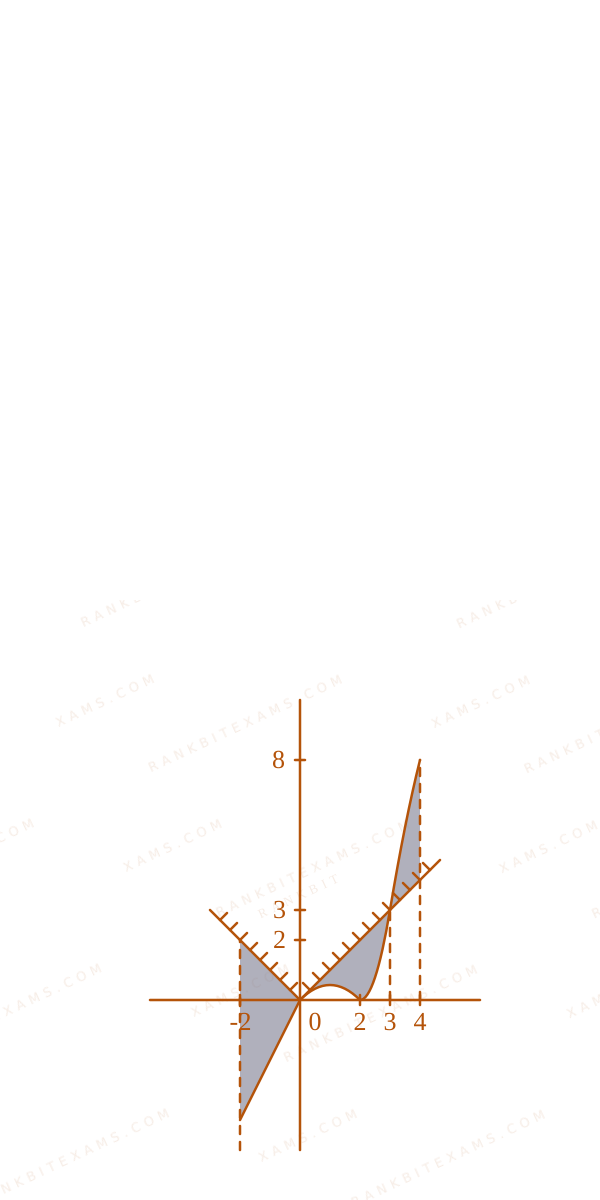
Area Under Bounded Curves diagram for Q75 - JEE Main 2025 Morning

Core Logic

Analyze intersection points between y₁ = |x| and y₂ = x|x-2| across required integration span regions:

  • For x in [-2, 0]: |x| = -x and x|x-2| = -x(2-x) = x² - 2x. Max curve tracks through distinct segments.
  • For positive sectors, compute intersections: x = x(2-x) x = 1 or x=0. Also check switch locations where graphs swap dominance.
Step 1: Setting up separate area integral blocks

Using geometric area partitions calculated across continuous regions:

Area = (1)/(2) × 2 × 2 + (1)/(2) × 3 × 3 + (1)/(2) × 1 × 11 = 12

Alternatively, splitting the boundary metrics via continuous definite limits yields identical whole tracking blocks matching exactly to 12 total units.

Pattern Recognition

Plotting multiple curves dynamically highlights dominance shifts quickly. Computing distinct straight triangular chunks saves valuable integration time.

Chapter Mix

Class 12 Mathematics: Integrals (Application of Integrals)
Q68 jee_main_2025_04_april_evening Properties of Definite Integrals
Let f(x) + 2f((1)/(x)) = x² + 5 and 2 g (x) - 3 g ((1)/(2)) = x, x > 0. If α = ∫_ 1 ^ 2 f (x) d x, and β = ∫_ 1 ^ 2 g (x) d x, then the value of 9α + β is:
  • A. 1
  • B. 0
  • C. 10
  • D. 11

Solution

Core Logic

We have two functional equations to solve before integrating.

Equation 1: f(x) + 2f((1)/(x)) = x² + 5 Replace x with (1)/(x):

f((1)/(x)) + 2f(x) = (1)/(x²) + 5

Multiplying this new equation by 2 and subtracting the original Equation 1 eliminates the f((1)/(x)) term:

4f(x) + 2f((1)/(x)) - (f(x) + 2f((1)/(x))) = 2((1)/(x²) + 5) - (x² + 5) 3f(x) = (2)/(x²) - x² + 5 f(x) = (2)/(3x²) - (x²)/(3) + (5)/(3)
Step 1: Finding alpha

Integrate f(x) from 1 to 2:

α = ∫₁² ( (2)/(3x²) - (x²)/(3) + (5)/(3) ) dx = [ -(2)/(3x) - (x³)/(9) + (5x)/(3) ]₁² α = ( -(1)/(3) - (8)/(9) + (10)/(3) ) - ( -(2)/(3) - (1)/(9) + (5)/(3) ) = (19)/(9) - (8)/(9) = (11)/(9)

Thus, 9α = 11.

Step 2: Solving for g(x) and finding beta

We are given 2g(x) - 3g((1)/(2)) = x. Substitute x = (1)/(2):

2g((1)/(2)) - 3g((1)/(2)) = (1)/(2) -g((1)/(2)) = (1)/(2) g((1)/(2)) = -(1)/(2)

Substitute this constant value back into the original equation:

2g(x) - 3(-(1)/(2)) = x 2g(x) + (3)/(2) = x g(x) = (x)/(2) - (3)/(4)

Now find β:

β = ∫₁² ( (x)/(2) - (3)/(4) ) dx = [ (x²)/(4) - (3x)/(4) ]₁² = ( 1 - (3)/(2) ) - ( (1)/(4) - (3)/(4) ) = -(1)/(2) - (-(1)/(2)) = 0
Step 3: Calculating 9alpha + beta

Combining our values:

9α + β = 11 + 0 = 11
Pattern Recognition

Functional equations involving x → (1)/(x) are easily solved by treating the swapped forms as a system of linear equations, allowing direct isolation of the underlying function.

Chapter Mix

Class 12 Mathematics: Definite Integrals Class 12 Mathematics: Functional Equations

Q72 jee_main_2025_04_april_evening Integration by Substitution
If ∫ (√(1 + x²) + x)¹⁰(√(1 + x²) - x)⁹dx = (1)/(m) (( 1 + x ^ 2 + x) ^ n (n 1 + x ^ 2 - x)) + C where C is the constant of integration and m,nin N, then m + n is equal to
Numerical Answer. Answer: 379 to 379

Solution

Core Logic

Let's simplify the integrand by rationalizing the denominator term block. Notice that:

(√(1+x²) - x)(√(1+x²) + x) = (1+x²) - x² = 1 1√(1+x²) - x = √(1+x²) + x

Substituting this back into the denominator expression column:

I = ∫ (√(1+x²) + x)¹⁰ · (√(1+x²) + x)⁹ dx = ∫ (√(1+x²) + x)¹⁹ dx
Step 1: Implementing the Substitution Path

Let t = √(1+x²) + x. Then:

dt = ( x√(1+x²) + 1 ) dx = ( x + √(1+x²)√(1+x²) ) dx = t√(1+x²) dx dx = √(1+x²)t dt

Since √(1+x²) + x = t and √(1+x²) - x = (1)/(t), adding both gives:

2√(1+x²) = t + (1)/(t) √(1+x²) = (1)/(2)(t + (1)/(t))

Thus, dx = (1)/(2t)(t + (1)/(t)) dt = (1)/(2)(1 + (1)/(t²)) dt.

Step 2: Integrating with respect to t

Substitute these back into the integral:

I = ∫ t¹⁹ · (1)/(2)(1 + (1)/(t²)) dt = (1)/(2) ∫ (t¹⁹ + t¹⁷) dt I = (1)/(2) ( t²⁰20 + t¹⁸18 ) + C = t¹⁸4 ( (t²)/(10) + (1)/(9) ) + C = t¹⁸360 (9t² + 10) + C
Step 3: Matching Form and Finding m + n

To match the template format, let's pull out a factor of t:

I = t¹⁹360 ( 9t + (10)/(t) ) + C = t¹⁹360 ( 9(√(1+x²)+x) + 10(√(1+x²)-x) ) + C I = (√(1+x²)+x)¹⁹360 ( 19√(1+x²) - x ) + C

Comparing this directly with the given answer format, we identify:

  • m = 360
  • n = 19
  • Computing m + n:

m + n = 360 + 19 = 379
Pattern Recognition

Expressions containing conjugate factors like √(1+x²) ± x frequently simplify under rationalization because their product equals 1. This dynamic quickly reduces fractional components into single power blocks.

Chapter Mix

Class 12 Mathematics: Indefinite Integrals

Q66 jee_main_2025_04_april_morning Properties of Definite Integrals
The value of ∫₋₁¹ (1 + √(|x| - x))e^x + (√(|x| - x))e-xe^x + e-x dx is equal to
  • A. 3 - 2√(2)3
  • B. 2 + 2√(2)3
  • C. 1 - 2√(2)3
  • D. 1 + 2√(2)3

Solution

Related Formula

King's property of definite integrals:

∫ₐb f(x)dx = ∫ₐb f(a+b-x)dx
Core Logic

Let the given integral be I. Apply King's property by substituting x → -x:

I = ∫₋₁¹ (1 + √(|x| + x))e-x + (√(|x| + x))exe-x + ex dx

Add both integral expressions 2I = I + I:

2I = ∫₋₁¹ (e^x + e-x) + (√(|x| - x) + √(|x| + x))(e^x + e-x)e^x + e-x dx 2I = ∫₋₁¹ (1 + √(|x| - x) + √(|x| + x)) dx
Step 1: Apply Symmetry Properties

The integrand is completely even. Hence, convert intervals:

2I = 2∫₀¹ (1 + √(|x| - x) + √(|x| + x)) dx

For x in [0,1], |x| = x √(|x| - x) = 0 and √(|x| + x) = √(2x):

I = ∫₀¹ (1 + √(2x)) dx
Step 2: Final Integration Execution
I = [ x + √(2) · x3/23/2 ]₀¹ = [ x + 2√(2)3x3/2 ]₀¹ I = 1 + 2√(2)3
Pattern Recognition

When functions involve combinations of exponential components (e^x, e-x) over symmetric boundaries, adding the variable reflection eliminates exponential fractions instantly.

Chapter Mix

Class 12 Mathematics: Definite Integration

Q57 jee_main_2025_07_april_evening Area Under Curves
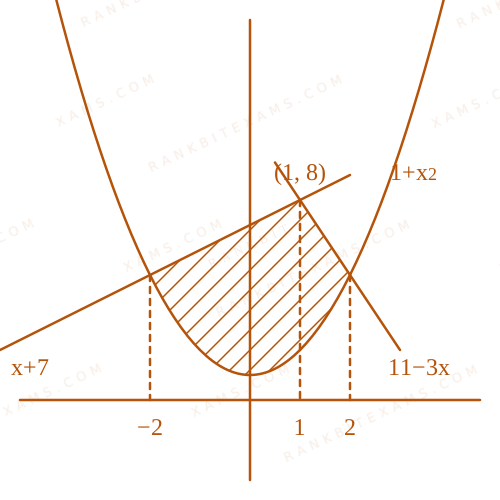
If the area of the region (x,y):1 + x²≤ y≤ x + 7,11 - 3x is A, then 3A is equal to
  • A. 50
  • B. 49
  • C. 46
  • D. 47

Solution

Related Formula

The area enclosed between upper bounding function yupper and lower function ylower is:

Area = ∫ₐb (yupper - ylower) dx
Core Logic

We need to find the intersection points of the curves to understand the x+7, 11-3x boundary transition:

  • x+7 = 11-3x 4x = 4 x = 1.
  • Hence, the line switches behavior at x=1.

  • Intersecting 1+x² with x+7:
x² - x - 6 = 0 (x-3)(x+2) = 0 x = -2 or x = 3
  • Intersecting 1+x² with 11-3x:
x² + 3x - 10 = 0 (x+5)(x-2) = 0 x = 2 or x = -5

Area Under Curves diagram for Q57 - JEE Main 2025 Evening

Step 1: Set up Integrals

The transition points show that from x = -2 to 1, the upper line is x+7, and from x = 1 to 2, the upper line is 11-3x.

A = ∫₋₂¹ ((x + 7) - (1 + x²)) dx + ∫₁² ((11 - 3x) - (1 + x²)) dx A = ∫₋₂¹ (x + 6 - x²) dx + ∫₁² (10 - 3x - x²) dx
Step 2: Integration Evaluation

Evaluating the first integral:

[ (x²)/(2) + 6x - (x³)/(3) ]₋₂¹ = ((1)/(2) + 6 - (1)/(3)) - (2 - 12 + (8)/(3)) = (37)/(6) - (-(22)/(3)) = (27)/(2)

Evaluating the second integral:

[ 10x - (3x²)/(2) - (x³)/(3) ]₁² = (20 - 6 - (8)/(3)) - (10 - (3)/(2) - (1)/(3)) = (34)/(3) - (49)/(6) = (19)/(6)

Total Area A:

A = (27)/(2) + (19)/(6) = (81 + 19)/(6) = (100)/(6) = (50)/(3)
Step 3: Calculate 3A

Multiplying the total area by 3:

3A = 3 · ((50)/(3)) = 50
Pattern Recognition

When a boundary contains a or component, always solve for their internal intersection first to identify the exact splitting point of your definite integrals.

Chapter Mix

Class 12 Mathematics: Integral Calculus

More Integral Calculus Questions — jee_main_2024_30_january_evening

Practice all Integral Calculus previous-year questions →

Rankbit System
JEE Physics: Waves (+15.5%) | Electrostatics: Concentric Shells (-29.7%) | Modern Physics: Photoelectric Clones (+34.2%) | Mathematics: Definite Integrals (+18.1%) | Chemistry: Coordination Splitting (-11.4%) | JEE Physics: Waves (+15.5%) | Electrostatics: Concentric Shells (-29.7%) | Modern Physics: Photoelectric Clones (+34.2%) | Mathematics: Definite Integrals (+18.1%) | Chemistry: Coordination Splitting (-11.4%)
