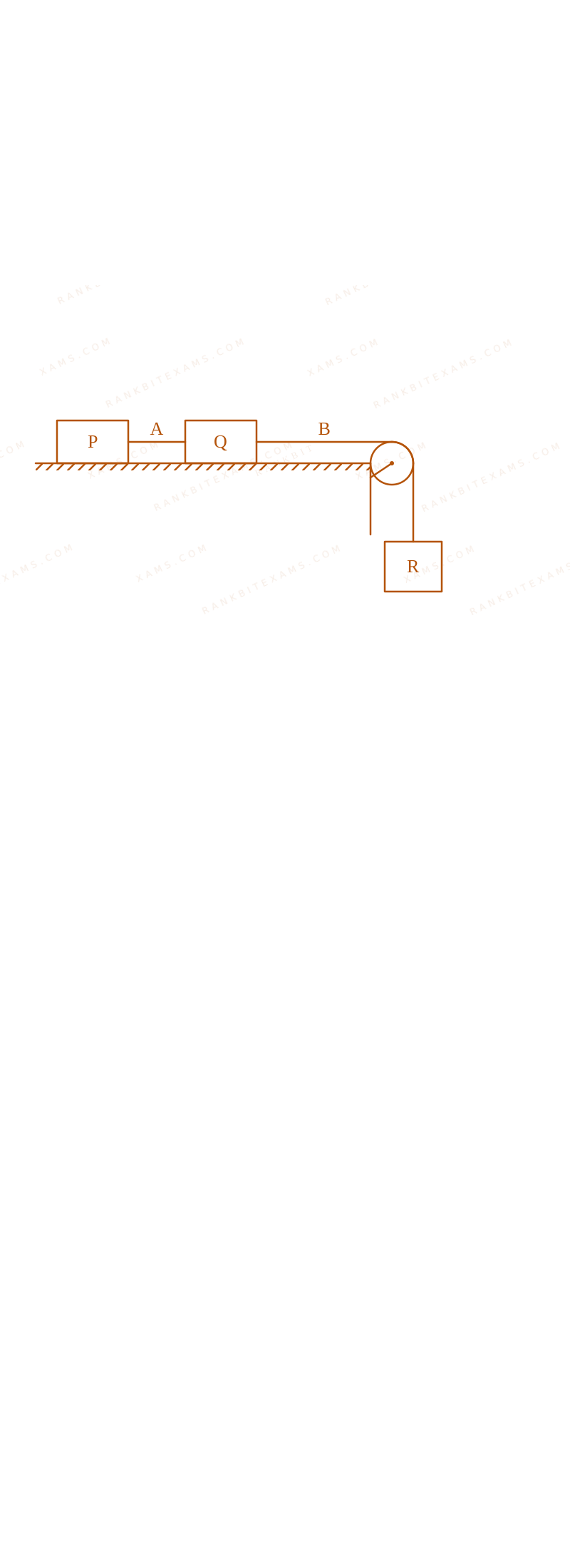
Each of three blocks P, Q and R shown in figure has a mass of 3 ~kg$3 \mathrm{~kg}$. Each of the wire A and B has cross-sectional area 0.005 ~cm²$0.005 \mathrm{~cm}^2$ and Young's modulus 2 × 10¹¹ Nm⁻²$2 \times 10^{11} \mathrm{Nm}^{-2}$. Neglecting friction, the longitudinal strain on wire B is _ _ _ _ × 10⁻⁴$\_ \_ \_ \_ \times 10^{-4}$. (Take g = 10 m / s²$g = 10 \mathrm{m / s^2}$)
Three 3kg blocks hanging and resting on table attached via wires A and B through a pulley.
Numerical Answer Type:
Enter a numerical valueAnswer: 2 to 2+4 marks
Solution & Explanation
Related Formula
a = Net Pulling ForceTotal Mass$$a = \frac{\text{Net Pulling Force}}{\text{Total Mass}}$$Strain = StressY = (T)/(AY)$$\text{Strain} = \frac{\text{Stress}}{Y} = \frac{T}{AY}$$
Core Logic
Three 3kg blocks hanging and resting on table attached via wires A and B through a pulley.
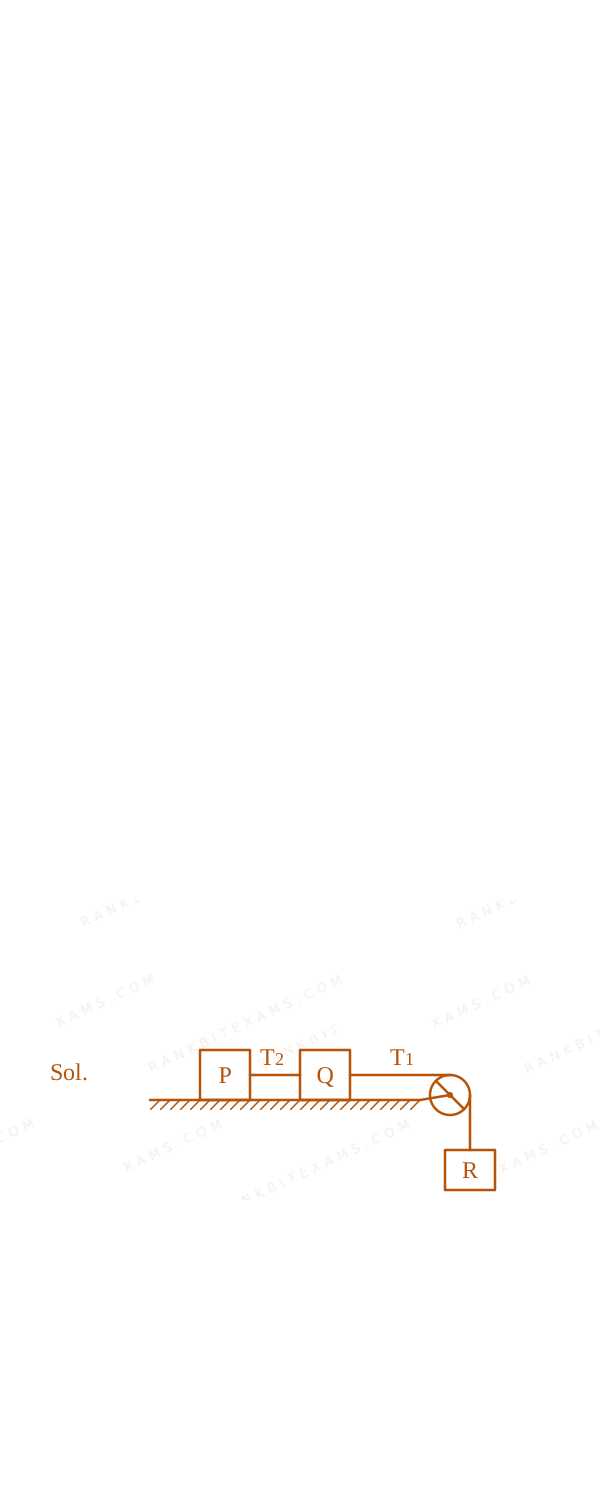
First, calculate the common acceleration of the system of three blocks. Block R provides the driving gravitational force (3g$3g$), pulling blocks P and Q. Then isolate the tension in wire B (T₁$T_1$) pulling block P. Finally, apply Young's modulus to find the strain.
Step 1: Find Acceleration
Total driving force = Weight of block R = 3 × 10 = 30 ~N$3 \times 10 = 30 \mathrm{~N}$.
Total mass being accelerated = mP + mQ + mR = 3 + 3 + 3 = 9 ~kg$m_P + m_Q + m_R = 3 + 3 + 3 = 9 \mathrm{~kg}$.
(Wait, the pdf solution says 30 - T₁ = 3 × a ⇒ T₁ = 20 ~N$30 - T_1 = 3 \times a \Rightarrow T_1 = 20 \mathrm{~N}$. Let's examine the arrangement from the image context. If block R hangs, wire A connects R to Q, and wire B connects Q to P. If B connects R and Q, it bears more tension. Let's trust the PDF calculation: The solution implies block P is the hanging block driving it? No, if 30 - T₁ = 3a$30 - T_1 = 3a$, then T₁$T_1$ is the tension supporting a hanging block. That means wire B is supporting a 3kg hanging block against gravity, or wire B connects Q and R. According to PDF logic: 30 - T₁ = 3 × (10/3) ⇒ T₁ = 20 N$30 - T_1 = 3 \times (10/3) \Rightarrow T_1 = 20 \mathrm{N}$. This means wire B is the vertical wire supporting block R.)
In multi-block connected systems, always find common 'a' first using Σ F / Σ m$\Sigma F / \Sigma m$. Then isolate the single block the wire directly pulls to find tension. Strain acts statically under that tension.
Chapter Mix
Class 11 Physics: Mechanical Properties of Solids
Class 11 Physics: Laws of Motion
More Mechanical Properties of Solids Previous-Year Questions — Page 5
Q58jee_main_2024_31_jan_morningBulk Modulus
The depth below the surface of sea to which a rubber ball be taken so as to decrease its volume by 0.02%$0.02\%$ is ________ m$\mathrm{m}$.
(Take density of sea water = 10³ kgm⁻³$= 10^3\mathrm{\ kgm^{-3}}$, Bulk modulus of rubber = 9 × 10⁸ Nm⁻²$= 9 \times 10^8\mathrm{\ Nm^{-2}}$, and g = 10 ms⁻²$g = 10\mathrm{\ ms^{-2}}$)
Numerical Answer.Answer: 18 to 18
Solution
Related Formula
β = (-Δ P)/((Δ V)/(V))$$\beta = \frac{-\Delta P}{\frac{\Delta V}{V}}$$Δ P = ρ g h$$\Delta P = \rho g h$$
Core Logic
The change in pressure Δ P$\Delta P$ is the hydrostatic pressure at depth h$h$.
Δ P = -β (Δ V)/(V)$$\Delta P = -\beta \frac{\Delta V}{V}$$ρ g h = -β (Δ V)/(V)$$\rho g h = -\beta \frac{\Delta V}{V}$$
Practice past-year questions one chapter at a time. Pick an exam → subject → chapter and get every PYQ for that topic — pulled together from all past papers — with the chapter's key formulas alongside.