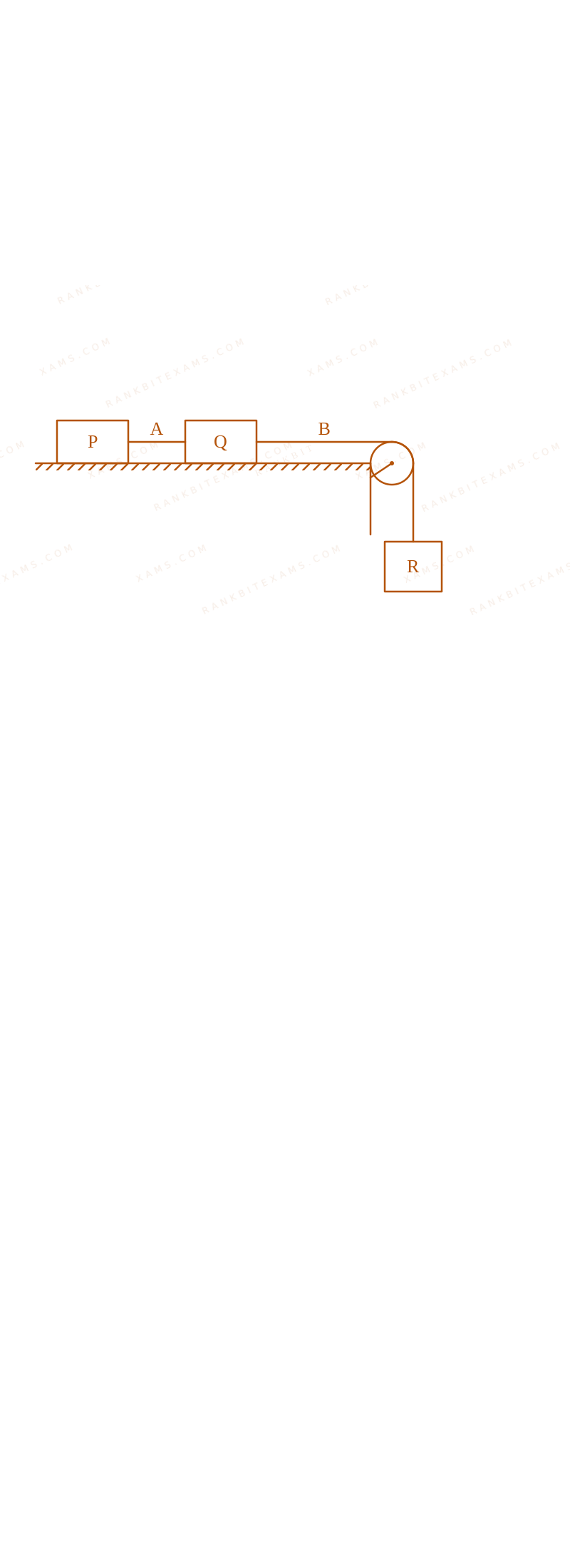
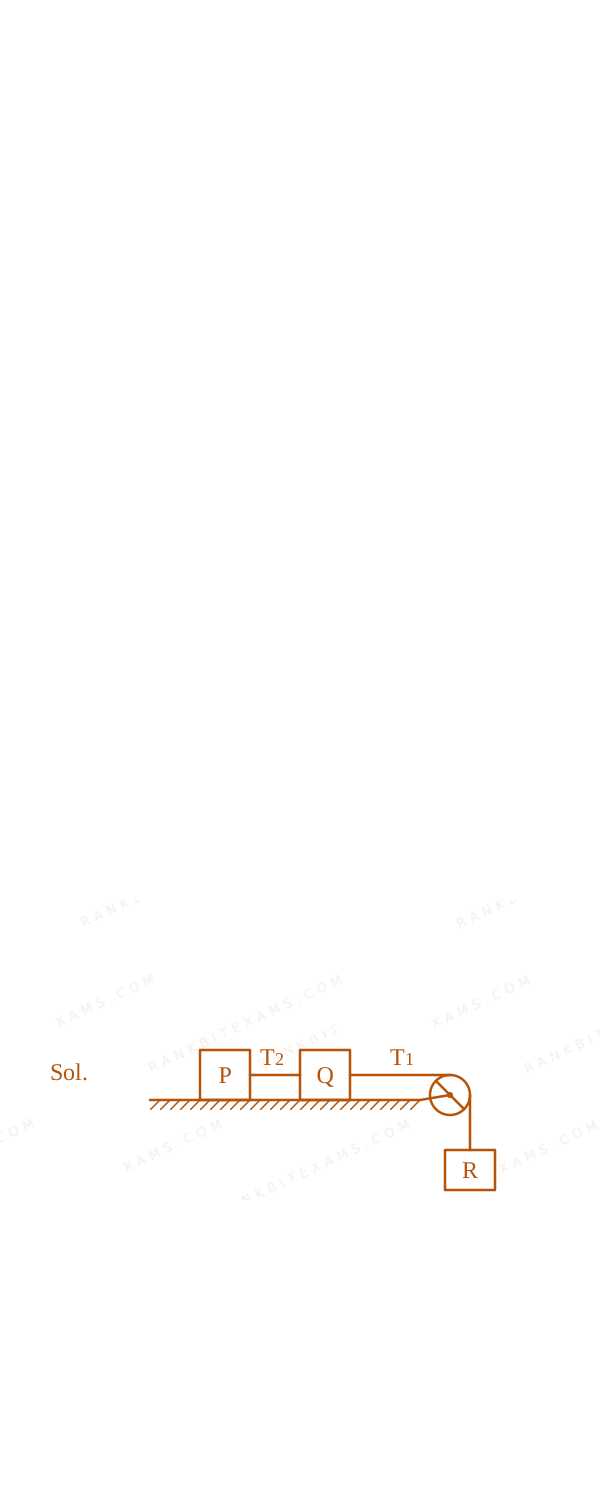
Each of three blocks P, Q and R shown in figure has a mass of 3 ~kg$3 \mathrm{~kg}$. Each of the wire A and B has cross-sectional area 0.005 ~cm²$0.005 \mathrm{~cm}^2$ and Young's modulus 2 × 10¹¹ Nm⁻²$2 \times 10^{11} \mathrm{Nm}^{-2}$. Neglecting friction, the longitudinal strain on wire B is _ _ _ _ × 10⁻⁴$\_ \_ \_ \_ \times 10^{-4}$. (Take g = 10 m / s²$g = 10 \mathrm{m / s^2}$)
Three 3kg blocks hanging and resting on table attached via wires A and B through a pulley.
Numerical Answer Type:
Enter a numerical valueAnswer: 2 to 2+4 marks
Solution & Explanation
Related Formula
a = Net Pulling ForceTotal Mass$$a = \frac{\text{Net Pulling Force}}{\text{Total Mass}}$$Strain = StressY = (T)/(AY)$$\text{Strain} = \frac{\text{Stress}}{Y} = \frac{T}{AY}$$
Core Logic
Three 3kg blocks hanging and resting on table attached via wires A and B through a pulley.
First, calculate the common acceleration of the system of three blocks. Block R provides the driving gravitational force (3g$3g$), pulling blocks P and Q. Then isolate the tension in wire B (T₁$T_1$) pulling block P. Finally, apply Young's modulus to find the strain.
Step 1: Find Acceleration
Total driving force = Weight of block R = 3 × 10 = 30 ~N$3 \times 10 = 30 \mathrm{~N}$.
Total mass being accelerated = mP + mQ + mR = 3 + 3 + 3 = 9 ~kg$m_P + m_Q + m_R = 3 + 3 + 3 = 9 \mathrm{~kg}$.
(Wait, the pdf solution says 30 - T₁ = 3 × a ⇒ T₁ = 20 ~N$30 - T_1 = 3 \times a \Rightarrow T_1 = 20 \mathrm{~N}$. Let's examine the arrangement from the image context. If block R hangs, wire A connects R to Q, and wire B connects Q to P. If B connects R and Q, it bears more tension. Let's trust the PDF calculation: The solution implies block P is the hanging block driving it? No, if 30 - T₁ = 3a$30 - T_1 = 3a$, then T₁$T_1$ is the tension supporting a hanging block. That means wire B is supporting a 3kg hanging block against gravity, or wire B connects Q and R. According to PDF logic: 30 - T₁ = 3 × (10/3) ⇒ T₁ = 20 N$30 - T_1 = 3 \times (10/3) \Rightarrow T_1 = 20 \mathrm{N}$. This means wire B is the vertical wire supporting block R.)
In multi-block connected systems, always find common 'a' first using Σ F / Σ m$\Sigma F / \Sigma m$. Then isolate the single block the wire directly pulls to find tension. Strain acts statically under that tension.
Chapter Mix
Class 11 Physics: Mechanical Properties of Solids
Class 11 Physics: Laws of Motion
More Mechanical Properties of Solids Previous-Year Questions — Page 2
Q22jee_main_2025_02_april_morningElastic Moduli
A steel wire of length 2~m$2\mathrm{~m}$ and Young's modulus 2.0× 10¹¹~N/m²$2.0\times 10^{11}\mathrm{~N/m}^2$ is stretched by a force. If Poisson's ratio and transverse strain for the wire are 0.2 and 10⁻³$10^{-3}$ respectively, then the elastic potential energy density of the wire is [value] × 10⁵$\text{[value]} \times 10^{5}$ (in SI units)
Numerical Answer.Answer: 25 to 25
Solution
Related Formula
σ = εtransverseεlongitudinal$$\sigma = \frac{\epsilon_{\text{transverse}}}{\epsilon_{\text{longitudinal}}}$$u = (1)/(2) Y εlongitudinal²$$u = \frac{1}{2} Y \epsilon_{\text{longitudinal}}^2$$
Expressing as x × 10⁵$x \times 10^5$, we have x = 25$x = 25$.
Step 1: Final Conclusion
The value of the coefficient is 25.
Pattern Recognition
Poisson's ratio is defined as the ratio of lateral/transverse strain to longitudinal strain. Use this to determine the longitudinal stretch, then apply the basic potential energy density formula (1)/(2) Y ε²$\frac{1}{2} Y \epsilon^2$ directly.
Two wires A and B are made of same material having ratio of lengths LALB = (1)/(3)$\frac{\mathrm{L}_{\mathrm{A}}}{\mathrm{L}_{\mathrm{B}}} = \frac{1}{3}$ and their diameters ratio dAdB = 2$\frac{\mathrm{d}_{\mathrm{A}}}{\mathrm{d}_{\mathrm{B}}} = 2$ . If both the wires are stretched using same force, what would be the ratio of their respective elongations?
A.1:6$1:6$
B.1:12$1:12$
C.3:4$3:4$
D.1:3$1:3$
Solution
Related Formula
Young's modulus Y$Y$ is defined as:
Y = StressStrain = (F / A)/(Δ L / L) Δ L = (F L)/(A Y)$$Y = \frac{\text{Stress}}{\text{Strain}} = \frac{F / A}{\Delta L / L} \implies \Delta L = \frac{F L}{A Y}$$
Area of cross-section of wire with diameter d$d$ is:
A = (π d²)/(4) Δ L = (4 F L)/(π d² Y)$$A = \frac{\pi d^2}{4} \implies \Delta L = \frac{4 F L}{\pi d^2 Y}$$
Core Logic
Since both wires are made of the same material (
$
Core Logic
Since both wires are made of the same material ($
Y_A = Y_B) and stretched with the same force ($) and stretched with the same force ($F_A = F_B):$):
$Δ L ∝ (L)/(d²)$\Delta L \propto \frac{L}{d^2}$
Sees: Same material, same stretching force. Shortcut: Elongation scales directly with length and inversely with the square of the diameter (radius). Thus, ratio is
$.
Pattern Recognition
Sees: Same material, same stretching force.
Shortcut: Elongation scales directly with length and inversely with the square of the diameter (radius). Thus, ratio is $
(1/3) / (2^2) = 1/12$.
Chapter Mix
Class 11 Physics: Mechanical Properties of Solids
Q3jee_main_2025_08_april_eveningYoung's Modulus
A 3~m$3\mathrm{~m}$ long wire of radius 3~mm$3\mathrm{~mm}$ shows an extension of 0.1~mm$0.1\mathrm{~mm}$ when loaded vertically by a mass of 50~kg$50\mathrm{~kg}$ in an experiment to determine Young's modulus. The value of Young's modulus of the wire as per this experiment is P × 10¹¹~N ⁻²$P \times 10^{11}\mathrm{~N}\cdot\mathrm{m}^{-2}$, where the value of P$P$ is:
(Take g = 3π~m/s²$g = 3\pi\mathrm{~m/s}^{2}$)
where,
Y$Y$ = Young's modulus
F = mg$F = mg$ = stretching force (load)
A = π r²$A = \pi r^2$ = cross-sectional area of the wire
L$L$ = original length of the wire
Δ L$\Delta L$ = extension produced
Core Logic
Given parameters:
Original length of wire, L = 3~m$L = 3\mathrm{~m}$
Radius of wire, r = 3~mm = 3 × 10⁻³~m$r = 3\mathrm{~mm} = 3 \times 10^{-3}\mathrm{~m}$
Mass loaded, m = 50~kg$m = 50\mathrm{~kg}$
Acceleration due to gravity, g = 3π~m/s²$g = 3\pi\mathrm{~m/s}^{2}$
Extension, Δ L = 0.1~mm = 10⁻⁴~m$\Delta L = 0.1\mathrm{~mm} = 10^{-4}\mathrm{~m}$
Substitute the values into the Young's modulus formula:
Comparing this with P × 10¹¹~N/m²$P \times 10^{11}\mathrm{~N/m}^{2}$:
P = 5$P = 5$
Pattern Recognition
Sees: Standard Young's modulus measurement.
Trap: Don't forget that the radius is in millimeters and the extension is in millimeters. Convert all units to SI systematically first.
Calculation Tip: The variable g = 3π$g = 3\pi$ is chosen deliberately to cancel the π$\pi$ in the area formula. Keep your eye open for these mathematical shortcuts! ✓
Chapter Mix
Class 11 Physics: Elasticity
Q5jee_main_2025_04_april_eveningElastic Moduli
A cylindrical rod of length 1 m and radius 4 cm is mounted vertically. It is subjected to a shear force of 10⁵$10^{5}$ N at the top. Considering infinitesimally small displacement in the upper edge, the angular displacement θ$\theta$ of the rod axis from its original position would be : (shear moduli, G=10¹⁰ N/m²$G=10^{10}\text{ N/m}^{2}$)
Shear strain definition is straightforwardly matching the geometry angle of shift. Avoid radius-to-diameter or unit mismatches.
Chapter Mix
Class 11 Physics: Mechanical Properties of Solids
Qjee_main_2025_04_april_morningShear Modulus of Elasticity
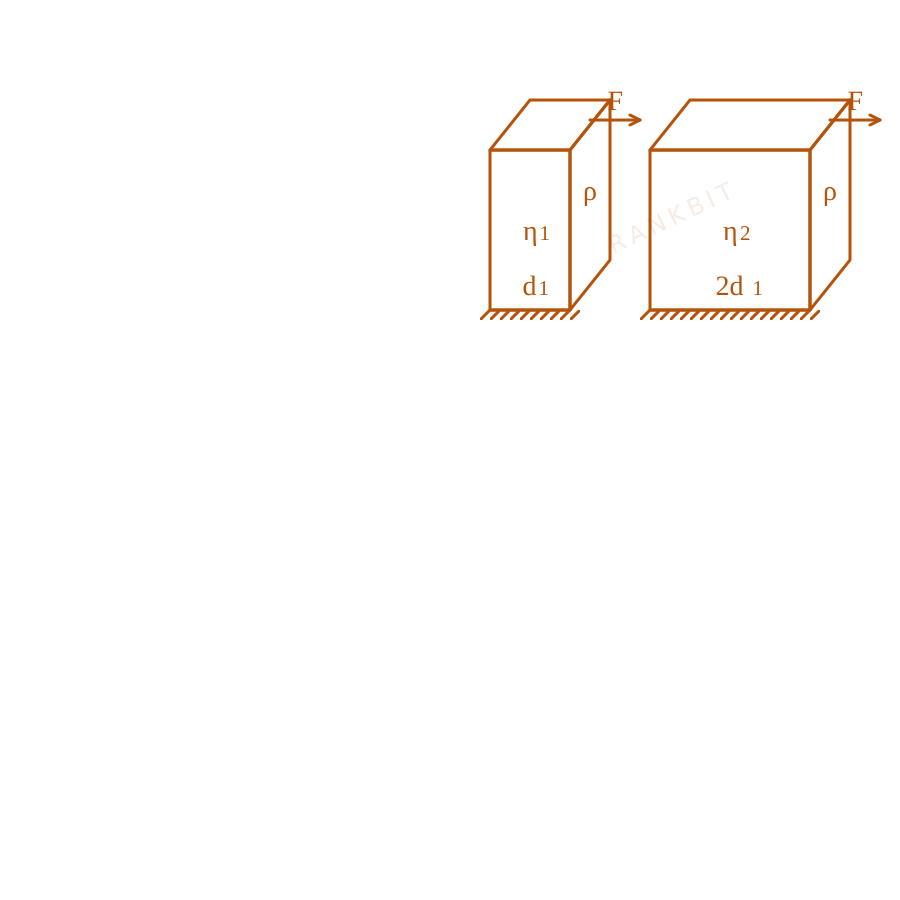
Two slabs with square cross section of different materials (1, 2) with equal sides (l$l$) and thickness d₁$d_{1}$ and d₂$d_{2}$ such that d₂ = 2d₁$d_{2} = 2d_{1}$ and l > d₂$l > d_{2}$. Considering lower edges of these slabs are fixed to the floor, we apply equal shearing force on the narrow faces. The angle of deformation is θ₂ = 2θ₁$\theta_{2} = 2\theta_{1}$. If the shear moduli of material 1 is 4 × 10⁹~N/m²$4 \times 10^{9}\mathrm{~N/m}^{2}$, then shear moduli of material 2 is x × 10⁹~N/m²$x \times 10^{9}\mathrm{~N/m}^{2}$, where value of x is
Comparing with η₂ = x × 10⁹ N/m²$\eta_2 = x \times 10^9\text{ N/m}^2$:
x = 1$x = 1$
Pattern Recognition
Shear stress is inversely proportional to the face area parallel to the applied shearing force (A = l · d$A = l \cdot d$). Doubling the slab thickness doubles the resisting contact area, halving the applied shear stress under identical lateral loading.
Evaluation Rubric / Model Answer
1
Chapter Mix
Class 11 Physics: Mechanical Properties of Solids
More Mechanical Properties of Solids Questions — jee_main_2024_30_jan_morning
Practice past-year questions one chapter at a time. Pick an exam → subject → chapter and get every PYQ for that topic — pulled together from all past papers — with the chapter's key formulas alongside.