The value of n→ ∞Σk = 1ⁿ(n³)/((n² + k²)(n² + 3k²)) is:

Solution & Explanation

Related Formula
n → ∞ (1)/(n) Σk=1ⁿ f((k)/(n)) = ∫₀¹ f(x) dx
Core Logic

Rewrite the series by extracting n⁴ from the denominator:

L = n→ ∞Σk = 1ⁿ(n³)/(n⁴(1 + (k²)/(n²))(1 + (3k²)/(n²))) L = n arrow ∞ (1)/(n) Σk = 1ⁿ (1)/((1 + (k²)/(n²))(1 + (3k²)/(n²)))

Using the limit of a sum, we convert this to a definite integral by substituting x = (k)/(n) and dx = (1)/(n):

I = ∫₀¹ (dx)/((1 + x²)(1 + 3x²))
Step 1: Partial Fractions

To integrate, we split the integrand using partial fractions. Notice that:

(1)/((1+x²)(1+3x²)) = (A)/(1+x²) + (B)/(1+3x²)

Let x² = t. Then (1)/((1+t)(1+3t)) = (A)/(1+t) + (B)/(1+3t).

1 = A(1+3t) + B(1+t)

If t = -1, 1 = A(-2) ⇒ A = -(1)/(2). If t = -1/3, 1 = B(2/3) ⇒ B = (3)/(2). So,

(1)/((1+x²)(1+3x²)) = (3/2)/(1+3x²) - (1/2)/(1+x²)

Alternatively, as formatted in the solution:

I = ∫₀¹ (dx)/(3(1 + x²)((1)/(3) + x²)) = ∫₀¹ (1)/(3) × (3)/(2) ((x² + 1) - (x² + (1)/(3)))/((1 + x²)(x² + (1)/(3))) dx = (1)/(2) ∫₀¹ [ 1x² + ( 1√(3))² - (1)/(1 + x²) ] dx
Step 2: Integration

Integrating both terms:

= (1)/(2) [ √(3) ⁻¹ (√(3) x) ]₀¹ - (1)/(2) ( ⁻¹ x )₀¹

Evaluating the limits:

= √(3)2 ((π)/(3)) - (1)/(2) ((π)/(4)) = π2 √(3) - (π)/(8) = 4π - √(3)π8√(3) = π(4 - √(3))8√(3)

Rationalizing and finding the common denominator to match options:

= 13 π8(4 √(3) + 3)

(Note: Multiply numerator and denominator by (4√(3)+3). Numerator becomes π(4-√(3))(4√(3)+3) = π(16√(3) + 12 - 12 - 3√(3)) = 13π√(3). Wait, let's verify: π2√(3) - (π)/(8) = π(4-√(3))8√(3). Let's rationalize the denominator in the given option 13π8(4√(3)+3) = 13π(4√(3)-3)8(48-9) = 13π(4√(3)-3)8(39) = π(4√(3)-3)24 = 4√(3)π24 - (3π)/(24) = π2√(3) - (π)/(8). Match is exact.)

Pattern Recognition

Divide numerator and denominator by the highest power of n to convert the series into the standard form of Riemann Sum (1)/(n) Σ f(k/n). Then use partial fractions for rational algebraic integrands.

Chapter Mix

Class 12 Maths: Integrals
Reference Study Guides

More Integrals Previous-Year Questions — Page 2

Q12 jee_main_2026_22_january_evening Area Under Curves
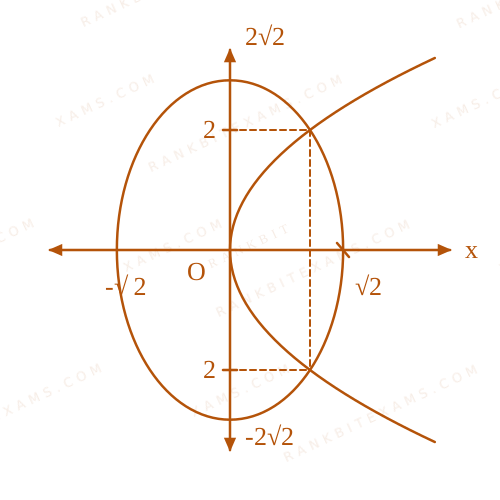
The area of the region A = (x,y) : 4x² + y² ≤ 8 and y² ≤ 4x is:
  • A. (π)/(2) + 2
  • B. π + (2)/(3)
  • C. π + 4
  • D. (π)/(2) + (1)/(3)

Solution

Related Formula

Area enclosed between curves is computed by breaking into integration regions at intersection points.

Core Logic

Area bounded by ellipse and parabola for Q12 - JEE Main 2026 Evening

Find intersection of 4x² + y² = 8 and y² = 4x:

4x² + 4x - 8 = 0 x² + x - 2 = 0 x = 1 (x > 0)

For x in [0, 1], region bounded by parabola y = ± 2√(x). For x in [1, √(2)], region bounded by ellipse y = ± √(8 - 4x²).

Step 1: Definite Integration
Area = 2 ∫₀¹ 2√(x) dx + 2 ∫₁√(2) √(8 - 4x²) dx = 4 [ (2)/(3) x3/2 ]₀¹ + 4 ∫₁√(2) √(2 - x²) dx = (8)/(3) + 4 · (1)/(2) [ x√(2-x²) + 2 ⁻¹( x√(2)) ]₁√(2) = (8)/(3) + 2 [ (0 + 2 · (π)/(2)) - (1 + 2 · (π)/(4)) ] = (8)/(3) + 2π - 2 - π = π + (2)/(3)

Area = π + (2)/(3) sq. units.

Pattern Recognition

Split area integration at intersection x=1 between parabola boundary and ellipse boundary.

Chapter Mix

Class 12 Maths: Integral Calculus

Q22 jee_main_2026_22_january_evening Definite Integral and King's Property
Let [·] be the greatest integer function. If α = ∫₀⁶⁴ (x1/3 - [x1/3]) dx, then (1)/(π) ∫₀απ ( ( ²θ)/( ⁶θ + ⁶θ) ) dθ is equal to ____.
Numerical Answer. Answer: 36 to 36

Solution

Related Formula

King's property of definite integrals: ∫ₐ^b f(x)dx = ∫ₐ^b f(a+b-x)dx.

Core Logic
  • Evaluate α:
∫₀⁶⁴ x1/3 dx = [ (3)/(4) x4/3 ]₀⁶⁴ = (3)/(4) (256) = 192 ∫₀⁶⁴ [x1/3] dx = ∫₀¹ 0 dx + ∫₁⁸ 1 dx + ∫₈²⁷ 2 dx + ∫₂₇⁶⁴ 3 dx = 0 + 7(1) + 19(2) + 37(3) = 7 + 38 + 111 = 156

Thus, α = 192 - 156 = 36.

Step 1: Evaluate Trigonometric Integral

Let E = (1)/(π) ∫₀36π ( ²θ)/( ⁶θ + ⁶θ) dθ = (36)/(π) ∫₀π ( ²θ)/( ⁶θ + ⁶θ) dθ

= (72)/(π) ∫₀π/2 ( ²θ)/( ⁶θ + ⁶θ) dθ

Let

Let $J = \int_{0}^{\pi/2} \frac{\sin^2\theta}{\sin^6\theta + \cos^6\theta} d\theta. By King's property,J = \int_{0}^{\pi/2} \frac{\cos^2\theta}{\sin^6\theta + \cos^6\theta} d\theta.

2J = ∫₀π/2 (1)/( ⁶θ + ⁶θ) dθ = ∫₀∞ (1 + λ²)/(λ⁴ - λ² + 1) dλ = (π)/(2) J = (π)/(4)

Wait, checking addition:

Wait, checking addition: $2J = \frac{\pi}{2} \implies J = \frac{\pi}{2}when evaluating\int_0^{\infty} \frac{1 + 1/\lambda^2}{\lambda^2 - 1 + 1/\lambda^2} d\lambda = \pi. SoJ = \frac{\pi}{2}.

Step 2: Final Calculation
E = (72)/(π) × (π)/(2) = 36$
Pattern Recognition

Break fractional part integral into piecewise constant steps; convert periodic trigonometric integral using symmetry.

Chapter Mix

Class 12 Maths: Integral Calculus

Q2 jee_main_2026_23_january_morning Indefinite Integration
Let f(x) = ∫ (2 - x²)e^x(√(1 + x))(1 - x)(3)/(2) dx. If f(0) = 0, then f((1)/(2)) is equal to:
  • A. √(3e) - 1
  • B. √(2e) + 1
  • C. √(2e) - 1
  • D. √(3e) + 1

Solution

Related Formula
∫ e^x [g(x) + g'(x)] dx = e^x g(x) + C
Core Logic

Rewrite the numerator (2 - x²) as (1 - x²) + 1 to split the integral into two recognizable parts matching the e^x [g(x) + g'(x)] form.

I = ∫ e^x ( (1 - x²) + 1√(1 + x) · (1 - x)3/2 ) dx = ∫ e^x ( 1 - x²√(1 + x) · (1 - x)3/2 + 1√(1 + x) · (1 - x)3/2 ) dx
Step 1: Simplify Terms

Simplify the first term:

1 - x²√(1 + x) · (1 - x)3/2 = (1 - x)(1 + x)√(1 + x) · (1 - x)√(1 - x) = √(1 + x)√(1 - x) = √((1 + x)/(1 - x))

Now verify if the derivative of g(x) = √((1 + x)/(1 - x)) matches the second term.

g'(x) = 12√((1+x)/(1-x)) · ((1-x)(1) - (1+x)(-1))/((1-x)²) = √(1-x)2√(1+x) · (2)/((1-x)²) = 1√(1+x) · (1-x)3/2

This perfectly matches the second term. Thus, the integral evaluates to:

f(x) = e^x √((1 + x)/(1 - x)) + C
Step 2: Apply Boundary Conditions

Given f(0) = 0:

e⁰ √((1 + 0)/(1 - 0)) + C = 0 ⇒ 1 + C = 0 ⇒ C = -1

So, f(x) = e^x √((1 + x)/(1 - x)) - 1.

Step 3: Evaluate at x = 1/2
f((1)/(2)) = e1/2 √((1 + 1/2)/(1 - 1/2)) - 1 = e1/2 √((3/2)/(1/2)) - 1

= √(3e) - 1

Pattern Recognition

Any integral involving e^x multiplied by an algebraic fraction heavily signals the use of ∫ e^x [g(x) + g'(x)] dx. Breaking the numerator into (1-x²) + 1 is the classic key to unlock this.

Chapter Mix

Class 12 Maths: Integrals

Q10 jee_main_2026_23_january_morning Definite Integration Properties
The value of the integral ∫ (π)/(24)(5π)/(24) dx1+3√( 2x) is:
  • A. (π)/(12)
  • B. (π)/(18)
  • C. (π)/(6)
  • D. (π)/(3)

Solution

Related Formula
∫ₐ^b f(x) dx = ∫ₐ^b f(a + b - x) dx (King's Property)
Core Logic

Let I = ∫(π)/(24)(5π)/(24) dx1+3√( 2x) (1) Apply King's property. Here a + b = (π)/(24) + (5π)/(24) = (6π)/(24) = (π)/(4). Replace x with (π)/(4) - x:

I = ∫(π)/(24)(5π)/(24) dx1+3√( 2((π)/(4) - x))
Step 1: Apply Trigonometric Identity

Notice that 2((π)/(4) - x) = ((π)/(2) - 2x) = 2x. So, I = ∫(π)/(24)(5π)/(24) dx1+3√( 2x). Convert 2x to (1)/( 2x):

I = ∫(π)/(24)(5π)/(24) 3√( 2x)3√( 2x)+1 dx (2)
Step 2: Add the Integrals

Add equations (1) and (2):

2I = ∫(π)/(24)(5π)/(24) 1 + 3√( 2x)1 + 3√( 2x) dx = ∫(π)/(24)(5π)/(24) (1) dx 2I = [ x ](π)/(24)(5π)/(24) = (5π)/(24) - (π)/(24) = (4π)/(24) = (π)/(6) I = (1)/(2) ( (π)/(6) ) = (π)/(12)
Pattern Recognition

Limits of π/24 and 5π/24 add up to π/4. When dealing with (2x), multiplying by 2 transforms this upper/lower sum to π/2, establishing the classic / symmetry map triggered by King's Property.

Chapter Mix

Class 12 Maths: Integrals

Q14 jee_main_2026_23_january_evening Integration by Substitution
Let I(x) = ∫ 3dx(4x + 6)( 4x² + 8x + 3) and I(0) = √(3)4 + 20. If I((1)/(2)) = a√(2)b + c, where a, b, c in N, (a,b) = 1, then a + b + c is equal to :
  • A. 29
  • B. 28
  • C. 31
  • D. 30

Solution

Related Formula
∫ xⁿ dx = xⁿ⁺¹n+1 + c

For integrals containing linear terms multiplied by the root of a quadratic, use the standard substitution L = (1)/(t).

Core Logic

Let 4x + 6 = (1)/(t) x = (1/t - 6)/(4). Differentiating, 4 dx = -(1)/(t²) dt dx = -(dt)/(4t²). We also need to map the quadratic part 4x² + 8x + 3 = 4(x² + 2x + 1) - 1 = 4(x+1)² - 1.

Substitute x+1 = (1/t - 6)/(4) + 1 = (1/t - 2)/(4):

4(x+1)² - 1 = 4((1/t - 2)/(4))² - 1 = ((1-2t)²)/(4t²) - 1

The integral becomes:

I(x) = ∫ 3 (-(dt)/(4t²))((1)/(t))√(((1-2t)²)/(4t²) - 1)
Step 1: Simplify Integral
I(x) = -(3)/(4) ∫ dtt √((1 - 4t + 4t² - 4t²)/(4t²)) I(x) = -(3)/(4) ∫ dtt √(1-4t)2t I(x) = -(3)/(2) ∫ dt√(1-4t) I(x) = -(3)/(2) (1-4t)1/2(1/2)(-4) + C = (3)/(4) √(1-4t) + C

Substituting back t = (1)/(4x+6):

I(x) = (3)/(4) √(1 - (4)/(4x+6)) + C = (3)/(4) √((4x+2)/(4x+6)) + C
Step 2: Final Calculation

Given I(0) = √(3)4 + 20:

I(0) = (3)/(4)√((2)/(6)) + C = (3)/(4) 1√(3) + C = √(3)4 + C

Thus, C = 20.

Now, evaluate I(1/2):

I((1)/(2)) = (3)/(4)√((4(1/2)+2)/(4(1/2)+6)) + 20 = (3)/(4)√((4)/(8)) + 20 = (3)/(4) 1√(2) + 20 = 3√(2)8 + 20

Comparing with a√(2)b + c, we get a=3, b=8, c=20. (3,8) = 1, condition is met.

a + b + c = 3 + 8 + 20 = 31
Pattern Recognition

The integral format ∫ dx(ax+b)√(px²+qx+r) classically demands substituting the linear outer piece as ax+b = 1/t.

Chapter Mix

Class 12 Maths: Indefinite Integration

More Integrals Questions — jee_main_2024_30_jan_morning

Practice all Integrals previous-year questions →

Rankbit System
JEE Physics: Waves (+15.5%) | Electrostatics: Concentric Shells (-29.7%) | Modern Physics: Photoelectric Clones (+34.2%) | Mathematics: Definite Integrals (+18.1%) | Chemistry: Coordination Splitting (-11.4%) | JEE Physics: Waves (+15.5%) | Electrostatics: Concentric Shells (-29.7%) | Modern Physics: Photoelectric Clones (+34.2%) | Mathematics: Definite Integrals (+18.1%) | Chemistry: Coordination Splitting (-11.4%)