According to Molecular Orbital Theory (MOT), the number of molecular orbitals (MOs) formed is equal to the total number of atomic orbitals (AOs) combined.
Step 1: Counting atomic orbitals
For a single atom in the 2nd period, the valence shell has:
One 2s orbital
Three 2p orbitals (2pₓ, 2py, 2pz$2p_x, 2p_y, 2p_z$)
Total = 4 atomic orbitals per atom.
For a diatomic molecule, two such atoms combine. Total atomic orbitals = 4 × 2 = 8$4 \times 2 = 8$.
Step 2: Forming molecular orbitals
Combining these 8 atomic orbitals yields 8 molecular orbitals:
From 2s: σ₂ₛ$\sigma_{2s}$ and σ^*₂ₛ$\sigma^*_{2s}$ (2 MOs)
Keywords:#total number of molecular orbitals#JEE Main 2024 Morning Q85#Chemical Bonding and Molecular Structure JEE Main 2024#Molecular Orbital Theory JEE Main 2024
More Chemical Bonding and Molecular Structure Previous-Year Questions — Page 6
Q43jee_main_2025_24_jan_morningHybridization and Molecular Geometry
Which of the following statement is true with respect to H₂O, NH₃$\mathrm{H}_2\mathrm{O}, \mathrm{NH}_3$ and CH₄$\mathrm{CH}_4$ ?
A. The central atoms of all the molecules are sp³$\mathfrak{sp}^3$ hybridized.
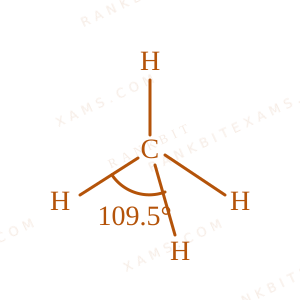
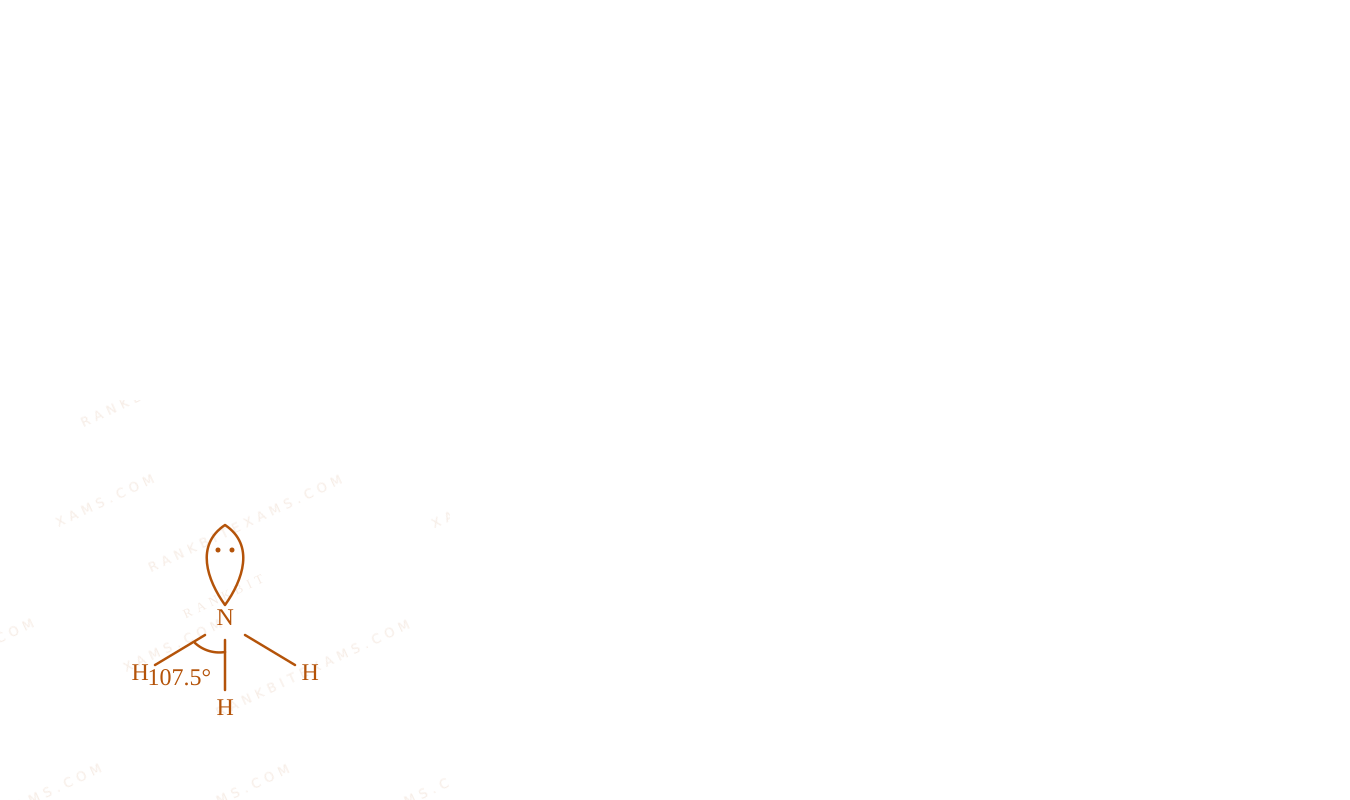
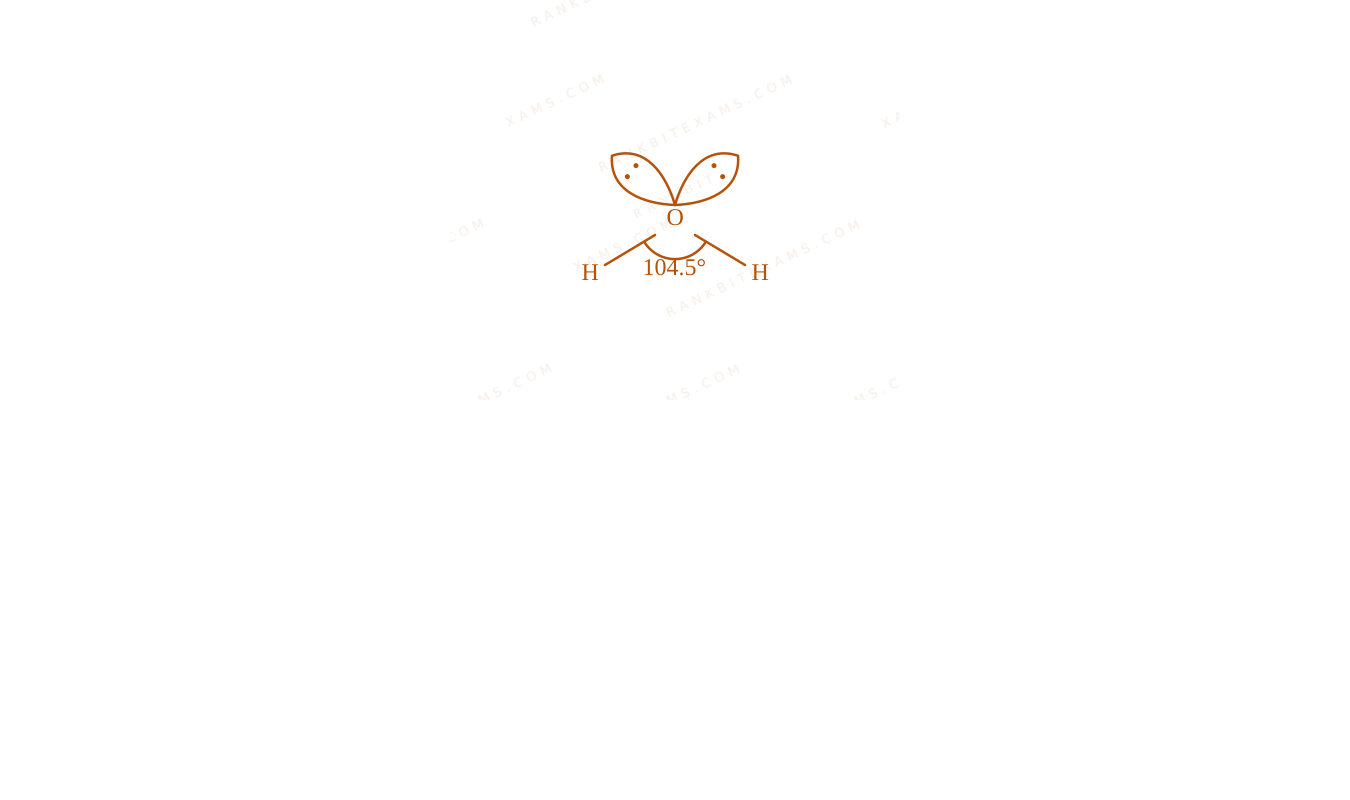
B. The H-O-H, H-N-H and H-C-H angles in the above molecules are 104.5°$104.5^{\circ}$ , 107.5°$107.5^{\circ}$ and 109.5°$109.5^{\circ}$ respectively.
C. The increasing order of dipole moment is CH₄ < NH₃ < H₂O$\mathrm{CH}_4 < \mathrm{NH}_3 < \mathrm{H}_2\mathrm{O}$ .
D. Both H₂O$\mathrm{H}_2\mathrm{O}$ and NH₃$\mathrm{NH}_3$ are Lewis acids and CH₄$\mathrm{CH}_4$ is a Lewis base
E. A solution of NH₃$\mathrm{NH}_3$ in H₂O$\mathrm{H}_2\mathrm{O}$ is basic. In this solution NH₃$\mathrm{NH}_3$ and H₂O$\mathrm{H}_2\mathrm{O}$ act as Lowry-Bronsted acid and base respectively.
Choose the correct answer from the options given below:
A. A, B and C only
B. C, D and E only
C. A, D and E only
D. A, B, C and E only
Solution
Core Logic
Analyzing each statement individually:
Statement A is true: The central atoms (O, N, C$O, N, C$) all possess an electron steric number equal to 4, indicating sp³$\mathfrak{sp}^3$ hybridization state pathways.
Statement B is true: Due to valence shell electron pair repulsions, the bond angles decrease from the ideal tetrahedral angle (109.5°$109.5^{\circ}$ in CH₄$CH_4$, Water molecule structural bond configuration shape representation) as lone pairs are added (107.5°$107.5^{\circ}$ in NH₃$NH_3$ with 1 lone pair, Water molecule structural bond configuration shape representation; 104.5°$104.5^{\circ}$ in H₂O$H_2O$ with 2 lone pairs, Water molecule structural bond configuration shape representation).
Statement C is true: The dipole moment increases alongside central atom electronegativity and asymmetric lone pair configurations, following the sequence CH₄ (0 D) < NH₃ (1.47 D) < H₂O (1.85 D)$\mathrm{CH}_4 (0\text{ D}) < \mathrm{NH}_3 (1.47\text{ D}) < \mathrm{H}_2\mathrm{O} (1.85\text{ D})$.
Pattern Recognition
Lone pairs repel bonding electron pairs more strongly than bonding pairs repel each other, systematically compressing adjacent bond angles.
Chapter Mix
Class 11 Chemistry: Chemical Bonding and Molecular Structure
Q74jee_main_2024_01_february_morningIonic Character
Arrange the bonds in order of increasing ionic character in the molecules. LiF$LiF$, K₂O$K_2O$, N₂$N_2$, SO₂$SO_2$ and ClF₃$ClF_3$.
The ionic character of a bond is directly proportional to the electronegativity difference (Δ EN$\Delta EN$) between the two bonded atoms.
Larger Δ EN$\Delta EN \implies$ higher ionic character.
Step 1: Assess Electronegativity Differences
N₂$N_2$: Both atoms are Nitrogen. Δ EN = 0$\Delta EN = 0$. Purely covalent. (Lowest ionic character)
SO₂$SO_2$: Bond between S and O. Moderate Δ EN$\Delta EN$. Covalent with some polarity.
ClF₃$ClF_3$: Bond between Cl and F. Δ EN$\Delta EN$ is higher than S-O as F is the most electronegative element.
K₂O$K_2O$: Bond between K (alkali metal, very low EN) and O. Very high Δ EN$\Delta EN$. Ionic.
LiF$LiF$: Bond between Li (alkali metal) and F (highest EN). Maximum Δ EN$\Delta EN$ possible among these options. Most ionic.
Step 2: Order Derivation
Increasing order of ionic character (or Δ EN$\Delta EN$):
N₂ < SO₂ < ClF₃ < K₂O < LiF$N_2 < SO_2 < ClF_3 < K_2O < LiF$
Pattern Recognition
Homodiatomic (N₂$N_2$) is always 0% ionic. Alkali metal + Halogen (LiF$LiF$) represents the extreme of the ionic spectrum. Sorting non-metals by group distance yields the middle ranks.
Chapter Mix
Class 11 Chemistry: Chemical Bonding and Molecular Structure
Q85jee_main_2024_01_february_morningVSEPR Theory
The number of molecules/ion/s having trigonal bipyramidal shape is ....
PF₅$PF_5$, BrF₅$BrF_5$, PCl₅$PCl_5$, [PtCl₄]²⁻$[PtCl_4]^{2-}$, BF₃$BF_3$, Fe(CO)₅$Fe(CO)_5$
Numerical Answer.Answer: 3 to 3
Solution
Core Logic
Using VSEPR theory to find the hybridization and shape:
PF₅$PF_5$: P has 5 valence electrons, forms 5 single bonds with F. Steric number = 5 (sp3d). 0 lone pairs. Shape = Trigonal bipyramidal.
BrF₅$BrF_5$: Br has 7 valence electrons, forms 5 single bonds, 1 lone pair. Steric number = 6 (sp3d2). Shape = Square pyramidal.
PCl₅$PCl_5$: P has 5 valence electrons, 5 bonds, 0 lone pairs. Steric number = 5 (sp3d). Shape = Trigonal bipyramidal.
[PtCl₄]²⁻$[PtCl_4]^{2-}$: Pt²⁺$Pt^{2+}$ is a d⁸$d^8$ system. With Cl^-$Cl^-$ (but 4d/5d transition metals always form low spin square planar complexes), it's dsp²$dsp^2$ hybridized. Shape = Square planar.
BF₃$BF_3$: B has 3 valence electrons, 3 bonds, 0 lone pairs. Steric number = 3 (sp2). Shape = Trigonal planar.
6. Fe(CO)₅$Fe(CO)_5$: Fe (d6s2 arrow$\rightarrow$ d8 under strong field CO$CO$). Carbonyls strongly prefer 5-coordinate trigonal bipyramidal geometry for d⁸$d^8$ (dsp³$dsp^3$ hybridization). Shape = Trigonal bipyramidal.
Step 1: Count Trigonal Bipyramidal Molecules
Molecules with trigonal bipyramidal shape:
PF₅$PF_5$
PCl₅$PCl_5$
Fe(CO)₅$Fe(CO)_5$
Total count = 3.
Pattern Recognition
Steric Number = 5 with 0 lone pairs ALWAYS yields Trigonal Bipyramidal geometry. Watch out for BrF₅$BrF_5$ which has 5 bonds but 1 lone pair (SN = 6, Square Pyramidal).
Chapter Mix
Class 11 Chemistry: Chemical Bonding and Molecular Structure
Class 12 Chemistry: Coordination Compounds
Qjee_main_2024_29_january_eveningMolecular Orbital Theory
The total number of anti bonding molecular orbitals, formed from 2s and 2p atomic orbitals in a diatomic molecule is ________.
Numerical Answer.Answer: 4 to 4
Solution
Related Formula
Total Atomic Orbitals Combinations = Bonding MOs + Antibonding MOs$$\text{Total Atomic Orbitals Combinations} = \text{Bonding MOs} + \text{Antibonding MOs}$$
Core Logic
When atomic orbitals combine, they form an equal number of molecular orbitals:
Two 2s$2s$ atomic orbitals combine to form 1 bonding orbital (σ₂ₛ$\sigma_{2s}$) and 1 antibonding orbital (σ^*₂ₛ$\sigma^*_{2s}$).
Six 2p$2p$ atomic orbitals combine to form 3 bonding orbitals (σ2pz, π2pₓ, π2py$\sigma_{2p_z}, \pi_{2p_x}, \pi_{2p_y}$) and 3 antibonding orbitals (σ^2pz, π^2pₓ, π^*2py$\sigma^_{2p_z}, \pi^_{2p_x}, \pi^*_{2p_y}$).
Step 1: Total Summation
Summing the antibonding orbitals from both subshells:
The linear combination of N$N$ atomic orbitals always yields exactly (N)/(2)$\frac{N}{2}$ antibonding molecular orbitals.
Chapter Mix
Class 11 Chemistry: Chemical Bonding and Molecular Structure
Qjee_main_2024_29_january_eveningDipole Moment
The total number of molecules with zero dipole moment among CH₄$\mathrm{CH}_4$, BF₃$\mathrm{BF}_3$, H₂O$\mathrm{H}_2\mathrm{O}$, HF$\mathrm{HF}$, NH₃$\mathrm{NH}_3$, CO₂$\mathrm{CO}_2$, and SO₂$\mathrm{SO}_2$ is ________.
NH₃$\text{NH}_3$: Trigonal pyramidal shape due to a lone pair μ ≠ 0$\implies \mu \neq 0$.
CO₂$\text{CO}_2$: Symmetrical linear structure (O=C=O$\mathrm{O}=\mathrm{C}=\mathrm{O}$) where dipoles cancel out μ = 0$\implies \mu = 0$.
SO₂$\text{SO}_2$: Bent angular geometry due to a lone pair μ ≠ 0$\implies \mu \neq 0$.
Step 1: Final Counting
The molecules with a net zero dipole moment are CH₄$\text{CH}_4$, BF₃$\text{BF}_3$, and CO₂$\text{CO}_2$. This gives a total count of 3.
Pattern Recognition
Molecules with a symmetrical arrangement of identical bonds and no lone pairs on the central atom (e.g., tetrahedral CH₄$\text{CH}_4$, trigonal planar BF₃$\text{BF}_3$, linear CO₂$\text{CO}_2$) always have a net dipole moment of zero.
Chapter Mix
Class 11 Chemistry: Chemical Bonding and Molecular Structure
More Chemical Bonding and Molecular Structure Questions — jee_main_2024_30_jan_morning
Practice past-year questions one chapter at a time. Pick an exam → subject → chapter and get every PYQ for that topic — pulled together from all past papers — with the chapter's key formulas alongside.