In a single slit diffraction pattern, a light of wavelength 6000 AA$6000\text{ \AA}$ is used. The distance between the first and third minima in the diffraction pattern is found to be 3 mm$3\text{ mm}$ when the screen is placed 50 cm$50\text{ cm}$ away from slits. The width of the slit is x × 10⁻⁴ m$x \times 10^{-4}\text{ m}$. The value of x$x$ is:
Numerical Answer Type:
Enter a numerical valueAnswer: 2 to 2+4 marks
Solution & Explanation
Related Formula
For single slit diffraction, the position of the n$n$-th minima on the screen is given by:
Comparing this with x × 10⁻⁴ m$x \times 10^{-4}\text{ m}$, we get:
x = 2$x = 2$
Diagram of single slit diffraction minima positions for Q57
Pattern Recognition
Distance between n$n$-th and m$m$-th minima is Δ y = (n-m)(λ D)/(b)$\Delta y = (n-m)\frac{\lambda D}{b}$. Since 3-1 = 2$3-1 = 2$, we get Δ y = 2(λ D)/(b)$\Delta y = 2\frac{\lambda D}{b}$. Substitute and scale variables directly.
Keywords:#distance between the first and third minima#JEE Main 2024 Evening Q57#Wave Optics JEE Main 2024#Diffraction Minima JEE Main 2024
More Wave Optics Previous-Year Questions — Page 7
Q41jee_main_2024_30_january_eveningPolarisation of Light
A beam of unpolarised light of intensity I₀$I_0$ is passed through a polaroid A$\mathrm{A}$ and then through another polaroid B$\mathrm{B}$ which is oriented so that its principal plane makes an angle of 45^°$45^\circ$ relative to that of A$\mathrm{A}$. The intensity of emergent light is :
When unpolarised light of intensity I₀$I_0$ passes through the first polaroid A$\mathrm{A}$, it becomes plane-polarised, and its intensity drops by exactly half.
I₁ = (I₀)/(2)$$I_1 = \frac{I_0}{2}$$
When this polarised light passes through the second polaroid B$\mathrm{B}$, the transmitted intensity is determined by Malus's Law.
Step 1: Apply Malus's Law
The angle between the principal planes of polaroids A$\mathrm{A}$ and B$\mathrm{B}$ is θ = 45^°$\theta = 45^\circ$.
Unpolarised to Polarised arrow I₀/2$\rightarrow I_0/2$.
Polarised to Polarised arrow I ²θ$\rightarrow I \cos^2\theta$.
At θ = 45^°$\theta = 45^\circ$, ²θ = 1/2$\cos^2\theta = 1/2$, resulting in a final intensity of I₀/4$I_0/4$.
Chapter Mix
Class 12 Physics: Wave Optics
Q40jee_main_2024_30_jan_morningDiffraction from a Single Slit
The diffraction pattern of a light of wavelength 400 nm diffracting from a slit of width 0.2 ~mm$0.2 \mathrm{~mm}$ is focused on the focal plane of a convex lens of focal length 100 ~cm$100 \mathrm{~cm}$. The width of the 1st$1^{\mathrm{st}}$ secondary maxima will be :
A.2 ~mm$2 \mathrm{~mm}$
B.2 ~cm$2 \mathrm{~cm}$
C.0.02 ~mm$0.02 \mathrm{~mm}$
D.0.2 ~mm$0.2 \mathrm{~mm}$
Solution
Related Formula
Width of secondary maxima = (λ D)/(a)$$\text{Width of secondary maxima} = \frac{\lambda D}{a}$$
Core Logic
In a single slit diffraction pattern, the linear width of any secondary maxima (fringe width of secondary bright bands) is given by W = (λ D)/(a)$W = \frac{\lambda D}{a}$, whereas the central maximum is double this width (2(λ D)/(a)$2\frac{\lambda D}{a}$).
Step 1: Parameter Identification
Given values:
Slit width, a = 0.2 × 10⁻³ ~m$a = 0.2 \times 10^{-3} \mathrm{~m}$
Wavelength, λ = 400 × 10⁻⁹ ~m$\lambda = 400 \times 10^{-9} \mathrm{~m}$
Distance to screen (focal length of the lens), D = 100 × 10⁻² ~m = 1 ~m$D = 100 \times 10^{-2} \mathrm{~m} = 1 \mathrm{~m}$
Remember to strictly distinguish between central maximum (2λ D/a$2\lambda D/a$) and secondary maxima (λ D/a$\lambda D/a$).
Chapter Mix
Class 12 Physics: Wave Optics

Q36jee_main_2024_31_jan_eveningPolarization by Reflection (Brewster's Law)
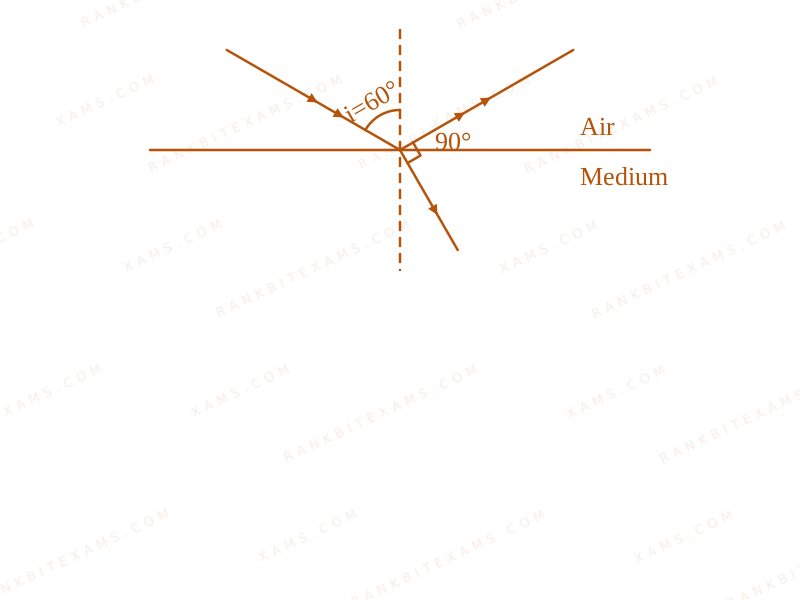
When unpolarized light is incident at an angle of 60°$60^{\circ}$ on a transparent medium from air. The reflected ray is completely polarized. The angle of refraction in the medium is
A.30°$30^{\circ}$
B.60°$60^{\circ}$
C.90°$90^{\circ}$
D.45°$45^{\circ}$
Solution
Related Formula
Brewster's Law states that at complete polarization upon reflection, the reflected and refracted rays are perpendicular to each other:
iₚ + r = 90°$$i_p + r = 90^{\circ}$$
Core Logic
The incident angle is given as iₚ = 60°$i_p = 60^{\circ}$.
At this angle, since the reflected ray is completely polarized, the geometry of Brewster's angle applies.
Polarization by Reflection (Brewster's Law) diagram for Q36 - JEE Main 2024 Evening
The condition "reflected ray is completely polarized" is a direct trigger for Brewster's Law (iₚ + r = 90°$i_p + r = 90^{\circ}$). No refractive index (μ$\mu$) calculation is needed if only the geometric angle is asked.
Chapter Mix
Class 12 Physics: Wave Optics
Class 12 Physics: Ray Optics and Optical Instruments
Q56jee_main_2024_31_jan_morningInterference Of Waves
Two waves of intensity ratio 1:9$1:9$ cross each other at a point. The resultant intensities at the point, when (a) Waves are incoherent is I₁$I_1$ (b) Waves are coherent is I₂$I_2$ and differ in phase by 60^°$60^\circ$. If (I₁)/(I₂) = (10)/(x)$\frac{I_1}{I_2} = \frac{10}{x}$ then x =$x =$
Practice past-year questions one chapter at a time. Pick an exam → subject → chapter and get every PYQ for that topic — pulled together from all past papers — with the chapter's key formulas alongside.