A simple harmonic oscillator has an amplitude A$A$ and time period 6π$6\pi$ second. Assuming the oscillation starts from its mean position, the time required by it to travel from x = A$x = A$ to x = √(3)2A$x = \frac{\sqrt{3}}{2}A$ will be (π)/(x)$\frac{\pi}{x}$ s, where x =$x =$ ________.
Numerical Answer Type:
Enter a numerical valueAnswer: 2 to 2+4 marks
Solution & Explanation
Related Formula
For a simple harmonic oscillator starting from the mean position at t = 0$t = 0$:
x(t) = A (ω t)$$x(t) = A \sin(\omega t)$$
where ω = (2π)/(T)$\omega = \frac{2\pi}{T}$ is the angular frequency.
Core Logic
Given:
Time period, T = 6π s ω = (2π)/(6π) = (1)/(3) rad/s$T = 6\pi\text{ s} \implies \omega = \frac{2\pi}{6\pi} = \frac{1}{3}\text{ rad/s}$
We need to find the time taken to travel from x = A$x = A$ to x = √(3)2A$x = \frac{\sqrt{3}}{2}A$.
Let's calculate the times from the mean position (x=0$x=0$) to both positions:
Time t₁$t_1$ to reach x = A$x = A$:
A = A (ω t₁) (ω t₁) = 1 ω t₁ = (π)/(2)$$A = A \sin(\omega t_1) \implies \sin(\omega t_1) = 1 \implies \omega t_1 = \frac{\pi}{2}$$
Time t₂$t_2$ to reach x = √(3)2A$x = \frac{\sqrt{3}}{2}A$:
Δ t = (π)/(6 × (1/3)) = (π)/(2) seconds$$\Delta t = \frac{\pi}{6 \times (1/3)} = \frac{\pi}{2}\text{ seconds}$$
Comparing this to (π)/(x) s$\frac{\pi}{x}\text{ s}$, we find:
x = 2$x = 2$
Phasor diagram for SHM positions for Q55
Pattern Recognition
Alternatively, using a phasor diagram, the angle swept in moving from A$A$ to √(3)2A$\frac{\sqrt{3}}{2}A$ is φ = (π)/(6)$\phi = \frac{\pi}{6}$. Therefore, Δ t = (φ)/(ω) = (π/6)/(1/3) = (π)/(2)$\Delta t = \frac{\phi}{\omega} = \frac{\pi/6}{1/3} = \frac{\pi}{2}$ s.
Chapter Mix
Class 11 Physics: Oscillations
More Oscillations Previous-Year Questions — Page 2
Q42jee_main_2026_28_january_eveningTwo Body Oscillator
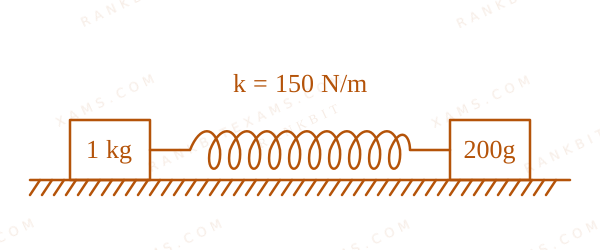
As shown in the figure, a spring is kept in a stretched position with some extension by holding the masses 1 kg$1 \text{ kg}$ and 0.2 kg$0.2 \text{ kg}$ with a separation more than spring natural length and are released. Assuming the horizontal surface to be frictionless, the angular frequency (in SI unit) of the system is :
Two masses attached to ends of a spring on a horizontal table.
A.30$30$
B.27$27$
C.20$20$
D.5$5$
Solution
Related Formula
ω = √((k)/(μ))$$\omega = \sqrt{\frac{k}{\mu}}$$
where μ$\mu$ is the reduced mass of the system given by:
For any two-body spring system free of external forces, always substitute the individual mass m$m$ with the reduced mass μ = (m₁ m₂)/(m₁ + m₂)$\mu = \frac{m_1 m_2}{m_1 + m_2}$ in the standard oscillator formula ω = √(k/m)$\omega = \sqrt{k/m}$.
Chapter Mix
Class 11 Physics: Oscillations
Qjee_main_2025_02_april_morningSuperposition of SHMs
A particle is subjected to two simple harmonic motions as:
x₁ = √(7) 5t~cm$$x_1 = \sqrt{7}\sin 5t\mathrm{~cm}$$
and
x₂ = 2√(7) (5t + (π)/(3))~cm$$x_2 = 2\sqrt{7}\sin\left(5t + \frac{\pi}{3}\right)\mathrm{~cm}$$
where x$x$ is displacement and t$t$ is time in seconds. The maximum acceleration of the particle is x × 10⁻²~ms⁻²$x \times 10^{-2}\mathrm{~ms}^{-2}$. The value of x$x$ is:
a = ω² A = (5)² × 0.07 = 25 × 0.07 = 1.75~ms⁻²$$a_{\max} = \omega^2 A = (5)^2 \times 0.07 = 25 \times 0.07 = 1.75\mathrm{~ms}^{-2}$$
Equating to x × 10⁻²~ms⁻²$x \times 10^{-2}\mathrm{~ms}^{-2}$:
1.75 = x × 10⁻² x = 175$$1.75 = x \times 10^{-2} \implies x = 175$$
Step 1: Final Conclusion
The value of x$x$ is 175.
Pattern Recognition
When superposing two SHMs of identical frequency, use the standard phasor addition formula to obtain the combined amplitude A$A$. Then compute maximum velocity v = ω A$v_{\max} = \omega A$ or maximum acceleration a = ω² A$a_{\max} = \omega^2 A$ directly.
Chapter Mix
Class 11 Physics: Simple Harmonic Motion
Q10jee_main_2025_29_jan_eveningEnergy in Simple Harmonic Motion
Two bodies A and B of equal mass are suspended from two massless springs of spring constant k₁$k_{1}$ and k₂$k_{2}$ , respectively. If the bodies oscillate vertically such that their amplitudes are equal, the ratio of the maximum velocity of A to the maximum velocity of B is:
A.√((k₁)/(k₂))$\sqrt{\frac{k_1}{k_2}}$
B.k₁k₂$\frac{\mathrm{k}_1}{\mathrm{k}_2}$
C.k₂k₁$\frac{\mathrm{k}_2}{\mathrm{k}_1}$
D.k₂k₁$\sqrt{\frac{k_{2}}{k_{1}}}$
Solution
Related Formula
v = Aω$$v_{\max} = A\omega$$ω = √((k)/(m))$$\omega = \sqrt{\frac{k}{m}}$$
Core Logic
The maximum velocity in vertical SHM happens at the mean equilibrium position and is given by v = Aω$v_{\max} = A\omega$.
Given mA = mB = m$m_A = m_B = m$ and AA = AB = A$A_A = A_B = A$:
vA = A ω₁ = A √((k₁)/(m))$$v_A = A \omega_1 = A \sqrt{\frac{k_1}{m}}$$vB = A ω₂ = A √((k₂)/(m))$$v_B = A \omega_2 = A \sqrt{\frac{k_2}{m}}$$
Since maximum velocity is directly proportional to angular frequency ω$\omega$ for equal amplitudes, and ω ∝ √(k)$\omega \propto \sqrt{k}$, the velocity ratio directly yields the square root of the spring constant ratio.
Chapter Mix
Class 11 Physics: Oscillations
Qjee_main_2025_04_april_morningSimple Pendulum
Two simple pendulums having lengths l₁$l_{1}$ and l₂$l_{2}$ with negligible string mass undergo angular displacements θ₁$\theta_{1}$ and θ₂$\theta_{2}$, from their mean positions, respectively. If the angular accelerations of both pendulums are same, then which expression is correct?
Angular acceleration scales inversely with length for a fixed angular displacement (α ∝ (θ)/(l)$\alpha \propto \frac{\theta}{l}$). To maintain identical angular accelerations, the ratio (θ)/(l)$\frac{\theta}{l}$ must remain constant, yielding the cross-multiplication relation θ₁ l₂ = θ₂ l₁$\theta_1 l_2 = \theta_2 l_1$.
A particle oscillates along the x-axis according to the law, x(t) = x₀ ²((t)/(2))$\mathrm{x}(t) = \mathrm{x}_{0} \sin^{2}\left(\frac{t}{2}\right)$ where x₀ = 1 m$x_{0} = 1 \, m$ . The kinetic energy (K) of the particle as a function of x is correctly represented by the graph.
This is an inverted parabola (K ∝ x - x²$K \propto x - x^2$) passing through x=0$x=0$ and x=1$x=1$, reaching a peak at x = 1/2$x = 1/2$. This matches Graph (1).
Pattern Recognition
The position oscillates purely within the boundary interval [0, 1]$[0, 1]$. Kinetic energy peaks perfectly at the equilibrium midpoint x = 1/2$x = 1/2$ where speed is maximum.
Chapter Mix
Class 11 Physics: Oscillations
More Oscillations Questions — jee_main_2024_29_january_evening
Practice past-year questions one chapter at a time. Pick an exam → subject → chapter and get every PYQ for that topic — pulled together from all past papers — with the chapter's key formulas alongside.