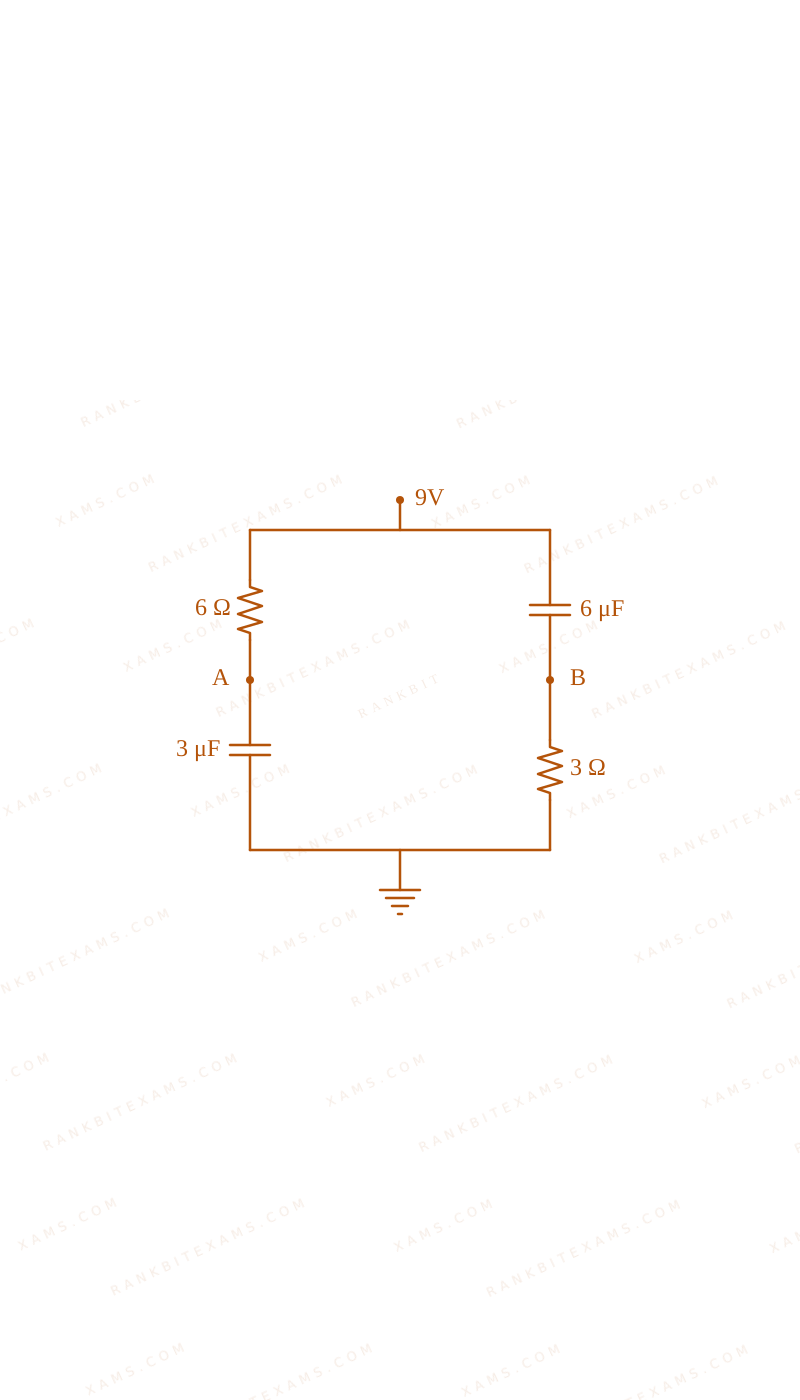
In the given figure, the charge stored in 6$6\mu\text{F}$ capacitor, when points A and B are joined by a connecting wire is ________ $\mu\text{C}$.
The diagram displays a bridge-like network containing a 6 Ohm resistor, 3uF capacitor, 6uF capacitor, and 3 Ohm resistor powered by a 9V supply.
Numerical Answer Type:
Enter a numerical valueAnswer: 36 to 36+4 marks
Solution & Explanation
Related Formula
At steady state, a capacitor acts as an open circuit to DC current.
The charge on a capacitor is:
Q = C Δ V$Q = C \Delta V$
Core Logic
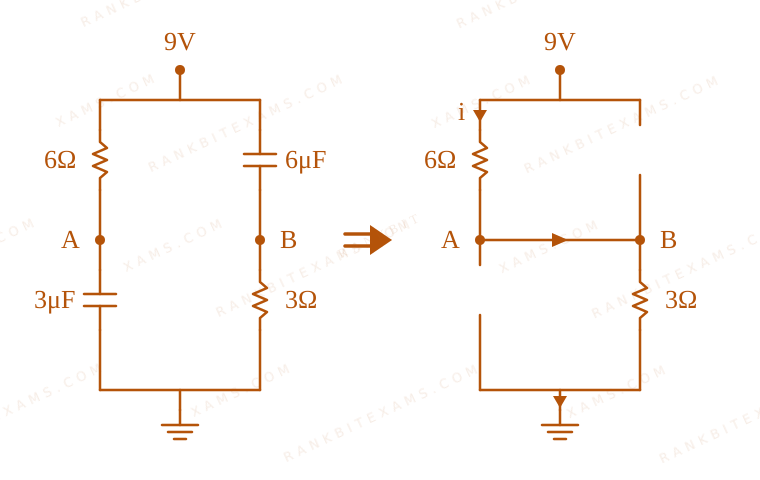
When node A$A$ and node B$B$ are connected by a wire, they reach the same electrical potential (VA = VB = VM$V_A = V_B = V_M$).
At DC steady state, capacitors block current, so current only flows through the resistors from the 9 V$9\text{ V}$ source to ground:
The 6 Ω$6\ \Omega$ resistor is connected between 9 V$9\text{ V}$ and node M$M$.
The 3 Ω$3\ \Omega$ resistor is connected between node M$M$ and ground.
Hence, the equivalent series resistance for the DC current path is:
The charge stored in the 6$6\mu\text{F}$ capacitor is:
Q = C Δ V = 6 × 6 V = 36$$Q = C \Delta V = 6\mu\text{F} \times 6\text{ V} = 36\ \mu\text{C}$$
Thus, the charge stored is 36$36\ \mu\text{C}$.
Pattern Recognition
Shorting A$A$ and B$B$ makes the network a simple voltage divider for resistors at steady state. Once potential of the middle node is found (3 V$3\text{ V}$), the capacitor charge is calculated instantly using Q = C Δ V$Q = C \Delta V$.
Chapter Mix
Class 12 Physics: Electrostatic Potential and Capacitance
Keywords:#charge stored in 6uF capacitor when joined#JEE Main 2024 Evening Q56#Electrostatic Potential and Capacitance JEE Main 2024#Capacitor Steady State JEE Main 2024#Bridge Circuit#Steady State Capacitor#Potential Difference
More Electrostatic Potential and Capacitance Previous-Year Questions — Page 2
Q42jee_main_2026_22_january_morningElectric Potential and Field
Electric field in a region is given by E = Ax i + By j$\vec{E} = Ax\hat{i} + By\hat{j}$, where A = 10~V / m²$A = 10~\mathrm{V / m^2}$ and B = 5~V / m²$B = 5~\mathrm{V / m^2}$. If the electric potential at a point (10, 20) is 500~V$500~\mathrm{V}$, then the electric potential at origin is \_\_\_\_ V.
A. 1000
B. 500
C. 2000
D. 0
Solution
Related Formula
V₂ - V₁ = -∫ E · d r$$V_2 - V_1 = -\int \vec{E} \cdot d\vec{r}$$
Sees: Electric field vector function given, find potential at origin.
Shortcut: Integrate line integral of electric field from origin to given point.
Check: Matches option (3). ✓
Chapter Mix
Class 12 Physics: Electrostatics
Q43jee_main_2026_22_january_morningCharged Pendulum in Electric Field
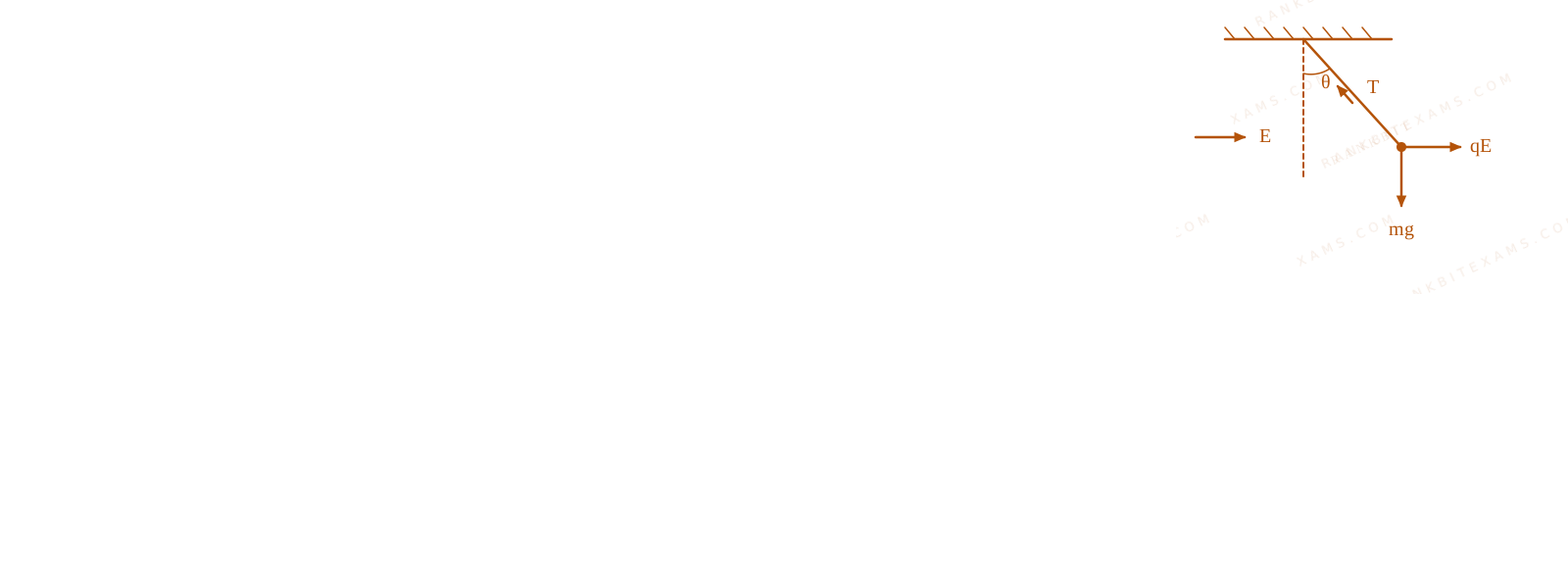
A simple pendulum has a bob with mass m and charge q. The pendulum string has negligible mass. When a uniform and horizontal electric field E$\vec{E}$ is applied, the tension in the string changes. The final tension in the string, when pendulum attains an equilibrium position is \_\_\_\_.
(g : acceleration due to gravity)
A.mg - qE$mg - qE$
B.mg + qE$mg + qE$
C.√(m²g² + q²E²)$\sqrt{m^2g^2 + q^2E^2}$
D.√(m²g² - q²E²)$\sqrt{m^2g^2 - q^2E^2}$
Solution
Related Formula
T = √((qE)² + (mg)²)$$T = \sqrt{(qE)^2 + (mg)^2}$$
Core Logic
Solution pendulum diagram for Q43 - JEE Main 2026 Morning
At equilibrium, the effective forces acting on the bob are vertical gravitational force mg$mg$ and horizontal electric force qE$qE$. The string tension balances the resultant of these orthogonal forces:
T = √((qE)² + (mg)²)$$T = \sqrt{(qE)^2 + (mg)^2}$$
Pattern Recognition
Sees: Charged pendulum in horizontal electric field.
Shortcut: Combine orthogonal forces (mg$mg$ downwards and qE$qE$ horizontally) via Pythagorean vector addition.
Check: Matches option (3). ✓
Chapter Mix
Class 12 Physics: Electrostatics
Q30jee_main_2026_22_january_eveningElectric Potential of Coalescing Bubbles
Three small identical bubbles of water having same charge on each coalesce to form a bigger bubble. Then the ratio of the potentials on one initial bubble and that on the resultant bigger bubble is :
A.1:31/3$1:3^{1/3}$
B.1:22/3$1:2^{2/3}$
C.32/3:1$3^{2/3}:1$
D.1:32/3$1:3^{2/3}$
Solution
Related Formula
V = (kq)/(r)$$V = \frac{kq}{r}$$Volume Conservation: N · ((4)/(3)π r³) = (4)/(3)π R³$$\text{Volume Conservation: } N \cdot \left(\frac{4}{3}\pi r^3\right) = \frac{4}{3}\pi R^3$$
Core Logic
From volume conservation of 3 coalescing droplets:
3 ((4)/(3)π r³) = (4)/(3)π R³ R = 31/3r$$3 \left(\frac{4}{3}\pi r^3\right) = \frac{4}{3}\pi R^3 \implies R = 3^{1/3}r$$
Total charge on resultant bigger bubble Q = 3q$Q = 3q$.
Calculating initial potential Vᵢ$V_i$ and final potential Vf$V_f$:
Coalescing charged bubbles diagram for Q30 - JEE Main 2026 Evening
Step 1: Final Conclusion
The ratio of potentials is 1 : 32/3$1 : 3^{2/3}$.
Pattern Recognition
Coalescing droplets rule: For N$N$ identical drops, R = N1/3r$R = N^{1/3}r$ and Q = Nq$Q = Nq$.
Potential ratio Vᵢ / Vf = 1 / N2/3$V_i / V_f = 1 / N^{2/3}$. For N=3$N=3$, ratio is 1 / 32/3$1 / 3^{2/3}$.
Chapter Mix
Class 12 Physics: Electrostatic Potential and Capacitance
Q42jee_main_2026_22_january_eveningElectric Field and Potential of Polygon of Charges
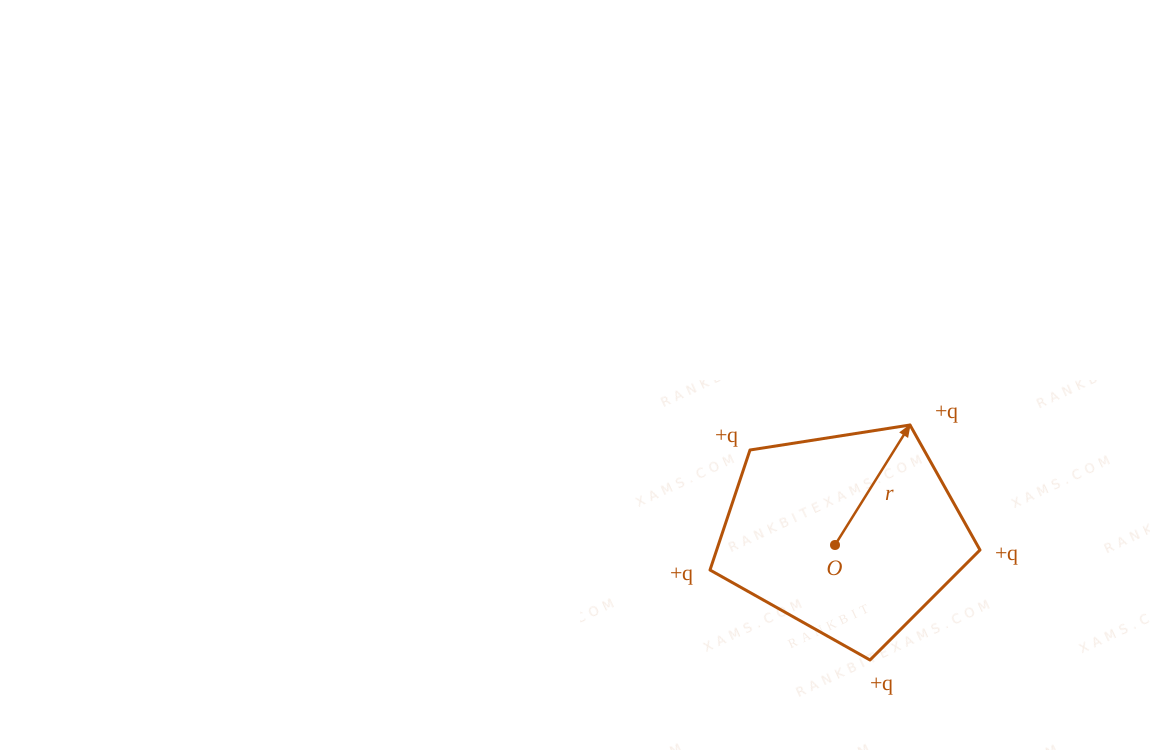
Five positive charges each having charge q are placed at the vertices of a pentagon as shown in the figure. The electric potential (V) and the electric field (E$\vec{E}$) at the center O of the pentagon due to these five positive charges are :
The figure illustrates a regular pentagon with five equal positive charges q placed at each vertex at distance r from center O.
A.V = (5q)/(4πε₀r)$V = \frac{5q}{4\pi\varepsilon_0r}$ and E = 0$\vec{E} = 0$
B.V = 5q4πε₀r$V = \frac{5q}{4\pi\varepsilon_{0}r}$ and E = 5√(3)q8πε₀r² r$\vec{E} = \frac{5\sqrt{3}q}{8\pi\varepsilon_{0}r^{2}} \hat{r}$
C.V = (5q)/(4πε₀r)$V = \frac{5q}{4\pi\varepsilon_0r}$ and E = (5q)/(4πε₀r²) r$\vec{E} = \frac{5q}{4\pi\varepsilon_0r^2}\hat{r}$
Option (1) gives the correct values V = (5q)/(4πε₀r)$V = \frac{5q}{4\pi\varepsilon_0r}$ and E = 0$\vec{E} = 0$.
Pattern Recognition
Symmetry rule: Identical charges at vertices of any regular polygon Ecenter = 0$\implies \vec{E}_{center} = 0$. Potential is scalar addition V = N (kq)/(r)$V = N \frac{kq}{r}$.
Chapter Mix
Class 12 Physics: Electrostatics
Q48jee_main_2026_22_january_eveningSharing of Charges between Capacitors
A capacitor P with capacitance 10 × 10⁻⁶$10 \times 10^{-6}$ F is fully charged with a potential difference of 6.0 V and disconnected from the battery. The charged capacitor P is connected across another capacitor Q with capacitance 20 × 10⁻⁶$20 \times 10^{-6}$ F. The charge on capacitor Q when equilibrium is established will be α × 10⁻⁵$\alpha \times 10^{-5}$ C (assume capacitor Q does not have any charge initially), the value of α$\alpha$ is ____.
Practice past-year questions one chapter at a time. Pick an exam → subject → chapter and get every PYQ for that topic — pulled together from all past papers — with the chapter's key formulas alongside.