JEE Main · Mathematics → Steady

Vector Algebra appeared 46 times across 3 years — 5.3% of Mathematics. This question is from Area of Quadrilateral and Parallelogram.

Year 2026 2025 2024 Total
Questions 15 17 14 46

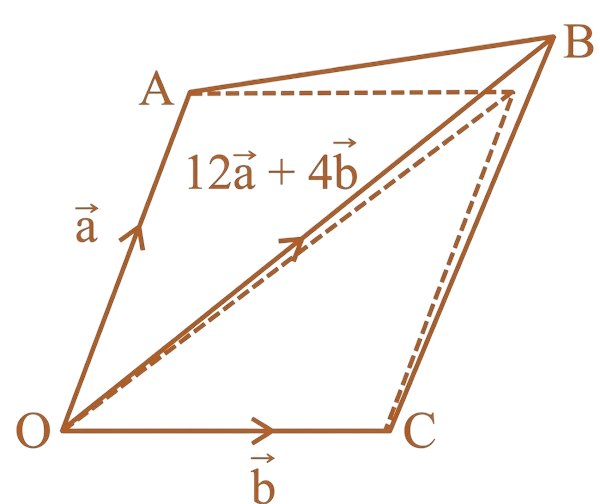
Let OA = a, OB = 12 a + 4 b and OC = b, where O is the origin. If S is the parallelogram with adjacent sides OA and OC, then the ratio of the area of the quadrilateral OABC to the area of S is equal to

Solution & Explanation

Related Formula
Area of Parallelogram S = | a × b| Area of Quadrilateral OABC = Area(Δ OAB) + Area(Δ OBC)
Core Logic

Let us compute the component areas using vector cross products:

Area(Δ OAB) = (1)/(2) | OA × OB| = (1)/(2) | a × (12 a + 4 b)| = (1)/(2) |4( a × b)| = 2| a × b| Area(Δ OBC) = (1)/(2) | OB × OC| = (1)/(2) |(12 a + 4 b) × b| = (1)/(2) |12( a × b)| = 6| a × b|
Step 1: Finding Total Ratio

Adding both triangles to find the total area of the quadrilateral OABC:

Area(OABC) = 2| a × b| + 6| a × b| = 8| a × b|

Area of Quadrilateral and Parallelogram diagram for Q8 - JEE Main 2024 Evening

Dividing this total by the area of the baseline parallelogram S = | a × b|:

Ratio = 8| a × b|| a × b| = 8
Pattern Recognition

Since a × a = 0 and b × b = 0, cross product distributions yield terms with purely a × b, ensuring absolute scalability independent of vectors chosen.

Chapter Mix

Class 12 Mathematics: Vector Algebra

More Vector Algebra Previous-Year Questions — Page 9

Q8 jee_main_2024_30_january_evening Cross Product
Let a and b be two vectors such that | b| = 1 and | b × a| = 2 . Then |( b × a) - b|² is equal to
  • A. 3
  • B. 5
  • C. 1
  • D. 4

Solution

Related Formula
| x - y|² = | x|² + | y|² - 2( x · y) ( b × a) · b = 0 (Scalar triple product with repeated vectors is zero)
Core Logic

Given | b| = 1 and | b × a| = 2. Expand the requested expression:

|( b × a) - b|² = | b × a|² + | b|² - 2(( b × a) · b)
Step 1: Simplify using Vector Properties

The cross product ( b × a) produces a vector orthogonal to both b and a. Therefore, ( b × a) · b = 0.

Substituting this back:

|( b × a) - b|² = | b × a|² + | b|² - 0 |( b × a) - b|² = (2)² + (1)² |( b × a) - b|² = 4 + 1 = 5
Pattern Recognition

A cross product u × v is inherently perpendicular to u. Any length squared involving ( u × v) ± u resolves simply via Pythagorean sum.

Chapter Mix

Class 12 Maths: Vector Algebra
Q4 jee_main_2024_30_jan_morning Vector Cross Product
Let a = a₁ i + a₂ j + a₃ k and b = b₁ i + b₂ j + b₃ k be two vectors such that | a| = 1; a· b = 2 and | b| = 4. If c = 2( a × b) - 3 b, then the angle between b and c is equal to:
  • A. ⁻¹( 2√(3))
  • B. ⁻¹(- 1√(3))
  • C. ⁻¹(- √(3)2)
  • D. ⁻¹((2)/(3))

Solution

Related Formula
| a × b|² + ( a · b)² = | a|² | b|² θ = b · c| b| | c|
Core Logic

Given | a| = 1, | b| = 4, a · b = 2. Let's evaluate | a × b|² using Lagrange's identity:

| a × b|² = | a|² | b|² - ( a · b)² | a × b|² = (1)(16) - (2)² = 16 - 4 = 12
Step 1: Dot products with c

We are given:

c = 2( a × b) - 3 b

To find the angle between b and c, we need b · c and | c|. Taking the dot product with b on both sides:

b · c = 2( b · ( a × b)) - 3( b · b)

Since b · ( a × b) = 0 (scalar triple product with repeated vector):

b · c = 0 - 3| b|² = -3(16) = -48 (1)
Step 2: Finding magnitude of c

Now, let's find | c|²:

| c|² = c · c = (2( a × b) - 3 b) · (2( a × b) - 3 b)

Since ( a × b) · b = 0, the cross terms vanish:

| c|² = 4| a × b|² + 9| b|² | c|² = 4(12) + 9(16) = 48 + 144 = 192 | c| = √(192) = 8√(3)
Step 3: Calculating angle

Now apply the angle formula:

θ = b · c| b| | c| = -48(4)(8√(3)) θ = -4832√(3) = -32√(3) = - √(3)2 θ = ⁻¹(- √(3)2)
Pattern Recognition

Always remember that the cross product vector ( a × b) is orthogonal to both a and b. This immediately eliminates cross terms when finding the magnitude of linear combinations like x( a × b) + y b.

Chapter Mix

Class 12 Maths: Vector Algebra

Q18 jee_main_2024_30_jan_morning Cross Product
Let A (2, 3, 5) and C(-3, 4, -2) be opposite vertices of a parallelogram ABCD if the diagonal BD = i + 2 j + 3 k then the area of the parallelogram is equal to
  • A. (1)/(2)√(410)
  • B. (1)/(2)√(474)
  • C. (1)/(2)√(586)
  • D. (1)/(2)√(306)

Solution

Related Formula
Area of parallelogram = (1)/(2) | d₁ × d₂|
Core Logic

The diagonals of the parallelogram are AC and BD. First, calculate the diagonal vector AC:

AC = Position vector of C - Position vector of A AC = (-3 - 2) i + (4 - 3) j + (-2 - 5) k = -5 i + 1 j - 7 k

Alternatively, taking CA = 5 i - j + 7 k. Let's use CA or AC, the magnitude of the cross product will be the same. The second diagonal is given:

BD = i + 2 j + 3 k
Step 1: Finding Cross Product
Area = (1)/(2) | AC × BD| AC × BD = vmatrix i & j & k -5 & 1 & -7 1 & 2 & 3 vmatrix = i(3 - (-14)) - j(-15 - (-7)) + k(-10 - 1) = i(17) - j(-8) + k(-11) = 17 i + 8 j - 11 k
Step 2: Calculating Magnitude
Area = (1)/(2) |17 i + 8 j - 11 k| = (1)/(2) √(17² + 8² + (-11)²) = (1)/(2) √(289 + 64 + 121) = (1)/(2) √(474)
Pattern Recognition

When opposite vertices and one full diagonal vector are provided, immediately calculate the second diagonal vector via displacement and evaluate half the magnitude of their cross product.

Chapter Mix

Class 12 Maths: Vector Algebra

Q26 jee_main_2024_31_jan_evening Vector Triple Product
Let a = 3 i + 2 j + k, b = 2 i - j + 3 k and c be a vector such that ( a + b) × c = 2( a × b) + 24 j - 6 k and ( a - b + i) · c = -3. Then | c|² is equal to
Numerical Answer. Answer: 38 to 38

Solution

Core Logic

Evaluate base vectors:

a + b = (5, 1, 4) a × b = vmatrix i & j & k 3 & 2 & 1 2 & -1 & 3 vmatrix = (7, -7, -7)

Substitute into given cross product equation, letting c = (x, y, z):

(5 i + j + 4 k) × (x i + y j + z k) = 2(7 i - 7 j - 7 k) + 24 j - 6 k vmatrix i & j & k 5 & 1 & 4 x & y & z vmatrix = (14, -14, -14) + (0, 24, -6) (z-4y) i - (5z-4x) j + (5y-x) k = (14, 10, -20)

Equating components:

z - 4y = 14 z = 4y + 14

4x - 5z = 10

5y - x = -20 x = 5y + 20

Now use the dot product constraint: a - b + i = (3-2+1) i + (2+1) j + (1-3) k = (2, 3, -2).

( a - b + i) · c = -3 2x + 3y - 2z = -3

Substitute x = 5y + 20 and z = 4y + 14:

2(5y + 20) + 3y - 2(4y + 14) = -3 10y + 40 + 3y - 8y - 28 = -3 5y + 12 = -3 5y = -15 y = -3

Calculate x and z:

x = 5(-3) + 20 = 5 z = 4(-3) + 14 = 2

So, c = (5, -3, 2).

| c|² = 5² + (-3)² + 2² = 25 + 9 + 4 = 38
Chapter Mix

Class 12 Maths: Vector Algebra

Q12 jee_main_2024_31_jan_morning Cross and Dot Product Operations
Let a = 3 i + j - 2 k, b = 4 i + j + 7 k and c = i - 3 j + 4 k be three vectors. If a vector p satisfies p × b = c × b and p · a = 0, then p · ( i - j - k) is equal to
  • A. 24
  • B. 36
  • C. 28
  • D. 32

Solution

Core Logic

Given p × b = c × b.

( p - c) × b = 0

Thus, p - c = λ b p = c + λ b.

Step 1: Utilize Dot Product Condition

Given p · a = 0.

( c + λ b) · a = 0 c · a + λ ( b · a) = 0

Calculate c · a: (1)(3) + (-3)(1) + (4)(-2) = 3 - 3 - 8 = -8. Calculate b · a: (4)(3) + (1)(1) + (7)(-2) = 12 + 1 - 14 = -1.

-8 + λ(-1) = 0 λ = -8
Step 2: Substitute and Solve

Substitute λ back to find p:

p = c - 8 b = ( i - 3 j + 4 k) - 8(4 i + j + 7 k) p = -31 i - 11 j - 52 k

Now compute p · ( i - j - k):

= (-31)(1) + (-11)(-1) + (-52)(-1) = -31 + 11 + 52 = 32
Chapter Mix

Class 12 Maths: Vector Algebra

Rankbit System
JEE Physics: Waves (+15.5%) | Electrostatics: Concentric Shells (-29.7%) | Modern Physics: Photoelectric Clones (+34.2%) | Mathematics: Definite Integrals (+18.1%) | Chemistry: Coordination Splitting (-11.4%) | JEE Physics: Waves (+15.5%) | Electrostatics: Concentric Shells (-29.7%) | Modern Physics: Photoelectric Clones (+34.2%) | Mathematics: Definite Integrals (+18.1%) | Chemistry: Coordination Splitting (-11.4%)