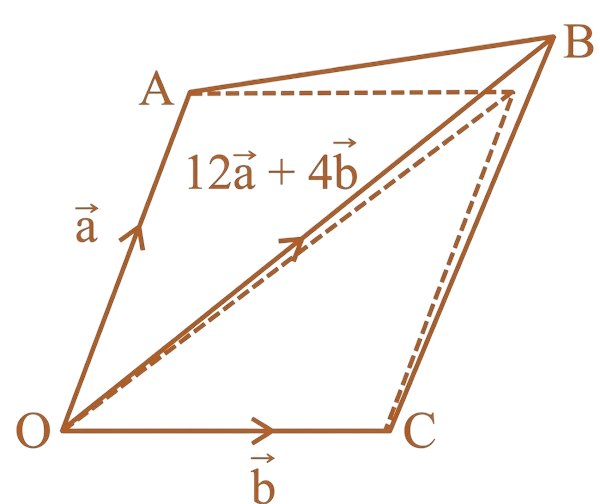
Let OA = a, OB = 12 a + 4 b$\overrightarrow{OA} = \vec{a}, \overrightarrow{OB} = 12\vec{a} + 4\vec{b}$ and OC = b$\overrightarrow{OC} = \vec{b}$, where O$O$ is the origin. If S$S$ is the parallelogram with adjacent sides OA$OA$ and OC$OC$, then the ratio of the area of the quadrilateral OABC to the area of S$S$ is equal to
A.6
B.10
C.7
D.8
Solution & Explanation
Related Formula
Area of Parallelogram S = | a × b|$$\text{Area of Parallelogram } S = |\vec{a} \times \vec{b}|$$Area of Quadrilateral OABC = Area(Δ OAB) + Area(Δ OBC)$$\text{Area of Quadrilateral OABC} = \text{Area}(\Delta OAB) + \text{Area}(\Delta OBC)$$
Core Logic
Let us compute the component areas using vector cross products:
Area(Δ OAB) = (1)/(2) | OA × OB| = (1)/(2) | a × (12 a + 4 b)| = (1)/(2) |4( a × b)| = 2| a × b|$$\text{Area}(\Delta OAB) = \frac{1}{2} |\overrightarrow{OA} \times \overrightarrow{OB}| = \frac{1}{2} |\vec{a} \times (12\vec{a} + 4\vec{b})| = \frac{1}{2} |4(\vec{a} \times \vec{b})| = 2|\vec{a} \times \vec{b}|$$Area(Δ OBC) = (1)/(2) | OB × OC| = (1)/(2) |(12 a + 4 b) × b| = (1)/(2) |12( a × b)| = 6| a × b|$$\text{Area}(\Delta OBC) = \frac{1}{2} |\overrightarrow{OB} \times \overrightarrow{OC}| = \frac{1}{2} |(12\vec{a} + 4\vec{b}) \times \vec{b}| = \frac{1}{2} |12(\vec{a} \times \vec{b})| = 6|\vec{a} \times \vec{b}|$$
Step 1: Finding Total Ratio
Adding both triangles to find the total area of the quadrilateral OABC:
Area(OABC) = 2| a × b| + 6| a × b| = 8| a × b|$$\text{Area(OABC)} = 2|\vec{a} \times \vec{b}| + 6|\vec{a} \times \vec{b}| = 8|\vec{a} \times \vec{b}|$$
Area of Quadrilateral and Parallelogram diagram for Q8 - JEE Main 2024 Evening
Dividing this total by the area of the baseline parallelogram S = | a × b|$S = |\vec{a} \times \vec{b}|$:
Ratio = 8| a × b|| a × b| = 8$$\text{Ratio} = \frac{8|\vec{a} \times \vec{b}|}{|\vec{a} \times \vec{b}|} = 8$$
Pattern Recognition
Since a × a = 0$\vec{a} \times \vec{a} = 0$ and b × b = 0$\vec{b} \times \vec{b} = 0$, cross product distributions yield terms with purely a × b$\vec{a} \times \vec{b}$, ensuring absolute scalability independent of vectors chosen.
Chapter Mix
Class 12 Mathematics: Vector Algebra
More Vector Algebra Previous-Year Questions — Page 10
Let a$\vec{a}$ and b$\vec{b}$ be two vectors such that | a| = 1, | b| = 4$|\vec{a}| = 1, |\vec{b}| = 4$ and a · b = 2$\vec{a} \cdot \vec{b} = 2$. If c = (2 a × b) - 3 b$\vec{c} = (2\vec{a} \times \vec{b}) - 3\vec{b}$ and the angle between b$\vec{b}$ and c$\vec{c}$ is α$\alpha$, then 192 ²α$192\sin^2\alpha$ is equal to
Numerical Answer.Answer: 48 to 48
Solution
Core Logic
b · c = b · ((2 a × b) - 3 b)$$\vec{b} \cdot \vec{c} = \vec{b} \cdot ((2\vec{a} \times \vec{b}) - 3\vec{b})$$|b||c| α = 2( b · ( a × b)) - 3|b|²$$|b||c|\cos\alpha = 2(\vec{b} \cdot (\vec{a} \times \vec{b})) - 3|b|^2$$
Since b · ( a × b) = 0$\vec{b} \cdot (\vec{a} \times \vec{b}) = 0$, we have |b||c| α = -3|b|²$|b||c|\cos\alpha = -3|b|^2$.
Practice past-year questions one chapter at a time. Pick an exam → subject → chapter and get every PYQ for that topic — pulled together from all past papers — with the chapter's key formulas alongside.