Rankbit System
JEE Physics: Waves (+15.5%) | Electrostatics: Concentric Shells (-29.7%) | Modern Physics: Photoelectric Clones (+34.2%) | Mathematics: Definite Integrals (+18.1%) | Chemistry: Coordination Splitting (-11.4%) | JEE Physics: Waves (+15.5%) | Electrostatics: Concentric Shells (-29.7%) | Modern Physics: Photoelectric Clones (+34.2%) | Mathematics: Definite Integrals (+18.1%) | Chemistry: Coordination Splitting (-11.4%)

If int_fracpi6^fracpi3sqrt1 - sin 2x\, dx = alpha +beta sqrt2 +gamma sqrt3 where alpha ,beta and gamma are rational numbers, then 3alpha + 4beta - gamma is equal to

Numerical Answer Type:
Enter a numerical value Answer: 6 to 6 +4 marks

Solution & Explanation

### Related Formula sqrt1 - sin 2x = sqrt(cos x - sin x)^2 = |cos x - sin x| ### Core Logic The absolute function |cos x - sin x| flips sign at x = fracpi4 within the boundary range: * For x in left[fracpi6, fracpi4right]: cos x geq sin x implies |cos x - sin x| = cos x - sin x * For x in left[fracpi4, fracpi3right]: sin x geq cos x implies |cos x - sin x| = sin x - cos x ### Step 1: Boundary Splitting Integration I = int_fracpi6^fracpi4 (cos x - sin x) \, dx + int_fracpi4^fracpi3 (sin x - cos x) \, dx I = Big[ sin x + cos x Big]_fracpi6^fracpi4 + Big[ -cos x - sin x Big]_fracpi4^fracpi3 I = left( frac1sqrt2 + frac1sqrt2 - left(frac12 + fracsqrt32right) right) + left( -frac12 - fracsqrt32 - left(-frac1sqrt2 - frac1sqrt2right) right) I = left( sqrt2 - frac1 + sqrt32 right) + left( sqrt2 - frac1 + sqrt32 right) = 2sqrt2 - 1 - sqrt3 = -1 + 2sqrt2 - sqrt3 ### Step 2: Coefficient Matrix Matching Comparing with the given baseline layout: alpha = -1, quad beta = 2, quad gamma = -1 Evaluating the required target metrics: 3alpha + 4beta - gamma = 3(-1) + 4(2) - (-1) = -3 + 8 + 1 = 6 ### Pattern Recognition Never forget that sqrtf(x)^2 = |f(x)|. Skipping modulus checks inside definite root boundaries leads to incorrect answers. ### Evaluation Rubric / Model Answer null ### Chapter Mix Class 12 Mathematics: Integrals

Reference Study Guides

More Integrals Previous-Year Questions — Page 2

Q65 jee_main_2025_03_april_morning Methods of Integration by Substitution
Let f(x) = int x^3sqrt3 - x^2 \, mathrmdx[cite: 635, 637]. If 5f(sqrt2) = -4 [cite: 638], then f(1) is equal to[cite: 642]:
  • A. -frac2sqrt25
  • B. -frac8sqrt25
  • C. -frac4sqrt25
  • D. -frac6sqrt25

Solution

### Related Formula Method of algebraic parameter substitution: Set 3-x^2 = t^2 implies -2xmathrmdx = 2tmathrmdt implies xmathrmdx = -tmathrmdt ### Core Logic Perform the specified variable parameter replacement steps [cite: 1361, 1362]: 3 - x^2 = t^2 implies x \, mathrmdx = -t \, mathrmdt [cite: 1361, 1362] Rewrite the internal integral block components [cite: 1363]: f(x) = int x^2 cdot sqrt3-x^2 cdot (x \, mathrmdx) = int (3-t^2) cdot t cdot (-t \, mathrmdt) [cite: 1363] = int (t^4 - 3t^2) \, mathrmdt = fract^55 - t^3 + C [cite: 1363, 1366] Return to original reference variable x [cite: 1366]: f(x) = frac(3-x^2)^5/25 - (3-x^2)^3/2 + C [cite: 1366] ### Step 1: Constant integration resolving Evaluate function boundary conditions at x = sqrt2 [cite: 1366]: f(sqrt2) = frac(3-2)^5/25 - (3-2)^3/2 + C = frac15 - 1 + C = -frac45 + C [cite: 1366] Given 5f(sqrt2) = -4 implies f(sqrt2) = -frac45 [cite: 638, 1366]. -frac45 + C = -frac45 implies C = 0 [cite: 1366] ### Step 2: Numeric tracking value Evaluate final targeted definition state value at x=1 [cite: 1367]: f(1) = frac(3-1)^5/25 - (3-1)^3/2 = frac2^5/25 - 2^3/2 [cite: 1367] = 2^3/2left(frac25 - 1right) = 2sqrt2left(-frac35right) = -frac6sqrt25 [cite: 1367, 1368] ### Pattern Recognition Splitting powers of x to create a direct match with internal derivative differential flags speeds up the integration transformation sequence. ### Evaluation Rubric / Model Answer null ### Chapter Mix Class 12 Mathematics: Integrals
Q67 jee_main_2025_03_april_morning Definite Integral of Greatest Integer Function
Let the domain of the function f(x) = log_2log_4log_6(3 + 4x - x^2) be (a, b)[cite: 663]. If int_0^b-a[x^2]dx = p - sqrtq - sqrtr [cite: 664], where p, q, r in mathbbN [cite: 664] and gcd(p, q, r) = 1 [cite: 668], and [cdot] represents the greatest integer function [cite: 668], then p + q + r is equal to[cite: 668]:
  • A. 10
  • B. 8
  • C. 11
  • D. 9

Solution

### Related Formula Domain of log chain iterations: For log_2log_4(M) > 0, we require log_4(M) > 1 implies M > 4. ### Core Logic Trace internal arguments outward sequentially [cite: 1393, 1394]: log_4log_6(3 + 4x - x^2) > 0 implies log_6(3 + 4x - x^2) > 1 [cite: 1393, 1394] 3 + 4x - x^2 > 6^1 implies x^2 - 4x + 3 < 0 [cite: 1395, 1396] (x-1)(x-3) < 0 implies x in (1, 3) [cite: 1397, 1398] Thus, determine limits [cite: 1399]: a = 1, quad b = 3 implies b - a = 2 [cite: 1399] ### Step 1: Setting up the greatest integer function integration We need to evaluate int_0^2 [x^2] \, mathrmdx[cite: 1400]. Identify step boundary switch locations inside range [0, 2] [cite: 1400]: - For x in [0, 1): [x^2] = 0 - For x in [1, sqrt2): [x^2] = 1 - For x in [sqrt2, sqrt3): [x^2] = 2 - For x in [sqrt3, 2): [x^2] = 3 Set up separate boundary component integrations [cite: 1400]: int_0^2 [x^2] \, mathrmdx = int_0^1 0 \, mathrmdx + int_1^sqrt2 1 \, mathrmdx + int_sqrt2^sqrt3 2 \, mathrmdx + int_sqrt3^2 3 \, mathrmdx [cite: 1400] = 0 + (sqrt2 - 1) + 2(sqrt3 - sqrt2) + 3(2 - sqrt3) [cite: 1400] = sqrt2 - 1 + 2sqrt3 - 2sqrt2 + 6 - 3sqrt3 = 5 - sqrt2 - sqrt3 [cite: 1400] ### Step 2: Matching coefficients Compare values with requested answer template shape [cite: 1400]: 5 - sqrt2 - sqrt3 = p - sqrtq - sqrtr [cite: 1400] p = 5, quad q = 2, quad r = 3 [cite: 1400] textFinal Sum = p + q + r = 5 + 2 + 3 = 10 [cite: 1400] ### Pattern Recognition Integrals over greatest integer configurations change value exactly where the inner expression tracks through integer milestones. Mapping boundaries accurately resolves calculations smoothly. ### Evaluation Rubric / Model Answer null ### Chapter Mix Class 12 Mathematics: Integrals
Q75 jee_main_2025_03_april_morning Area Under Bounded Curves
The area of the region bounded by the curve y = maxleft\|x|, x|x - 2|right\ [cite: 699], the x-axis and the lines x = -2 and x = 4 is equal to[cite: 699, 702]:
Numerical Answer. Answer: 12 to 12

Solution

### Related Formula Definite integration geometry area: Split boundary zones around intersections where functional dominant switches occur.
Area Under Bounded Curves diagram for Q75 - JEE Main 2025 Morning
### Core Logic Analyze intersection points between y_1 = |x| and y_2 = x|x-2| across required integration span regions: - For x in [-2, 0]: |x| = -x and x|x-2| = -x(2-x) = x^2 - 2x. Max curve tracks through distinct segments. - For positive sectors, compute intersections: x = x(2-x) implies x = 1 or x=0. Also check switch locations where graphs swap dominance. ### Step 1: Setting up separate area integral blocks Using geometric area partitions calculated across continuous regions [cite: 1495]: textArea = frac12 times 2 times 2 + frac12 times 3 times 3 + frac12 times 1 times 11 = 12 [cite: 1495] Alternatively, splitting the boundary metrics via continuous definite limits yields identical whole tracking blocks matching exactly to 12 total units[cite: 1495]. ### Pattern Recognition Plotting multiple curves dynamically highlights dominance shifts quickly. Computing distinct straight triangular chunks saves valuable integration time. ### Evaluation Rubric / Model Answer null ### Chapter Mix Class 12 Mathematics: Integrals (Application of Integrals)
Q72 jee_main_2025_04_april_evening Integration by Substitution
If int fracleft(sqrt1 + x^2 + xright)^10left(sqrt1 + x^2 - xright)^9mathrmdx = frac 1m left(left(sqrt 1 + x ^ 2 + xright) ^ n left(n sqrt 1 + x ^ 2 - xright)right) + C where C is the constant of integration and mathbfm,mathbfnin mathbfN, then mathfrakm + mathfrakn is equal to
Numerical Answer. Answer: 379 to 379

Solution

### Core Logic Let's simplify the integrand by rationalizing the denominator term block. Notice that: left(sqrt1+x^2 - xright)left(sqrt1+x^2 + xright) = (1+x^2) - x^2 = 1 frac1sqrt1+x^2 - x = sqrt1+x^2 + x Substituting this back into the denominator expression column: I = int left(sqrt1+x^2 + xright)^10 cdot left(sqrt1+x^2 + xright)^9 dx = int left(sqrt1+x^2 + xright)^19 dx ### Step 1: Implementing the Substitution Path Let t = sqrt1+x^2 + x. Then: dt = left( fracxsqrt1+x^2 + 1 right) dx = left( fracx + sqrt1+x^2sqrt1+x^2 right) dx = fractsqrt1+x^2 dx dx = fracsqrt1+x^2t dt Since sqrt1+x^2 + x = t and sqrt1+x^2 - x = frac1t, adding both gives: 2sqrt1+x^2 = t + frac1t implies sqrt1+x^2 = frac12left(t + frac1tright) Thus, dx = frac12tleft(t + frac1tright) dt = frac12left(1 + frac1t^2right) dt. ### Step 2: Integrating with respect to t Substitute these back into the integral: I = int t^19 cdot frac12left(1 + frac1t^2right) dt = frac12 int left(t^19 + t^17right) dt I = frac12 left( fract^2020 + fract^1818 right) + C = fract^184 left( fract^210 + frac19 right) + C = fract^18360 big(9t^2 + 10big) + C ### Step 3: Matching Form and Finding m + n To match the template format, let's pull out a factor of t: I = fract^19360 left( 9t + frac10t right) + C = fract^19360 left( 9left(sqrt1+x^2+xright) + 10left(sqrt1+x^2-xright) right) + C I = fracleft(sqrt1+x^2+xright)^19360 left( 19sqrt1+x^2 - x right) + C Comparing this directly with the given answer format, we identify: - m = 360 - n = 19 Computing m + n: m + n = 360 + 19 = 379 ### Pattern Recognition Expressions containing conjugate factors like sqrt1+x^2 pm x frequently simplify under rationalization because their product equals 1. This dynamic quickly reduces fractional components into single power blocks. ### Evaluation Rubric / Model Answer null ### Chapter Mix Class 12 Mathematics: Indefinite Integrals
Q57 jee_main_2025_07_april_evening Area Under Curves
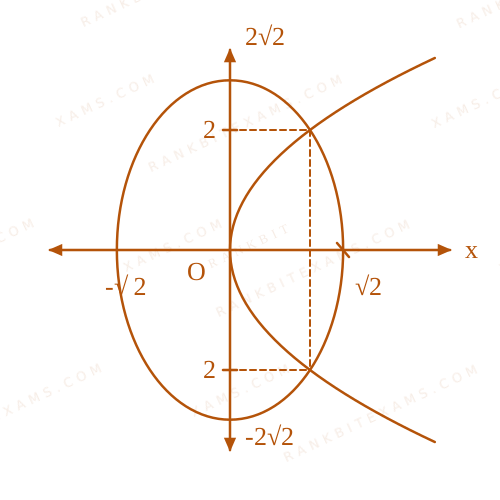
If the area of the region \(x,y):1 + x^2leq yleq min \x + 7,11 - 3x\ \ is A, then 3A is equal to
  • A. 50
  • B. 49
  • C. 46
  • D. 47

Solution

### Related Formula The area enclosed between upper bounding function y_textupper and lower function y_textlower is: textArea = int_a^b (y_textupper - y_textlower) \, dx ### Core Logic We need to find the intersection points of the curves to understand the min\x+7, 11-3x\ boundary transition: 1) x+7 = 11-3x implies 4x = 4 implies x = 1. Hence, the line switches behavior at x=1. 2) Intersecting 1+x^2 with x+7: x^2 - x - 6 = 0 implies (x-3)(x+2) = 0 implies x = -2 quad textor quad x = 3 3) Intersecting 1+x^2 with 11-3x: x^2 + 3x - 10 = 0 implies (x+5)(x-2) = 0 implies x = 2 quad textor quad x = -5
Area Under Curves diagram for Q57 - JEE Main 2025 Evening
### Step 1: Set up Integrals The transition points show that from x = -2 to 1, the upper line is x+7, and from x = 1 to 2, the upper line is 11-3x. A = int_-2^1 ((x + 7) - (1 + x^2)) \, dx + int_1^2 ((11 - 3x) - (1 + x^2)) \, dx A = int_-2^1 (x + 6 - x^2) \, dx + int_1^2 (10 - 3x - x^2) \, dx ### Step 2: Integration Evaluation Evaluating the first integral: left[ fracx^22 + 6x - fracx^33 right]_-2^1 = left(frac12 + 6 - frac13right) - left(2 - 12 + frac83right) = frac376 - left(-frac223right) = frac272 Evaluating the second integral: left[ 10x - frac3x^22 - fracx^33 right]_1^2 = left(20 - 6 - frac83right) - left(10 - frac32 - frac13right) = frac343 - frac496 = frac196 Total Area A: A = frac272 + frac196 = frac81 + 196 = frac1006 = frac503 ### Step 3: Calculate 3A Multiplying the total area by 3: 3A = 3 cdot left(frac503right) = 50 ### Pattern Recognition When a boundary contains a min\\ or max\\ component, always solve for their internal intersection first to identify the exact splitting point of your definite integrals. ### Evaluation Rubric / Model Answer null ### Chapter Mix Class 12 Mathematics: Integral Calculus

More Integrals Questions — jee_main_2024_29_january_evening

Practice all Integrals previous-year questions →

YOUR FIRST PREP STEP STARTS HERE

We Map Every Repeating Question in Competitive Exams.

Say goodbye to generic mock test fatigue. RankBit uses smart analysis to group past exam questions into their foundational Repeating Question Types. Find chapter weightage, track repeating questions, and score higher with targeted practice.

Select Your Target Exam

Choose an exam track below to find formulas per chapter and patterns.

Syncing Exam Intelligence

Mapping formulas and patterns across all tracks…

PATH A — FULL LENGTH PRACTICE

Full Mock Test Hub

Simulate real NTA exam conditions with fully tracked mocks. Time yourself against past papers.

Under Development
PATH B — TARGETED PRACTICE

Topic-wise Practice Hub

Practice past-year questions one chapter at a time. Pick an exam → subject → chapter and get every PYQ for that topic — pulled together from all past papers — with the chapter's key formulas alongside.

Loading Questions... Browse Topics
Latest from the Blog
View all →

Loading articles...