Molality of 0.8 M$0.8\,\mathrm{M}$H₂SO₄$\mathrm{H}_2\mathrm{SO}_4$ solution (density 1.06 g cm⁻³$1.06\,\mathrm{g\,cm}^{-3}$) is **815** × 10⁻³ m$\times 10^{-3}\,\mathrm{m}$.
Ensure you explicitly subtract the mass of the solute from the total mass of the solution to correctly isolate the mass of the solvent needed for molality calculations.
Sea water, which can be considered as a 6 molar (6 M) solution of NaCl, has a density of 2~g~mL⁻¹$2\mathrm{~g~mL}^{-1}$ . The concentration of dissolved oxygen (O₂)$\left(\mathrm{O}_2\right)$ in sea water is 5.8~ppm$5.8\mathrm{~ppm}$ . Then the concentration of dissolved oxygen (O₂)$\left(\mathrm{O}_2\right)$ in sea water, is x × 10⁻⁴m$\mathrm{x} \times 10^{-4}\mathrm{m}$ . x =$\mathrm{x} =$ _______. (Nearest integer)
Given: Molar mass of NaCl is 58.5~g~mol⁻¹$58.5\mathrm{~g~mol}^{-1}$ Molar mass of O₂$\mathrm{O}_2$ is 32~g~mol⁻¹$32\mathrm{~g~mol}^{-1}$
Numerical Answer.Answer: 1.9 to 2.1
Solution
Related Formula
ppm = mass of solutemass of solution × 10⁶$$\text{ppm} = \frac{\text{mass of solute}}{\text{mass of solution}} \times 10^6$$Molality (m) = moles of solutemass of solvent in kg$$\text{Molality (m)} = \frac{\text{moles of solute}}{\text{mass of solvent in kg}}$$
Core Logic
Consider 1000 ~mL$1000 \mathrm{~mL}$ of seawater solution:
Mass of solution = Volume × density = 1000 × 2 = 2000 ~g$$\text{Mass of solution} = \text{Volume} \times \text{density} = 1000 \times 2 = 2000 \mathrm{~g}$$Mass of NaCl = 6 moles × 58.5 = 351 ~g$$\text{Mass of NaCl} = 6 \text{ moles} \times 58.5 = 351 \mathrm{~g}$$Mass of solvent (water) = 2000 - 351 = 1649 ~g = 1.649 ~kg$$\text{Mass of solvent (water)} = 2000 - 351 = 1649 \mathrm{~g} = 1.649 \mathrm{~kg}$$
Compute the mass and moles of dissolved O₂$O_2$ using the ppm value:
ppm = 5.8 = mass of O₂2000 × 10⁶ mass of O₂ = 1.16 × 10⁻² ~g$$\text{ppm} = 5.8 = \frac{\text{mass of } O_2}{2000} \times 10^6 \implies \text{mass of } O_2 = 1.16 \times 10^{-2} \mathrm{~g}$$moles of O₂ = 1.16 × 10⁻²32 = 3.625 × 10⁻⁴ moles$$\text{moles of } O_2 = \frac{1.16 \times 10^{-2}}{32} = 3.625 \times 10^{-4} \text{ moles}$$
Matching the pattern x × 10⁻⁴m$\mathbf{x} \times 10^{-4}\mathrm{m}$, we get x ≈ 2.19$\mathbf{x} \approx 2.19$. The nearest integer is 2.
Pattern Recognition
For high concentration saline solutions, the mass of the solvent drops significantly below the total mass of the solution. Be careful to subtract the solute weight (351 ~g$351 \mathrm{~g}$) before computing molality.
Chapter Mix
Class 12 Chemistry: Solutions
Q26jee_main_2025_04_april_morningReverse Osmosis
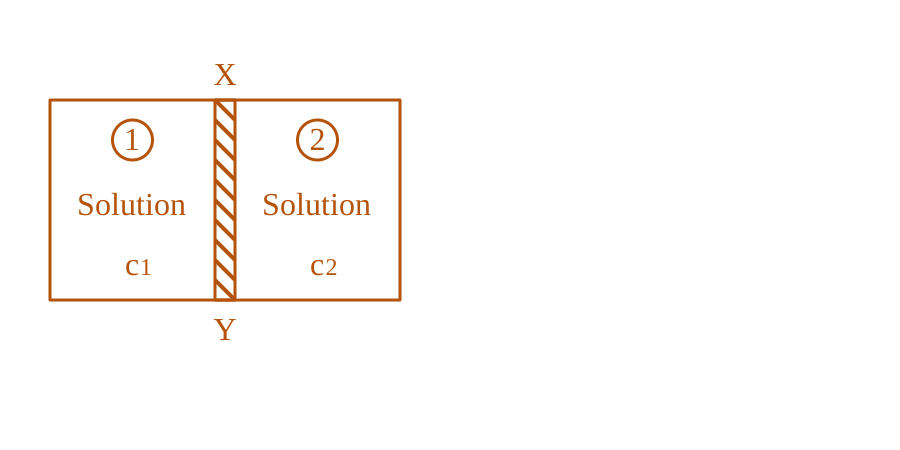
XY is the membrane / partition between two chambers 1 and 2 containing sugar solutions of concentration c₁$c_1$ and c₂$c_2$ (c₁ > c₂$c_1 > c_2$) mol~L⁻¹$\mathrm{mol~L^{-1}}$. For the reverse osmosis to take place identify the correct condition (Here p₁$p_1$ and p₂$p_2$ are pressures applied on chamber 1 and 2):
The diagram illustrates two chambers separated by a membrane XY containing sugar solutions of concentrations c1 and c2.
A.(B) and (D) only$\text{(B) and (D) only}$
B.(A) and (D) only$\text{(A) and (D) only}$
C.(A) and (C) only$\text{(A) and (C) only}$
D.(C) only$\text{(C) only}$
Solution
Related Formula
π = c R T$\pi = c R T$
where π$\pi$ is the osmotic pressure of the solution.
Core Logic
Given that c₁ > c₂$c_1 > c_2$, chamber 1 has a higher concentration of solute than chamber 2. Under normal conditions, solvent molecules spontaneously flow from lower concentration (chamber 2) to higher concentration (chamber 1) via osmosis.
To achieve reverse osmosis, the solvent must flow in the opposite direction—from chamber 1 to chamber 2. This requires applying an external pressure on the higher concentration side (chamber 1) that exceeds its osmotic pressure π$\pi$.
Condition for Reverse Osmosis: p₁ > π$$\text{Condition for Reverse Osmosis: } p_1 > \pi$$
Cellophane and parchment paper both act as suitable semi-permeable membranes for this setup. Thus, statements (A) and (C) are correct.
Pattern Recognition
Reverse osmosis always requires external pressure applied on the concentrated solution side (chigh$c_{\text{high}}$) such that Papplied > π$P_{\text{applied}} > \pi$.
Chapter Mix
Class 12 Chemistry: Solutions
Q34jee_main_2025_07_april_eveningRaoult's Law and Liquid-Vapour Composition
Liquid A$\text{A}$ and B$\text{B}$ form an ideal solution. The vapour pressure of pure liquids A$\text{A}$ and B$\text{B}$ are 350 and 750 mm Hg$750\text{ mm Hg}$ respectively at the same temperature. If xA$\text{x}_{\text{A}}$ and xB$\text{x}_{\text{B}}$ are the mole fraction of A$\text{A}$ and B$\text{B}$ in solution while yA$\text{y}_{\text{A}}$ and yB$\text{y}_{\text{B}}$ are the mole fraction of A$\text{A}$ and B$\text{B}$ in vapour phase then:
Konovalov's Rule Shortcut: The vapour phase is always enriched with the more volatile component. Since component B$\text{B}$ has a higher pure vapour pressure (750 > 350$750 > 350$), it will be preferentially enriched in the vapour phase, meaning yB/yA > xB/xA$y_\text{B}/y_\text{A} > x_\text{B}/x_\text{A}$. Reversing the fractions directly matches option (3).
Chapter Mix
Class 12 Chemistry: Solutions
Q38jee_main_2025_07_april_eveningAzeotropes and Liquid Mixtures
Match List-I with List-II
List-I
List-II
(A) Solution of chloroform and acetone
(I) Minimum boiling azeotrope
(B) Solution of ethanol and water
(II) Dimerizes
(C) Solution of benzene and toluene
(III) Maximum boiling azeotrope
(D) Solution of acetic acid in benzene
(IV) Δ Vmix=0$\Delta V{\text{mix}}=0$
Choose the correct answer from the options given below:
Negative Deviation from Raoult's Law Maximum Boiling Azeotrope$$\text{Negative Deviation from Raoult's Law} \implies \text{Maximum Boiling Azeotrope} $$Positive Deviation from Raoult's Law Minimum Boiling Azeotrope$$\text{Positive Deviation from Raoult's Law} \implies \text{Minimum Boiling Azeotrope} $$Ideal Solution Δ Vmix = 0$$\text{Ideal Solution} \implies \Delta V{\text{mix}} = 0 $$
Core Logic
Evaluating molecular interaction behaviors:
- (A) Chloroform and Acetone: Form intermolecular hydrogen bonds, showing negative deviation from Raoult's law, which forms a maximum boiling azeotrope arrow$\rightarrow$ (III)
- (B) Ethanol and Water: Exhibit hydrogen bond disruptions, leading to positive deviation, forming a minimum boiling azeotrope arrow$\rightarrow$ (I)
- (C) Benzene and Toluene: Highly structurally similar, forming a near-perfect ideal solution where Δ Vmix = 0$\Delta V{\text{mix}} = 0$arrow$\rightarrow$ (IV)
- (D) Acetic acid in benzene: Acetic acid undergoes intermolecular hydrogen bonding inside the non-polar solvent, causing it to dimerize arrow$\rightarrow$ (II)
Step 1: Alignment Selection
Combining the pairs gives: (A)-(III), (B)-(I), (C)-(IV), (D)-(II).
Pattern Recognition
Liquid properties shortcut: Acetic acid in benzene is a classic textbook example of dimerization (i=0.5$i=0.5$). Benzene-toluene is the most famous ideal solution pair. Recognizing either instantly shortcuts the options list to the correct key.
Chapter Mix
Class 12 Chemistry: Solutions
Q46jee_main_2025_24_jan_eveningAbnormal Molar Masses and Van't Hoff Factor
The observed and normal masses of compound MX₂$\mathrm{MX}_2$ are 65.6 and 164 respectively. The percent degree of ionisation of MX₂$\mathrm{MX}_2$ is ____ %. (Nearest integer)
For a salt that dissociates into three ions (like MX₂$\mathrm{MX}_2$), the relationship simplifies to i = 1 + 2α$i = 1 + 2\alpha$. Calculating i$i$ from the ratio of the molar masses lets you find α$\alpha$ directly.
Practice past-year questions one chapter at a time. Pick an exam → subject → chapter and get every PYQ for that topic — pulled together from all past papers — with the chapter's key formulas alongside.