Rankbit System
JEE Physics: Waves (+15.5%) | Electrostatics: Concentric Shells (-29.7%) | Modern Physics: Photoelectric Clones (+34.2%) | Mathematics: Definite Integrals (+18.1%) | Chemistry: Coordination Splitting (-11.4%) | JEE Physics: Waves (+15.5%) | Electrostatics: Concentric Shells (-29.7%) | Modern Physics: Photoelectric Clones (+34.2%) | Mathematics: Definite Integrals (+18.1%) | Chemistry: Coordination Splitting (-11.4%)

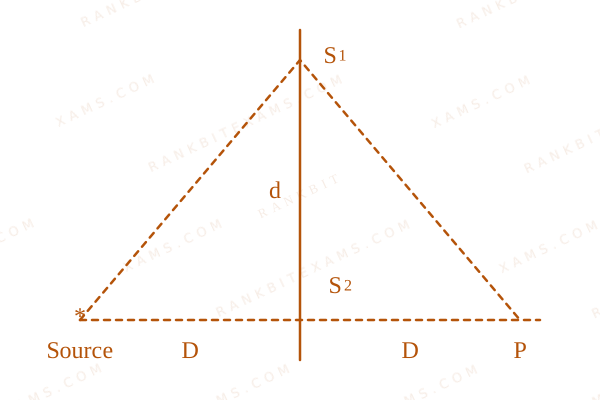
In a double slit experiment shown in figure, when light of wavelength 400 mathrm~nm is used, dark fringe is observed at P. If D = 0.2 mathrm~m, the minimum distance between the slits S_1 and S_2 is ________ mm.
Double slit experimental configuration layout mapping path differences to point P for Q56
The image outlines a symmetric source alignment where path lengths from Source to upper slit S1 and lower slit S2 are drawn, passing over distance scale components D and converging at a focus node P.

Numerical Answer Type:
Enter a numerical value Answer: 0.2 to 0.2 +4 marks

Solution & Explanation

### Related Formula For a first order dark fringe (minima) to form, the net optical path difference between the interfering paths must be an odd multiple of half-wavelength: Delta x = fraclambda2 ### Core Logic From the symmetric setup diagram geometry: * Total path length 1 = textSource rightarrow S_1 rightarrow P = sqrtD^2 + d^2 + sqrtD^2 + d^2 = 2sqrtD^2 + d^2 * Total path length 2 = textSource rightarrow S_2 rightarrow P = D + D = 2D Hence, the exact geometric path difference is: Delta x = 2sqrtD^2 + d^2 - 2D ### Step 1: Set up Path Difference Balance Equating path difference to the minima criterion: 2sqrtD^2 + d^2 - 2D = fraclambda2 sqrtD^2 + d^2 - D = fraclambda4 implies sqrtD^2 + d^2 = D + fraclambda4 ### Step 2: Expand and Isolate Slit Space d Squaring both sides: D^2 + d^2 = D^2 + fraclambda^216 + frac2 D lambda4 d^2 = fracD lambda2 + fraclambda^216 ### Step 3: Approximate and Substitute Values Since lambda (400 mathrm~nm) is tiny compared to D (0.2 mathrm~m), the term fraclambda^216 is completely negligible: d^2 approx fracD lambda2 Substituting values: d^2 = frac0.2 times 400 times 10^-92 = 400 times 10^-10 mathrm~m^2 d = sqrt400 times 10^-10 = 20 times 10^-5 mathrm~m = 0.20 times 10^-3 mathrm~m = 0.20 mathrm~mm Therefore, the minimum distance between the slits is 0.20 mathrm~mm. ### Pattern Recognition This non-standard double slit setup calculates the primary total path directly from geometric lines rather than relying on standard angular small angle assumptions (y d / D). Recognizing when secondary higher-order differentials (lambda^2) can be safely dropped keeps calculations clean. ### Evaluation Rubric / Model Answer null ### Chapter Mix Class 12 Physics: Wave Optics
Reference Study Guides

More Wave Optics Previous-Year Questions — Page 5

Q40 jee_main_2024_30_jan_morning Diffraction from a Single Slit
The diffraction pattern of a light of wavelength 400 nm diffracting from a slit of width 0.2 mathrm~mm is focused on the focal plane of a convex lens of focal length 100 mathrm~cm. The width of the 1^mathrmst secondary maxima will be :
  • A. 2 mathrm~mm
  • B. 2 mathrm~cm
  • C. 0.02 mathrm~mm
  • D. 0.2 mathrm~mm

Solution

### Related Formula textWidth of secondary maxima = fraclambda Da ### Core Logic In a single slit diffraction pattern, the linear width of any secondary maxima (fringe width of secondary bright bands) is given by W = fraclambda Da, whereas the central maximum is double this width (2fraclambda Da). ### Step 1: Parameter Identification Given values: Slit width, a = 0.2 times 10^-3 mathrm~m Wavelength, lambda = 400 times 10^-9 mathrm~m Distance to screen (focal length of the lens), D = 100 times 10^-2 mathrm~m = 1 mathrm~m ### Step 2: Execution Substitute these into the formula: textWidth = frac400 times 10^-90.2 times 10^-3 times 1 textWidth = frac4000.2 times 10^-6 mathrm~m textWidth = 2000 times 10^-6 mathrm~m = 2 times 10^-3 mathrm~m textWidth = 2 mathrm~mm ### Pattern Recognition Remember to strictly distinguish between central maximum (2lambda D/a) and secondary maxima (lambda D/a). ### Evaluation Rubric / Model Answer null ### Chapter Mix Class 12 Physics: Wave Optics
Q36 jee_main_2024_31_jan_evening Polarization by Reflection (Brewster's Law)
When unpolarized light is incident at an angle of 60^circ on a transparent medium from air. The reflected ray is completely polarized. The angle of refraction in the medium is
  • A. 30^circ
  • B. 60^circ
  • C. 90^circ
  • D. 45^circ

Solution

### Related Formula Brewster's Law states that at complete polarization upon reflection, the reflected and refracted rays are perpendicular to each other: i_p + r = 90^circ ### Core Logic The incident angle is given as i_p = 60^circ. At this angle, since the reflected ray is completely polarized, the geometry of Brewster's angle applies.
Polarization by Reflection (Brewster's Law) diagram for Q36 - JEE Main 2024 Evening
### Step 1: Calculate Refraction Angle 60^circ + r = 90^circ r = 90^circ - 60^circ = 30^circ ### Pattern Recognition The condition "reflected ray is completely polarized" is a direct trigger for Brewster's Law (i_p + r = 90^circ). No refractive index (mu) calculation is needed if only the geometric angle is asked. ### Evaluation Rubric / Model Answer null ### Chapter Mix Class 12 Physics: Wave Optics Class 12 Physics: Ray Optics and Optical Instruments
Q56 jee_main_2024_31_jan_morning Interference Of Waves
Two waves of intensity ratio 1:9 cross each other at a point. The resultant intensities at the point, when (a) Waves are incoherent is I_1 (b) Waves are coherent is I_2 and differ in phase by 60^circ. If fracI_1I_2 = frac10x then x =
Numerical Answer. Answer: 13 to 13

Solution

### Related Formula I_textincoherent = I_A + I_B I_textcoherent = I_A + I_B + 2sqrtI_A I_B cosphi ### Core Logic Let the individual intensities be I_A = I_0 and I_B = 9I_0. For incoherent waves, the net intensity is simply the algebraic sum: I_1 = I_A + I_B = I_0 + 9I_0 I_1 = 10I_0 ### Step 2: Coherent Waves Interference For coherent waves with a phase difference of phi = 60^circ: I_2 = I_A + I_B + 2sqrtI_A I_B cos(60^circ) I_2 = I_0 + 9I_0 + 2sqrt(I_0)(9I_0) left(frac12right) I_2 = 10I_0 + 2(3I_0) left(frac12right) I_2 = 10I_0 + 3I_0 = 13I_0 ### Step 3: Finding x Taking the ratio: fracI_1I_2 = frac10I_013I_0 = frac1013 Comparing with the given expression frac10x, we get: x = 13 ### Evaluation Rubric / Model Answer null ### Chapter Mix Class 12 Physics: Wave Optics

More Wave Optics Questions — jee_main_2024_29_jan_morning

Practice all Wave Optics previous-year questions →

YOUR FIRST PREP STEP STARTS HERE

We Map Every Repeating Question in Competitive Exams.

Say goodbye to generic mock test fatigue. RankBit uses smart analysis to group past exam questions into their foundational Repeating Question Types. Find chapter weightage, track repeating questions, and score higher with targeted practice.

Select Your Target Exam

Choose an exam track below to find formulas per chapter and patterns.

Syncing Exam Intelligence

Mapping formulas and patterns across all tracks…

PATH A — FULL LENGTH PRACTICE

Full Mock Test Hub

Simulate real NTA exam conditions with fully tracked mocks. Time yourself against past papers.

Under Development
PATH B — TARGETED PRACTICE

Topic-wise Practice Hub

Practice past-year questions one chapter at a time. Pick an exam → subject → chapter and get every PYQ for that topic — pulled together from all past papers — with the chapter's key formulas alongside.

Loading Questions... Browse Topics
Latest from the Blog
View all →

Loading articles...
