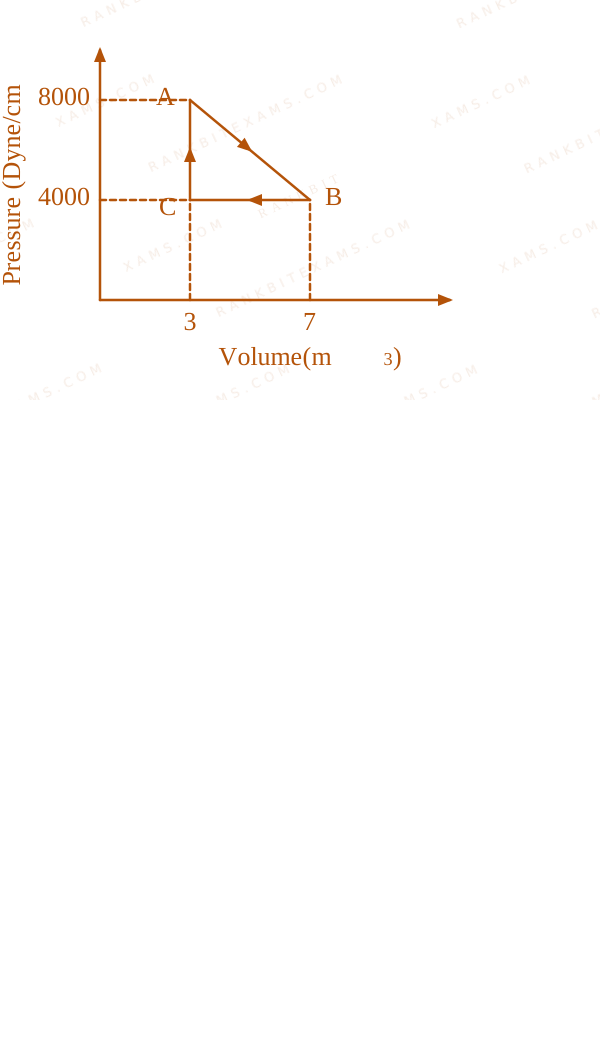
A thermodynamic system is taken from an original state A to an intermediate state B by a linear process as shown in the figure. It's volume is then reduced to the original value from B to C by an isobaric process. The total work done by the gas from A to B and B to C would be:
The graph plots Pressure (Dyne/cm^2) on the y-axis (with coordinates at 4000 and 8000) versus Volume (m^3) on the x-axis (with marks at 3 and 7). State path goes linearly from A to B, then horizontally from B to C.
A.33800 ~J$33800 \mathrm{~J}$
B.2200 ~J$2200 \mathrm{~J}$
C.600 ~J$600 \mathrm{~J}$
D.1200 ~J$1200 \mathrm{~J}$
Solution & Explanation
Related Formula
Work done (W$W$) in a thermodynamic process corresponds to the area under the curve on a P-V$P-V$ diagram:
W = ∫ P dV$$W = \int P \, dV$$
Core Logic
Let's compute the work done along the distinct steps AB$AB$ and BC$BC$ matching the values shown in the graph:
The graph plots Pressure (Dyne/cm^2) on the y-axis (with coordinates at 4000 and 8000) versus Volume (m^3) on the x-axis (with marks at 3 and 7). State path goes linearly from A to B, then horizontally from B to C.
Step 1: Calculate Work Done in Process AB
Process AB$AB$ is a linear expansion. Fulfilling the area of the trapezoid underneath path AB$AB$:
Since 800 ~J$800 \mathrm{~J}$ is not present in the options, this question was declared a BONUS.
Pattern Recognition
Always be highly vigilant of mixed unit systems in thermodynamic graphics. Here, pressure is in CGS (Dyne/cm²$\text{Dyne/cm}^2$) while volume is in MKS (m³$\text{m}^3$). Converting early keeps you clear of algebraic traps.
More Thermodynamics Previous-Year Questions — Page 6
Q6jee_main_2025_24_jan_eveningAdiabatic Processes
Given below are two statements. One is labelled as Assertion (A) and the other is labelled as Reason (R).
Assertion (A) : In an insulated container, a gas is adiabatically shrunk to half of its initial volume. The temperature of the gas decreases.
Reason (R) : Free expansion of an ideal gas is an irreversible and an adiabatic process.
In the light of the above statement, choose the correct answer from the options given below :
A. Both (A)$(A)$ and (R)$(R)$ are true and (R)$(R)$ is the correct explanation of (A)$(A)$
B.(A)$(A)$ is true but (R)$(R)$ is false
C.(A)$(A)$ is false but (R)$(R)$ is true
D. Both (A)$(A)$ and (R)$(R)$ are true but (R)$(R)$ is NOT the correct explanation of (A)$(A)$
Assertion (A) review:
An insulated container means the process is adiabatic (Q=0$Q=0$). When the gas is shrunk (compressed) to half its volume (V₂ = V₁ / 2$V_2 = V_1 / 2$),
Since γ > 1$\gamma > 1$, T₂ > T₁$T_2 > T_1$. Therefore, temperature increases during adiabatic compression, which makes Assertion (A) false.
Reason (R) review:
Free expansion occurs when a gas expands into a vacuum inside an insulated container. No work is done (W=0$W=0$) and no heat is exchanged (Q=0$Q=0$), hence it is adiabatic. It cannot spontaneously reverse, so it is irreversible. Thus, Reason (R) is true.
Pattern Recognition
Adiabatic compression always raises temperature due to work being done on the gas, while free expansion keeps the temperature of an ideal gas constant (dI=0$dI=0$ as W=0, Q=0$W=0, Q=0$).
Chapter Mix
Class 11 Physics: Thermodynamics
Q13jee_main_2025_24_jan_eveningCyclic Processes
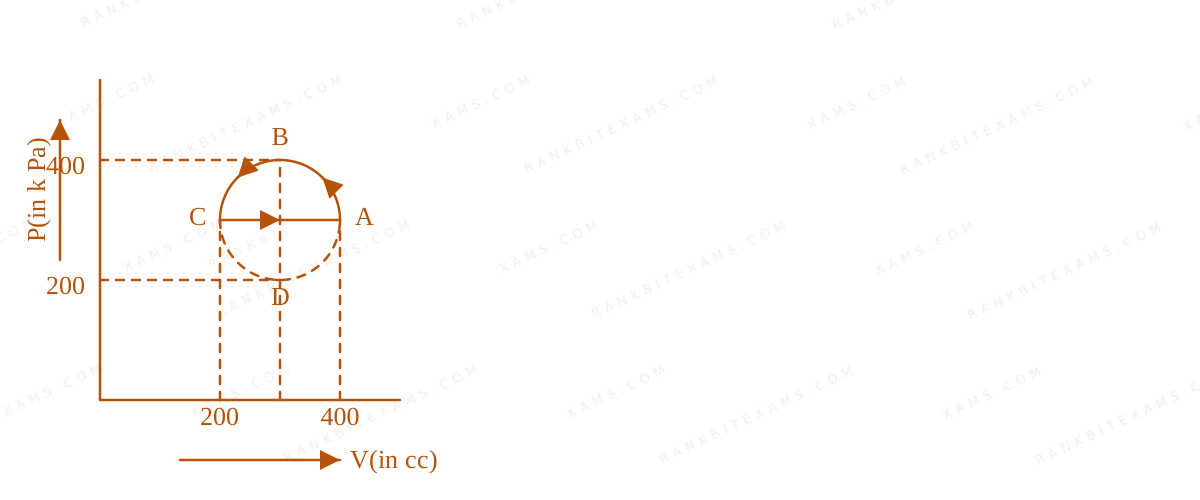
The magnitude of heat exchanged by a system for the given cyclic process ABCA (as shown in figure The image shows a P-V cycle consisting of a horizontal line from C to A and a semicircular loop from A back to C via B.) is (in SI unit)
A.10π$10\pi$
B.5π$5\pi$
C. zero
D.40π$40\pi$
Solution
Related Formula
From the first law of thermodynamics for a complete cycle:
Δ U = 0 Q = W = Area of the loop$$\Delta U = 0 \implies Q = W = \text{Area of the loop}$$
Core Logic
The graph shows a semicircle in a P-V$P\text{-}V$ indicator diagram. The image shows a P-V cycle consisting of a horizontal line from C to A and a semicircular loop from A back to C via B.
Since Q = W$Q = W$, the heat exchanged has a magnitude of 5π J$5\pi\ \mathrm{J}$.
Pattern Recognition
For a cycle on an indicator chart with mismatched scales, use the elliptic area template π a b$\pi a b$ (or (1)/(2)π a b$\frac{1}{2}\pi a b$ for a half-ellipse/semicircle).
An ideal gas goes from an initial state to final state. During the process, the pressure of gas increases linearly with temperature.
A. The work done by gas during the process is zero.
B. The heat added to gas is different from change in its internal energy.
C. The volume of the gas is increased.
D. The internal energy of the gas is increased.
E. The process is isochoric (constant volume process)
Choose the correct answer from the options given below :-
A. A, B, C, D Only
B. A, D, E Only
C. E Only
D. A, C Only
Solution
Related Formula
From the Ideal Gas Law:
PV = nRT$PV = nRT$
According to the First Law of Thermodynamics:
Δ Q = Δ U + W$$\Delta Q = \Delta U + W$$
Core Logic
The question states that pressure increases linearly with temperature, which means their ratio is constant :
Since (P)/(T) = (nR)/(V)$\frac{P}{T} = \frac{nR}{V}$, the volume V$V$ must remain constant throughout the process. This identifies it as an isochoric process (Statement E is true).
Step 1: Evaluate All Statements
Statement A: True. In an isochoric process, dV = 0 W = ∫ P dV = 0$dV = 0 \implies W = \int P dV = 0$.
Statement B: False. Since work is zero, the First Law simplifies to Δ Q = Δ U$\Delta Q = \Delta U$, meaning heat added equals the change in internal energy.
Statement C: False. Volume is constant, so it does not increase.
Statement D: True. As pressure increases linearly with temperature, temperature increases, which causes the internal energy of the gas to increase.
Step 2: Final Selection
Gathering the true statements (A, D, and E) points directly to Option (2).
Pattern Recognition
A linear P-T$P-T$ line passing through the origin always indicates a constant volume graph. For constant volume graphs, work done is zero, which simplifies the first law calculation.
Chapter Mix
Class 11 Physics: Thermodynamics
Q25jee_main_2025_24_jan_morningSpecific Heat Capacities of Gases
The temperature of 1 mole of an ideal monoatomic gas is increased by 50°C$50^{\circ}C$ at constant pressure. The total heat added and change in internal energy are E₁$E_{1}$ and E₂$E_{2}$, respectively. If E₁E₂=(x)/(9)$\frac{E_{1}}{E_{2}}=\frac{x}{9}$ then the value of x is
Numerical Answer.Answer: 15 to 15
Solution
Related Formula
For an ideal gas thermodynamic process:
Total heat added at constant pressure (isobaric process) is :
E₁ = n CP Δ T$$E_{1} = n C_{P} \Delta T$$
Total change in internal energy is given by :
E₂ = n CV Δ T$$E_{2} = n C_{V} \Delta T$$
The ratio of specific heat capacities is defined as:
γ = CPCV$$\gamma = \frac{C_{P}}{C_{V}} $$
Core Logic
Taking the ratio of the two energy expressions[cite: 179, 823]:
The ratio of heat added to the change in internal energy during an isobaric process is always equal to the adiabatic exponent γ$\gamma$ of the gas.
Chapter Mix
Class 11 Physics: Thermodynamics

Qjee_main_2025_29_jan_morningAdiabatic Process
The workdone in an adiabatic change in an ideal gas depends upon only :
A. change in its pressure
B. change in its specific heat
C. change in its volume
D. change in its temperature
Solution
Related Formula
Δ W = -Δ U = -n Cv Δ T$$\Delta W = -\Delta U = -n C_v \Delta T$$
Core Logic
In an adiabatic system, no heat exchange occurs (Q=0$Q=0$). By the first law of thermodynamics, Δ W = -Δ U$\Delta W = -\Delta U$. Since internal energy U$U$ depends explicitly on temperature metrics, the total work output shifts uniquely based on temperature variation Δ T$\Delta T$.
Chapter Mix
Class 11 Physics: Thermodynamics
More Thermodynamics Questions — jee_main_2024_29_jan_morning
Practice past-year questions one chapter at a time. Pick an exam → subject → chapter and get every PYQ for that topic — pulled together from all past papers — with the chapter's key formulas alongside.