Rankbit System
JEE Physics: Waves (+15.5%) | Electrostatics: Concentric Shells (-29.7%) | Modern Physics: Photoelectric Clones (+34.2%) | Mathematics: Definite Integrals (+18.1%) | Chemistry: Coordination Splitting (-11.4%) | JEE Physics: Waves (+15.5%) | Electrostatics: Concentric Shells (-29.7%) | Modern Physics: Photoelectric Clones (+34.2%) | Mathematics: Definite Integrals (+18.1%) | Chemistry: Coordination Splitting (-11.4%)

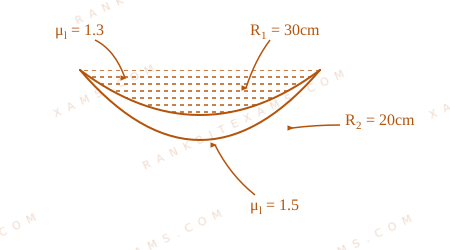
A biconvex lens of refractive index 1.5 has a focal length of 20 mathrm~cm in air. Its focal length when immersed in a liquid of refractive index 1.6 will be:

Solution & Explanation

### Related Formula From the Lens Maker's Formula: frac1f = left( fracmu_textlensmu_textmedium - 1 right) left( frac1R_1 - frac1R_2 right) Taking the ratio of focal length in liquid medium (f_m) to focal length in air (f_a): fracf_mf_a = frac(mu_1 - 1) mu_mmu_1 - mu_m where, mu_1 = refractive index of the lens material = 1.5 mu_m = refractive index of the liquid medium = 1.6 f_a = focal length in air = 20 mathrm~cm ### Core Logic Substitute the parameters into the relative ratio template equation: fracf_m20 = frac(1.5 - 1) times 1.61.5 - 1.6 ### Step 1: Simplify and Compute $fracf_m20 = frac0.5 times 1.6-0.1 fracf_m20 = frac0.8-0.1 = -8 f_m = -8 times 20 = -160 mathrm~cm Therefore, the focal length in the liquid is -160 mathrm~cm. ### Pattern Recognition Notice that since the surrounding liquid medium has a higher refractive index than the lens material itself (mu_m gt mu_1), the sign of the focal length flips from positive to negative. The convex lens behaves as a diverging lens inside this specific liquid. ### Evaluation Rubric / Model Answer null ### Chapter Mix Class 12 Physics: Ray Optics and Optical Instruments

Reference Study Guides

More Ray Optics and Optical Instruments Previous-Year Questions — Page 6

Q14 jee_main_2025_24_jan_evening Lenses and Magnification
A photograph of a landscape is captured by a drone camera at a height of 18 km. The size of the camera film is 2 \, cm times 2 \, cm and the area of the landscape photographed is 400 \, km^2 . The focal length of the lens in the drone camera is:
  • A. 1.8 cm
  • B. 2.8 cm
  • C. 2.5 cm
  • D. 0.9 cm

Solution

### Related Formula Areal Magnification: m^2 = fracA_textimageA_textobject = left(fracff+u ight)^2 approx left(fracfu ight)^2 since object distance u = -18\ mathrmkm is vastly larger than f. ### Core Logic Given parameters:
Ray context geometry for drone camera scaling layout Q14
- Object height distance, H = 18\ mathrmkm = 18 times 10^3\ mathrmm - Film size area, A_textimage = 2\ mathrmcm times 2\ mathrmcm = 4\ mathrmcm^2 = 4 times 10^-4\ mathrmm^2 - Landscape area, A_textobject = 400\ mathrmkm^2 = 400 times 10^6\ mathrmm^2 Linear magnification factor: fracyx = sqrtfracA_textimageA_textobject = sqrtfrac4 times 10^-4400 times 10^6 = sqrt10^-12 = 10^-6 Using the simple pinhole/thin lens perspective ratio: fracfH = 10^-6 implies f = 18 times 10^3 times 10^-6 = 18 times 10^-3\ mathrmm = 1.8\ mathrmcm ### Pattern Recognition For aerial satellite imaging contexts where u gg f, linear sizing scales directly as fractextfilm sidetextground side = fracfH. ### Evaluation Rubric / Model Answer null ### Chapter Mix Class 12 Physics: Ray Optics and Optical Instruments
Q2 jee_main_2025_24_jan_morning Power of a Lens
What is the relative decrease in focal length of a lens for an increase in optical power by 0.1 D from 2.5 D ? ['D' stands for dioptre]
  • A. 0.04
  • B. 0.40
  • C. 0.1
  • D. 0.01

Solution

### Related Formula The relationship between optical power P and focal length F is given by: F = frac1P Relative decrease in focal length is defined as: fracDelta FF = fracF - F'F ### Core Logic Given initial power P = 2.5text D[cite: 19, 600]. After an increase of 0.1text D, the new power is[cite: 19, 603]: P' = 2.5 + 0.1 = 2.6text D ### Step 1: Calculate Focal Length Change Find the initial and final focal lengths [cite: 602, 604]: F = frac12.5 = frac25 F' = frac12.6 = frac513 Now, calculate the relative decrease: fracF - F'F = 1 - fracF'F = 1 - fracPP' = 1 - frac2.52.6 = frac0.12.6 = frac126 approx 0.04 ### Pattern Recognition For a small change, we can approximate using differentiation: P = frac1F implies dP = -fracdFF^2 implies fracdFF = -fracdPP. Thus, the relative change magnitude is frac0.12.5 = frac125 = 0.04. ### Evaluation Rubric / Model Answer null ### Chapter Mix Class 12 Physics: Ray Optics and Optical Instruments
Q12 jee_main_2025_24_jan_morning Silvering of Lenses
A thin plano convex lens made of glass of refractive index 1.5 is immersed in a liquid of refractive index 1.2. When the plane side of the lens is silver coated for complete reflection, the lens immersed in the liquid behaves like a concave mirror of focal length 0.2 m. The radius of curvature of the curved surface of the lens is :-
  • A. 0.15 m
  • B. 0.10 m
  • C. 0.20 m
  • D. 0.25 m

Solution

### Related Formula The net focal power of a silvered tracking lens system is given by: P = 2P_L + P_M frac1f = frac2f_L + frac1f_M ### Core Logic As shown in diagram
Silvering of Lenses diagram for Q12 - JEE Main 2025 Morning
, the plane flat side boundary interface has an infinite radius of curvature (R_2 = infty), meaning its mirror focal component is f_M = infty implies P_M = 0. The power depends entirely on the refraction step: frac1f = frac2f_L ### Step 1: Lens Maker Formulation Find the focal expression of the immersed lens element [cite: 91, 679]: frac1f_L = left(fracmu_textglassmu_textliquid - 1 ight)left(frac1R ight) = left(frac1.51.2 - 1 ight)frac1R = frac0.31.2frac1R = frac14R Now insert this into the total system tracking balance relation : frac1f = 2 left(frac14R ight) = frac12R Given the final effective concave configuration matches f = 0.2text m : frac10.2 = frac12R implies 2R = 0.2 implies R = 0.10text m ### Pattern Recognition Silvering a plano-flat back boundary means light traverses the initial curved face interface exactly twice, mapping to R = 2 cdot f cdot (mu_textrel - 1). ### Evaluation Rubric / Model Answer null ### Chapter Mix Class 12 Physics: Ray Optics and Optical Instruments
Q15 jee_main_2025_24_jan_morning Lens Maker's Formula
A plano-convex lens having radius of curvature of first surface 2 cm exhibits focal length of f_1 in air. Another plano-convex lens with first surface radius of curvature 3 cm has focal length of f_2 when it is immersed in a liquid of refractive index 1.2. If both the lenses are made of same glass of refractive index 1.5, the ratio of f_1 and f_2 will be :-
  • A. 3:5
  • B. 1:3
  • C. 1:2
  • D. 2:3

Solution

### Related Formula Lens Maker's Formula for a lens in a surrounding medium of refractive index mu_m is: frac1f = left(fracmu_textlensmu_m - 1 ight)left(frac1R_1 - frac1R_2 ight) ### Core Logic For a plano-convex configuration, the flat side has an infinite radius of curvature (R_2 = infty implies frac1R_2 = 0). ### Step 1: Evaluating Respective Focal Scales For the first lens setup in air (mu_m = 1) : frac1f_1 = (1.5 - 1)left(frac12 - 0 ight) = 0.5 times frac12 = frac14 implies f_1 = 4text cm For the second lens setup immersed inside fluid (mu_m = 1.2) : frac1f_2 = left(frac1.51.2 - 1 ight)left(frac13 - 0 ight) = (1.25 - 1)frac13 = frac0.253 = frac112 implies f_2 = 12text cm Taking their direct ratio : f_1 : f_2 = 4 : 12 = 1 : 3 ### Pattern Recognition Always separate the refractive index multiplier from the geometric shape factor. This lets you calculate each change independently before taking the final ratio. ### Evaluation Rubric / Model Answer null ### Chapter Mix Class 12 Physics: Ray Optics and Optical Instruments
Q6 jee_main_2025_28_jan_evening Refraction at Spherical Surfaces
In a long glass tube, mixture of two liquids A and B with refractive indices 1.3 and 1.4 respectively, forms a convex refractive meniscus towards A. If an object placed at 13mathrmcm from the vertex of the meniscus in A forms an image with a magnification of -2 then the radius of curvature of meniscus is :
  • A. 1 \, textcm
  • B. frac13mathrmcm
  • C. frac23 mathrm~cm
  • D. frac43 mathrm~cm

Solution

### Related Formula For refraction at a single spherical surface separating two mediums : fracn_2v - fracn_1u = fracn_2 - n_1R Linear magnification for a spherical refracting boundary is given by: m = fracv / n_2u / n_1 = fracv cdot n_1u cdot n_2$ ### Core Logic Given parameters from the text [cite: 17, 651, 654]: * Refractive index of Medium A, $n_1 = 1.3$ * Refractive index of Medium B, $n_2 = 1.4$ * Object distance, $u = -13 text cm$ * Magnification, $m = -2$ Using the magnification formula to locate image position $v$ : -2 = \frac{v \cdot 1.3}{(-13) \cdot 1.4} -2 = \frac{1.3 \cdot v}{-18.2} \implies 1.3 v = 36.4 \implies v = 28 \text{ cm} Now substitute $u = -13$, $v = 28$, $n_1 = 1.3$, $n_2 = 1.4$ into the boundary equation: \frac{1.4}{28} - \frac{1.3}{-13} = \frac{1.4 - 1.3}{R} \frac{1}{20} + \frac{1}{10} = \frac{0.1}{R} \frac{1 + 2}{20} = \frac{0.1}{R} \implies \frac{3}{20} = \frac{1}{10R} 30 R = 20 \implies R = \frac{2}{3} \text{ cm}$ ### Step 1: Visual Context The visual system configuration of the refracting interface is tracked here:
Refraction at Spherical Surfaces diagram for Q6 - JEE Main 2025 Evening
### Pattern Recognition Keep precise track of sign conventions for single spherical surfaces. A convex meniscus towards A means the center of curvature lies inside medium B, meaning
R$ will mathematically return as a positive parameter. ### Evaluation Rubric / Model Answer null ### Chapter Mix Class 12 Physics: Ray Optics

More Ray Optics and Optical Instruments Questions — jee_main_2024_29_jan_morning

Practice all Ray Optics and Optical Instruments previous-year questions →

YOUR FIRST PREP STEP STARTS HERE

We Map Every Repeating Question in Competitive Exams.

Say goodbye to generic mock test fatigue. RankBit uses smart analysis to group past exam questions into their foundational Repeating Question Types. Find chapter weightage, track repeating questions, and score higher with targeted practice.

Select Your Target Exam

Choose an exam track below to find formulas per chapter and patterns.

Syncing Exam Intelligence

Mapping formulas and patterns across all tracks…

PATH A — FULL LENGTH PRACTICE

Full Mock Test Hub

Simulate real NTA exam conditions with fully tracked mocks. Time yourself against past papers.

Under Development
PATH B — TARGETED PRACTICE

Topic-wise Practice Hub

Practice past-year questions one chapter at a time. Pick an exam → subject → chapter and get every PYQ for that topic — pulled together from all past papers — with the chapter's key formulas alongside.

Loading Questions... Browse Topics
Latest from the Blog
View all →

Loading articles...