Rankbit System
JEE Physics: Waves (+15.5%) | Electrostatics: Concentric Shells (-29.7%) | Modern Physics: Photoelectric Clones (+34.2%) | Mathematics: Definite Integrals (+18.1%) | Chemistry: Coordination Splitting (-11.4%) | JEE Physics: Waves (+15.5%) | Electrostatics: Concentric Shells (-29.7%) | Modern Physics: Photoelectric Clones (+34.2%) | Mathematics: Definite Integrals (+18.1%) | Chemistry: Coordination Splitting (-11.4%)

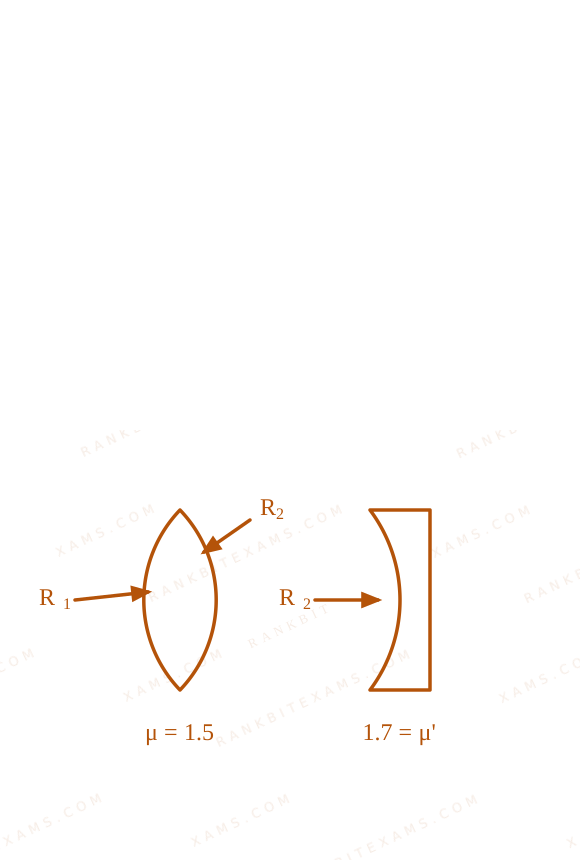
A biconvex lens of refractive index 1.5 has a focal length of 20 mathrm~cm in air. Its focal length when immersed in a liquid of refractive index 1.6 will be:

Solution & Explanation

### Related Formula From the Lens Maker's Formula: frac1f = left( fracmu_textlensmu_textmedium - 1 right) left( frac1R_1 - frac1R_2 right) Taking the ratio of focal length in liquid medium (f_m) to focal length in air (f_a): fracf_mf_a = frac(mu_1 - 1) mu_mmu_1 - mu_m where, mu_1 = refractive index of the lens material = 1.5 mu_m = refractive index of the liquid medium = 1.6 f_a = focal length in air = 20 mathrm~cm ### Core Logic Substitute the parameters into the relative ratio template equation: fracf_m20 = frac(1.5 - 1) times 1.61.5 - 1.6 ### Step 1: Simplify and Compute $fracf_m20 = frac0.5 times 1.6-0.1 fracf_m20 = frac0.8-0.1 = -8 f_m = -8 times 20 = -160 mathrm~cm Therefore, the focal length in the liquid is -160 mathrm~cm. ### Pattern Recognition Notice that since the surrounding liquid medium has a higher refractive index than the lens material itself (mu_m gt mu_1), the sign of the focal length flips from positive to negative. The convex lens behaves as a diverging lens inside this specific liquid. ### Evaluation Rubric / Model Answer null ### Chapter Mix Class 12 Physics: Ray Optics and Optical Instruments
Reference Study Guides

More Ray Optics and Optical Instruments Previous-Year Questions — Page 4

Q5 jee_main_2025_28_jan_morning Total Internal Reflection
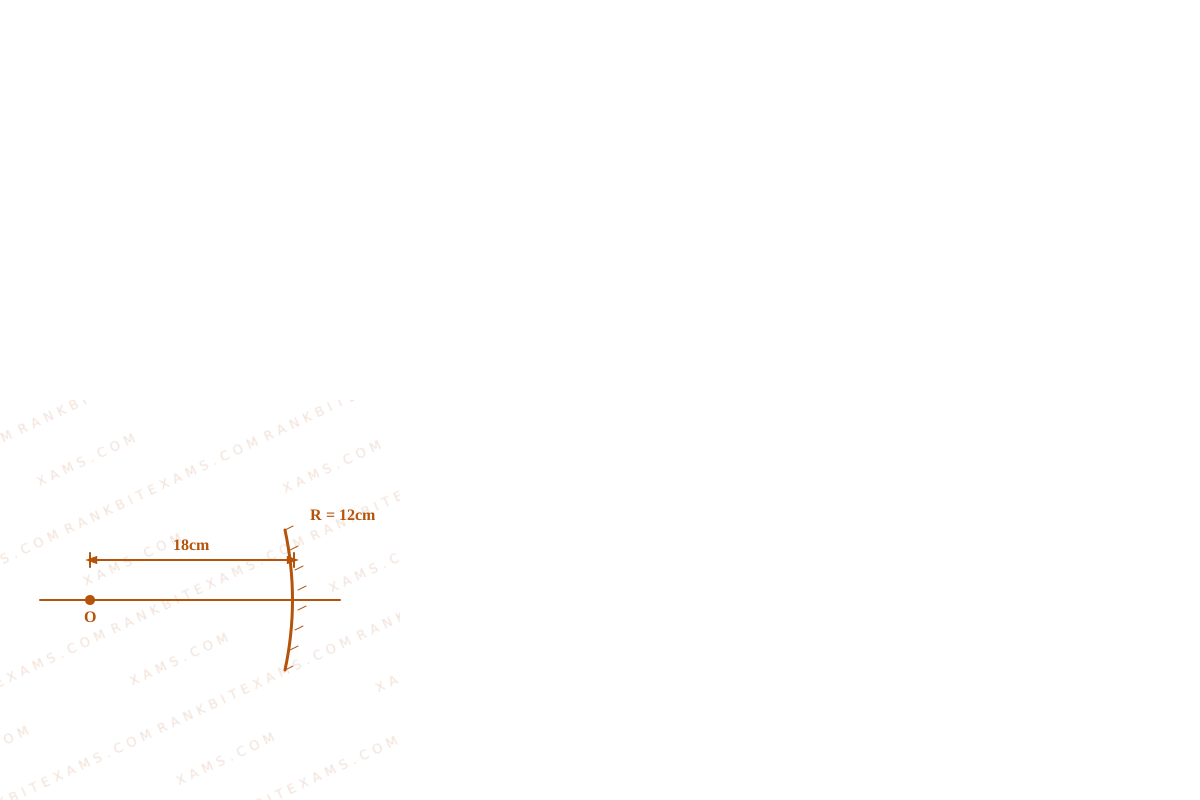
A hemispherical vessel is completely filled with a liquid of refractive index mu . A small coin is kept at the lowest point (O) of the vessel as shown in figure. The minimum value of the refractive index of the liquid so that a person can see the coin from point E (at the level of the vessel) is
Total Internal Reflection diagram for Q5 - JEE Main 2025 Morning
A coin at the base of a hemispherical liquid filled container viewed from the grazing edge point E.
  • A. sqrt3
  • B. frac32
  • C. sqrt2
  • D. fracsqrt32

Solution

### Related Formula sin mathrmc = frac1mu ### Core Logic To see the coin from edge point mathrmE at grazing emergency, the light ray travelling from mathrmO to mathrmE must strike the flat upper boundary at the critical angle.
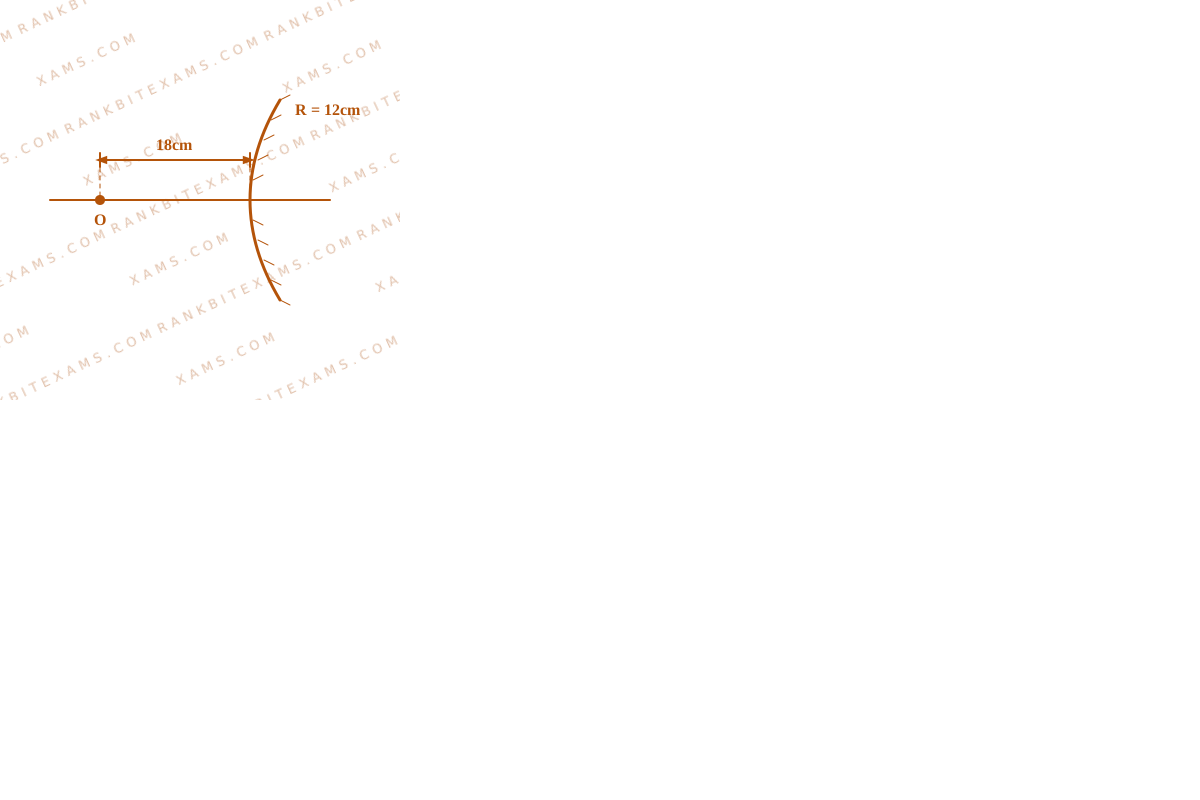
Ray tracing verification layout for Q5
A coin at the base of a hemispherical liquid filled container viewed from the grazing edge point E.
Given the hemispherical layout geometry, the ray's angle of incidence at the center of the surface plane satisfies: theta = mathrmc = 45^circ Substituting this value into the critical value expression: mu = frac1sin 45^circ = sqrt2 ### Step 1: Final Conclusion The minimum refractive index required is sqrt2, matching option (3). ### Pattern Recognition Grazing boundary ray vision configurations dictate evaluating the specific systemic geometric configuration to compute the critical boundary angle. Here, the radius profile fixes theta = 45^circ deterministically. ### Evaluation Rubric / Model Answer null ### Chapter Mix Class 12 Physics: Ray Optics and Optical Instruments
Q20 jee_main_2025_28_jan_morning Prism and Dispersion
A thin prism mathrmP_1 with angle 4^circ made of glass having refractive index 1.54, is combined with another thin prism mathrmP_2 made of glass having refractive index 1.72 to get dispersion without deviation. The angle of the prism mathrmP_2 in degrees is
  • A. 4
  • B. 3
  • C. 16/3
  • D. 1.5

Solution

### Related Formula delta = (mu - 1)mathrmA ### Core Logic To achieve dispersion without deviation, the net deviation produced by the prism combination must be zero: delta_textnet = 0 implies (mu_1 - 1)mathrmA_1 - (mu_2 - 1)mathrmA_2 = 0 Substituting the given parameters into the equation: (1.54 - 1) cdot 4^circ - (1.72 - 1)mathrmA_2 = 0 0.54 cdot 4 = 0.72 cdot mathrmA_2 mathrmA_2 = frac2.160.72 = 3^circ ### Step 1: Final Angle Value The required angle for the second thin prism is 3^circ, which matches option (2). ### Pattern Recognition For zero deviation conditions using thin components, balance the deviation equations directly: (mu-1)mathrmA = (mu'-1)mathrmA'. ### Evaluation Rubric / Model Answer null ### Chapter Mix Class 12 Physics: Ray Optics and Optical Instruments
Q18 jee_main_2025_03_april_morning Lens Maker's Formula
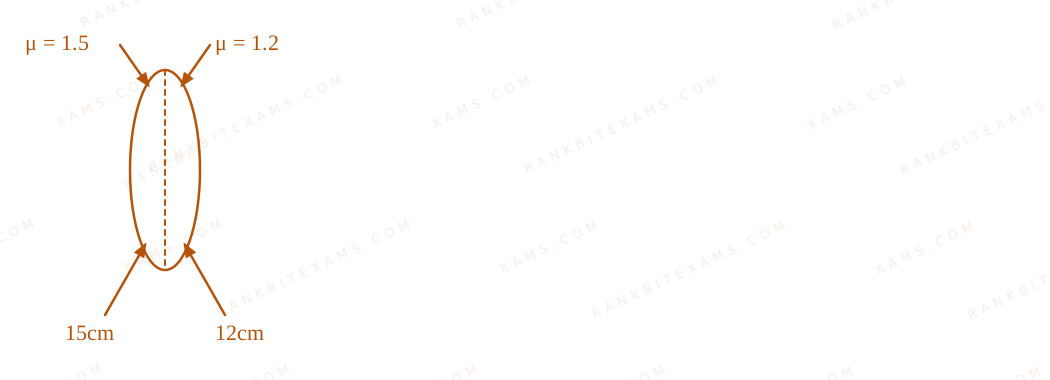
The radii of curvature for a thin convex lens are 10mathrm~cm and 15mathrm~cm respectively. The focal length of the lens is 12mathrm~cm. The refractive index of the lens material is:
  • A. 1.2
  • B. 1.4
  • C. 1.5
  • D. 1.8

Solution

### Related Formula Lens Maker's Formula: frac1f = (mu - 1) left(frac1R_1 - frac1R_2right) where, f = focal length of the lens, mu = refractive index of the material, R_1, R_2 = radii of curvature with standard Cartesian sign convention. ### Core Logic For a thin bi-convex lens, using standard coordinate conventions: - R_1 = +10mathrm~cm (positive since first surface centers to the right of light trajectory), - R_2 = -15mathrm~cm (negative since second surface centers to the left), - Focal length f = +12mathrm~cm. ### Step 1: Substituting in the Equation Substitute the values into Lens Maker's formula: frac112 = (mu - 1) left(frac110 - frac1-15right) frac112 = (mu - 1) left(frac110 + frac115right) frac112 = (mu - 1) left(frac3 + 230right) frac112 = (mu - 1) left(frac530right) = (mu - 1) left(frac16right) mu - 1 = frac612 = 0.5 implies mu = 1.5 ### Pattern Recognition Convex lenses always have opposite signs for R_1 and R_2. The term left(frac1R_1 - frac1R_2right) is additive: left(frac1|R_1| + frac1|R_2|right). ### Evaluation Rubric / Model Answer null ### Chapter Mix Class 12 Physics: Ray Optics and Optical Instruments

Q20 jee_main_2025_03_april_morning Minimum Deviation in Prism
Consider following statements for refraction of light through prism, when angle of deviation is minimum. (A) The refracted ray inside prism becomes parallel to the base. (B) Larger angle prisms provide smaller angle of minimum deviation. (C) Angle of incidence and angle of emergence becomes equal. (D) There are always two sets of angle of incidence for which deviation will be same except at minimum deviation setting. (E) Angle of refraction becomes double of prism angle. Choose the correct answer from the options given below.
  • A. A, C and D Only
  • B. B, C and D Only
  • C. A, B and E Only
  • D. B, D and E Only

Solution

### Related Formula For a prism of angle A: - Deviation: delta = i + e - A - Minimum deviation delta_textmin occurs when: i = e quad textand quad r_1 = r_2 = fracA2 - Under minimum deviation, the ray inside an equilateral/isosceles prism travels symmetrically, making it parallel to the prism base. ### Core Logic Let's check the validity of each statement: - **Statement (A)**: The refracted ray inside the prism becomes parallel to the base at minimum deviation. (True for symmetric prisms) - **Statement (B)**: Larger angle prisms provide smaller minimum deviation. By minimum deviation equation: mu = fracsinleft(fracA+delta_textmin2right)sinleft(fracA2right) As A increases, delta_textmin generally increases, not decreases. (False) - **Statement (C)**: Angle of incidence i and angle of emergence e become equal (i = e) during the minimum deviation state. (True) - **Statement (D)**: The delta-i curve is asymmetric and parabolic-like; for any deviation delta > delta_textmin, there are always exactly two different incident angles (i and e) that yield the same deviation, except at the minimum deviation point (which has a single unique value). (True) - **Statement (E)**: Angle of refraction r = A/2, which is half of the prism angle, not double. (False) ### Step 1: Conclusion Since statements A, C, and D are true, the correct option is (1). ### Pattern Recognition Review the classic parabolic shape of the deviation vs. angle of incidence (delta-i) graph. Notice that any horizontal line above the minimum point intersects twice (representing i and e for that deviation). Minimum deviation is the unique local minimum, where i = e and r_1 = r_2 = A/2. ### Evaluation Rubric / Model Answer null ### Chapter Mix Class 12 Physics: Ray Optics and Optical Instruments: Refraction through Prism
Q19 jee_main_2025_04_april_evening Spherical Mirrors
A finite size object is placed normal to the principal axis at a distance of 30 cm from a convex mirror of focal length 30 cm. A plane mirror is now placed in such a way that the image produced by both the mirrors coincide with each other. The distance between the two mirrors is :
  • A. 45 cm
  • B. 7.5 cm
  • C. 22.5 cm
  • D. 15 cm

Solution

### Related Formula Mirror Formula: frac1v + frac1u = frac1f ### Core Logic For the convex mirror, u = -30text cm and f = +30text cm. frac1v - frac130 = frac130 implies frac1v = frac230 implies v = +15text cm So, the convex mirror forms a virtual image 15 cm behind its surface. ### Step 1: Align Plane Mirror Image The total distance from the object to the image location is 30 + 15 = 45text cm. For a plane mirror to create an image at this same exact location, it must be placed precisely midway between the object and the image. Distance from object to plane mirror: d = frac452 = 22.5text cm Therefore, the clearance distance between the convex mirror and the plane mirror surface is: textDistance = 30 - 22.5 = 7.5text cm ### Pattern Recognition Coinciding images imply identical coordinate endpoints. Calculate the convex position explicitly, find the total path length from the real source object, and slice it in half for the plane mirror location. ### Evaluation Rubric / Model Answer null ### Chapter Mix Class 12 Physics: Ray Optics and Optical Instruments

More Ray Optics and Optical Instruments Questions — jee_main_2024_29_jan_morning

Practice all Ray Optics and Optical Instruments previous-year questions →

YOUR FIRST PREP STEP STARTS HERE

We Map Every Repeating Question in Competitive Exams.

Say goodbye to generic mock test fatigue. RankBit uses smart analysis to group past exam questions into their foundational Repeating Question Types. Find chapter weightage, track repeating questions, and score higher with targeted practice.

Select Your Target Exam

Choose an exam track below to find formulas per chapter and patterns.

Syncing Exam Intelligence

Mapping formulas and patterns across all tracks…

PATH A — FULL LENGTH PRACTICE

Full Mock Test Hub

Simulate real NTA exam conditions with fully tracked mocks. Time yourself against past papers.

Under Development
PATH B — TARGETED PRACTICE

Topic-wise Practice Hub

Practice past-year questions one chapter at a time. Pick an exam → subject → chapter and get every PYQ for that topic — pulled together from all past papers — with the chapter's key formulas alongside.

Loading Questions... Browse Topics
Latest from the Blog
View all →

Loading articles...