The deflection in moving coil galvanometer falls from 25 divisions to 5 division when a shunt of 24 \, Omega$24 \, \Omega$ is applied. The resistance of galvanometer coil will be:
A.12 \, Omega$12 \, \Omega$
B.96 \, Omega$96 \, \Omega$
C.48 \, Omega$48 \, \Omega$
D.100 \, Omega$100 \, \Omega$
Solution & Explanation
### Related Formula
For a shunted galvanometer, the potential difference across the galvanometer is equal to the potential difference across the shunt resistor:
I_g G = (I - I_g) S$$I_g G = (I - I_g) S$$
### Core Logic
Let the current sensitivity per division be x$x$.
* Initially, without the shunt, the total current I$I$ gives a full scale deflection of 25 divisions:
I = 25x$I = 25x$Schematic diagrams representing galvanometer before and after shunting for Q44
* When the shunt (S = 24 \, Omega$S = 24 \, \Omega$) is connected in parallel, the current passing through the galvanometer branch (I_g$I_g$) corresponds to a deflection of 5 divisions:
I_g = 5x$I_g = 5x$Schematic diagrams representing galvanometer before and after shunting for Q44
### Step 1: Find Current through the Shunt
The current remaining for the shunt branch is:
I - I_g = 25x - 5x = 20x$$I - I_g = 25x - 5x = 20x$$
### Step 2: Equate Potential Drops
Applying the parallel branch condition:
5x cdot G = 20x cdot 24$$5x \cdot G = 20x \cdot 24$$
Dividing both sides by 5x$5x$:
G = 4 times 24 = 96 \, Omega$$G = 4 \times 24 = 96 \, \Omega$$
Therefore, the resistance of the galvanometer coil is 96 \, Omega$96 \, \Omega$.
### Pattern Recognition
The deflection is directly proportional to the branch current. A drop from 25 divisions to 5 divisions means only frac525 = frac15$\frac{5}{25} = \frac{1}{5}$ of the total current flows through the galvanometer, leaving frac45$\frac{4}{5}$ to go through the shunt. Hence, the galvanometer resistance must be 4 times the shunt resistance.
### Evaluation Rubric / Model Answer
null
### Chapter Mix
Class 12 Physics: Moving Charges and Magnetism
Keywords:#deflection in moving coil galvanometer falls#JEE Main 2024 Morning Q44#Magnetism JEE Main 2024#Galvanometer and its Conversions
More Moving Charges and Magnetism Previous-Year Questions — Page 5
Q42jee_main_2024_29_jan_morningGalvanometer and its Conversions
A galvanometer having coil resistance 10 \, Omega$10 \, \Omega$ shows a full scale deflection for a current of 3 mathrm~mA$3 \mathrm{~mA}$. For it to measure a current of 8 mathrm~A$8 \mathrm{~A}$, the value of the shunt should be:
A.3 times 10^-3 \, Omega$3 \times 10^{-3} \, \Omega$
B.4.85 times 10^-3 \, Omega$4.85 \times 10^{-3} \, \Omega$
C.3.75 times 10^-3 \, Omega$3.75 \times 10^{-3} \, \Omega$
D.2.75 times 10^-3 \, Omega$2.75 \times 10^{-3} \, \Omega$
Solution
### Related Formula
To convert a galvanometer into an ammeter, a small resistance called a shunt (S$S$) is connected in parallel with the galvanometer (G$G$):
I_g G = (I - I_g) S implies S = fracI_g GI - I_g$$I_g G = (I - I_g) S \implies S = \frac{I_g G}{I - I_g}$$
where,
G$G$ = resistance of the galvanometer coil
I_g$I_g$ = full-scale deflection current of the galvanometer
I$I$ = total current to be measured
S$S$ = shunt resistance
### Core Logic
Given values:
G = 10 \, Omega$$G = 10 \, \Omega$$I_g = 3 mathrm~mA = 3 times 10^-3 mathrm~A$$I_g = 3 \mathrm{~mA} = 3 \times 10^{-3} \mathrm{~A}$$I = 8 mathrm~A$$I = 8 \mathrm{~A}$$
### Step 1: Calculate Shunt Resistance
Substituting these values into the shunt formula:
S = frac(3 times 10^-3) times 108 - 0.003$$S = \frac{(3 \times 10^{-3}) \times 10}{8 - 0.003}$$S = frac0.037.997$$S = \frac{0.03}{7.997}$$S approx 3.75 times 10^-3 \, Omega$$S \approx 3.75 \times 10^{-3} \, \Omega$$
Therefore, the required value of the shunt resistance is 3.75 times 10^-3 \, Omega$3.75 \times 10^{-3} \, \Omega$.
Circuit diagram of conversion of a galvanometer into an ammeter using parallel shunt resistance for Q42
### Pattern Recognition
Since I gg I_g$I \gg I_g$, the value I - I_g$I - I_g$ in the denominator can be approximated directly as I$I$ for a very accurate quick shortcut in choice selection: S approx fracI_g GI = frac0.038 = 3.75 times 10^-3 \, Omega$S \approx \frac{I_g G}{I} = \frac{0.03}{8} = 3.75 \times 10^{-3} \, \Omega$.
### Evaluation Rubric / Model Answer
null
### Chapter Mix
Class 12 Physics: Moving Charges and Magnetism
Q56jee_main_2024_30_january_eveningMagnetic Field of a Square Loop
The current of 5 mathrm~A$5 \mathrm{~A}$ flows in a square loop of sides 1 mathrm~m$1 \mathrm{~m}$ is placed in air. The magnetic field at the centre of the loop is mathrmXsqrt2 times 10^-7 mathrmT$\mathrm{X}\sqrt{2} \times 10^{-7} \mathrm{T}$. The value of mathrmX$\mathrm{X}$ is ________
Numerical Answer.Answer: 40 to 40
Solution
### Related Formula
B = fracmu_0 i4pi d (sintheta_1 + sintheta_2)$$B = \frac{\mu_0 i}{4\pi d} (\sin\theta_1 + \sin\theta_2)$$
### Core Logic
For a square loop of side length a$a$, the perpendicular distance from the center to any side is d = fraca2$d = \frac{a}{2}$.
The angles subtended by the ends of one side at the center are theta_1 = theta_2 = 45^circ$\theta_1 = \theta_2 = 45^\circ$.
Since there are 4 identical sides contributing to the field in the same direction, the total magnetic field is 4$4$ times the field due to one side.
### Step 1: Calculate Field for One Side
B_1 = fracmu_0 i4pi (a/2) (sin 45^circ + sin 45^circ)$$B_1 = \frac{\mu_0 i}{4\pi (a/2)} (\sin 45^\circ + \sin 45^\circ)$$B_1 = frac4pi times 10^-7 times 54pi times 0.5 left( frac1sqrt2 + frac1sqrt2 right)$$B_1 = \frac{4\pi \times 10^{-7} \times 5}{4\pi \times 0.5} \left( \frac{1}{\sqrt{2}} + \frac{1}{\sqrt{2}} \right)$$B_1 = frac10^-7 times 50.5 times frac2sqrt2 = 10 times 10^-7 times sqrt2$$B_1 = \frac{10^{-7} \times 5}{0.5} \times \frac{2}{\sqrt{2}} = 10 \times 10^{-7} \times \sqrt{2}$$
### Step 2: Total Magnetic Field
B_texttotal = 4 times B_1 = 4 times 10sqrt2 times 10^-7 mathrm~T$$B_{\text{total}} = 4 \times B_1 = 4 \times 10\sqrt{2} \times 10^{-7} \mathrm{~T}$$B_texttotal = 40sqrt2 times 10^-7 mathrm~T$$B_{\text{total}} = 40\sqrt{2} \times 10^{-7} \mathrm{~T}$$
Comparing with Xsqrt2 times 10^-7 mathrmT$X\sqrt{2} \times 10^{-7} \mathrm{T}$, we get X = 40$X = 40$.
### Pattern Recognition
The magnetic field at the center of an n$n$-sided regular polygon carrying current I$I$ and circumscribed by circle of radius R$R$ is B = fracmu_0 n I2pi R sinleft(fracpinright)$B = \frac{\mu_0 n I}{2\pi R} \sin\left(\frac{\pi}{n}\right)$. Or simply use B = 4 times B_textwire$B = 4 \times B_{\text{wire}}$.
### Evaluation Rubric / Model Answer
null
### Chapter Mix
Class 12 Physics: Moving Charges and Magnetism
Q39jee_main_2024_30_jan_morningMagnetic Field at the Center of a Loop
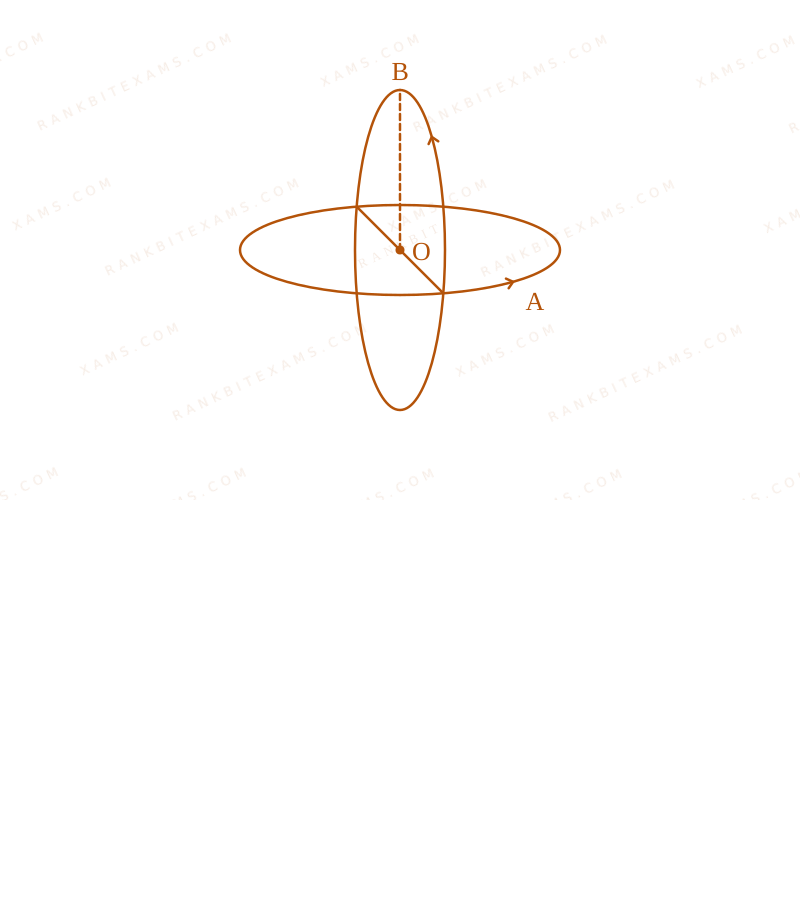
Two insulated circular loop A and B radius 'a' carrying a current of 'I' in the anti clockwise direction as shown in figure. The magnitude of the magnetic induction at the centre will be :
Two circular current carrying loops placed orthogonally.
A.fracsqrt2 mu_0 Ia$\frac{\sqrt{2} \mu_0 I}{a}$
B.fracmu_0 I2 a$\frac{\mu_0 I}{2 a}$
C.fracmu_0 Isqrt2 a$\frac{\mu_0 I}{\sqrt{2} a}$
D.frac2 mu_0 Ia$\frac{2 \mu_0 I}{a}$
Solution
### Related Formula
B = fracmu_0 I2R$$B = \frac{\mu_0 I}{2R}$$B_textnet = sqrtB_1^2 + B_2^2 quad (textfor mutually perpendicular fields)$$B_{\text{net}} = \sqrt{B_1^2 + B_2^2} \quad (\text{for mutually perpendicular fields})$$
### Core Logic
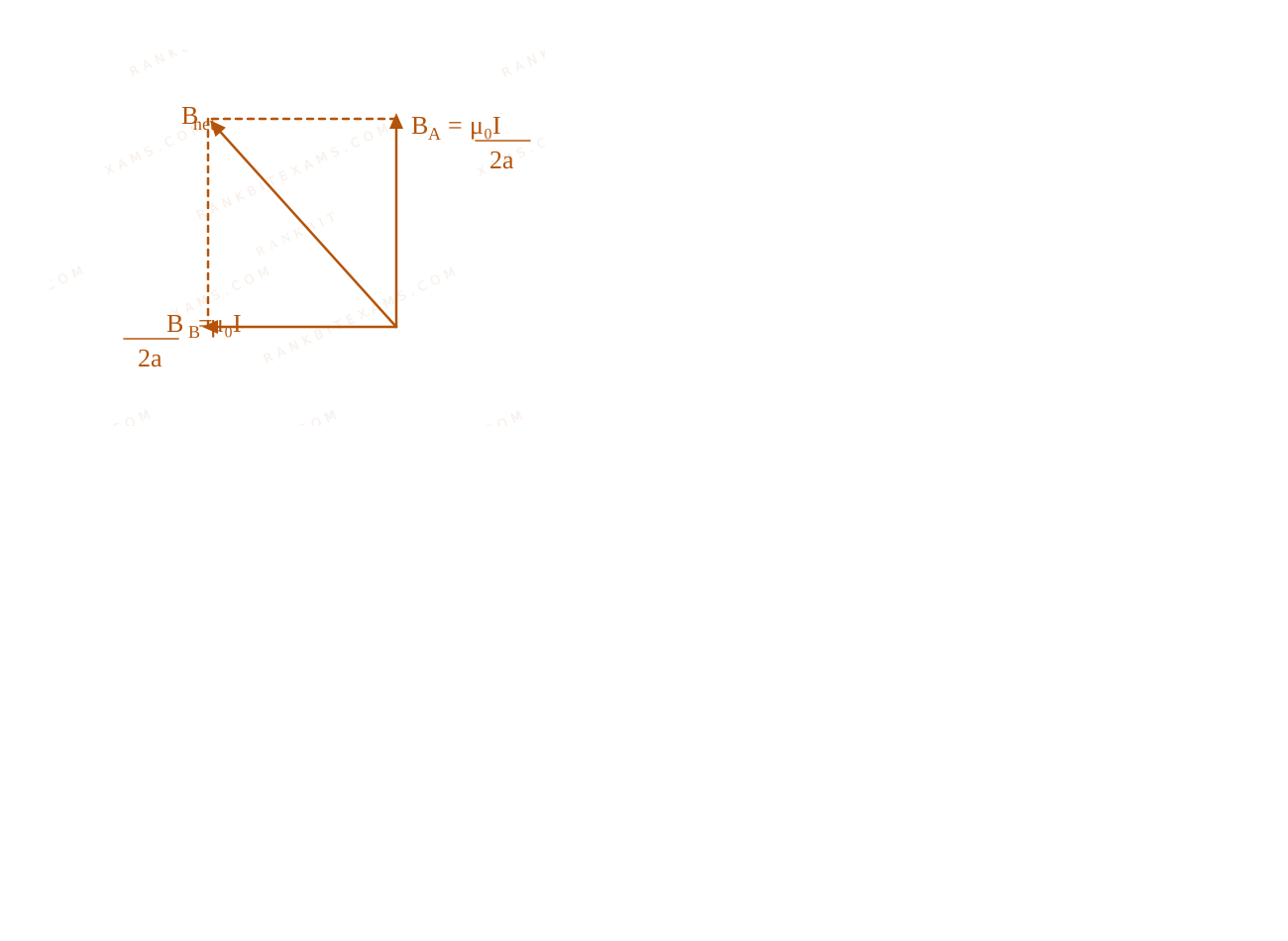
The two loops are mutually perpendicular to each other. The magnetic field at the center due to each loop acts along their respective normal axes, meaning the two resulting magnetic field vectors are orthogonal (90^circ$90^\circ$ apart).
Two circular current carrying loops placed orthogonally.
### Step 1: Calculate Individual Fields
Magnetic field at the center due to loop A:
B_A = fracmu_0 I2a$$B_A = \frac{\mu_0 I}{2a}$$
Magnetic field at the center due to loop B:
B_B = fracmu_0 I2a$$B_B = \frac{\mu_0 I}{2a}$$
### Step 2: Resultant Magnetic Field
Since B_A$B_A$ and B_B$B_B$ are perpendicular to each other:
B_textnet = sqrtB_A^2 + B_B^2$$B_{\text{net}} = \sqrt{B_A^2 + B_B^2}$$B_textnet = sqrtleft(fracmu_0 I2aright)^2 + left(fracmu_0 I2aright)^2$$B_{\text{net}} = \sqrt{\left(\frac{\mu_0 I}{2a}\right)^2 + \left(\frac{\mu_0 I}{2a}\right)^2}$$B_textnet = fracmu_0 I2a sqrt2 = fracsqrt2 mu_0 I2a = fracmu_0 Isqrt2 a$$B_{\text{net}} = \frac{\mu_0 I}{2a} \sqrt{2} = \frac{\sqrt{2} \mu_0 I}{2a} = \frac{\mu_0 I}{\sqrt{2} a}$$
### Pattern Recognition
When two identical physical sources generate orthogonal vector fields of magnitude B$B$, the resultant is simply sqrt2B$\sqrt{2}B$.
### Evaluation Rubric / Model Answer
null
### Chapter Mix
Class 12 Physics: Moving Charges and Magnetism
Q51jee_main_2024_30_jan_morningMagnetic Force on Current Carrying Wire
The horizontal component of earth's magnetic field at a place is 3.5 times 10^-5 mathrm~T$3.5 \times 10^{-5} \mathrm{~T}$. A very long straight conductor carrying current of sqrt2 mathrm~A$\sqrt{2} \mathrm{~A}$ in the direction from South east to North West is placed. The force per unit length experienced by the conductor is dots dots dots times 10^-6 mathrm~N/m$\dots \dots \dots \times 10^{-6} \mathrm{~N/m}$.
Numerical Answer.Answer: 35 to 35
Solution
### Related Formula
F = I L B sin theta$$F = I L B \sin \theta$$fracFL = I B sin theta$$\frac{F}{L} = I B \sin \theta$$
### Core Logic
Earth's horizontal magnetic field (B_H$B_H$) points strictly from South to North. The conductor is aligned from South-East to North-West. Thus, the angle theta$\theta$ between the current flow direction (SE to NW) and Earth's magnetic field (S to N) is exactly 45^circ$45^\circ$.
### Step 1: Compute Force per Unit Length
B_H = 3.5 times 10^-5 mathrm~T$B_H = 3.5 \times 10^{-5} \mathrm{~T}$i = sqrt2 mathrm~A$i = \sqrt{2} \mathrm{~A}$theta = 45^circ$\theta = 45^\circ$fracFell = i B_H sin theta$$\frac{F}{\ell} = i B_H \sin \theta$$fracFell = sqrt2 times (3.5 times 10^-5) times frac1sqrt2$$\frac{F}{\ell} = \sqrt{2} \times (3.5 \times 10^{-5}) \times \frac{1}{\sqrt{2}}$$fracFell = 3.5 times 10^-5 mathrm~N/m$$\frac{F}{\ell} = 3.5 \times 10^{-5} \mathrm{~N/m}$$fracFell = 35 times 10^-6 mathrm~N/m$$\frac{F}{\ell} = 35 \times 10^{-6} \mathrm{~N/m}$$
### Step 2: Extract Value
The required multiplier for 10^-6$10^{-6}$ is 35.
### Pattern Recognition
Geographical alignments often yield clean angles like 45^circ$45^\circ$ or 90^circ$90^\circ$. S-N field intersecting SE-NW current creates a 45^circ$45^\circ$ angular intersection, perfectly canceling the sqrt2$\sqrt{2}$ amp current.
### Evaluation Rubric / Model Answer
null
### Chapter Mix
Class 12 Physics: Moving Charges and Magnetism
Class 12 Physics: Magnetism and Matter
More Moving Charges and Magnetism Questions — jee_main_2024_29_jan_morning
We Map Every Repeating Question in Competitive Exams.
Say goodbye to generic mock test fatigue. RankBit uses smart analysis to group past exam questions into their foundational Repeating Question Types. Find chapter weightage, track repeating questions, and score higher with targeted practice.
Select Your Target Exam
Choose an exam track below to find formulas per chapter and patterns.
Syncing Exam Intelligence
Mapping formulas and patterns across all tracks…
PATH A — FULL LENGTH PRACTICE
Full Mock Test Hub
Simulate real NTA exam conditions with fully tracked mocks. Time yourself against past papers.
Practice past-year questions one chapter at a time. Pick an exam → subject → chapter and get every PYQ for that topic — pulled together from all past papers — with the chapter's key formulas alongside.