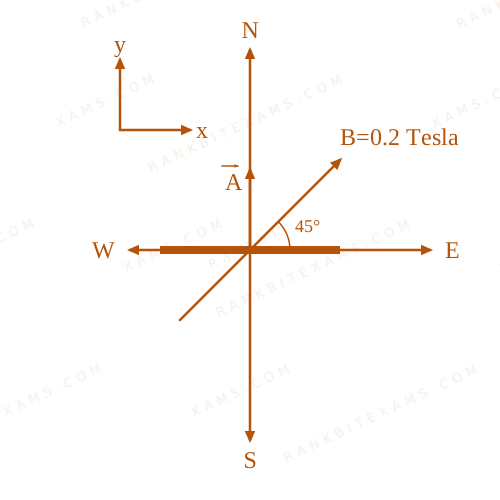
A square loop of side 10 ~cm$10 \mathrm{~cm}$ and resistance 0.7 Ω$0.7 \, \Omega$ is placed vertically in east-west plane. A uniform magnetic field of 0.20 ~T$0.20 \mathrm{~T}$ is set up across the plane in north east direction. The magnetic field is decreased to zero in 1 ~s$1 \mathrm{~s}$ at a steady rate. Then, magnitude of induced emf is x × 10⁻³ ~V$\sqrt{\mathrm{x}} \times 10^{-3} \mathrm{~V}$. The value of x is
Numerical Answer Type:
Enter a numerical valueAnswer: 2 to 2+4 marks
Solution & Explanation
Related Formula
According to Faraday's Law of Electromagnetic Induction, the magnitude of induced EMF (e$e$) is:
e = (Δ φ)/(Δ t)$$e = \frac{\Delta \phi}{\Delta t}$$
where magnetic flux φ$\phi$ is defined via dot product:
φ = B · A = B A θ$$\phi = \vec{B} \cdot \vec{A} = B A \cos \theta$$
Core Logic
Let the East-West plane lie vertical along the x-z plane. The normal vector to the loop points along the North direction (along j$\hat{j}$):
The uniform magnetic field points North-East, meaning it is at an angle of 45^°$45^\circ$ to the North vector direction:
B = B 45^° i + B 45^° j = 0.2√(2) i + 0.2√(2) j$$\vec{B} = B \cos 45^\circ \hat{i} + B \sin 45^\circ \hat{j} = \frac{0.2}{\sqrt{2}}\hat{i} + \frac{0.2}{\sqrt{2}}\hat{j}$$
Vector reference showing orientation of loop area and North-East magnetic field vectors for Q53
\Delta t = 1 \mathrm{~s}, the final flux value$, the final flux value $\phi_f = 0:$:
$e = (|0 - φᵢ|)/(1) = √(2) × 10⁻³ ~V$e = \frac{|0 - \phi_i|}{1} = \sqrt{2} \times 10^{-3} \mathrm{~V}$
Step 3: Extract x
Comparing this with the target expression
$
Step 3: Extract x
Comparing this with the target expression $
\sqrt{x} \times 10^{-3} \mathrm{~V}: $:
$
x = 2
Pattern Recognition
Be careful when identifying angles between directional plane descriptors. An East-West plane has a normal axis directed North-South. A North-East field makes a clean
$
Pattern Recognition
Be careful when identifying angles between directional plane descriptors. An East-West plane has a normal axis directed North-South. A North-East field makes a clean $
45^\circ$ angle relative to this structural normal line.
Chapter Mix
Class 12 Physics: Electromagnetic Induction
Vector reference showing orientation of loop area and North-East magnetic field vectors for Q53
More Electromagnetic Induction Previous-Year Questions — Page 6
Q53jee_main_2024_31_jan_eveningFaraday's Law
The magnetic flux φ$\phi$ (in weber) linked with a closed circuit of resistance 8 Ω$8 \, \Omega$ varies with time (in seconds) as φ = 5t² - 36t + 1$\phi = 5t^2 - 36t + 1$. The induced current in the circuit at t = 2 s$t = 2 \text{ s}$ is ________ A.
Calculate the time derivative of the magnetic flux to find the induced EMF. Evaluate it at the requested time, and then apply Ohm's law to find the current magnitude.
Flux polynomials (At² - Bt + C$At^2 - Bt + C$) instantly trigger a simple derivative test. Remember to drop the negative sign for final current magnitude unless direction is specifically asked.
Chapter Mix
Class 12 Physics: Electromagnetic Induction
Qjee_main_2024_31_jan_morningMutual Inductance
A small square loop of wire of side $\ell$ is placed inside a large square loop of wire of side L$L$ (L = ²$L = \ell^2$). The loops are coplanar and their centers coincide. The value of the mutual inductance of the system is √(x) × 10⁻⁷ H$\sqrt{x} \times 10^{-7}\mathrm{\ H}$, where x =$x =$
Mutual Inductance diagram for Q57 - JEE Main 2024 Morning
Assume a current i$i$ flows through the larger square loop of side L$L$. The magnetic field generated by it at its center acts as a uniform field across the very small inner loop of side $\ell$.
The magnetic field at the center of the large square loop (distance d = L/2$d = L/2$ from each side, angles 45^°$45^\circ$):
Comparing with √(x) × 10⁻⁷$\sqrt{x} \times 10^{-7}$, we get x = 128$x = 128$.
Chapter Mix
Class 12 Physics: Electromagnetic Induction
Q44jee_main_2024_31_jan_morningFaraday's Law
A coil is placed perpendicular to a magnetic field of 5000 ~T$5000 \mathrm{~T}$. When the field is changed to 3000 ~T$3000 \mathrm{~T}$ in 2s$2\mathrm{s}$, an induced emf of 22 ~V$22 \mathrm{~V}$ is produced in the coil. If the diameter of the coil is 0.02 ~m$0.02 \mathrm{~m}$, then the number of turns in the coil is:
A.7$7$
B.70$70$
C.35$35$
D.140$140$
Solution
Related Formula
ε = N | (Δφ)/(Δ t) |$$\varepsilon = N \left| \frac{\Delta\phi}{\Delta t} \right|$$Δφ = (Δ B) A θ$$\Delta\phi = (\Delta B) A \cos\theta$$
Core Logic
Given data:
Initial Magnetic Field, Bᵢ = 5000 T$B_i = 5000\mathrm{\,T}$
Final Magnetic Field, Bf = 3000 T$B_f = 3000\mathrm{\,T}$
Time interval, Δ t = 2 s$\Delta t = 2\mathrm{\,s}$
Diameter, d = 0.02 m ⇒ r = 0.01 m$d = 0.02\mathrm{\,m} \Rightarrow r = 0.01\mathrm{\,m}$
Induced emf, ε = 22 V$\varepsilon = 22\mathrm{\,V}$
Change in magnetic field magnitude |Δ B| = 5000 - 3000 = 2000 T$|\Delta B| = 5000 - 3000 = 2000\mathrm{\,T}$.
Area of the coil A = π r² = π (0.01)² = 10⁻⁴π m²$A = \pi r^2 = \pi (0.01)^2 = 10^{-4}\pi \mathrm{\,m^2}$.
Practice past-year questions one chapter at a time. Pick an exam → subject → chapter and get every PYQ for that topic — pulled together from all past papers — with the chapter's key formulas alongside.