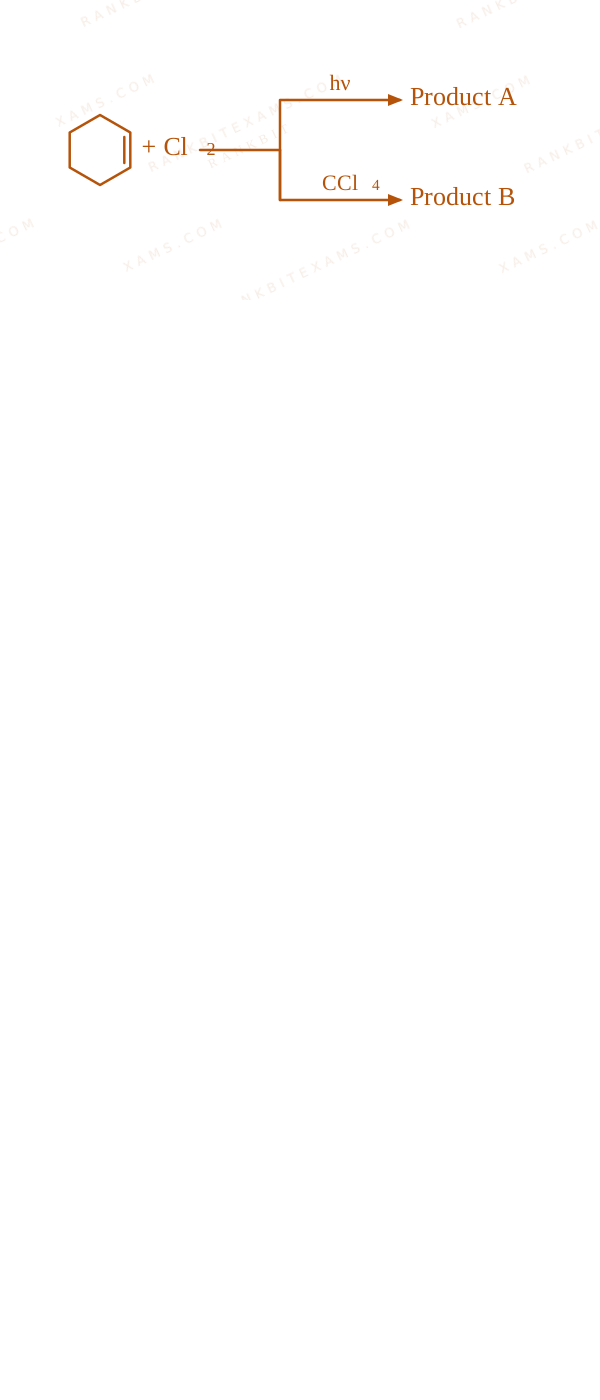
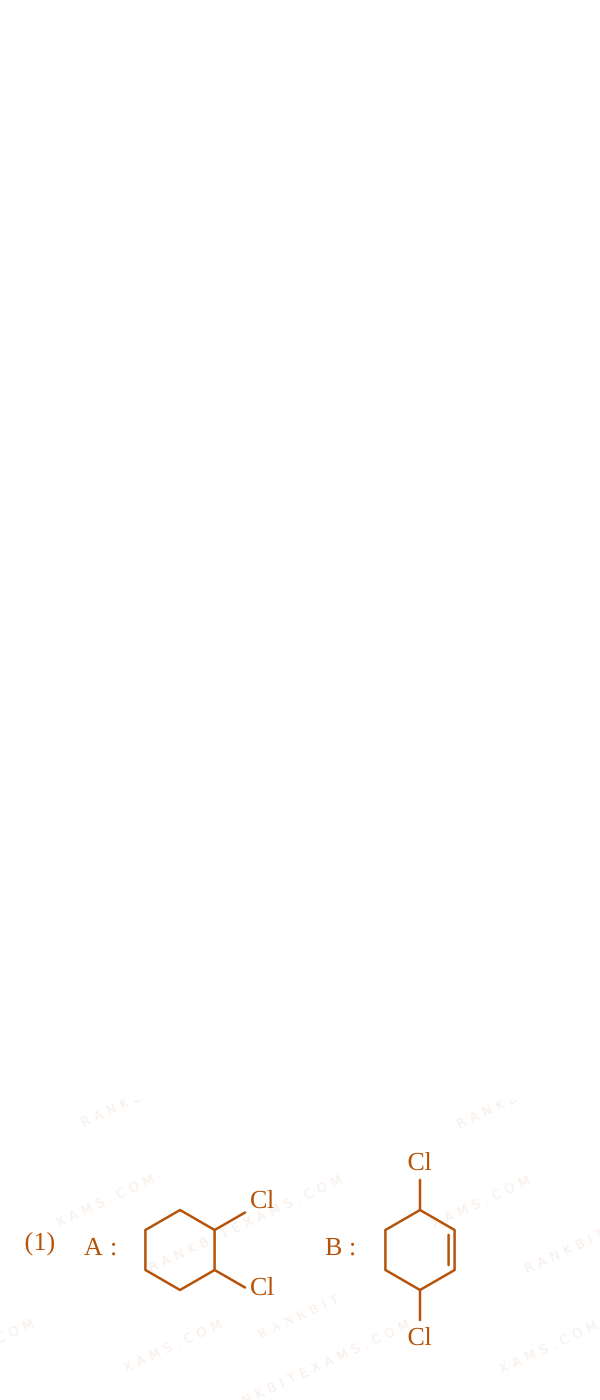
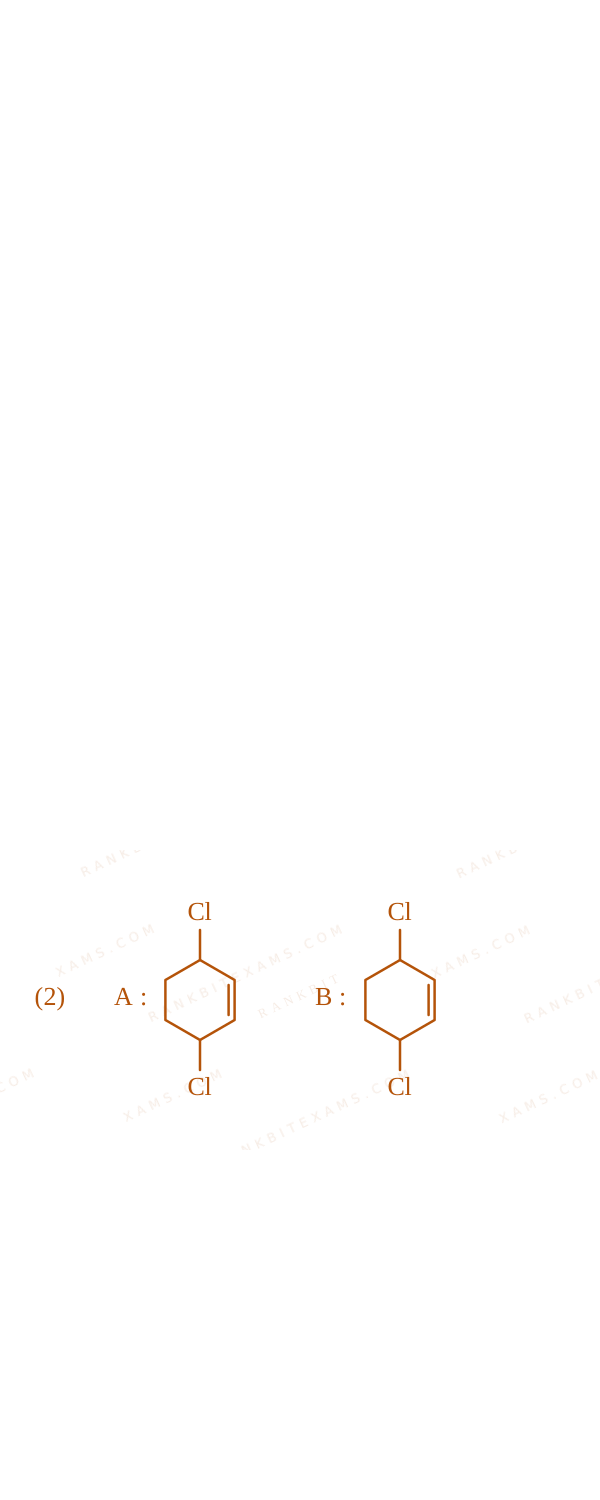
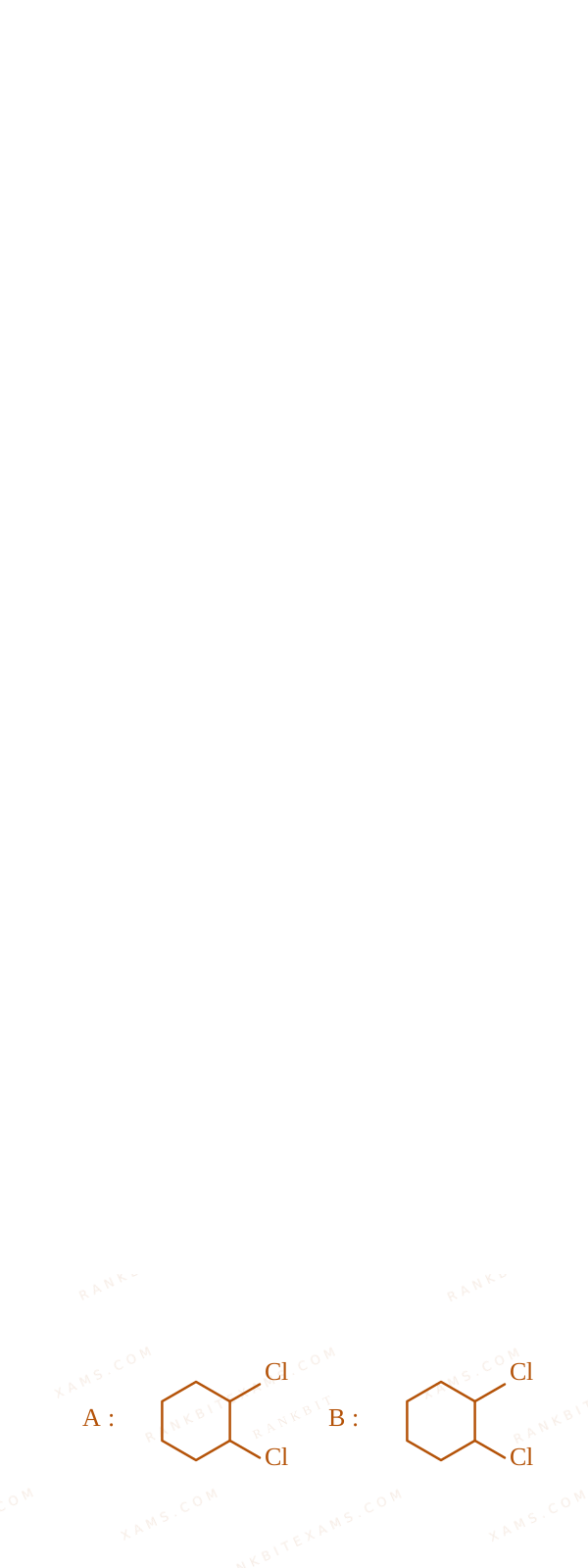
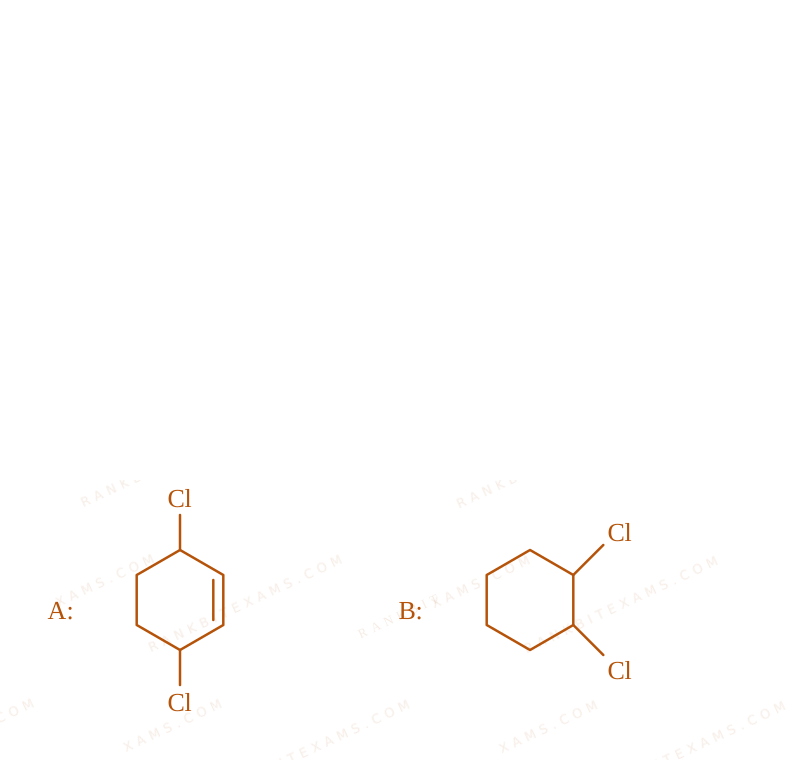

Identify product A and product B :
Addition Reactions of Alkenes diagram for Q71 - JEE Main 2024 Morning
Cyclohexene undergoing chlorination under two different conditions: light (hv) and dark with CCl4 solvent.

Solution & Explanation

### Core Logic The substrate is cyclohexene, which can undergo two distinct types of reactions with chlorine (Cl_2) depending on the reaction conditions. **Reaction 1: Condition hv (Product A)** In the presence of light (hnu) or high temperature, halogens undergo homolytic cleavage to generate free radicals. This triggers allylic substitution (a free radical substitution mechanism). The allylic position is targeted because the resulting allylic free radical is resonance stabilized. Thus, substitution occurs at the carbon adjacent to the double bond, yielding 3-chlorocyclohexene as Product A. **Reaction 2: Condition CCl_4 (Product B)** In the presence of a non-polar solvent like CCl_4 and without light/heat, Cl_2 undergoes an electrophilic addition reaction across the carbon-carbon double bond. A cyclic chloronium ion intermediate is formed, leading to anti-addition of two chlorine atoms. This yields 1,2-dichlorocyclohexane as Product B. ### Step 1: Structures of A and B
Addition Reactions of Alkenes diagram for Q71 - JEE Main 2024 Morning
Cyclohexene undergoing chlorination under two different conditions: light (hv) and dark with CCl4 solvent.
Product A preserves the double bond and substitutes a Cl at the allylic position. Product B loses the double bond and adds two Cl atoms adjacently. ### Pattern Recognition X_2 + light (hnu) = Free radical Allylic Substitution. X_2 + dark/solvent (CCl_4) = Electrophilic Addition across double bond. ### Evaluation Rubric / Model Answer null ### Chapter Mix Class 11 Chemistry: Hydrocarbons Class 12 Chemistry: Haloalkanes and Haloarenes
Reference Study Guides

More Hydrocarbons Previous-Year Questions — Page 4

Q90 jee_main_2024_29_jan_morning Reactions of Alkenes Ozonolysis
Consider the given reaction. CH_3-CH=C(CH_3)_2 xrightarrow[(ii) Zn/H_2O, (i) O_3 (P) The total number of oxygen atoms present per molecule of the product (P) is
Numerical Answer. Answer: 1 to 1

Solution

### Core Logic The reaction given is the reductive ozonolysis of an alkene, 2-methylbut-2-ene (CH_3-CH=C(CH_3)_2). In reductive ozonolysis (O_3 followed by Zn/H_2O), the carbon-carbon double bond is completely cleaved. An oxygen atom is placed on each carbon atom of the broken double bond to form carbonyl compounds (aldehydes or ketones). ### Step 1: Identifying the Products CH_3-CH=C(CH_3)_2 xrightarrowO_3 / Zn, H_2O CH_3-CHO + O=C(CH_3)_2 The reaction yields two distinct product molecules: 1. Acetaldehyde (CH_3CHO) - contains 1 oxygen atom. 2. Acetone (CH_3COCH_3) - contains 1 oxygen atom. The question asks for the number of oxygen atoms present **per molecule** of the product (P). Since any resulting product molecule (either acetaldehyde or acetone) contains exactly 1 oxygen atom, the answer is 1. ### Pattern Recognition Reductive ozonolysis of a simple alkene without other oxygenated functional groups always creates simple aldehydes or ketones. Each resulting discrete molecule formed from the cleaved double bond will have exactly 1 carbonyl group (1 oxygen atom) unless it's a cyclic alkene opening up (which would have 2). ### Evaluation Rubric / Model Answer null ### Chapter Mix Class 11 Chemistry: Hydrocarbons Class 12 Chemistry: Aldehydes Ketones and Carboxylic Acids
Q77 jee_main_2024_30_jan_morning Alkynes
Compound A formed in the following reaction reacts with B gives the product C. Find out A and B. CH_3-Cequiv CH + Na rightarrow A xrightarrowB CH_3-Cequiv C-CH_2-CH_2-CH_3 + NaBr
  • A. A=CH_3-Cequiv C^-Na^+, B=CH_3-CH_2-CH_2-Br
  • B. A=CH_3-CH=CH_2, B=CH_3-CH_2-CH_2-Br
  • C. A=CH_3-CH_2-CH_3, B=CH_3-Cequiv CH
  • D. A=CH_3-Cequiv C^-Na^+, B=CH_3-CH_2-CH_3

Solution

### Core Logic Terminal alkynes possess acidic hydrogen. When treated with a strong base or active metal like Sodium (Na), they form sodium acetylide salts. CH_3-Cequiv C-H + Na rightarrow CH_3-Cequiv C^-Na^+ + frac12H_2 So, A is Sodium propynide (CH_3-Cequiv C^-Na^+). ### Step 1: Analyzing the second step The product is CH_3-Cequiv C-CH_2-CH_2-CH_3. This indicates an S_N2 substitution reaction between the acetylide ion (nucleophile) and an alkyl halide (electrophile). Since NaBr is a byproduct, B must be a propyl bromide. CH_3-Cequiv C^-Na^+ + CH_3-CH_2-CH_2-Br rightarrow CH_3-Cequiv C-CH_2-CH_2-CH_3 + NaBr ### Step 2: Conclusion A is CH_3-Cequiv C^-Na^+ and B is CH_3-CH_2-CH_2-Br (1-Bromopropane). ### Evaluation Rubric / Model Answer null ### Chapter Mix Class 11 Chemistry: Hydrocarbons Class 12 Chemistry: Haloalkanes and Haloarenes
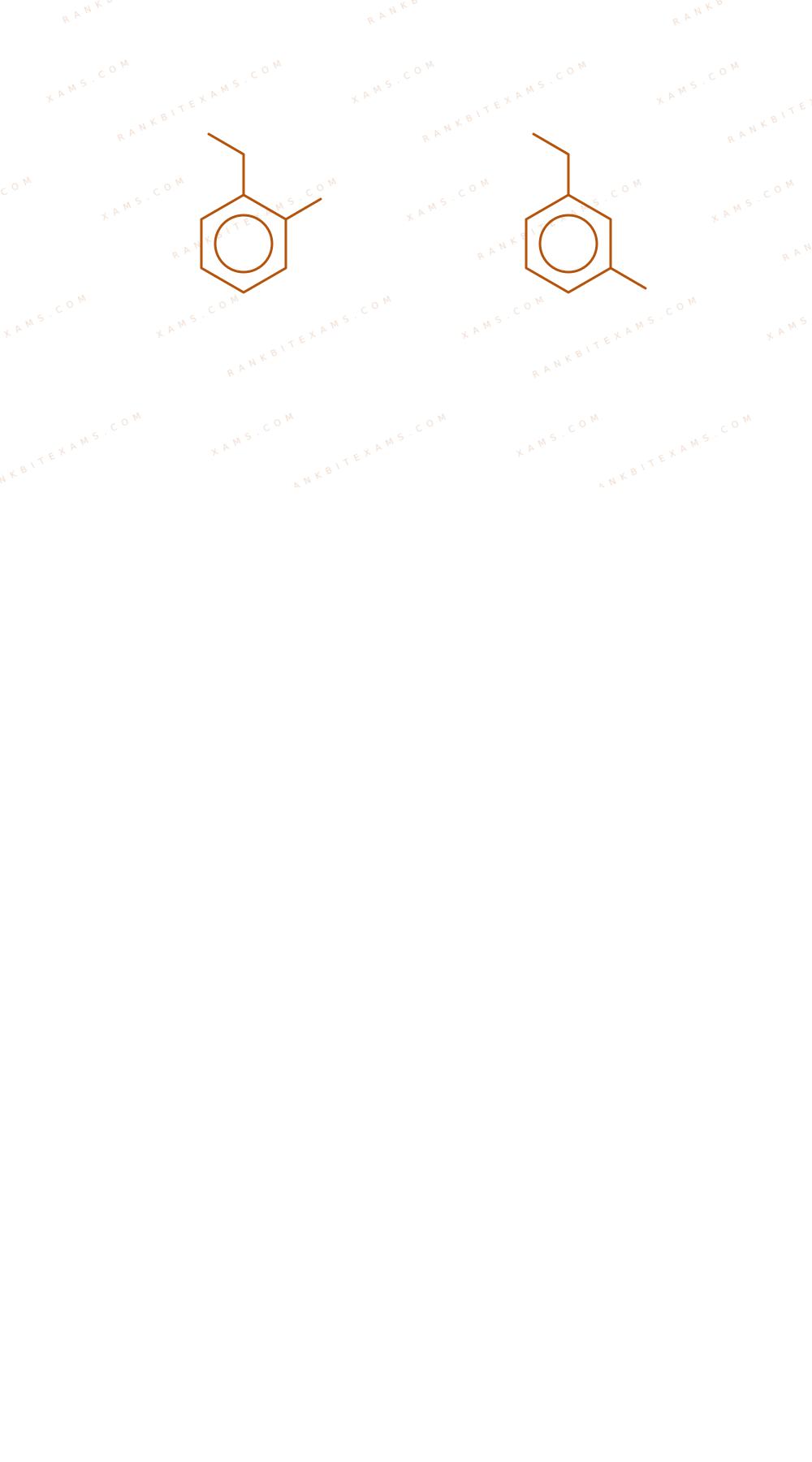
Q65 jee_main_2024_31_jan_evening Electrophilic Aromatic Substitution
Identify major product 'P' formed in the following reaction.
Electrophilic Aromatic Substitution diagram for Q65 - JEE Main 2024 Evening
The image shows an aromatic ring undergoing a reaction with an alkyl halide in the presence of anhydrous AlCl3.
  • A. text(1) Product A
  • B. text(2) Product B
  • C. text(3) Product C
  • D. text(4) Product D

Solution

### Core Logic The given reaction is an intramolecular Friedel-Crafts alkylation. 1) The alkyl chloride reacts with anhydrous AlCl_3 to form a carbocation intermediate. 2) The carbocation generated will act as an electrophile and attack the adjacent phenyl ring. 3) The intermediate carbocation will undergo electrophilic aromatic substitution to form a new six-membered ring, as a 6-membered ring is highly stable and preferred over other ring sizes.
Electrophilic Aromatic Substitution diagram for Q65 - JEE Main 2024 Evening
The image shows an aromatic ring undergoing a reaction with an alkyl halide in the presence of anhydrous AlCl3.
### Pattern Recognition Intramolecular Friedel-Crafts usually prefers forming 5 or 6 membered rings due to lesser angle strain. Here, the tether length is perfect for closing into a 6-membered tetralin-like system. ### Evaluation Rubric / Model Answer null ### Chapter Mix Class 11 Chemistry: Hydrocarbons
Q66 jee_main_2024_31_jan_evening Electrophilic Addition to Alkenes
Major product of the following reaction is -
Electrophilic Addition to Alkenes diagram for Q66 - JEE Main 2024 Evening
The image shows a methylcyclopentene derivative reacting with D-Cl.
  • A. text(1) Product A
  • B. text(2) Product B
  • C. text(3) Product C
  • D. text(4) Product D

Solution

### Core Logic Addition of D-Cl across the double bond takes place via an electrophilic addition mechanism following Markovnikov's rule. 1) The electrophile D^+ attacks the double bond to generate the most stable carbocation. The tertiary carbocation formed at the methyl-substituted carbon is more stable than the secondary carbocation. 2) The nucleophile Cl^- then attacks the planar tertiary carbocation from either face (top or bottom), resulting in a racemic mixture if a new chiral center is fully free, but here the stereochemistry depends on the relative anti/syn addition logic or thermodynamic stability. A mixture of diastereomers can be formed, but standard electrophilic additions often yield predominantly the trans-product due to steric reasons or via a bridged intermediate depending on conditions, though pure HCl/DCl addition is non-stereospecific. However, based on the official answer key (Option 3), we identify the correct stereochemical representation provided by the examining body.
Electrophilic Addition to Alkenes diagram for Q66 - JEE Main 2024 Evening
The image shows a methylcyclopentene derivative reacting with D-Cl.
### Note on Discrepancy According to the official NTA key, Option 3 is correct. According to our experts, both options 3 and 4 can be formed as a mixture since the carbocation is planar and Cl^- can attack from both sides. We proceed with the officially accepted answer (3). ### Evaluation Rubric / Model Answer null ### Chapter Mix Class 11 Chemistry: Hydrocarbons
Q79 jee_main_2024_31_jan_evening Electrophilic Aromatic Substitution Reactivity
The correct order of reactivity in electrophilic substitution reaction of the following compounds is:
Electrophilic Aromatic Substitution Reactivity diagram for Q79 - JEE Main 2024 Evening
The image displays four aromatic compounds: Benzene (A), Toluene (B), Chlorobenzene (C), and Nitrobenzene (D).
  • A. text(1) B > C > A > D
  • B. text(2) D > C > B > A
  • C. text(3) A > B > C > D
  • D. text(4) B > A > C > D

Solution

### Core Logic Electrophilic substitution reactivity depends on the electron density of the aromatic ring, which is influenced by the inductive (I) and mesomeric (M) effects of the substituents. - Compound A (Benzene): Standard reference. - Compound B (Toluene): The -CH_3 group shows +I and hyperconjugation effects, activating the ring. Most reactive. - Compound C (Chlorobenzene): The -Cl group shows +M and -I effects, but the -I effect dominates, mildly deactivating the ring. - Compound D (Nitrobenzene): The -NO_2 group shows strong -M and -I effects, heavily deactivating the ring. Least reactive. Order of reactivity: Toluene (B) > Benzene (A) > Chlorobenzene (C) > Nitrobenzene (D). ### Step 1: Final Order Reactivity: B > A > C > D. This matches option (4). ### Evaluation Rubric / Model Answer null ### Chapter Mix Class 11 Chemistry: Hydrocarbons Class 12 Chemistry: Haloalkanes and Haloarenes

More Hydrocarbons Questions — jee_main_2024_29_jan_morning

Practice all Hydrocarbons previous-year questions →

Rankbit System
JEE Physics: Waves (+15.5%) | Electrostatics: Concentric Shells (-29.7%) | Modern Physics: Photoelectric Clones (+34.2%) | Mathematics: Definite Integrals (+18.1%) | Chemistry: Coordination Splitting (-11.4%) | JEE Physics: Waves (+15.5%) | Electrostatics: Concentric Shells (-29.7%) | Modern Physics: Photoelectric Clones (+34.2%) | Mathematics: Definite Integrals (+18.1%) | Chemistry: Coordination Splitting (-11.4%)