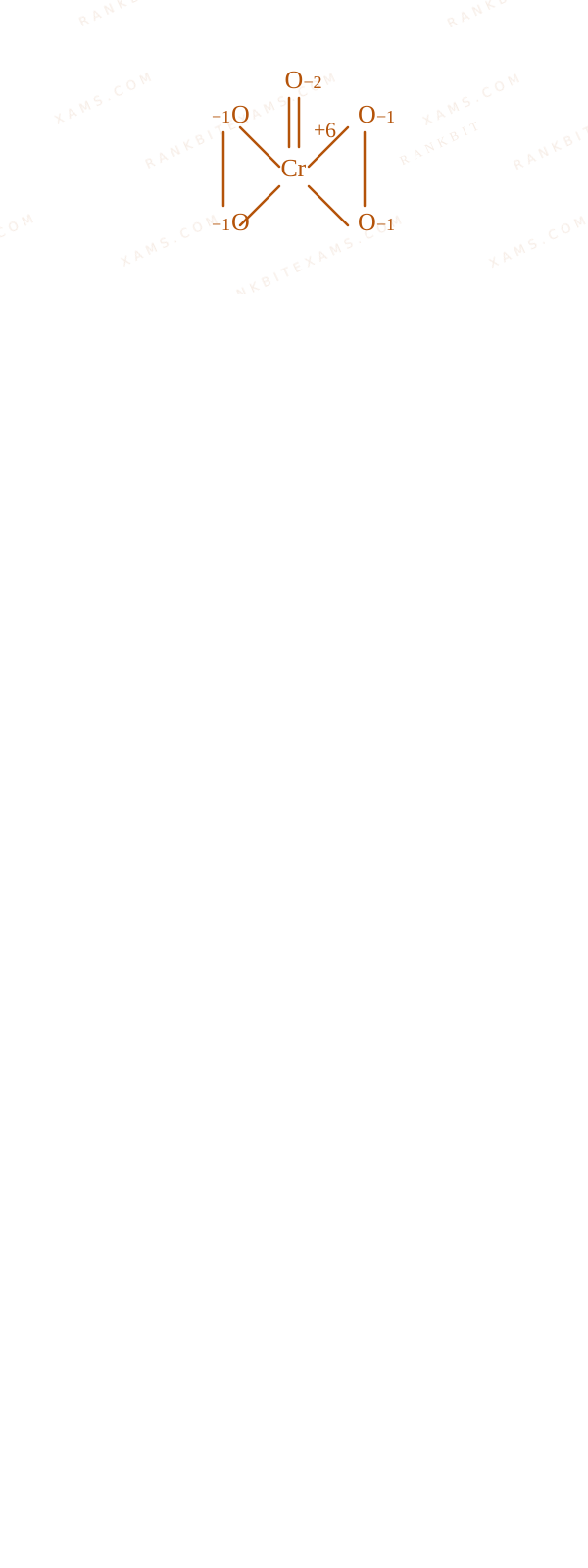
In chromyl chloride test for confirmation of Cl^-$Cl^-$ ion, a yellow solution is obtained. Acidification of the solution and addition of amyl alcohol and 10%$10\%$H₂O₂$H_2O_2$ turns organic layer blue indicating formation of chromium pentoxide. The oxidation state of chromium in that is
Acidification of the yellow CrO₄²⁻$CrO_4^{2-}$ solution followed by the addition of H₂O₂$H_2O_2$ and amyl alcohol yields a blue-colored organic layer due to the formation of chromium pentoxide (CrO₅$CrO_5$).
Potassium Dichromate and Chromyl Chloride Test diagram for Q63 - JEE Main 2024 Morning
The structure of chromium pentoxide (CrO₅$CrO_5$) features a distinctive "butterfly" arrangement. It contains one double-bonded oxide oxygen (O²⁻$O^{2-}$) and four peroxide oxygens (O₂²⁻$O_2^{2-}$). Therefore, there are 2 peroxo linkages.
Let the oxidation state of Chromium be x$x$.
x + 1(-2) + 4(-1) = 0$$x + 1(-2) + 4(-1) = 0$$
x - 2 - 4 = 0$x - 2 - 4 = 0$x = +6$x = +6$
Thus, the oxidation state of Cr in CrO₅$CrO_5$ is +6$+6$.
Pattern Recognition
A classic oxidation state trap. Calculating simply via formula CrO₅$CrO_5$ yields x - 10 = 0 x = +10$x - 10 = 0 \implies x = +10$, which is impossible for Chromium (max +6). Whenever calculation exceeds the maximum group valency, peroxide bonds are present.
Chapter Mix
Class 12 Chemistry: d and f Block Elements
Class 11 Chemistry: Redox Reactions
Keywords:#chromyl chloride test#JEE Main 2024 Morning Q63#d and f Block Elements JEE Main 2024#Potassium Dichromate and Chromyl Chloride Test JEE Main 2024
More d and f Block Elements Previous-Year Questions — Page 2
Among the following oxides of 3d elements, the number of mixed oxides are ____.
Ti₂O₃, V₂O₄, Cr₂O₃, Mn₃O₄, Fe₃O₄, Fe₂O₃, Co₃O₄$$Ti_2O_3, V_2O_4, Cr_2O_3, Mn_3O_4, Fe_3O_4, Fe_2O_3, Co_3O_4$$
Numerical Answer.Answer: 3 to 3
Solution
Related Formula
Mixed Oxide Formulation: M₃O₄ ≡ MO · M₂O₃$$\text{Mixed Oxide Formulation: } M_3O_4 \equiv MO \cdot M_2O_3$$
Core Logic
Step 1: Check stoichiometric compositions of oxides:
Sees: Transition metal oxides list.
Shortcut: Oxides with M₃O₄$M_3O_4$ formula (Mn₃O₄, Fe₃O₄, Co₃O₄$Mn_3O_4, Fe_3O_4, Co_3O_4$) are mixed oxides containing metal in both +2 and +3 oxidation states.
Acidified potassium dichromate (K₂Cr₂O₇$K_2Cr_2O_7$) acts as a strong oxidizing agent. In acidic medium, the dichromate ion (Cr₂O₇²⁻$Cr_2O_7^{2-}$, where Cr is in the +6$+6$ oxidation state) is reduced to the Chromium(III) ion (Cr³⁺$Cr^{3+}$).
Concurrently, iodide ions (I^-$I^-$ from KI) are oxidized to elemental iodine (I₂$I_2$).
The full ionic equation is:
The final product containing chromium is the Cr³⁺$Cr^{3+}$ ion, meaning its oxidation state is +3$+3$.
Pattern Recognition
Always remember that in acidic media, Cr₂O₇²⁻$Cr_2O_7^{2-}$ (orange) universally reduces to Cr³⁺$Cr^{3+}$ (green). The oxidation state invariably goes from +6 arrow +3$+6 \rightarrow +3$.
Chapter Mix
Class 12 Chemistry: d and f Block Elements
Class 11 Chemistry: Redox Reactions
Q69jee_main_2026_24_january_eveningCompounds of Transition Elements
"X" is an oxoanion of the lightest element of group 7 (in the periodic table). The metal is in +6 oxidation state in "X". The color of the potassium salt of X is
A. green
B. purple
C. yellow
D. orange
Solution
Core Logic
The lightest element of Group 7 in the periodic table is Manganese (Mn$Mn$).
The oxoanion of Mn$Mn$ where it resides in the +6 oxidation state is the manganate ion (MnO₄²⁻$MnO_4^{2-}$).
The potassium salt of this oxoanion is potassium manganate (K₂MnO₄$K_2MnO_4$).
Step 1: Deduce Color
K₂MnO₄$K_2MnO_4$ (containing the MnO₄²⁻$MnO_4^{2-}$ ion) is known to have a green color.
(Contrast with the +7 state in KMnO₄$KMnO_4$, which is intensely purple).
Pattern Recognition
Manganese oxoanions have signature colors: MnO₄⁻$MnO_4^{-}$ (Permanganate, +7) is Purple/Pink, while MnO₄²⁻$MnO_4^{2-}$ (Manganate, +6) is Green.
Chapter Mix
Class 12 Chemistry: The d- and f-Block Elements
Q68jee_main_2026_28_january_morningColor and Oxidation States of Transition Metals
Given below are two statements:
Statement I: The number of pairs, from the following, in which both the ions are coloured in aqueous solution is 3.
[Sc³⁺, Ti³⁺], [Mn²⁺, Cr²⁺], [Cu²⁺, Zn²⁺]$[Sc^{3+}, Ti^{3+}], [Mn^{2+}, Cr^{2+}], [Cu^{2+}, Zn^{2+}]$ and [Ni²⁺, Ti⁴⁺]$[Ni^{2+}, Ti^{4+}]$
Statement II: Th⁴⁺$Th^{4+}$ is the strongest reducing agent among Th⁴⁺, Ce⁴⁺, Gd³⁺$Th^{4+}, Ce^{4+}, Gd^{3+}$ and Eu²⁺$Eu^{2+}$.
In the light of the above statements, choose the correct answer from the options given below
A. Statement I is true but Statement II is false
B. Statement I is false but Statement II is true
C. Both Statement I and Statement II are false
D. Both Statement I and Statement II are true
Solution
Step 1: Evaluate Statement I
Color in transition metal ions arises from d-d transitions, which require unpaired d-electrons (d¹$d^1$ to d⁹$d^9$).\n$\bullet$[Sc³⁺, Ti³⁺]$[Sc^{3+}, Ti^{3+}]$: Sc³⁺$Sc^{3+}$ is 3d⁰$3d^0$ (Colourless). Pair invalid.\n$\bullet$[Mn²⁺, Cr²⁺]$[Mn^{2+}, Cr^{2+}]$: Mn²⁺$Mn^{2+}$ is 3d⁵$3d^5$ (Coloured), Cr²⁺$Cr^{2+}$ is 3d⁴$3d^4$ (Coloured). Pair valid.\n$\bullet$[Cu²⁺, Zn²⁺]$[Cu^{2+}, Zn^{2+}]$: Zn²⁺$Zn^{2+}$ is 3d¹⁰$3d^{10}$ (Colourless). Pair invalid.\n$\bullet$[Ni²⁺, Ti⁴⁺]$[Ni^{2+}, Ti^{4+}]$: Ti⁴⁺$Ti^{4+}$ is 3d⁰$3d^0$ (Colourless). Pair invalid.\nOnly ONE pair contains both colored ions. Statement I is false.
Step 2: Evaluate Statement II
Thorium (Th$Th$) exhibits a stable +4$+4$ oxidation state. Th⁴⁺$Th^{4+}$ has an empty shell (5f⁰ 6d⁰ 7s⁰$5f^0 6d^0 7s^0$) and cannot lose more electrons to act as a reducing agent (which requires getting oxidized further). Statement II is false.
Final Conclusion
Both Statement I and Statement II are false.
Pattern Recognition
d⁰$d^0$ and d¹⁰$d^{10}$ configurations never absorb visible light for d-d transitions, rendering them strictly colourless. Maximum group oxidation states cannot act as reducing agents.
Chapter Mix
Class 12 Chemistry: The d- and f-Block Elements
Q57jee_main_2026_28_january_eveningProperties Of Permanganate And Manganate Ions
Consider the following statements about manganate and permanganate ions. Identify the correct statements:
(A) The geometry of both manganate and permanganate ions is tetrahedral.
(B) The oxidation states of Mn in manganate and permanganate are +7 and +6, respectively.
(C) Oxidation of Mn(II) salt by peroxodisulphate gives manganate ion as the final product.
(D) Manganate ion is paramagnetic and permanganate ions is diamagnetic.
(E) Acidified permanganate ion reduces oxalate, nitrite and iodide ions.
Choose the correct answer from the options given below:
A.(1) A, C and D Only$(1)\text{ A, C and D Only}$
B.(2) A, B and C Only$(2)\text{ A, B and C Only}$
C.(3) A, D and E Only$(3)\text{ A, D and E Only}$
D.(4) A and D Only$(4)\text{ A and D Only}$
Solution
Core Logic
(A) Both MnO₄²⁻$MnO_{4}^{2-}$ (Manganate) and MnO₄⁻$MnO_{4}^{-}$ (Permanganate) have tetrahedral geometry utilizing d³s$d^3s$ hybridization. (Correct)
(B) The oxidation state of Mn in manganate (MnO₄²⁻$MnO_{4}^{2-}$) is +6 and in permanganate (MnO₄⁻$MnO_{4}^{-}$) is +7. The statement swaps these. (Incorrect)
Practice past-year questions one chapter at a time. Pick an exam → subject → chapter and get every PYQ for that topic — pulled together from all past papers — with the chapter's key formulas alongside.