Position of an ant (S$S$ in metres) moving in Y-Z plane is given by S = 2t² j + 5 k$\vec{S} = 2t^{2}\hat{j} + 5\hat{k}$ (where t$t$ is in seconds).
The magnitude and direction of velocity of the ant at t = 1$t = 1$ s will be:
A.16 m/s in y-direction$16\text{ m/s in y-direction}$
B.4 m/s in x-direction$4\text{ m/s in x-direction}$
C.9 m/s in z-direction$9\text{ m/s in z-direction}$
D.4 m/s in y-direction$4\text{ m/s in y-direction}$
Solution & Explanation
Related Formula
v = d Sdt$$\vec{v} = \frac{d\vec{S}}{dt}$$
Core Logic
Differentiating the position vector with respect to time gives the velocity vector:
Constant term vectors (like 5 k$5\hat{k}$) drop out during differentiation. The resulting velocity only has a component along the j$\hat{j}$ direction, confirming motion purely parallel to the y-axis at that instant.
Keywords:#Position of an ant moving in Y-Z plane#JEE Main 2024 Morning Q31#Kinematics JEE Main 2024#Velocity and Acceleration in Two Dimensions JEE Main 2024
More Kinematics Previous-Year Questions — Page 2
Q44jee_main_2026_24_january_eveningMotion Graphs
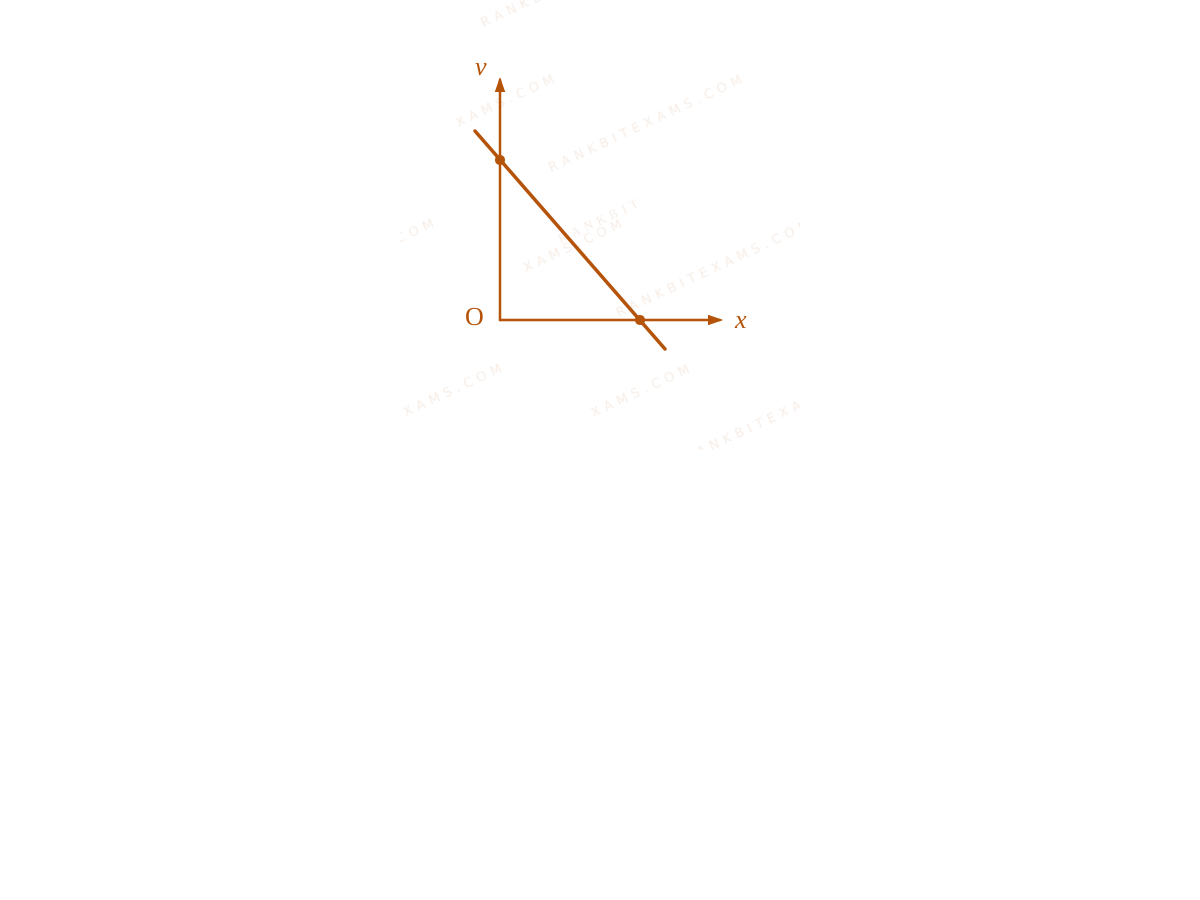
The velocity (v) - Distance (x) graph is shown in figure. Which graph represents acceleration (a) versus distance (x) variation of this system?
A linear descending velocity versus distance graph.
A. Option 1
B. Option 2
C. Option 3
D. Option 4
Solution
Related Formula
a = v (dv)/(dx)$$a = v \frac{dv}{dx}$$
Core Logic
A linear descending velocity versus distance graph.
Equation of V$V$ vs x$x$ from the provided graph is a straight line with a negative slope:
V = C₁ - C₂ x$V = C_1 - C_2 x$
(where C₁, C₂ > 0$C_1, C_2 > 0$).
Step 1: Calculate Acceleration
Differentiate V$V$ with respect to x$x$:
(dV)/(dx) = -C₂$$\frac{dV}{dx} = -C_2$$
Substitute into the acceleration formula:
a = (C₁ - C₂ x) × (-C₂)$$a = (C_1 - C_2 x) \times (-C_2)$$a = C₂² x - C₁ C₂$$a = C_2^2 x - C_1 C_2$$
Step 2: Analyze Graph Profile
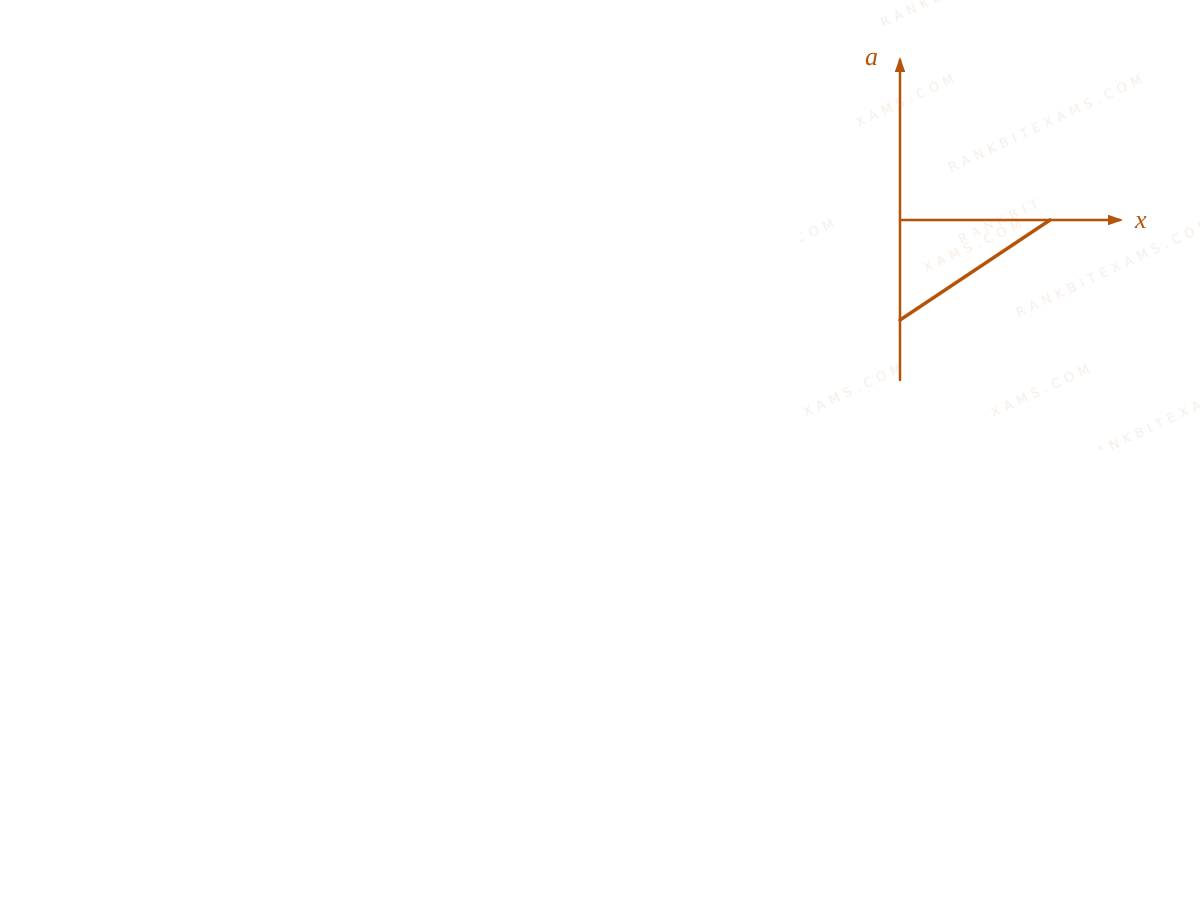
The equation a = C₂² x - C₁ C₂$a = C_2^2 x - C_1 C_2$ represents a straight line with a positive slope (C₂²$C_2^2$) and a negative y-intercept (-C₁ C₂$-C_1 C_2$).
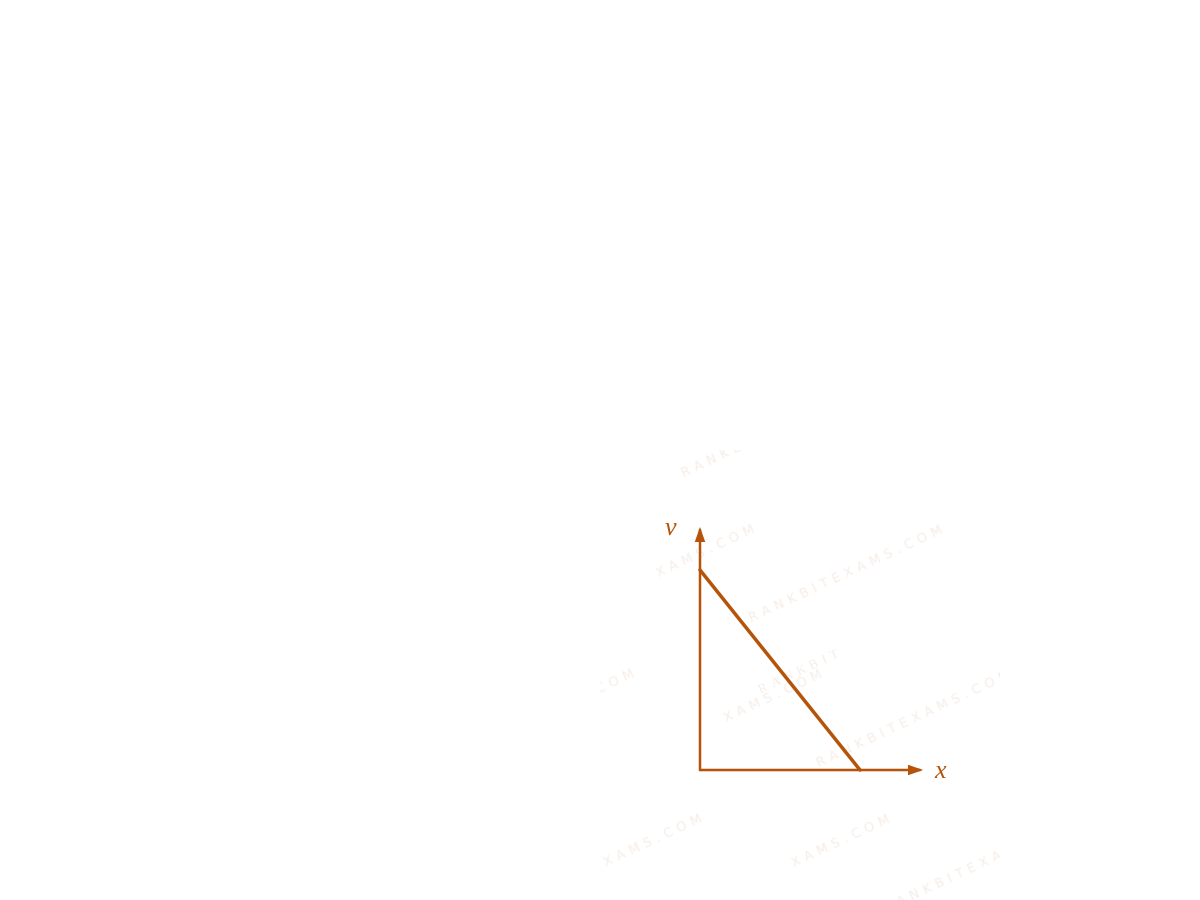
A linear descending velocity versus distance graph.
Therefore, the graph is a straight line intercepting the negative a-axis and moving positively.
Pattern Recognition
A linear negative v-x$v-x$ graph always yields an a-x$a-x$ graph which is linear with a positive slope and negative intercept. Memorizing a = v(dv/dx)$a = v(dv/dx)$ maps graphical traits instantly.
Water drops fall from a tap on the floor, 5 m below, at regular intervals of time, the first drop strikes the floor when the sixth drop begins to fall. The height at which the fourth drop will be from ground, at the instant when the first drop strikes the ground is ____ m.
(g = 10 ~m/s²)$(g = 10 \mathrm{~m/s}^{2})$
A.2.5$2.5$
B.4.0$4.0$
C.4.2$4.2$
D.3.8$3.8$
Solution
Related Formula
h = ut + (1)/(2)gt²$$h = ut + \frac{1}{2}gt^2$$
Core Logic
Since drops fall at regular intervals, find the total time of fall for the first drop and divide it by the number of intervals to get the time gap between successive drops.
The first drop strikes the floor when the sixth drop begins to fall. There are exactly 5 intervals between the 1st and 6th drop.
Time between each drop Δ t = 1 ~sec5 = 0.2 ~sec$\Delta t = \frac{1 \mathrm{~sec}}{5} = 0.2 \mathrm{~sec}$.
Step 3: Distance of the Fourth Drop
The 4th drop has been falling for 2 intervals (since drops 6, 5, 4 mean the 4th drop was released 2 × 0.2 ~s$2 \times 0.2 \mathrm{~s}$ after the 6th drop started... wait, no. The 4th drop was released before the 5th and 6th).
Time of fall for the 4th$4^{\text{th}}$ drop is:
It was released 2 intervals after the 1st drop, so it has been falling for 1.0 - 2(0.2) = 0.6 ~s$1.0 - 2(0.2) = 0.6 \mathrm{~s}$? Wait, the PDF solution says:
"Time of fall for 4th$4^{\text{th}}$ drop is 1 - 0.6 = 0.4 ~sec$1 - 0.6 = 0.4 \mathrm{~sec}$"
Let's trace: 6th drop (0s fall), 5th drop (0.2s fall), 4th drop (0.4s fall).
Distance fallen by 4th$4^{\text{th}}$ drop:
In 'falling drops' problems, if N drops are in the air, there are (N-1) time intervals. The kth$k^{\text{th}}$ drop from the top has fallen for (k-1)$(k-1)$ intervals.
Chapter Mix
Class 11 Physics: Motion in a Straight Line
Q33jee_main_2026_28_january_eveningMotion in a Straight Line
A particle starts moving from time t = 0$t = 0$ and its coordinate is given as x(t) = 4t³ - 3t$x(t) = 4t^{3} - 3t$ .
A. The particle returns to its original position (origin) 0.866$0.866$ units later
B. The particle is 1 unit away from origin at its turning point.
C. Acceleration of the particle is non-negative.
D. The particle is 0.5 units away from origin at its turning point.
E. Particle never turns back as acceleration is non-negative.
Choose the correct answer from the options given below:
A.A,C,D only$\text{A,C,D only}$
B.A,B,C only$\text{A,B,C only}$
C.C,E only$\text{C,E only}$
D.A,C only$\text{A,C only}$
Solution
Related Formula
v = (dx)/(dt)$$v = \frac{dx}{dt}$$a = (dv)/(dt)$$a = \frac{dv}{dt}$$
Core Logic
Given x(t) = 4t³ - 3t$x(t) = 4t^3 - 3t$.
The particle returns to origin when x = 0$x = 0$:
The particle is |-1| = 1$|-1| = 1$ unit away from origin. Statement B is correct, and D is incorrect.
Step 3: Acceleration check
Acceleration a = (dv)/(dt) = 24t$a = \frac{dv}{dt} = 24t$.
Since t ≥ 0$t \geq 0$, a ≥ 0$a \geq 0$, so acceleration is always non-negative. Statement C is correct.
Statement E is incorrect because the particle does turn back (at t = 0.5$t = 0.5$, velocity changes sign from negative to positive).
Step 4: Final Conclusion
Statements A, B, and C are correct.
Pattern Recognition
To analyze 1D motion, simply find roots of x(t)=0$x(t)=0$ (origin passes), v(t)=0$v(t)=0$ (turning points), and check the sign of a(t)$a(t)$ over the given domain t ≥ 0$t \geq 0$.
Chapter Mix
Class 11 Physics: Kinematics
Q15jee_main_2025_02_april_eveningDistance and Displacement
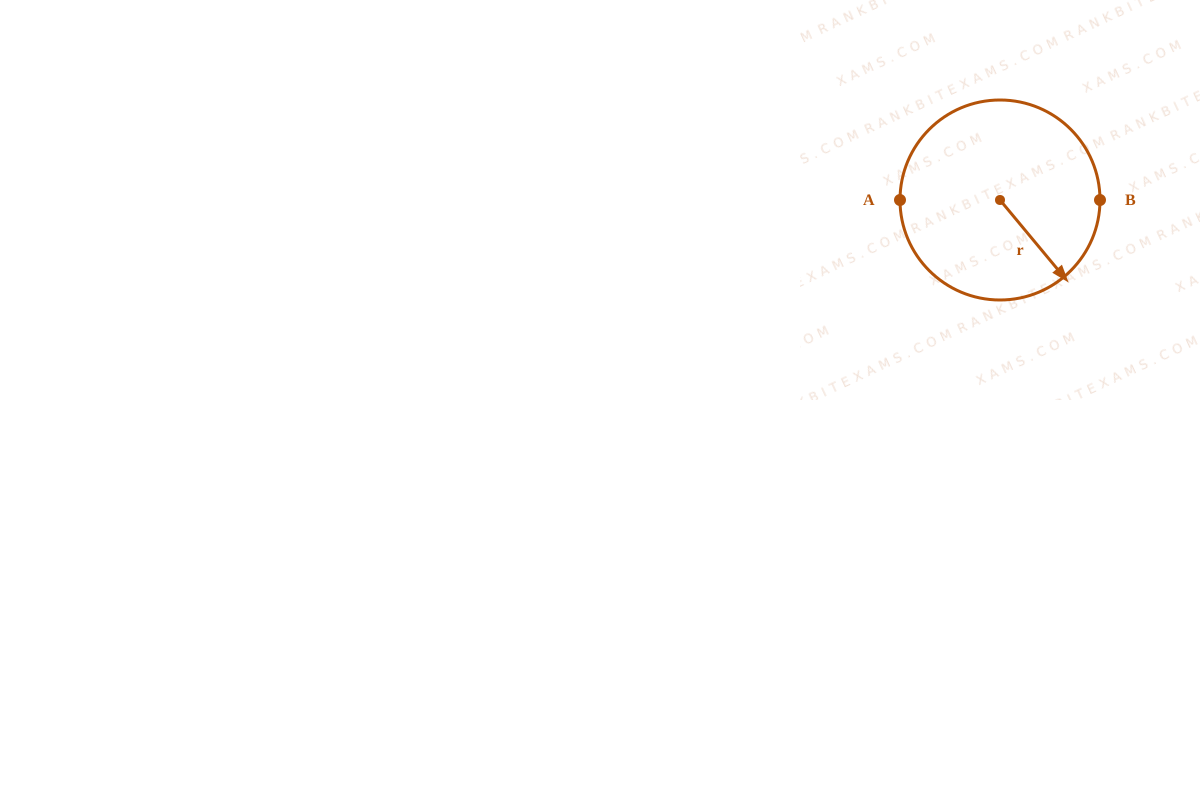
A sportsman runs around a circular track of radius r$r$ such that he traverses the path ABAB. The distance travelled and displacement, respectively, are
The diagram displays a circular track of radius r with diametrically opposite points A and B.
A.2r, 3π r$2\mathrm{r}, 3\pi \mathrm{r}$
B.3π r,π r$3\pi \mathbf{r},\pi \mathbf{r}$
C.π r, 3r$\pi \mathrm{r}, 3\mathrm{r}$
D.3π r, 2r$3\pi \mathrm{r}, 2\mathrm{r}$
Solution
Related Formula
Distance: Total actual path length covered.
Displacement: Shortest straight-line distance connecting the initial and final position.
Circumference of a complete circle = 2π r$2\pi r$
Semicircular arc length = π r$\pi r$
Core Logic
The trajectory is defined by the sequence of points A → B → A → B$A \to B \to A \to B$:
Distance Travelled:
Segment 1 (A → B$A \to B$): Semicircular path of length π r$\pi r$
Segment 3 (A → B$A \to B$): Semicircular path of length π r$\pi r$
Total distance:
Distance = π r + π r + π r = 3π r$$\text{Distance} = \pi r + \pi r + \pi r = 3\pi r$$
Displacement:
Initial position: A$A$
Final position: B$B$
Since points A$A$ and B$B$ represent diametrically opposite positions on the circle, the shortest distance between them is equal to the diameter of the circle:
Displacement = 2r$$\text{Displacement} = 2r$$
Step 1: Write result
The actual distance travelled is 3π r$3\pi r$ and the magnitude of displacement is 2r$2r$.
Pattern Recognition
Sees: Circular kinematics path tracing.
Trap: Accidentally substituting straight chords for the distance arcs, or assuming the loop returns fully to A (which would yield a zero displacement).
Shortcut: The path ends at B. Since 3 half-loops are made, distance = 3 × π r = 3π r$3 \times \pi r = 3\pi r$. The direct path from start A to end B is just the diameter 2r$2r$.
Chapter Mix
Class 11 Physics: Motion in a Straight Line
Qjee_main_2025_02_april_morningMotion in Two Dimensions
A river is flowing from west to east direction with speed of 9~km~h⁻¹$9\mathrm{~km~h}^{-1}$. If a boat capable of moving at a maximum speed of 27~km~h⁻¹$27\mathrm{~km~h}^{-1}$ in still water, crosses the river in half a minute, while moving with maximum speed at an angle of 150°$150^{\circ}$ to direction of river flow, then the width of the river is:
Let the West-to-East river flow direction be along the positive x$x$-axis.
The boat's velocity relative to water is vbr = 27~km/h$v_{br} = 27\mathrm{~km/h}$ at an angle of 150°$150^{\circ}$ with respect to the river flow (which is 30°$30^{\circ}$ upstream from the perpendicular crossing line).
To find the width of the river, we only need the component of the boat's velocity perpendicular to the river bank (y$y$-axis):
Given the crossing time is half a minute (t = 30~s$t = 30\mathrm{~s}$):
w = v⊥ · t = 3.75 × 30 = 112.5~m$$w = v_{\perp} \cdot t = 3.75 \times 30 = 112.5\mathrm{~m}$$
Step 1: Final Conclusion
The width of the river is 112.5~m$112.5\mathrm{~m}$.
Pattern Recognition
In river-boat crossing problems, river velocity (vᵣ$v_r$) only causes drift along the bank; it has zero impact on crossing time or the crossing width calculations when the angle is defined relative to the flow. Use the vertical velocity component exclusively.
Chapter Mix
Class 11 Physics: Kinematics
More Kinematics Questions — jee_main_2024_27_jan_morning
Practice past-year questions one chapter at a time. Pick an exam → subject → chapter and get every PYQ for that topic — pulled together from all past papers — with the chapter's key formulas alongside.