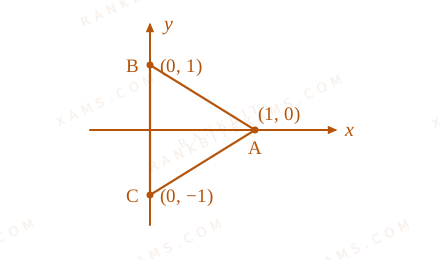
If S=\zin C:|z-i|=|z+i|=|z-1|\, then n(S) is:

Solution & Explanation

### Related Formula |z - z_1| = |z - z_2| This represents the perpendicular bisector of the line segment joining the points z_1 and z_2 in the complex plane. ### Core Logic The given set defines a complex number z that is equidistant from three fixed points: A equiv (0, 1) corresponding to i B equiv (0, -1) corresponding to -i C equiv (1, 0) corresponding to 1 The condition |z-i|=|z+i|=|z-1| implies that z is the point of intersection of the perpendicular bisectors of the sides of the triangle formed by A, B, and C. ### Step 1: Finding the Circumcenter The point of intersection of the perpendicular bisectors of a triangle is its circumcenter. Since A(0,1), B(0,-1), and C(1,0) form a unique, non-degenerate triangle, they have exactly one unique circumcenter. ### Step 2: Final Conclusion Therefore, there is only one such complex number z that satisfies the condition. n(S) = 1 ### Pattern Recognition Recognize that |z - z_1| = |z - z_2| = |z - z_3| is geometrically identical to finding the circumcenter of a triangle with vertices at z_1, z_2, and z_3. A non-collinear set of three points always yields exactly 1 circumcenter. ### Evaluation Rubric / Model Answer null ### Chapter Mix Class 11 Maths: Complex Numbers Class 11 Maths: Straight Lines

Reference Study Guides

More Complex Numbers Previous-Year Questions — Page 7

Q26 jee_main_2024_31_jan_morning Properties of Modulus and Argument
If alpha denotes the number of solutions of |1 - i|^x = 2^x and beta = left(frac|z|arg(z)right), where z = fracpi4 (1 + i)^4 left(frac1 - sqrtpi isqrtpi + i + fracsqrtpi - i1 + sqrtpi iright), i = sqrt-1, then the distance of the point (alpha, beta) from the line 4x - 3y = 7 is
Numerical Answer. Answer: 3 to 3

Solution

### Core Logic |1 - i|^x = 2^x implies (sqrt2)^x = 2^x implies 2^x/2 = 2^x This implies fracx2 = x implies x = 0. There is exactly 1 solution, so alpha = 1. ### Step 1: Simplify complex number z (1+i)^4 = ((1+i)^2)^2 = (1 + i^2 + 2i)^2 = (2i)^2 = -4 Thus, z = -pi left( frac(1-sqrtpii)(sqrtpi-i)pi + 1 + frac(sqrtpi-i)(1-sqrtpii)1 + pi right) ### Step 2: Simplify Bracket Let's expand the terms directly: z = fracpi4(-4) left[ fracsqrtpi - pi i - i - sqrtpipi + 1 + fracsqrtpi - i - pi i - sqrtpi1 + pi right] = -pi left[ frac-i(pi+1)pi+1 + frac-i(pi+1)pi+1 right] = -pi [ -i - i ] = 2pi i ### Step 3: Find beta For z = 2pi i: |z| = 2pi and arg(z) = fracpi2. beta = frac|z|arg(z) = frac2pipi/2 = 4 ### Step 4: Distance from Line Distance of point (alpha, beta) = (1, 4) from the line 4x - 3y - 7 = 0: D = frac|4(1) - 3(4) - 7|sqrt4^2 + (-3)^2 = frac|4 - 12 - 7|5 = frac|-15|5 = 3 ### Evaluation Rubric / Model Answer null ### Chapter Mix Class 11 Maths: Complex Numbers and Quadratic Equations Class 11 Maths: Straight Lines

More Complex Numbers Questions — jee_main_2024_27_jan_morning

Practice all Complex Numbers previous-year questions →

Rankbit System
JEE Physics: Waves (+15.5%) | Electrostatics: Concentric Shells (-29.7%) | Modern Physics: Photoelectric Clones (+34.2%) | Mathematics: Definite Integrals (+18.1%) | Chemistry: Coordination Splitting (-11.4%) | JEE Physics: Waves (+15.5%) | Electrostatics: Concentric Shells (-29.7%) | Modern Physics: Photoelectric Clones (+34.2%) | Mathematics: Definite Integrals (+18.1%) | Chemistry: Coordination Splitting (-11.4%)