If S=zin C:|z-i|=|z+i|=|z-1|$S=\{z\in C:|z-i|=|z+i|=|z-1|\}$, then n(S)$n(S)$ is:
A.1$1$
B.0$0$
C.3$3$
D.2$2$
Solution & Explanation
Related Formula
|z - z₁| = |z - z₂|$$|z - z_1| = |z - z_2|$$
This represents the perpendicular bisector of the line segment joining the points z₁$z_1$ and z₂$z_2$ in the complex plane.
Core Logic
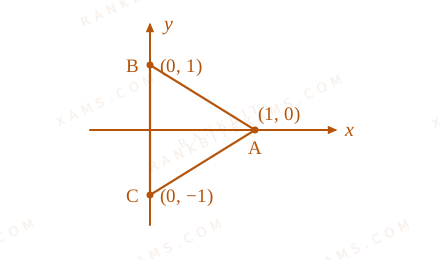
The given set defines a complex number z$z$ that is equidistant from three fixed points:
A ≡ (0, 1)$A \equiv (0, 1)$ corresponding to i$i$B ≡ (0, -1)$B \equiv (0, -1)$ corresponding to -i$-i$C ≡ (1, 0)$C \equiv (1, 0)$ corresponding to 1$1$
The condition |z-i|=|z+i|=|z-1|$|z-i|=|z+i|=|z-1|$ implies that z$z$ is the point of intersection of the perpendicular bisectors of the sides of the triangle formed by A$A$, B$B$, and C$C$.
Step 1: Finding the Circumcenter
The point of intersection of the perpendicular bisectors of a triangle is its circumcenter.
Since A(0,1)$A(0,1)$, B(0,-1)$B(0,-1)$, and C(1,0)$C(1,0)$ form a unique, non-degenerate triangle, they have exactly one unique circumcenter.
Step 2: Final Conclusion
Therefore, there is only one such complex number z$z$ that satisfies the condition.
n(S) = 1$n(S) = 1$
Pattern Recognition
Recognize that |z - z₁| = |z - z₂| = |z - z₃|$|z - z_1| = |z - z_2| = |z - z_3|$ is geometrically identical to finding the circumcenter of a triangle with vertices at z₁$z_1$, z₂$z_2$, and z₃$z_3$. A non-collinear set of three points always yields exactly 1 circumcenter.
Chapter Mix
Class 11 Maths: Complex Numbers
Class 11 Maths: Straight Lines
Modulus and Conjugate
More Complex Numbers Previous-Year Questions — Page 6
Q54jee_main_2025_28_jan_eveningComplex Roots of Quadratic Equations
If α+iβ$\alpha+i\beta$ and γ+iδ$\gamma+i\delta$ are the roots of x²-(3-2i)x-(2i-2)=0,$x^{2}-(3-2i)x-(2i-2)=0,$i=√(-1)$i=\sqrt{-1}$ then αγ+βδ$\alpha\gamma+\beta\delta$ is equal to :
A.6$6$
B.2$2$
C.-2$-2$
D.-6$-6$
Solution
Related Formula
For a quadratic equation Ax² + Bx + C = 0$Ax^2 + Bx + C = 0$, roots can be obtained via the quadratic formula:
Always try to express the complex number under the square root in the form (a + bi)²$(a + bi)^2$ by matching the imaginary part 2ab = -4i ab = -2$2ab = -4i \implies ab = -2$, and a² - b² = -3$a^2 - b^2 = -3$. This avoids long calculations.
Chapter Mix
Class 11 Mathematics: Complex Numbers and Quadratic Equations
Qjee_main_2025_29_jan_morningGeometry of Complex Numbers
Let |z₁ - 8 - 2i| ≤ 1$|z_1 - 8 - 2i| \le 1$ and |z₂ - 2 + 6i| ≤ 2$|z_2 - 2 + 6i| \le 2$, z₁, z₂ in C$z_1, z_2 \in \mathbb{C}$. Then the minimum value of |z₁ - z₂|$|z_1 - z_2|$ is:
A. 3
B. 7
C. 13
D. 10
Solution
Related Formula
Minimum distance between two circles: d = C₁C₂ - r₁ - r₂$$\text{Minimum distance between two circles: } d_{\min} = C_1C_2 - r_1 - r_2$$
Core Logic
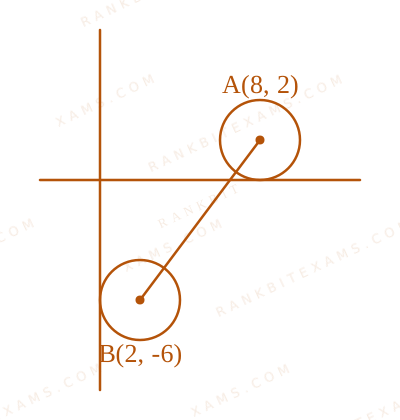
The expressions define two circular disc fields in the complex plane:
Circle 1: Center C₁(8, 2)$C_1(8, 2)$, radius r₁ = 1$r_1 = 1$
Circle 2: Center C₂(2, -6)$C_2(2, -6)$, radius r₂ = 2$r_2 = 2$
Geometry of Complex Numbers diagram for Q69 - JEE Main 2025 Morning
Always interpret modulus circle properties geometrically rather than algebraically. Disconnecting complex plane variables into simple 2D analytical geometry centers avoids calculation mistakes entirely.
Chapter Mix
Class 11 Mathematics: Complex Numbers
Class 11 Mathematics: Coordinate Geometry
Qjee_main_2024_01_february_morningGeometry of Complex Numbers
Let P=zin C:|z+2-3i|≤1$P=\{z\in\mathbb{C}:|z+2-3i|\le1\}$ and Q=zin C:z(1+i)+ z(1-i)≤-8$Q=\{z\in\mathbb{C}:z(1+i)+\overline{z}(1-i)\le-8\}$. Let in P Q, |z-3+2i|$P \cap Q, |z-3+2i|$ be maximum and minimum at z₁$z_{1}$ and z₂$z_{2}$ respectively. If |z₁|²+2|z₂|²=α+β√(2)$|z_{1}|^{2}+2|z_{2}|^{2}=\alpha+\beta\sqrt{2}$, where α, β$\alpha, \beta$ are integers, then α+β$\alpha+\beta$ equals
Numerical Answer.Answer: 36 to 36
Solution
Related Formula
For a complex coordinate transformation, substituting z = x + iy$z = x + iy$ and its conjugate z = x - iy$\overline{z} = x - iy$ maps a complex condition directly into rectangular Cartesian coordinates.
Core Logic
Let's translate the complex set properties into Cartesian geometry:
Set P$P$: |z - (-2 + 3i)| ≤ 1$|z - (-2 + 3i)| \le 1 \implies$ Interior and boundary of a circle with center C(-2, 3)$C(-2, 3)$ and radius r = 1$r = 1$.
Set Q$Q$: (x+iy)(1+i) + (x-iy)(1-i) ≤ -8 (x - y + ix + iy) + (x - y - ix - iy) ≤ -8$(x+iy)(1+i) + (x-iy)(1-i) \le -8 \implies (x - y + ix + iy) + (x - y - ix - iy) \le -8$
2(x - y) ≤ -8 x - y + 4 ≤ 0$$2(x - y) \le -8 \implies x - y + 4 \le 0$$
This defines a half-plane below or to the left of the boundary line L₂: x - y + 4 = 0$L_2: x - y + 4 = 0$.
Step 1: Identify Extreme Points for Distance from Point A
We want to find points in the region P Q$P \cap Q$ that minimize and maximize the distance to the external point A(3, -2)$A(3, -2)$, corresponding to |z - (3 - 2i)|$|z - (3 - 2i)|$.
The line L₁$L_1$ connecting center C(-2, 3)$C(-2, 3)$ and point A(3, -2)$A(3, -2)$ has slope:
Equation of line L₁$L_1$: y - 3 = -1(x + 2) x + y - 1 = 0$y - 3 = -1(x + 2) \implies x + y - 1 = 0$.
The graphic details the intersection region bounded by the circular locus and the line inequality, showing points z1 and z2 relative to external reference point P.
Step 2: Calculate Coordinates for z₁$z_1$ and z₂$z_2$
Minimum Distance Point (z₂$z_2$): By geometric observation, the minimum distance from A$A$ to the bounded region is the intersection point of lines L₁$L_1$ and L₂$L_2$:
x - y + 4 = 0 and x + y - 1 = 0 2x + 3 = 0 x = -(3)/(2), y = (5)/(2)$$x - y + 4 = 0 \quad \text{and} \quad x + y - 1 = 0 \implies 2x + 3 = 0 \implies x = -\frac{3}{2}, \, y = \frac{5}{2}$$
So, z₂ = (-(3)/(2), (5)/(2))$z_2 = \left(-\frac{3}{2}, \frac{5}{2}\right)$.
Maximum Distance Point (z₁$z_1$): The maximum distance is at the far boundary edge of the circle along line L₁$L_1$. The vector path from C(-2, 3)$C(-2, 3)$ opposite to A$A$ has unit direction (- 1√(2), 1√(2))$\left(-\frac{1}{\sqrt{2}}, \frac{1}{\sqrt{2}}\right)$:
Sees: Locus intersection involving geometric complex inequalities.
Shortcut: Translating complex equations into standard 2D graphs reveals the geometry instantly, mapping extreme distances to line intersections or boundary nodes cleanly.
Chapter Mix
Class 11 Complex Numbers: Geometry
Class 11 Coordinate Geometry: Straight Lines
Q6jee_main_2024_01_february_morningGeometry of Complex Numbers
Let S=zin C:|z-1|=1 and (√(2)-1)(z+ z)-i(z- z)=2√(2)$S=\{z\in C:|z-1|=1 \text{ and } (\sqrt{2}-1)(z+\overline{z})-i(z-\overline{z})=2\sqrt{2}\}$. Let z₁, z₂in S$z_{1}, z_{2}\in S$ be such that |z₁|= zin S|z|$|z_{1}|=\max_{z\in S}|z|$ and |z₂|= zin S|z|$|z_{2}|=\min_{z\in S}|z|$. Then |√(2)z₁-z₂|²$|\sqrt{2}z_{1}-z_{2}|^{2}$ equals:
A.1$1$
B.4$4$
C.3$3$
D.2$2$
Solution
Related Formula
For a complex number z = x + iy$z = x + iy$:
|z| = √(x² + y²)$|z| = \sqrt{x^2 + y^2}$
z + z = 2x$z + \overline{z} = 2x$
z - z = 2iy$z - \overline{z} = 2iy$
Core Logic
Let z = x + iy$z = x + iy$.
The first condition |z - 1| = 1$|z - 1| = 1$ describes a circle:
Sees: Geometric constraint mapping to a circle and line intersection in the complex plane.
Shortcut: Rationalizing terms like 12-√(2)$\frac{1}{2-\sqrt{2}}$ immediately into standard form 1+ 1√(2)$1+\frac{1}{\sqrt{2}}$ saves you from handling layered fraction algebra down the line.
Chapter Mix
Class 11 Complex Numbers: Geometry
Class 10 Coordinate Geometry: Lines and Circles
Qjee_main_2024_29_january_eveningModulus and Argument of a Complex Number
Let r$r$ and θ$\theta$ respectively be the modulus and amplitude of the complex number z = 2 - i (2 (5 π)/(8))$z = 2 - i \left(2 \tan \frac{5 \pi}{8}\right)$, then (r, θ)$(r, \theta)$ is equal to
For z = x + iy$z = x + iy$, modulus r = √(x² + y²)$r = \sqrt{x^2 + y^2}$ and argument θ$\theta$ depends on the quadrant location.
Core Logic
Given z = 2 - i(2 (5π)/(8))$z = 2 - i\left(2 \tan \frac{5\pi}{8}\right)$.
Note that (5π)/(8)$\frac{5\pi}{8}$ lies in the second quadrant, so (5π)/(8) < 0$\tan \frac{5\pi}{8} < 0$.
Let's write r$r$:
Practice past-year questions one chapter at a time. Pick an exam → subject → chapter and get every PYQ for that topic — pulled together from all past papers — with the chapter's key formulas alongside.