Let |z₁ - 8 - 2i| ≤ 1$|z_1 - 8 - 2i| \le 1$ and |z₂ - 2 + 6i| ≤ 2$|z_2 - 2 + 6i| \le 2$, z₁, z₂ in C$z_1, z_2 \in \mathbb{C}$. Then the minimum value of |z₁ - z₂|$|z_1 - z_2|$ is:
A.3
B.7
C.13
D.10
Solution & Explanation
Related Formula
Minimum distance between two circles: d = C₁C₂ - r₁ - r₂$$\text{Minimum distance between two circles: } d_{\min} = C_1C_2 - r_1 - r_2$$
Core Logic
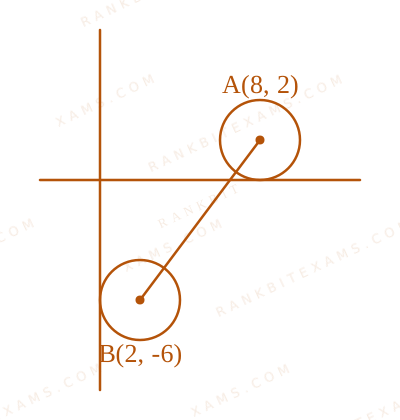
The expressions define two circular disc fields in the complex plane:
Circle 1: Center C₁(8, 2)$C_1(8, 2)$, radius r₁ = 1$r_1 = 1$
Circle 2: Center C₂(2, -6)$C_2(2, -6)$, radius r₂ = 2$r_2 = 2$
Geometry of Complex Numbers diagram for Q69 - JEE Main 2025 Morning
Always interpret modulus circle properties geometrically rather than algebraically. Disconnecting complex plane variables into simple 2D analytical geometry centers avoids calculation mistakes entirely.
Chapter Mix
Class 11 Mathematics: Complex Numbers
Class 11 Mathematics: Coordinate Geometry
More Complex Numbers Previous-Year Questions
Q17jee_main_2026_21_jan_morningCube Roots of Unity
If x² + x + 1 = 0$x^{2} + x + 1 = 0$ , then the value of (x+ 1x)⁴+(x²+ 1x²)⁴+(x³+ 1x³)⁴+…+(x²⁵+ 1x²⁵)⁴$\left(\mathrm{x}+\frac{1}{\mathrm{x}}\right)^{4}+\left(\mathrm{x}^{2}+\frac{1}{\mathrm{x}^{2}}\right)^{4}+\left(\mathrm{x}^{3}+\frac{1}{\mathrm{x}^{3}}\right)^{4}+\ldots+\left(\mathrm{x}^{25}+\frac{1}{\mathrm{x}^{25}}\right)^{4}$ is :
Properties of cube roots of unity: ω³ = 1$\omega^3 = 1$ and 1 + ω + ω² = 0$1 + \omega + \omega^2 = 0$.
Core Logic
Let α = ω$\alpha = \omega$. Then (1)/(x) = (1)/(ω) = ω²$\frac{1}{x} = \frac{1}{\omega} = \omega^2$.
The series is Σk=1²⁵ (ω^k + ω2k)⁴$\sum_{k=1}^{25} (\omega^k + \omega^{2k})^4$.
Evaluate the term Tk = (ω^k + ω2k)⁴$T_k = (\omega^k + \omega^{2k})^4$ based on the modulo of k$k$ with 3.
Powers of x+1/x$x+1/x$ when x$x$ solves x² ± x + 1 = 0$x^2 \pm x + 1 = 0$ perfectly orbit around periods of 3 or 6. Isolate the 3m$3m$ resonant beats (which hit pure scalars like 1+1=2$1+1=2$) versus the out-of-phase beats (which collapse to -1$-1$ or 1$1$ via basic ω$\omega$ identities).
Chapter Mix
Class 11 Maths: Complex Numbers and Quadratic Equations
Q19jee_main_2026_21_jan_eveningGeometry of Complex Numbers
Let z$z$ be the complex number satisfying |z-5|≤ 3$|z-5|\leq 3$ and having maximum positive principal argument. Then 34|(5z-12)/(5iz+16)|²$34\left|\frac{5z-12}{5iz+16}\right|^{2}$ is equal to:
A.16$16$
B.12$12$
C.26$26$
D.20$20$
Solution
Related Formula
For maximum argument of z on a circle, the ray from origin is tangent to the circle.$$\text{For maximum argument of } z \text{ on a circle, the ray from origin is tangent to the circle.}$$If |z-a| ≤ r, maximum argument implies θ = (r)/(|a|) and coordinates are x=a ²θ, y=a θ θ$$\text{If } |z-a| \leq r, \text{ maximum argument implies } \sin\theta = \frac{r}{|a|} \text{ and coordinates are } x=a\cos^2\theta, y=a\sin\theta\cos\theta$$
Core Logic
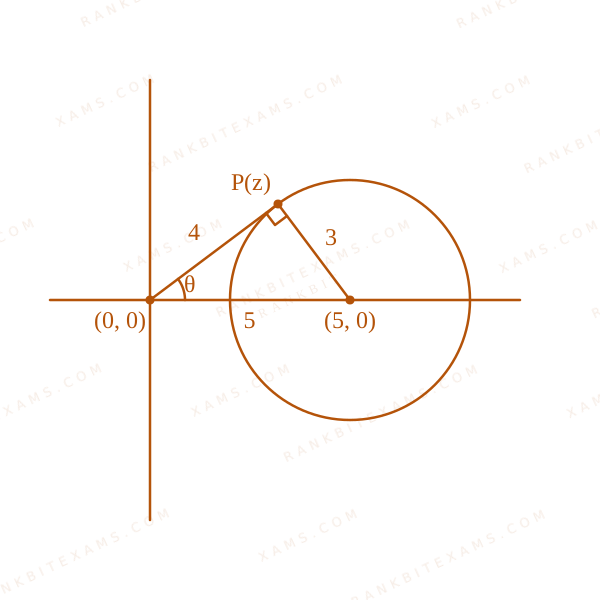
Complex geometry maximum argument diagram for Q19 - JEE Main 2026 Evening
The condition |z-5|≤ 3$|z-5|\leq 3$ represents a disk centered at (5,0)$(5,0)$ with radius 3$3$.
To maximize the principal argument θ$\theta$, the ray from origin must touch the circle in the first quadrant.
The tangent, origin, and center form a right-angled triangle.
Step 1: Locate the Point z
From geometry, hypotenuse c = 5$c = 5$, opposite (radius) r = 3$r = 3$.
The adjacent side (length of tangent) is √(5² - 3²) = 4$\sqrt{5^2 - 3^2} = 4$.
The angle of tangency θ$\theta$ satisfies θ = (3)/(5)$\sin\theta = \frac{3}{5}$ and θ = (4)/(5)$\cos\theta = \frac{4}{5}$.
The point P(z)$P(z)$ lies on the circle and the tangent ray:
For maximum (z)$\arg(z)$ on |z-c| = r$|z-c| = r$ where c$c$ is real, z$z$ coordinates are given by geometric projection: z = √(c²-r²)( θ + i θ)$z = \sqrt{c^2-r^2}(\cos\theta + i\sin\theta)$ where θ = r/c$\sin\theta = r/c$.
Chapter Mix
Class 11 Maths: Complex Numbers
Q21jee_main_2026_22_january_morningCube Roots of Unity
Cube Roots of Unity diagram for Q21 - JEE Main 2026 Morning
Pattern Recognition
Complex expressions with ω$\omega$ raised to large powers almost always exploit rotational symmetry. If coefficients are permuted circularly (A, B, C) → (C, A, B) → (B, C, A)$(A, B, C) \to (C, A, B) \to (B, C, A)$, multiplying by ω$\omega$ maps them to one another, meaning their sum of 3n$3n$ or symmetric powers identically nullifies.
Chapter Mix
Class 11 Maths: Complex Numbers
Q4jee_main_2026_22_january_eveningComplex Equations and Modulus
Let S = z in C : 4z² + z = 0$S = \{z \in \mathbb{C} : 4z^2 + \overline{z} = 0\}$. Then Σz in S |z|²$\sum_{z \in S} |z|^2$ is equal to:
A.(3)/(16)$\frac{3}{16}$
B.(7)/(64)$\frac{7}{64}$
C.(1)/(16)$\frac{1}{16}$
D.(5)/(64)$\frac{5}{64}$
Solution
Related Formula
For z = x + iy$z = x + iy$, z = x - iy$\overline{z} = x - iy$ and |z|² = x² + y²$|z|^2 = x^2 + y^2$.
Core Logic
Substitute z = x + iy$z = x + iy$ into 4z² + z = 0$4z^2 + \overline{z} = 0$:
Separate complex equation into real and imaginary components to systematically find all roots.
Chapter Mix
Class 11 Maths: Complex Numbers
Q17jee_main_2026_23_january_morningGeometry of Complex Numbers
Let S = z : 3 ≤ |2z - 3(1 + i)| ≤ 7$S = \{z : 3 \leq |2z - 3(1 + i)| \leq 7\}$ be a set of complex numbers. Then z in S | ( z + (1)/(2)(5 + 3i) ) |$\min_{z \in S} \left| \left( z + \frac{1}{2}(5 + 3i) \right) \right|$ is equal to:
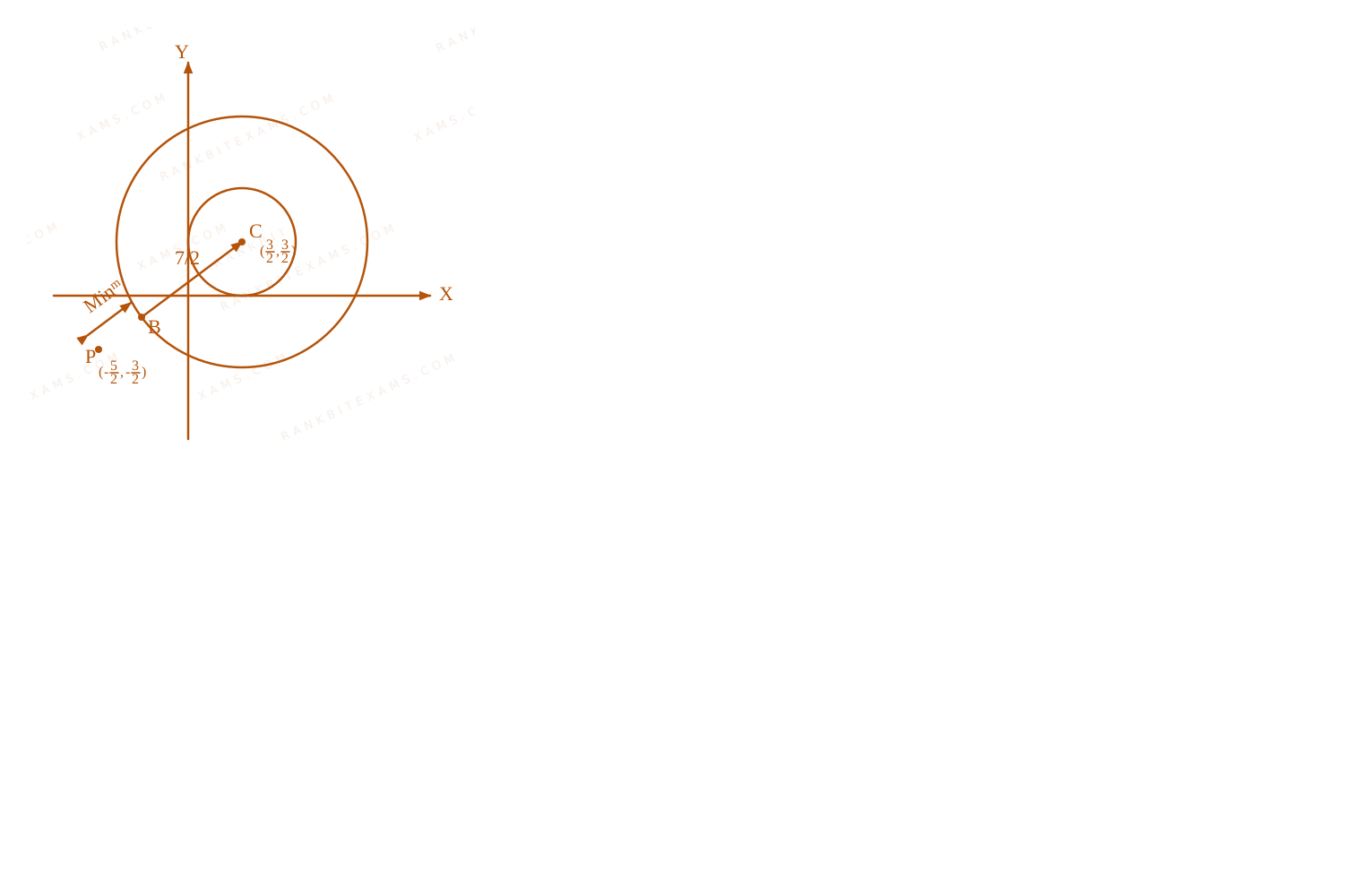
This represents an annular region bounded by two concentric circles centered at C = (3)/(2) + (3)/(2)i$C = \frac{3}{2} + \frac{3}{2}i$ with radii r₁ = (3)/(2)$r_1 = \frac{3}{2}$ and r₂ = (7)/(2)$r_2 = \frac{7}{2}$.
Geometry of Complex Numbers diagram for Q17 - JEE Main 2026 Morning
Step 1: Identify the Target Point
We need to minimize | z - ( -(5)/(2) - (3)/(2)i ) |$\left| z - \left( -\frac{5}{2} - \frac{3}{2}i \right) \right|$.
Let P$P$ be the point -(5)/(2) - (3)/(2)i$-\frac{5}{2} - \frac{3}{2}i$. The expression represents the distance from point P$P$ to a point z$z$ in the set S$S$.
Step 2: Distance from Center to P
Calculate the distance PC$PC$ between the center of the circles C((3)/(2), (3)/(2))$C\left(\frac{3}{2}, \frac{3}{2}\right)$ and the point P(-(5)/(2), -(3)/(2))$P\left(-\frac{5}{2}, -\frac{3}{2}\right)$:
Since 5 > (7)/(2)$5 > \frac{7}{2}$, the point P$P$ lies outside the outer circle.
Step 3: Minimum Distance Calculation
The shortest distance from an external point to an annular region is the distance to the outer boundary along the line connecting the point to the center.
z in S |z - P| = PC - router$$\min_{z \in S} |z - P| = PC - r_{\text{outer}}$$Minimum Distance = 5 - (7)/(2) = (10 - 7)/(2) = (3)/(2)$$\text{Minimum Distance} = 5 - \frac{7}{2} = \frac{10 - 7}{2} = \frac{3}{2}$$
Pattern Recognition
Transforming |az - b|$|az - b|$ by factoring out a$a$ immediately reveals the true geometric center. Shortest distance to any ring/circle from an external point is always collinear with the center: d - Router$d - R_{outer}$.
Chapter Mix
Class 11 Maths: Complex Numbers and Quadratic Equations
Practice past-year questions one chapter at a time. Pick an exam → subject → chapter and get every PYQ for that topic — pulled together from all past papers — with the chapter's key formulas alongside.