Rankbit System
JEE Physics: Waves (+15.5%) | Electrostatics: Concentric Shells (-29.7%) | Modern Physics: Photoelectric Clones (+34.2%) | Mathematics: Definite Integrals (+18.1%) | Chemistry: Coordination Splitting (-11.4%) | JEE Physics: Waves (+15.5%) | Electrostatics: Concentric Shells (-29.7%) | Modern Physics: Photoelectric Clones (+34.2%) | Mathematics: Definite Integrals (+18.1%) | Chemistry: Coordination Splitting (-11.4%)

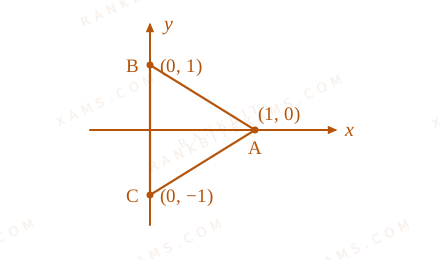
If S=\zin C:|z-i|=|z+i|=|z-1|\, then n(S) is:

Solution & Explanation

### Related Formula |z - z_1| = |z - z_2| This represents the perpendicular bisector of the line segment joining the points z_1 and z_2 in the complex plane. ### Core Logic The given set defines a complex number z that is equidistant from three fixed points: A equiv (0, 1) corresponding to i B equiv (0, -1) corresponding to -i C equiv (1, 0) corresponding to 1 The condition |z-i|=|z+i|=|z-1| implies that z is the point of intersection of the perpendicular bisectors of the sides of the triangle formed by A, B, and C. ### Step 1: Finding the Circumcenter The point of intersection of the perpendicular bisectors of a triangle is its circumcenter. Since A(0,1), B(0,-1), and C(1,0) form a unique, non-degenerate triangle, they have exactly one unique circumcenter. ### Step 2: Final Conclusion Therefore, there is only one such complex number z that satisfies the condition. n(S) = 1 ### Pattern Recognition Recognize that |z - z_1| = |z - z_2| = |z - z_3| is geometrically identical to finding the circumcenter of a triangle with vertices at z_1, z_2, and z_3. A non-collinear set of three points always yields exactly 1 circumcenter. ### Evaluation Rubric / Model Answer null ### Chapter Mix Class 11 Maths: Complex Numbers Class 11 Maths: Straight Lines

Reference Study Guides

More Complex Numbers Previous-Year Questions — Page 4

Q69 jee_main_2025_29_jan_morning Geometry of Complex Numbers
Let left|z_1 - 8 - 2iright| leq 1 and left|z_2 - 2 + 6iright| leq 2 , z_1, z_2 in C . Then the minimum value of left|z_1 - z_2 ight| is:
  • A. 3
  • B. 7
  • C. 13
  • D. 10

Solution

### Related Formula textMinimum distance between two circles: d_textmin = C_1C_2 - r_1 - r_2 ### Core Logic The expressions define two circular disc fields in the complex plane: Circle 1: Center C_1(8, 2), radius r_1 = 1 Circle 2: Center C_2(2, -6), radius r_2 = 2
Geometry of Complex Numbers diagram for Q69 - JEE Main 2025 Morning
### Step 1: Calculate Center Distance Using coordinate distance formulation: C_1C_2 = sqrt(8 - 2)^2 + (2 - (-6))^2 = sqrt6^2 + 8^2 = 10 ### Step 2: Find Minimum Separation |z_1 - z_2|_textmin = C_1C_2 - r_1 - r_2 = 10 - 1 - 2 = 7 ### Pattern Recognition Always interpret modulus circle properties geometrically rather than algebraically. Disconnecting complex plane variables into simple 2D analytical geometry centers avoids calculation mistakes entirely. ### Evaluation Rubric / Model Answer null ### Chapter Mix Class 11 Mathematics: Complex Numbers Class 11 Mathematics: Coordinate Geometry
Q6 jee_main_2024_01_february_morning Geometry of Complex Numbers
Let S=\zin C:|z-1|=1 text and (sqrt2-1)(z+overlinez)-i(z-overlinez)=2sqrt2\. Let z_1, z_2in S be such that |z_1|=max_zin S|z| and |z_2|=min_zin S|z|. Then |sqrt2z_1-z_2|^2 equals:
  • A. 1
  • B. 4
  • C. 3
  • D. 2

Solution

### Related Formula For a complex number z = x + iy: 1. |z| = sqrtx^2 + y^2 2. z + overlinez = 2x 3. z - overlinez = 2iy ### Core Logic Let z = x + iy. The first condition |z - 1| = 1 describes a circle: (x-1)^2 + y^2 = 1 quad implies (1) The second condition gives a straight line: (sqrt2-1)(2x) - i(2iy) = 2sqrt2 2(sqrt2-1)x + 2y = 2sqrt2 (sqrt2-1)x + y = sqrt2 quad implies (2) The set S contains the intersection points of this circle and line. ### Step 1: Solve for Intersection Points From (2), y = sqrt2 - (sqrt2-1)x. Substitute this into (1): (x-1)^2 + [sqrt2 - (sqrt2-1)x]^2 = 1 Solving this quadratic equation gives two values of x: x = 1 quad textor quad x = frac12-sqrt2 - **Case A**: x = 1 implies y = sqrt2 - (sqrt2-1)(1) = 1. So, one point is z_A = 1 + i. Its magnitude is |z_A| = sqrt1^2 + 1^2 = sqrt2. - **Case B**: x = frac12-sqrt2 = frac2+sqrt22 = 1 + frac1sqrt2. Then y = sqrt2 - (sqrt2-1)left(1+frac1sqrt2right) = sqrt2 - left(sqrt2 + 1 - 1 - frac1sqrt2right) = frac1sqrt2. So, the other point is z_B = left(1 + frac1sqrt2right) + fracisqrt2. Its magnitude is |z_B| = sqrtleft(1+frac1sqrt2right)^2 + left(frac1sqrt2right)^2 = sqrt1 + sqrt2 + frac12 + frac12 = sqrt2 + sqrt2. ### Step 2: Evaluate Min and Max Magnitude Expressions Comparing magnitudes, |z_B| > |z_A|, so: z_1 = z_B = left(1 + frac1sqrt2right) + fracisqrt2 z_2 = z_A = 1 + i Now, calculate |sqrt2z_1-z_2|^2: sqrt2z_1 = sqrt2left(1 + frac1sqrt2right) + sqrt2left(fracisqrt2right) = (sqrt2 + 1) + i sqrt2z_1 - z_2 = (sqrt2 + 1 + i) - (1 + i) = sqrt2 |sqrt2z_1 - z_2|^2 = |sqrt2|^2 = 2 ### Pattern Recognition Sees: Geometric constraint mapping to a circle and line intersection in the complex plane. Shortcut: Rationalizing terms like frac12-sqrt2 immediately into standard form 1+frac1sqrt2 saves you from handling layered fraction algebra down the line. ### Evaluation Rubric / Model Answer null ### Chapter Mix Class 11 Complex Numbers: Geometry Class 10 Coordinate Geometry: Lines and Circles
Q27 jee_main_2024_01_february_morning Geometry of Complex Numbers
Let P=\zinmathbbC:|z+2-3i|le1\ and Q=\zinmathbbC:z(1+i)+overlinez(1-i)le-8\. Let in P cap Q, |z-3+2i| be maximum and minimum at z_1 and z_2 respectively. If |z_1|^2+2|z_2|^2=alpha+betasqrt2, where alpha, beta are integers, then alpha+beta equals
Numerical Answer. Answer: 36 to 36

Solution

### Related Formula For a complex coordinate transformation, substituting z = x + iy and its conjugate overlinez = x - iy maps a complex condition directly into rectangular Cartesian coordinates. ### Core Logic Let's translate the complex set properties into Cartesian geometry: - Set P: |z - (-2 + 3i)| le 1 implies Interior and boundary of a circle with center C(-2, 3) and radius r = 1. - Set Q: (x+iy)(1+i) + (x-iy)(1-i) le -8 implies (x - y + ix + iy) + (x - y - ix - iy) le -8 2(x - y) le -8 implies x - y + 4 le 0 This defines a half-plane below or to the left of the boundary line L_2: x - y + 4 = 0. ### Step 1: Identify Extreme Points for Distance from Point A We want to find points in the region P cap Q that minimize and maximize the distance to the external point A(3, -2), corresponding to |z - (3 - 2i)|. The line L_1 connecting center C(-2, 3) and point A(3, -2) has slope: m = frac-2 - 33 - (-2) = frac-55 = -1 Equation of line L_1: y - 3 = -1(x + 2) implies x + y - 1 = 0.
Geometric region intersection for complex inequalities for Q27 - JEE Main 2024 01 February Morning
The graphic details the intersection region bounded by the circular locus and the line inequality, showing points z1 and z2 relative to external reference point P.
### Step 2: Calculate Coordinates for z1 and z2 - **Minimum Distance Point (z_2):** By geometric observation, the minimum distance from A to the bounded region is the intersection point of lines L_1 and L_2: x - y + 4 = 0 quad textand quad x + y - 1 = 0 implies 2x + 3 = 0 implies x = -frac32, \, y = frac52 So, z_2 = left(-frac32, frac52 ight). - **Maximum Distance Point (z_1):** The maximum distance is at the far boundary edge of the circle along line L_1. The vector path from C(-2, 3) opposite to A has unit direction left(-frac1sqrt2, frac1sqrt2right): z_1 = left(-2 - frac1sqrt2, \, 3 + frac1sqrt2right) ### Step 3: Evaluate Magnitudes and Sum Parameters Calculate the squares of the moduli: |z_1|^2 = left(-2 - frac1sqrt2right)^2 + left(3 + frac1sqrt2right)^2 = 4 + 2sqrt2 + frac12 + 9 + 3sqrt2 + frac12 = 14 + 5sqrt2 |z_2|^2 = left(-frac32right)^2 + left(frac52 ight)^2 = frac94 + frac254 = frac344 = frac172 Now compute the total requested term: |z_1|^2 + 2|z_2|^2 = (14 + 5sqrt2) + 2left(frac172right) = 14 + 5sqrt2 + 17 = 31 + 5sqrt2 Matching with alpha + betasqrt2 gives alpha = 31 and beta = 5. Thus: alpha + beta = 31 + 5 = 36 ### Pattern Recognition Sees: Locus intersection involving geometric complex inequalities. Shortcut: Translating complex equations into standard 2D graphs reveals the geometry instantly, mapping extreme distances to line intersections or boundary nodes cleanly. ### Evaluation Rubric / Model Answer null ### Chapter Mix Class 11 Complex Numbers: Geometry Class 11 Coordinate Geometry: Straight Lines
Q6 jee_main_2024_29_january_evening Modulus and Argument of a Complex Number
Let r and theta respectively be the modulus and amplitude of the complex number z = 2 - i left(2 tan frac5 pi8right), then (r, theta) is equal to
  • A. left(2sec frac3pi8,frac3pi8right)
  • B. left(2sec frac3pi8,frac5pi8right)
  • C. left(2sec frac5pi8,frac3pi8right)
  • D. left(2sec frac11pi8,frac11pi8 ight)

Solution

### Related Formula For z = x + iy, modulus r = sqrtx^2 + y^2 and argument theta depends on the quadrant location. ### Core Logic Given z = 2 - ileft(2 tan frac5pi8right). Note that frac5pi8 lies in the second quadrant, so tan frac5pi8 < 0. Let's write r: r = sqrt2^2 + left(-2 tan frac5pi8right)^2 = 2 sqrt1 + tan^2 frac5pi8 = 2 left| sec frac5pi8 right| Since sec frac5pi8 is negative: r = -2 sec frac5pi8 = -2 sec left(pi - frac3pi8right) = 2 sec frac3pi8 ### Step 1: Finding the Amplitude Since x = 2 > 0 and y = -2 tan frac5pi8 > 0, the complex number lies in the first quadrant. theta = tan^-1 left( fracyx right) = tan^-1 left( frac-2 tan frac5pi82 right) = tan^-1 left( -tan frac5pi8 right) -tan frac5pi8 = -tan left(pi - frac3pi8right) = tan frac3pi8 theta = tan^-1 left( tan frac3pi8 right) = frac3pi8 ### Pattern Recognition Always absolute-value trigonometric terms coming out of square roots (e.g., sqrtsec^2 phi = |sec phi|). Knowing the precise quadrant prevents incorrect signs. ### Evaluation Rubric / Model Answer null ### Chapter Mix Class 11 Mathematics: Complex Numbers and Quadratic Equations

Q21 jee_main_2024_29_january_evening Roots of Quadratic Equations
Let alpha, beta be the roots of the equation x^2 - sqrt6 x + 3 = 0 such that operatornameIm(alpha) > operatornameIm(beta). Let a, b be integers not divisible by 3 and n be a natural number such that fracalpha^99beta + alpha^98 = 3^n (a + ib), i = sqrt-1. Then n + a + b is equal to
Numerical Answer. Answer: 49 to 49

Solution

### Related Formula Using Euler's formula: e^itheta = costheta + isintheta ### Core Logic Solving the quadratic root configurations for x^2 - sqrt6x + 3 = 0: x = fracsqrt6 pm sqrt6 - 122 = fracsqrt6 pm isqrt62 = fracsqrt62(1 pm i) Given operatornameIm(alpha) > operatornameIm(beta), we set: alpha = sqrt3 left(frac1+isqrt2right) = sqrt3 e^ipi/4 beta = sqrt3 left(frac1-isqrt2right) = sqrt3 e^-ipi/4 ### Step 1: Simplify Target Expression Let us factor out common variables: fracalpha^99beta + alpha^98 = alpha^98 left( fracalphabeta + 1 right) = fracalpha^98(alpha + beta)beta Since alpha + beta = sqrt6: textValue = frac(sqrt3e^ipi/4)^98 cdot sqrt6sqrt3e^-ipi/4 = 3^49 e^i 98pi/4 cdot sqrt2 e^ipi/4 = 3^49 cdot sqrt2 e^i 99pi/4 Evaluate e^i 99pi/4: 99fracpi4 = 24pi + frac3pi4 implies e^i 99pi/4 = e^i 3pi/4 = frac-1+isqrt2 Substituting this back: textValue = 3^49 cdot sqrt2 left( frac-1+isqrt2 right) = 3^49(-1 + i) ### Step 2: Resolving Constants Comparing with the given expression 3^n(a + ib): n = 49, quad a = -1, quad b = 1 Therefore: n + a + b = 49 - 1 + 1 = 49 ### Pattern Recognition Convert complex expressions into polar form r e^itheta early. Power scaling like alpha^98 becomes simple multiplication under Euler structures. ### Evaluation Rubric / Model Answer null ### Chapter Mix Class 11 Mathematics: Complex Numbers and Quadratic Equations

More Complex Numbers Questions — jee_main_2024_27_jan_morning

Practice all Complex Numbers previous-year questions →

YOUR FIRST PREP STEP STARTS HERE

We Map Every Repeating Question in Competitive Exams.

Say goodbye to generic mock test fatigue. RankBit uses smart analysis to group past exam questions into their foundational Repeating Question Types. Find chapter weightage, track repeating questions, and score higher with targeted practice.

Select Your Target Exam

Choose an exam track below to find formulas per chapter and patterns.

Syncing Exam Intelligence

Mapping formulas and patterns across all tracks…

PATH A — FULL LENGTH PRACTICE

Full Mock Test Hub

Simulate real NTA exam conditions with fully tracked mocks. Time yourself against past papers.

Under Development
PATH B — TARGETED PRACTICE

Topic-wise Practice Hub

Practice past-year questions one chapter at a time. Pick an exam → subject → chapter and get every PYQ for that topic — pulled together from all past papers — with the chapter's key formulas alongside.

Loading Questions... Browse Topics
Latest from the Blog
View all →

Loading articles...