Related Formula
Area = ∫y₁y₂ (xright - xleft) dy$$\text{Area} = \int_{y_1}^{y_2} (x_{\text{right}} - x_{\text{left}}) dy$$
Core Logic
We need to find the area bounded by the curves in the first quadrant (since y ≥ 0$y \ge 0$). Note that the first inequality x²y + 4 ≥ 0$x^2y + 4 \ge 0$ is trivially satisfied for all x, y ≥ 0$x, y \ge 0$.
So we focus on bounding x$x$ using:
Right curve: x = 8 - 4y²$x = 8 - 4y^2$
Left curve: x = -2y²$x = -2y^2$
However, there might be constraints where these cross or hit the axes. We must inspect intersections.
Step 1: Finding Intersection Points
Where do the left and right parabolas intersect?
8 - 4y² = -2y² ⇒ 2y² = 8 ⇒ y² = 4 ⇒ y = 2$8 - 4y^2 = -2y^2 \Rightarrow 2y^2 = 8 \Rightarrow y^2 = 4 \Rightarrow y = 2$ (Since y ≥ 0$y \ge 0$).
Wait, does x$x$ have boundaries? Since x$x$ can't drop arbitrarily into negative territory if it's restricted by other axes. Let's check x²y + 4 ≥ 0$x^2y + 4 \ge 0$. If x = -2y²$x = -2y^2$, then y$y$ must be bounded, but wait - the question limits are actually split into two regions depending on x²y+4 ≥ 0$x^2y+4 \ge 0$? Wait, the first inequality x²y+4 ≥ 0$x^2y+4 \ge 0$ might not be trivial if x$x$ is negative.
If x = -2y²$x = -2y^2$, then (-2y²)² y + 4 ≥ 0 ⇒ 4y⁵ + 4 ≥ 0$(-2y^2)^2 y + 4 \ge 0 \Rightarrow 4y^5 + 4 \ge 0$, which is true for all y ≥ 0$y \ge 0$.
Wait, there seems to be a misinterpretation of the first inequality. Let's look closer at the PDF solution boundaries.
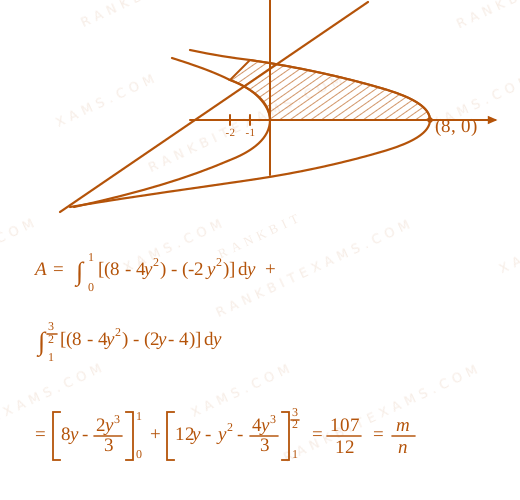
The integration is broken at y=1$y=1$.
Why? x+2y² ≥ 0 ⇒ x ≥ -2y²$x+2y^2 \ge 0 \Rightarrow x \ge -2y^2$. Wait, the solution states another left curve: 2y-4$2y-4$. Is x²y+4 ≥ 0$x^2y+4 \ge 0$ actually x + 2y - 4 ≥ 0$x + 2y - 4 \ge 0$?
Yes, OCR shows `x^2y+4` but the solution integrates `(2y-4)`. Thus the original condition is likely x - 2y + 4 ≥ 0 ⇒ x ≥ 2y - 4$x - 2y + 4 \ge 0 \Rightarrow x \ge 2y - 4$!
Let's assume the left boundary splits between x = -2y²$x = -2y^2$ and x = 2y - 4$x = 2y - 4$.
Step 2: Region Bounds
Intersection of x = -2y²$x = -2y^2$ and x = 2y - 4$x = 2y - 4$:
-2y² = 2y - 4 ⇒ y² + y - 2 = 0 ⇒ (y+2)(y-1) = 0 ⇒ y = 1$-2y^2 = 2y - 4 \Rightarrow y^2 + y - 2 = 0 \Rightarrow (y+2)(y-1) = 0 \Rightarrow y = 1$.
Intersection of x = 2y - 4$x = 2y - 4$ and x = 8 - 4y²$x = 8 - 4y^2$:
2y - 4 = 8 - 4y² ⇒ 4y² + 2y - 12 = 0 ⇒ 2y² + y - 6 = 0 ⇒ (2y-3)(y+2) = 0 ⇒ y = 3/2$2y - 4 = 8 - 4y^2 \Rightarrow 4y^2 + 2y - 12 = 0 \Rightarrow 2y^2 + y - 6 = 0 \Rightarrow (2y-3)(y+2) = 0 \Rightarrow y = 3/2$.
So the region shifts left boundary at y=1$y=1$ and closes entirely at y=3/2$y=3/2$.
Step 3: Setting up the Integration
Region 1 (from y=0$y=0$ to y=1$y=1$):
A₁ = ∫₀¹ ((8 - 4y²) - (-2y²)) dy = ∫₀¹ (8 - 2y²) dy$$A_1 = \int_0^1 ((8 - 4y^2) - (-2y^2)) dy = \int_0^1 (8 - 2y^2) dy$$
A₁ = [ 8y - (2y³)/(3) ]₀¹ = 8 - (2)/(3) = (22)/(3)$$A_1 = \left[ 8y - \frac{2y^3}{3} \right]_0^1 = 8 - \frac{2}{3} = \frac{22}{3}$$
Region 2 (from y=1$y=1$ to y=3/2$y=3/2$):
A₂ = ∫₁3/2 ((8 - 4y²) - (2y - 4)) dy = ∫₁3/2 (12 - 2y - 4y²) dy$$A_2 = \int_1^{3/2} ((8 - 4y^2) - (2y - 4)) dy = \int_1^{3/2} (12 - 2y - 4y^2) dy$$
A₂ = [ 12y - y² - (4y³)/(3) ]₁3/2$$A_2 = \left[ 12y - y^2 - \frac{4y^3}{3} \right]_1^{3/2}$$
A₂ = ( 12((3)/(2)) - (9)/(4) - (4)/(3)((27)/(8)) ) - ( 12 - 1 - (4)/(3) )$$A_2 = \left( 12\left(\frac{3}{2}\right) - \frac{9}{4} - \frac{4}{3}\left(\frac{27}{8}\right) \right) - \left( 12 - 1 - \frac{4}{3} \right)$$
A₂ = ( 18 - (9)/(4) - (9)/(2) ) - ( 11 - (4)/(3) ) = ( 18 - (27)/(4) ) - (29)/(3) = (45)/(4) - (29)/(3) = (135 - 116)/(12) = (19)/(12)$$A_2 = \left( 18 - \frac{9}{4} - \frac{9}{2} \right) - \left( 11 - \frac{4}{3} \right) = \left( 18 - \frac{27}{4} \right) - \frac{29}{3} = \frac{45}{4} - \frac{29}{3} = \frac{135 - 116}{12} = \frac{19}{12}$$
Step 4: Final Output
Total Area A = A₁ + A₂$A = A_1 + A_2$:
A = (22)/(3) + (19)/(12) = (88 + 19)/(12) = (107)/(12)$$A = \frac{22}{3} + \frac{19}{12} = \frac{88 + 19}{12} = \frac{107}{12}$$
This implies m = 107$m = 107$ and n = 12$n = 12$.
Since 107 and 12 are coprime, m + n = 107 + 12 = 119$m + n = 107 + 12 = 119$.
Pattern Recognition
When dealing with multiple inequalities bounded by y ≥ 0$y \ge 0$, always project horizontally (integrate wrt y$y$) as the bounds natively trace left-to-right distances. Find intersection nodes to partition the integral correctly.
Chapter Mix
Class 12 Maths: Application of Integrals