With rise in temperature, the Young's modulus of elasticity:
A.changes erratically
B.decreases
C.increases
D.remains unchanged
Solution & Explanation
Related Formula
Intermolecular forces weaken as thermal agitation increases:
Y = StressStrain$$Y = \frac{\text{Stress}}{\text{Strain}}$$
Core Logic
When temperature rises, the mean separation between atoms or molecules increases due to thermal expansion. This weakens the intermolecular binding forces, making the material easier to deform for the same amount of applied stress. Consequently, the value of Young's modulus decreases with a rise in temperature.
Step 1: Final Conclusion
Thus, Young's modulus of elasticity decreases with the increase in temperature.
Pattern Recognition
Temperature up arrow$\rightarrow$ Thermal expansion up arrow$\rightarrow$ Intermolecular bonds weaken arrow$\rightarrow$ Modulus of elasticity down.
Chapter Mix
Class 11 Physics: Mechanical Properties of Solids
More Mechanical Properties of Solids Previous-Year Questions — Page 4
Q51jee_main_2024_29_january_eveningElasticity and Hooke's Law
Two metallic wires P$P$ and Q$Q$ have same volume and are made up of same material. If their area of cross sections are in the ratio 4:1$4:1$ and force F₁$F_1$ is applied to P$P$, an extension of Δ l$\Delta l$ is produced. The force which is required to produce same extension in Q$Q$ is F₂$F_2$. The value of (F₁)/(F₂)$\frac{F_1}{F_2}$ is:
Numerical Answer.Answer: 16 to 16
Solution
Related Formula
The Young's modulus Y$Y$ is:
Y = StressStrain = (F / A)/(Δ l / l) = (F l)/(A Δ l)$$Y = \frac{\text{Stress}}{\text{Strain}} = \frac{F / A}{\Delta l / l} = \frac{F l}{A \Delta l}$$
Solving for extension Δ l$\Delta l$:
Δ l = (F l)/(A Y)$$\Delta l = \frac{F l}{A Y}$$
Since volume V = A l$V = A l$, we substitute l = (V)/(A)$l = \frac{V}{A}$:
Δ l = (F V)/(A² Y)$$\Delta l = \frac{F V}{A^2 Y}$$
Core Logic
We are given that the wires are made of the same material (Y$Y$ is constant) and have the same volume (V$V$ is constant). Also, we want to achieve the same extension (Δ l$\Delta l$ is constant).
Thus, from the formula:
Δ l ∝ (F)/(A²) F ∝ A²$$\Delta l \propto \frac{F}{A^2} \implies F \propto A^2$$
For a constant volume and material, extension Δ l ∝ (F)/(A²)$\Delta l \propto \frac{F}{A^2}$. Since area ratio is 4$4$, the required force ratio is 4² = 16$4^2 = 16$.
Chapter Mix
Class 11 Physics: Mechanical Properties of Solids
Qjee_main_2024_27_jan_morningBulk Modulus and Compressibility
If the average depth of an ocean is 4000 m$4000\text{ m}$ and the bulk modulus of water is 2 × 10⁹ N ⁻²$2 \times 10^{9}\text{ N}\cdot\text{m}^{-2}$, then the fractional compression (Δ V)/(V)$\frac{\Delta V}{V}$ of water at the bottom of the ocean is α × 10⁻²$\alpha \times 10^{-2}$. The value of α$\alpha$ is ______.
(Given, g = 10 m⋯⁻²$g = 10\text{ m}\cdot\text{s}^{-2}$, ρ = 1000 kg ⁻³$\rho = 1000\text{ kg}\cdot\text{m}^{-3}$).
Hydrostatic scaling expressions yield precise decade cancellations when tracked directly relative to high exponent elastic constants like Bulk Moduli.
Chapter Mix
Class 11 Physics: Mechanical Properties of Solids / Fluids
Qjee_main_2024_30_jan_morningLongitudinal Strain on Moving Wires
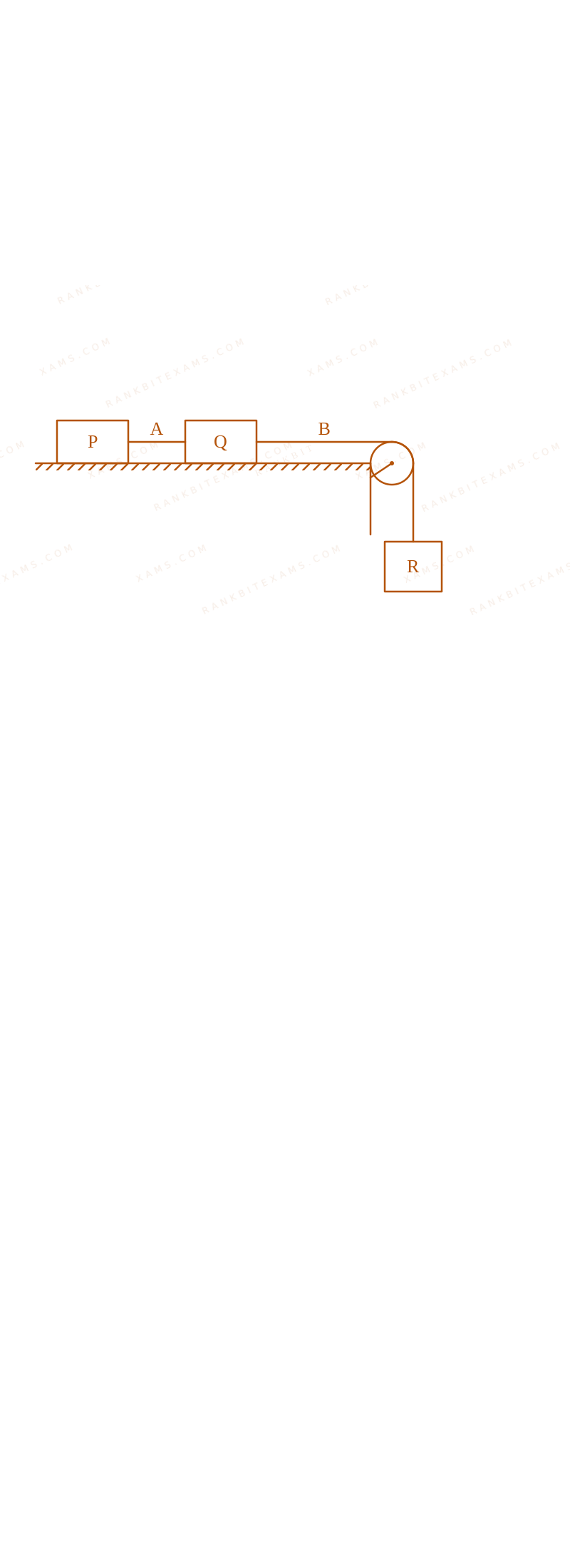
Each of three blocks P, Q and R shown in figure has a mass of 3 ~kg$3 \mathrm{~kg}$. Each of the wire A and B has cross-sectional area 0.005 ~cm²$0.005 \mathrm{~cm}^2$ and Young's modulus 2 × 10¹¹ Nm⁻²$2 \times 10^{11} \mathrm{Nm}^{-2}$. Neglecting friction, the longitudinal strain on wire B is _ _ _ _ × 10⁻⁴$\_ \_ \_ \_ \times 10^{-4}$. (Take g = 10 m / s²$g = 10 \mathrm{m / s^2}$)
Three 3kg blocks hanging and resting on table attached via wires A and B through a pulley.
Numerical Answer.Answer: 2 to 2
Solution
Related Formula
a = Net Pulling ForceTotal Mass$$a = \frac{\text{Net Pulling Force}}{\text{Total Mass}}$$Strain = StressY = (T)/(AY)$$\text{Strain} = \frac{\text{Stress}}{Y} = \frac{T}{AY}$$
Core Logic
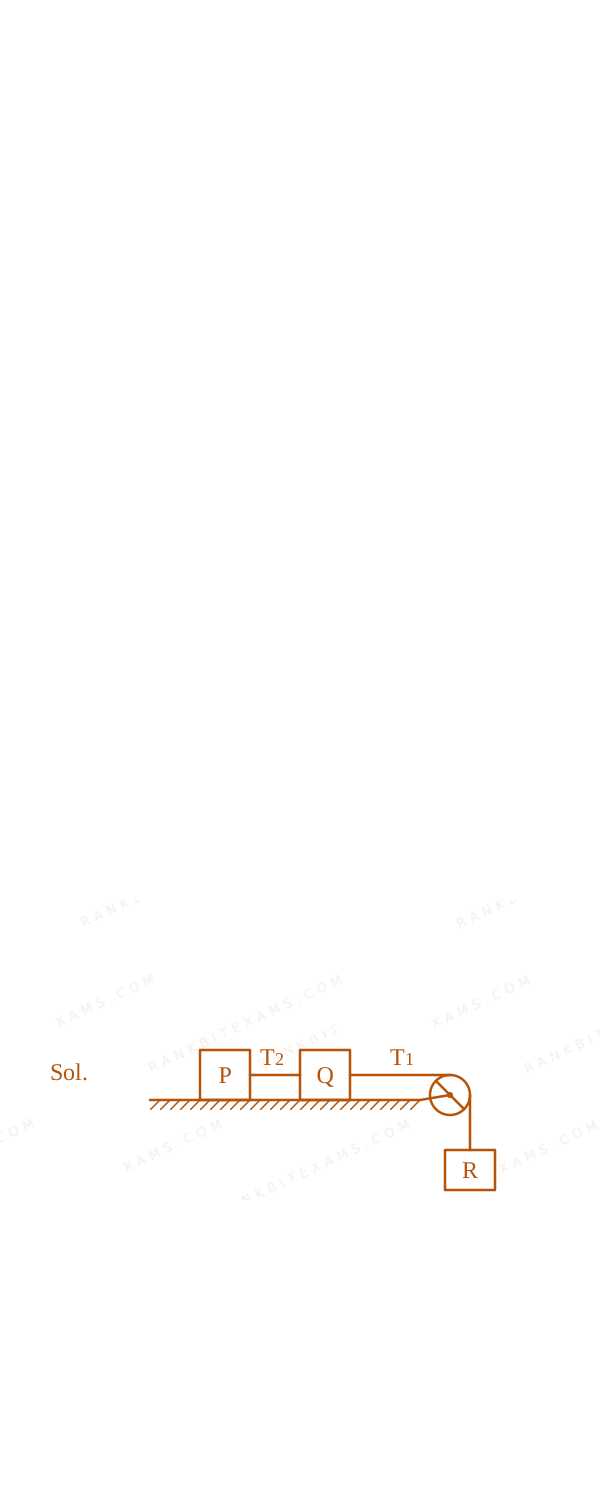
Three 3kg blocks hanging and resting on table attached via wires A and B through a pulley.
First, calculate the common acceleration of the system of three blocks. Block R provides the driving gravitational force (3g$3g$), pulling blocks P and Q. Then isolate the tension in wire B (T₁$T_1$) pulling block P. Finally, apply Young's modulus to find the strain.
Step 1: Find Acceleration
Total driving force = Weight of block R = 3 × 10 = 30 ~N$3 \times 10 = 30 \mathrm{~N}$.
Total mass being accelerated = mP + mQ + mR = 3 + 3 + 3 = 9 ~kg$m_P + m_Q + m_R = 3 + 3 + 3 = 9 \mathrm{~kg}$.
(Wait, the pdf solution says 30 - T₁ = 3 × a ⇒ T₁ = 20 ~N$30 - T_1 = 3 \times a \Rightarrow T_1 = 20 \mathrm{~N}$. Let's examine the arrangement from the image context. If block R hangs, wire A connects R to Q, and wire B connects Q to P. If B connects R and Q, it bears more tension. Let's trust the PDF calculation: The solution implies block P is the hanging block driving it? No, if 30 - T₁ = 3a$30 - T_1 = 3a$, then T₁$T_1$ is the tension supporting a hanging block. That means wire B is supporting a 3kg hanging block against gravity, or wire B connects Q and R. According to PDF logic: 30 - T₁ = 3 × (10/3) ⇒ T₁ = 20 N$30 - T_1 = 3 \times (10/3) \Rightarrow T_1 = 20 \mathrm{N}$. This means wire B is the vertical wire supporting block R.)
In multi-block connected systems, always find common 'a' first using Σ F / Σ m$\Sigma F / \Sigma m$. Then isolate the single block the wire directly pulls to find tension. Strain acts statically under that tension.
Chapter Mix
Class 11 Physics: Mechanical Properties of Solids
Class 11 Physics: Laws of Motion
Q34jee_main_2024_30_jan_morningElasticity and Young's Modulus
Young's modulus of material of a wire of length 'L' and cross-sectional area A is Y. If the length of the wire is doubled and cross-sectional area is halved then Young's modulus will be :
A.(Y)/(4)$\frac{Y}{4}$
B.4Y$4Y$
C.Y$Y$
D.2Y$2Y$
Solution
Related Formula
Y = StressStrain$$Y = \frac{\text{Stress}}{\text{Strain}}$$
(However, Y is an intrinsic property of the material.)
Core Logic
Young's modulus (Y$Y$) is a fundamental material property (intensive property). It depends exclusively on the nature of the material and its temperature, not on the macroscopic physical dimensions such as length or cross-sectional area of the specific specimen.
Step 1: Final Conclusion
Since the material remains unchanged, the Young's modulus remains the same.
Therefore, Ynew = Y$Y_{new} = Y$.
Pattern Recognition
Whenever dimensions (length, area, radius) change but the material is constant, intrinsic properties like density, resistivity, and elastic moduli remain strictly invariant.
Chapter Mix
Class 11 Physics: Mechanical Properties of Solids
Q54jee_main_2024_31_jan_eveningYoung's Modulus and Strain
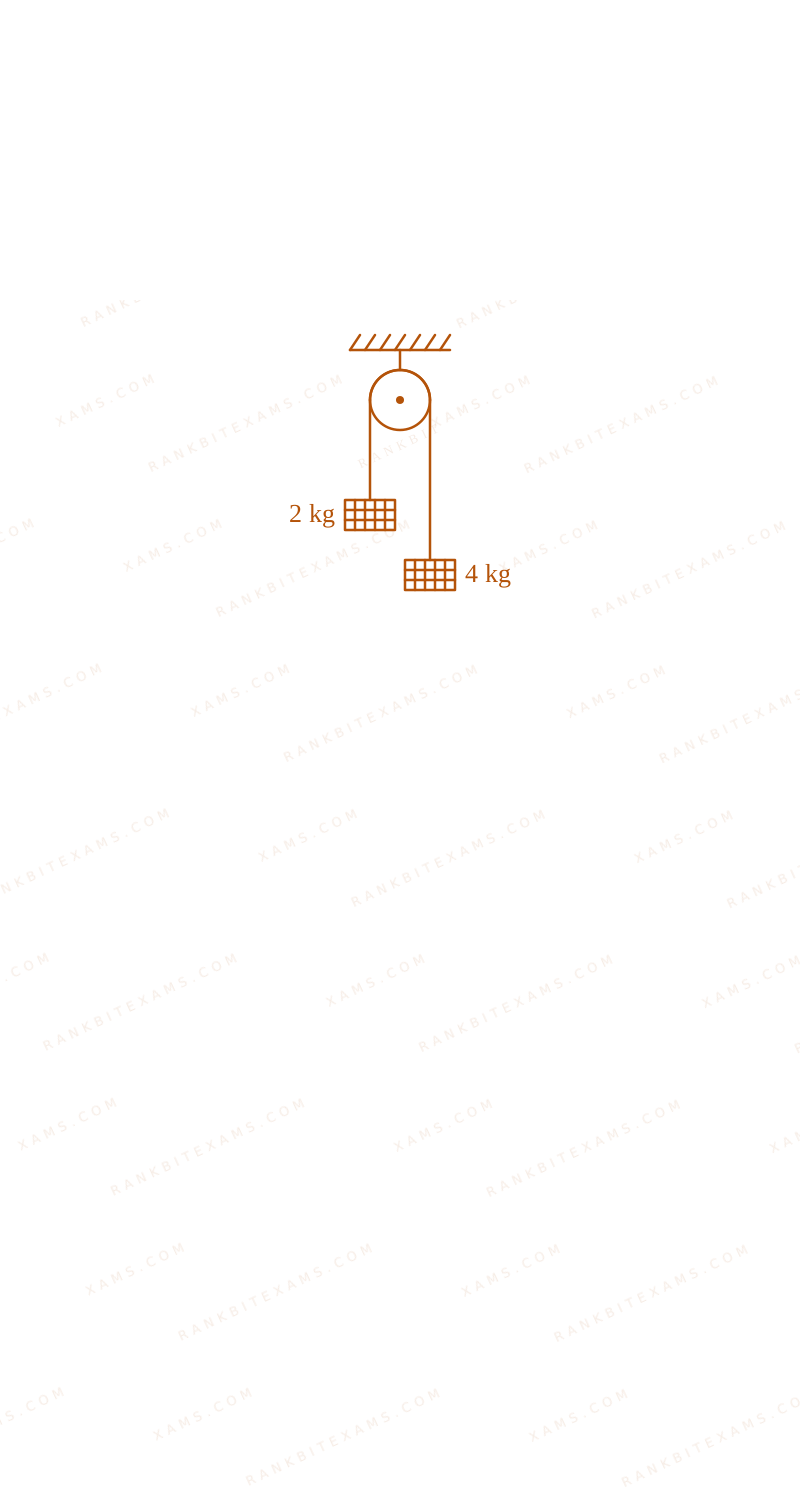
Two blocks of mass 2 kg$2 \text{ kg}$ and 4 kg$4 \text{ kg}$ are connected by a metal wire going over a smooth pulley as shown in figure. The radius of wire is 4.0 × 10⁻⁵ m$4.0 \times 10^{-5} \text{ m}$ and Young's modulus of the metal is 2.0 × 10¹¹ N/m²$2.0 \times 10^{11} \text{ N/m}^2$. The longitudinal strain developed in the wire is (1)/(α π)$\frac{1}{\alpha \pi}$. The value of α$\alpha$ is _______. [Use g = 10 m/s²$g = 10 \text{ m/s}^2$]
The image shows a standard Atwood machine with a wire holding 2 kg and 4 kg masses.
First, determine the tension T$T$ in the wire produced by the accelerating system (Atwood machine). Then, apply the formula for longitudinal strain using the calculated tension, cross-sectional area, and Young's Modulus.
Practice past-year questions one chapter at a time. Pick an exam → subject → chapter and get every PYQ for that topic — pulled together from all past papers — with the chapter's key formulas alongside.