Rankbit System
JEE Physics: Waves (+15.5%) | Electrostatics: Concentric Shells (-29.7%) | Modern Physics: Photoelectric Clones (+34.2%) | Mathematics: Definite Integrals (+18.1%) | Chemistry: Coordination Splitting (-11.4%) | JEE Physics: Waves (+15.5%) | Electrostatics: Concentric Shells (-29.7%) | Modern Physics: Photoelectric Clones (+34.2%) | Mathematics: Definite Integrals (+18.1%) | Chemistry: Coordination Splitting (-11.4%)

Arrange the bonds in order of increasing ionic character in the molecules. LiF, K_2O, N_2, SO_2 and ClF_3.

Solution & Explanation

### Core Logic The ionic character of a bond is directly proportional to the electronegativity difference (Delta EN) between the two bonded atoms. Larger Delta EN implies higher ionic character. ### Step 1: Assess Electronegativity Differences - N_2: Both atoms are Nitrogen. Delta EN = 0. Purely covalent. (Lowest ionic character) - SO_2: Bond between S and O. Moderate Delta EN. Covalent with some polarity. - ClF_3: Bond between Cl and F. Delta EN is higher than S-O as F is the most electronegative element. - K_2O: Bond between K (alkali metal, very low EN) and O. Very high Delta EN. Ionic. - LiF: Bond between Li (alkali metal) and F (highest EN). Maximum Delta EN possible among these options. Most ionic. ### Step 2: Order Derivation Increasing order of ionic character (or Delta EN): N_2 < SO_2 < ClF_3 < K_2O < LiF ### Pattern Recognition Homodiatomic (N_2) is always 0% ionic. Alkali metal + Halogen (LiF) represents the extreme of the ionic spectrum. Sorting non-metals by group distance yields the middle ranks. ### Evaluation Rubric / Model Answer null ### Chapter Mix Class 11 Chemistry: Chemical Bonding and Molecular Structure
More Chemical Bonding and Molecular Structure Previous-Year Questions — Page 5
Q81 jee_main_2024_29_jan_morning VSEPR Theory
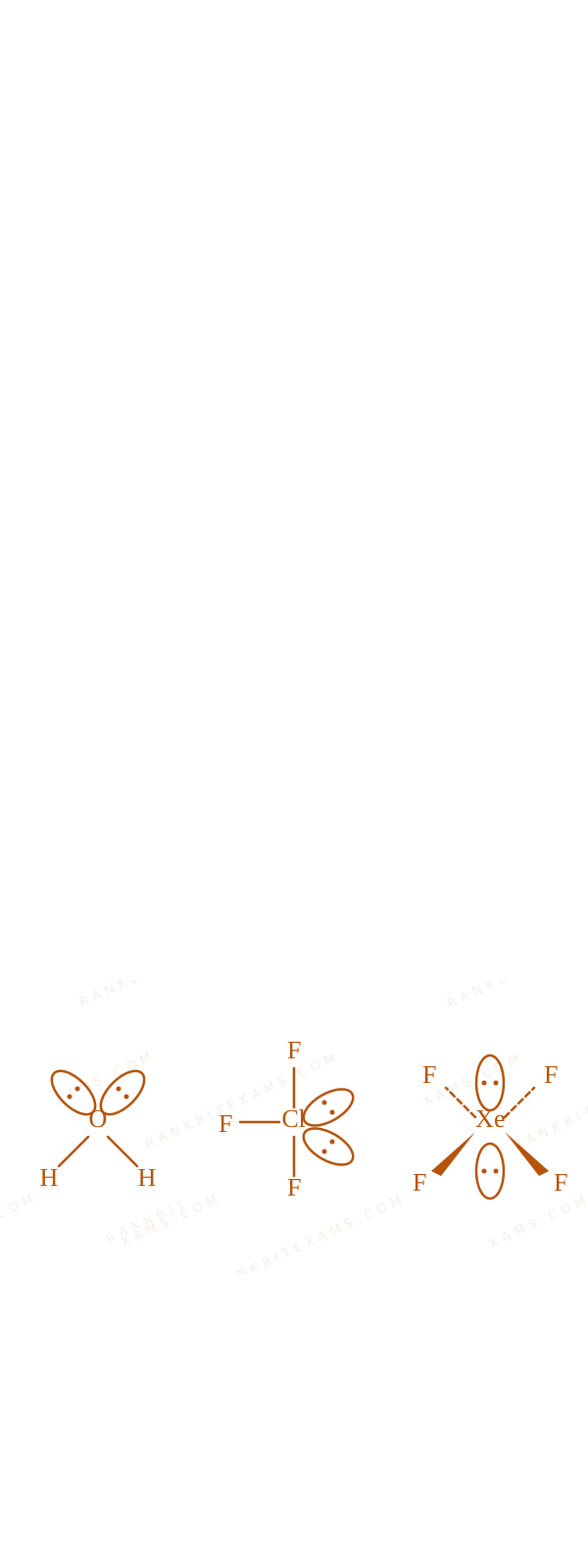
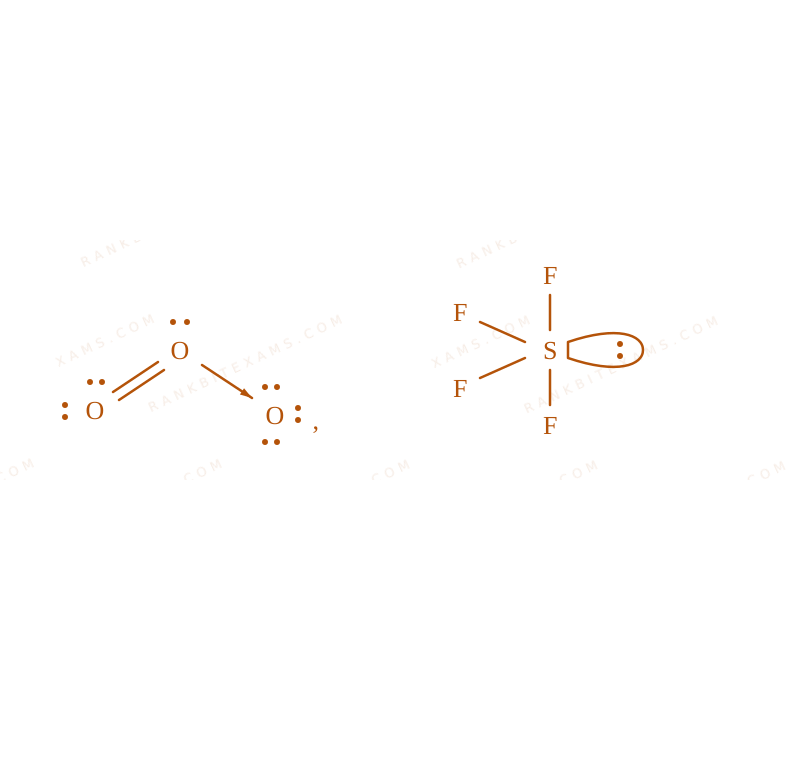
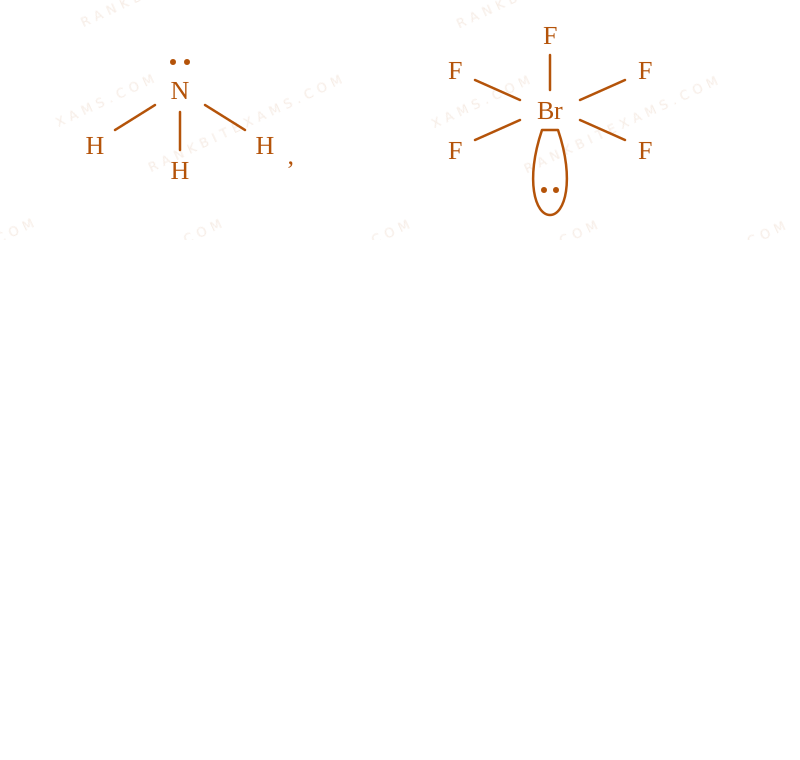
Number of compounds with one lone pair of electrons on central atom amongst following is O_3, H_2O, SF_4, ClF_3, NH_3, BrF_5, XeF_4
Numerical Answer. Answer: 4 to 4

Solution

### Core Logic Let us determine the steric number (Z) and number of lone pairs (LP) for the central atom in each given molecule. Formula: Z = frac12 (V + M - C + A) Where V = valence electrons on central atom, M = number of monovalent atoms, C = cationic charge, A = anionic charge. LP = Z - textBond Pairs (B.P.) 1. **O_3**: Central atom O (V=6). It forms one double bond and one dative bond. It has 1 lone pair remaining. 2. **H_2O**: Central atom O (V=6). Z = frac12(6 + 2) = 4. LP = 4 - 2 = 2. 3. **SF_4**: Central atom S (V=6). Z = frac12(6 + 4) = 5. LP = 5 - 4 = 1 (See-saw shape). 4. **ClF_3**: Central atom Cl (V=7). Z = frac12(7 + 3) = 5. LP = 5 - 3 = 2 (T-shape). 5. **NH_3**: Central atom N (V=5). Z = frac12(5 + 3) = 4. LP = 4 - 3 = 1 (Pyramidal). 6. **BrF_5**: Central atom Br (V=7). Z = frac12(7 + 5) = 6. LP = 6 - 5 = 1 (Square Pyramidal). 7. **XeF_4**: Central atom Xe (V=8). Z = frac12(8 + 4) = 6. LP = 6 - 4 = 2 (Square Planar). ### Step 1: Final Counting
VSEPR Theory diagram for Q81 - JEE Main 2024 Morning
The compounds containing exactly ONE lone pair on the central atom are O_3, SF_4, NH_3, and BrF_5. Total count = 4. ### Evaluation Rubric / Model Answer null ### Chapter Mix Class 11 Chemistry: Chemical Bonding and Molecular Structure
Q88 jee_main_2024_29_jan_morning Molecular Orbital Theory
The number of species from the following which are paramagnetic and with bond order equal to one is mathrm H_2, mathrmHe_2^+, mathrmO_2^+, mathrmN_2^2-, mathrmO_2^2-, mathrmF_2, mathrmNe_2^+, mathrmB_2
Numerical Answer. Answer: 1 to 1

Solution

### Core Logic Using Molecular Orbital (MO) Theory, we evaluate the bond order (BO = fracN_b - N_a2) and magnetic nature (unpaired electrons = paramagnetic, all paired = diamagnetic) for each species:
SpeciesMagnetic behaviourBond order
H_2Diamagnetic1
He_2^+Paramagnetic0.5
O_2^+Paramagnetic2.5
N_2^2-Paramagnetic2
O_2^2-Diamagnetic1
F_2Diamagnetic1
Ne_2^+Paramagnetic0.5
B_2Paramagnetic1
### Step 1: Final Selection We need the species that satisfies BOTH conditions: 1. Paramagnetic 2. Bond Order = 1 Looking at the table, B_2 is the only molecule that is paramagnetic (it has 2 unpaired electrons in degenerate pi_2p orbitals) and has a bond order of 1. Total number of such species = 1. ### Pattern Recognition B_2 (10 electrons) and O_2 (16 electrons) are the classic exceptions in MO theory that are paramagnetic despite having an even number of electrons. B_2 has BO = 1, and O_2 has BO = 2. ### Evaluation Rubric / Model Answer null ### Chapter Mix Class 11 Chemistry: Chemical Bonding and Molecular Structure
Q69 jee_main_2024_30_january_evening VSEPR Theory and Molecular Shapes
The molecule/ion with square pyramidal shape is:
  • A. text[Ni(CN)_4]^2-
  • B. textPCl_5
  • C. textBrF_5
  • D. textPF_5

Solution

### Core Logic According to VSEPR theory: 1. [Ni(CN)_4]^2-: dsp^2 hybridization rightarrow Square Planar. 2. PCl_5: sp^3d hybridization with 0 lone pairs rightarrow Trigonal Bipyramidal. 3. BrF_5: Bromine has 7 valence electrons. It forms 5 single bonds with Fluorine, leaving 1 lone pair. sp^3d^2 hybridization rightarrow geometry is octahedral, but shape is Square Pyramidal. 4. PF_5: sp^3d hybridization with 0 lone pairs rightarrow Trigonal Bipyramidal.
Square Pyramidal structure of BrF5 diagram for Q69 - JEE Main 2024 Evening
### Pattern Recognition AX_5E_1 configuration (5 bond pairs + 1 lone pair) typically yields a Square Pyramidal shape. ### Evaluation Rubric / Model Answer null ### Chapter Mix Class 11 Chemistry: Chemical Bonding and Molecular Structure Class 12 Chemistry: Coordination Compounds
Q75 jee_main_2024_30_january_evening Dipole Moment
Given below are two statements: Statement-I: Since fluorine is more electronegative than nitrogen, the net dipole moment of NF_3 is greater than NH_3. Statement-II: In NH_3, the orbital dipole due to lone pair and the dipole moment of NH bonds are in opposite direction, but in NF_3 the orbital dipole due to lone pair and dipole moments of N-F bonds are in same direction. In the light of the above statements. Choose the most appropriate from the options given below.
  • A. textStatement I is true but Statement II is false.
  • B. textBoth Statement I and Statement II are false.
  • C. textBoth statement I and Statement II is are true.
  • D. textStatement I is false but Statement II is are true.

Solution

### Core Logic Statement I: The net dipole moment of NH_3 (1.47\, D) is actually greater than that of NF_3 (0.23\, D). Therefore, Statement I is false. Statement II: In NH_3, the N-H bond dipole moments (pointing towards the more electronegative N) reinforce the orbital dipole moment of the lone pair. In NF_3, the N-F bond dipole moments point away from N (towards the more electronegative F), opposing the orbital dipole moment of the lone pair. This partial cancellation in NF_3 makes its net dipole moment lower. Therefore, Statement II is also false, as it reverses the correct orientations.
Dipole moments in NH3 and NF3 diagram for Q75 - JEE Main 2024 Evening
### Step 1: Final Conclusion Since both statements assert the opposite of established facts regarding NH_3 and NF_3, both are false. ### Evaluation Rubric / Model Answer null ### Chapter Mix Class 11 Chemistry: Chemical Bonding and Molecular Structure
Q71 jee_main_2024_30_jan_morning VSEPR Theory
Match List-I with List-II.
List-I (Molecule)List-II (Shape)
(A) BrF_5(I) T-shape
(B) H_2O(II) See saw
(C) ClF_3(III) Bent
(D) SF_4(IV) Square pyramidal
  • A. text(A)-(I), (B)-(II), (C)-(IV), (D)-(III)
  • B. text(A)-(II), (B)-(I), (C)-(III), (D)-(IV)
  • C. text(A)-(III), (B)-(IV), (C)-(I), (D)-(II)
  • D. text(A)-(IV), (B)-(III), (C)-(I), (D)-(II)

Solution

### Core Logic Using VSEPR theory: (A) BrF_5: Br has 7 valence electrons. 5 form bonds with F, leaving 1 lone pair. (5 bp + 1 lp) rightarrow sp^3d^2 hybridization rightarrow Square pyramidal shape. (B) H_2O: O has 6 valence electrons. 2 form bonds with H, leaving 2 lone pairs. (2 bp + 2 lp) rightarrow sp^3 hybridization rightarrow Bent shape. (C) ClF_3: Cl has 7 valence electrons. 3 form bonds with F, leaving 2 lone pairs. (3 bp + 2 lp) rightarrow sp^3d hybridization rightarrow T-shape. (D) SF_4: S has 6 valence electrons. 4 form bonds with F, leaving 1 lone pair. (4 bp + 1 lp) rightarrow sp^3d hybridization rightarrow See-saw shape. ### Step 1: Matching (A) - (IV) (B) - (III) (C) - (I) (D) - (II)
VSEPR Theory solution diagram for Q71 - JEE Main 2024 Morning
### Evaluation Rubric / Model Answer null ### Chapter Mix Class 11 Chemistry: Chemical Bonding and Molecular Structure

More Chemical Bonding and Molecular Structure Questions — jee_main_2024_01_february_morning

Practice all Chemical Bonding and Molecular Structure previous-year questions →

YOUR FIRST PREP STEP STARTS HERE

We Map Every Repeating Question in Competitive Exams.

Say goodbye to generic mock test fatigue. RankBit uses smart analysis to group past exam questions into their foundational Repeating Question Types. Find chapter weightage, track repeating questions, and score higher with targeted practice.

Select Your Target Exam

Choose an exam track below to find formulas per chapter and patterns.

Syncing Exam Intelligence

Mapping formulas and patterns across all tracks…

PATH A — FULL LENGTH PRACTICE

Full Mock Test Hub

Simulate real NTA exam conditions with fully tracked mocks. Time yourself against past papers.

Under Development
PATH B — TARGETED PRACTICE

Topic-wise Practice Hub

Practice past-year questions one chapter at a time. Pick an exam → subject → chapter and get every PYQ for that topic — pulled together from all past papers — with the chapter's key formulas alongside.

Loading Questions... Browse Topics
Latest from the Blog
View all →

Loading articles...