Core Logic
Let's analyze the transformation happening in each reaction:
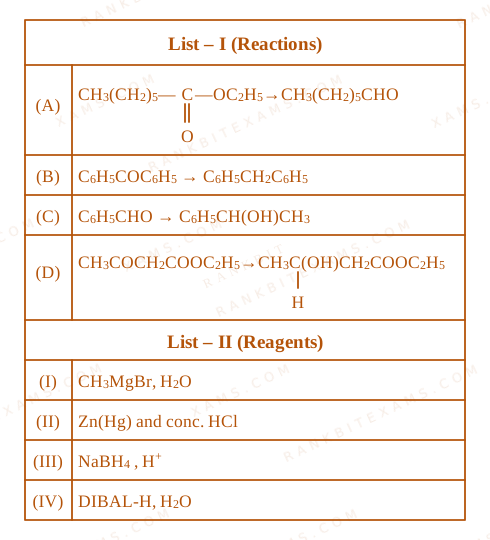
(A) CH₃(CH₂)₅COOC₂H₅ arrow CH₃(CH₂)₅CHO$CH_3(CH_2)_5COOC_2H_5 \rightarrow CH_3(CH_2)_5CHO$
An ester is reduced to an aldehyde. This is a selective reduction achieved using DIBAL-H (Diisobutylaluminium hydride) followed by hydrolysis. Thus, (A) arrow$\rightarrow$ (IV).
(B) C₆H₅COC₆H₅ arrow C₆H₅CH₂C₆H₅$C_6H_5COC_6H_5 \rightarrow C_6H_5CH_2C_6H_5$
A ketone (carbonyl group >C=O$>C=O$) is fully reduced to an alkane (>CH₂$>CH_2$) methylene group. This is the Clemmensen reduction, which uses Zinc amalgam and concentrated HCl. Thus, (B) arrow$\rightarrow$ (II).
(C) C₆H₅CHO arrow C₆H₅CH(OH)CH₃$C_6H_5CHO \rightarrow C_6H_5CH(OH)CH_3$
Benzaldehyde (aldehyde) is converted into a secondary alcohol with an extra methyl group. This is a nucleophilic addition of a Grignard reagent (CH₃MgBr$CH_3MgBr$) followed by hydrolysis. Thus, (C) arrow$\rightarrow$ (I).
(D) CH₃COCH₂COOC₂H₅ arrow CH₃CH(OH)CH₂COOC₂H₅$CH_3COCH_2COOC_2H_5 \rightarrow CH_3CH(OH)CH_2COOC_2H_5$
A ketone group is reduced to a secondary alcohol while the ester group remains intact. NaBH₄$NaBH_4$ is a mild reducing agent that reduces aldehydes and ketones but generally does not touch esters. Thus, (D) arrow$\rightarrow$ (III).
Pattern Recognition
Ester arrow$\rightarrow$ Aldehyde = DIBAL-H
Ketone arrow$\rightarrow$ Alkane = Clemmensen (Zn(Hg)/HCl$Zn(Hg)/HCl$) or Wolff-Kishner
Carbonyl arrow$\rightarrow$ Alcohol with carbon chain extension = Grignard Reagent
Ketone arrow$\rightarrow$ Alcohol (leaving ester intact) = NaBH₄$NaBH_4$
Chapter Mix
Class 12 Chemistry: Aldehydes, Ketones and Carboxylic Acids