JEE Main · Chemistry → Steady

Aldehydes, Ketones and Carboxylic Acids appeared 46 times across 3 years — 5.3% of Chemistry. This question is from Reactions of Carbonyl Compounds.

Year 2026 2025 2024 Total
Questions 14 21 11 46

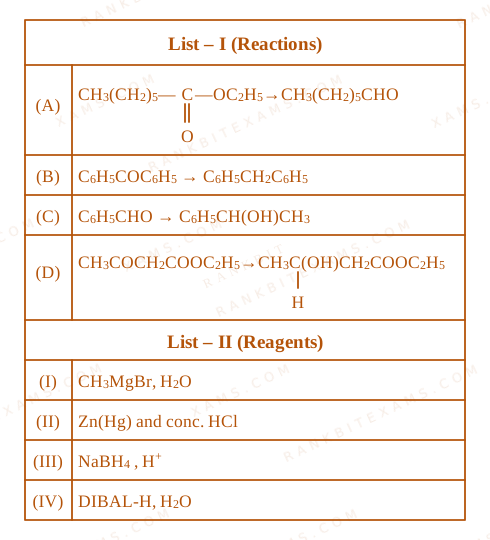
Match List - I with List - II.
List - I (Reactions)List - II (Reagents)
(A) CH₃(CH₂)₅-CO-OC₂H₅ arrow CH₃(CH₂)₅CHO(I) CH₃MgBr, H₂O
(B) C₆H₅COC₆H₅ arrow C₆H₅CH₂C₆H₅(II) Zn(Hg) and conc. HCl
(C) C₆H₅CHO arrow C₆H₅CH(OH)CH₃(III) NaBH₄, H^+
(D) CH₃COCH₂COOC₂H₅ arrow CH₃CH(OH)CH₂COOC₂H₅(IV) DIBAL-H, H₂O
Choose the correct answer from options given below:

Reactions of Carbonyl Compounds

Solution & Explanation

Core Logic

Let's analyze the transformation happening in each reaction:

(A) CH₃(CH₂)₅COOC₂H₅ arrow CH₃(CH₂)₅CHO An ester is reduced to an aldehyde. This is a selective reduction achieved using DIBAL-H (Diisobutylaluminium hydride) followed by hydrolysis. Thus, (A) arrow (IV).

(B) C₆H₅COC₆H₅ arrow C₆H₅CH₂C₆H₅ A ketone (carbonyl group >C=O) is fully reduced to an alkane (>CH₂) methylene group. This is the Clemmensen reduction, which uses Zinc amalgam and concentrated HCl. Thus, (B) arrow (II).

(C) C₆H₅CHO arrow C₆H₅CH(OH)CH₃ Benzaldehyde (aldehyde) is converted into a secondary alcohol with an extra methyl group. This is a nucleophilic addition of a Grignard reagent (CH₃MgBr) followed by hydrolysis. Thus, (C) arrow (I).

(D) CH₃COCH₂COOC₂H₅ arrow CH₃CH(OH)CH₂COOC₂H₅ A ketone group is reduced to a secondary alcohol while the ester group remains intact. NaBH₄ is a mild reducing agent that reduces aldehydes and ketones but generally does not touch esters. Thus, (D) arrow (III).

Pattern Recognition

Ester arrow Aldehyde = DIBAL-H Ketone arrow Alkane = Clemmensen (Zn(Hg)/HCl) or Wolff-Kishner Carbonyl arrow Alcohol with carbon chain extension = Grignard Reagent Ketone arrow Alcohol (leaving ester intact) = NaBH₄

Chapter Mix

Class 12 Chemistry: Aldehydes, Ketones and Carboxylic Acids

More Aldehydes, Ketones and Carboxylic Acids Previous-Year Questions — Page 10

Q jee_main_2024_31_jan_morning Reactions with Grignard Reagent
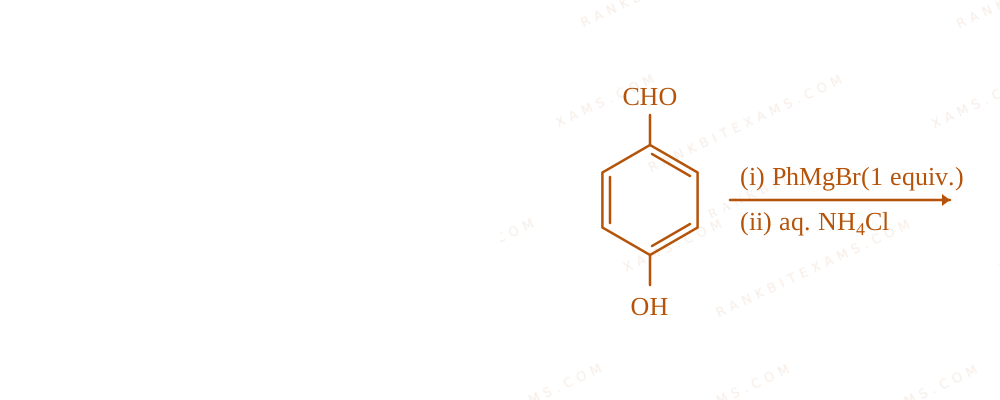
The product of the following reaction is P.
Reactions with Grignard Reagent diagram for Q84 - JEE Main 2024 Morning
The image shows p-hydroxybenzaldehyde reacting with one equivalent of PhMgBr followed by aqueous ammonium chloride.
The number of hydroxyl groups present in the product P is
Numerical Answer. Answer: 0 to 0

Solution

Core Logic

The given reactant is p-hydroxybenzaldehyde, which contains both a phenolic -OH group (acidic) and an aldehyde group (electrophilic).

When one equivalent of Grignard reagent (PhMgBr) is added, it behaves primarily as a strong base due to the presence of an acidic proton. Acid-base reactions are extremely fast compared to nucleophilic additions.

The acidic phenolic -OH reacts with PhMgBr:

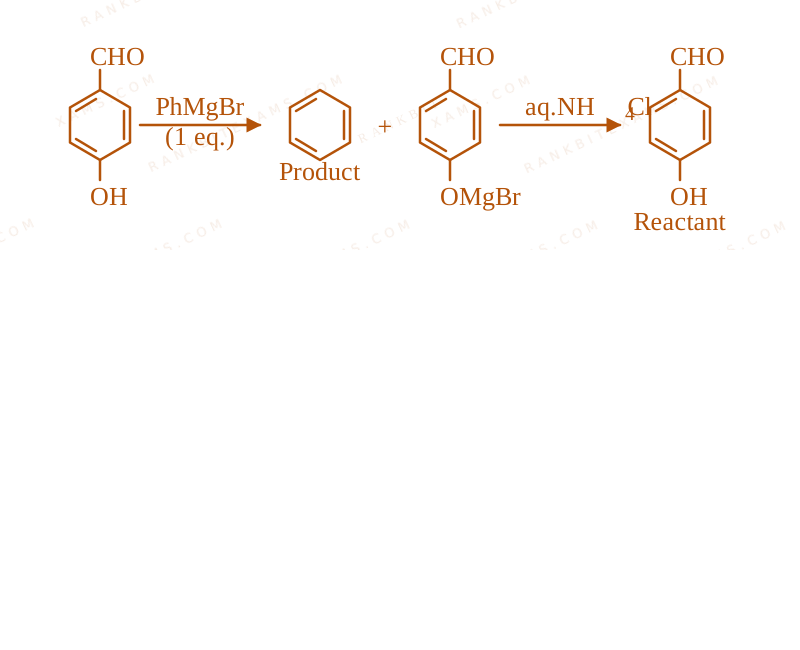
PhMgBr + HO-C₆H₄-CHO arrow Ph-H (Benzene) + BrMg-O-C₆H₄-CHO

Upon workup with aq. NH₄Cl, the phenoxide ion simply regenerates the starting p-hydroxybenzaldehyde. However, the question asks for the number of hydroxyl groups present in the formed product (Benzene).
Reactions with Grignard Reagent diagram for Q84 - JEE Main 2024 Morning
The image shows p-hydroxybenzaldehyde reacting with one equivalent of PhMgBr followed by aqueous ammonium chloride.

The distinct product formed in the reaction is Benzene. Benzene has 0 hydroxyl groups.

Pattern Recognition

Whenever a Grignard reagent encounters a molecule with an acidic hydrogen (alcohol, phenol, amine, alkyne), it will invariably act as a base first. If only 1 equivalent is used, nucleophilic addition to carbonyls will NOT happen.

Chapter Mix

Class 12 Chemistry: Aldehydes, Ketones and Carboxylic Acids Class 12 Chemistry: Alcohols, Phenols and Ethers

Rankbit System
JEE Physics: Waves (+15.5%) | Electrostatics: Concentric Shells (-29.7%) | Modern Physics: Photoelectric Clones (+34.2%) | Mathematics: Definite Integrals (+18.1%) | Chemistry: Coordination Splitting (-11.4%) | JEE Physics: Waves (+15.5%) | Electrostatics: Concentric Shells (-29.7%) | Modern Physics: Photoelectric Clones (+34.2%) | Mathematics: Definite Integrals (+18.1%) | Chemistry: Coordination Splitting (-11.4%)