SAT · Math —

Heart of Algebra appeared 17 times across 1 year — 100% of Math. This question is from Linear Equations and Inequalities.

Year 2023 Total
Questions 17 17

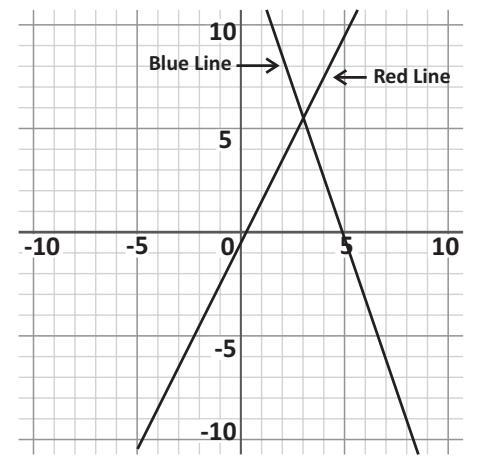
Which of the following graphs demonstrates a system of linear equations with no solution? i.
Linear Equations and Inequalities diagram for Q8 - SAT 2023
Four distinct coordinate sub-graphs labeled i, ii, iii, iv showing different line pairs.
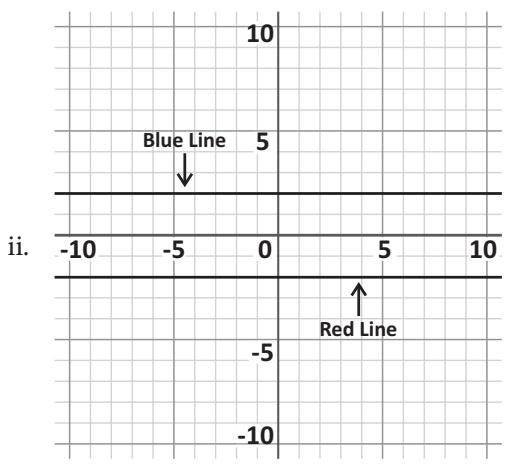
ii.
Linear Equations and Inequalities diagram for Q8 - SAT 2023
Four distinct coordinate sub-graphs labeled i, ii, iii, iv showing different line pairs.
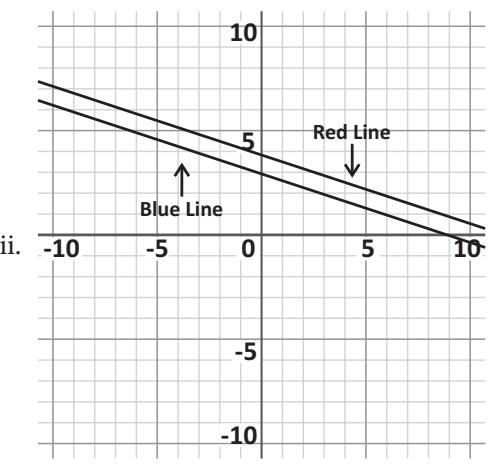
iii.
Linear Equations and Inequalities diagram for Q8 - SAT 2023
Four distinct coordinate sub-graphs labeled i, ii, iii, iv showing different line pairs.
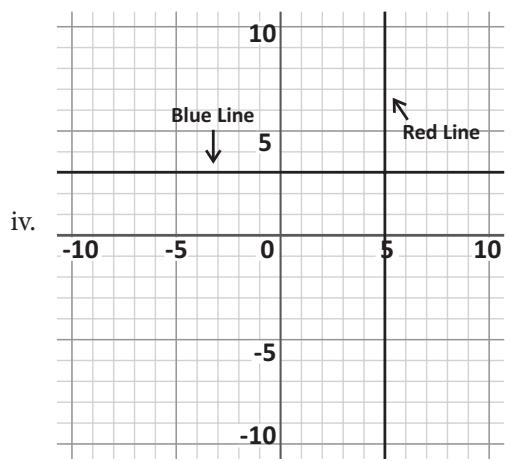
iv.
Linear Equations and Inequalities diagram for Q8 - SAT 2023
Four distinct coordinate sub-graphs labeled i, ii, iii, iv showing different line pairs.

Linear Equations and Inequalities diagram for Q8 - SAT 2023
Four distinct coordinate sub-graphs labeled i, ii, iii, iv showing different line pairs.

Solution & Explanation

Related Formula

A system of linear equations has no solution if and only if the lines are parallel.

Core Logic

Examine each graph for parallel lines:

  • Graph i shows perpendicular lines (one vertical, one horizontal).
  • Graph ii shows two horizontal parallel lines.
  • Graph iii shows two vertical parallel lines.
  • Graph iv shows intersecting lines.
Step 1: Conclusion

Since graphs ii and iii depict parallel lines, both systems have no solution. Hence, option D is correct.

Pattern Recognition

Identify parallel orientation in multi-graph sets arrow both represent no solution systems.

Chapter Mix

SAT Math: Heart of Algebra

More Heart of Algebra Previous-Year Questions — Page 4

Q16 sat_math_2023_01_january_morning Solving Systems of Linear Equations
Using the following equation, what value of A makes the following system of equations have (-(4)/(7), -(1)/(7)) as a solution? Ax + 5y = -3 -8x + Ay = 4
  • A. 3
  • B. 5
  • C. 4
  • D. -4

Solution

Related Formula

A point (x₀, y₀) is a solution to a system of equations if substituting (x₀, y₀) into each equation yields a true identity.

Core Logic

Substitute x = -(4)/(7) and y = -(1)/(7) into Ax + 5y = -3:

A(-(4)/(7)) + 5(-(1)/(7)) = -3 -(4A)/(7) - (5)/(7) = -3

Multiply by 7:

-4A - 5 = -21 -4A = -16 A = 4
Step 1: Verification in Second Equation

Check A = 4 in -8x + Ay = 4:

-8(-(4)/(7)) + 4(-(1)/(7)) = (32 - 4)/(7) = (28)/(7) = 4 (Verified)

Thus, A = 4 (Option C).

Pattern Recognition

Given solution point (x, y) arrow substitute directly into linear equation to solve for unknown parameter A.

Chapter Mix

SAT Math: Heart of Algebra

Q17 sat_math_2023_01_january_morning Systems of Linear Inequalities
Choose the answer choice that best graphically displays the following equations: y < 2x + 4 y ≥ -(1)/(3)x - 2
  • A. A
  • B. B
  • C. C
  • D. D

Solution

Related Formula

For y < mx + b, boundary is dashed, shading is below. For y ≥ mx + b, boundary is solid, shading is above.

Core Logic

Analyze boundary line 1: y = 2x + 4

  • Dashed line with y-intercept (0, 4) and positive slope 2.
  • y < 2x + 4 shade BELOW the dashed line.
  • Analyze boundary line 2: y = -(1)/(3)x - 2

  • Solid line with y-intercept (0, -2) and negative slope -(1)/(3).
  • y ≥ -(1)/(3)x - 2 shade ABOVE the solid line.
Step 1: Select Matching Graph

Graph A correctly shows shading above the solid line y = -(1)/(3)x - 2 and below the dashed line y = 2x + 4.

Hence, choice A is correct.

Pattern Recognition

Dashed vs. solid line test arrow strict inequality (<) requires dashed; non-strict (≥) requires solid.

Chapter Mix

SAT Math: Heart of Algebra

More Heart of Algebra Questions — sat_math_2023_01_january_morning

Practice all Heart of Algebra previous-year questions →

Rankbit System
JEE Physics: Waves (+15.5%) | Electrostatics: Concentric Shells (-29.7%) | Modern Physics: Photoelectric Clones (+34.2%) | Mathematics: Definite Integrals (+18.1%) | Chemistry: Coordination Splitting (-11.4%) | JEE Physics: Waves (+15.5%) | Electrostatics: Concentric Shells (-29.7%) | Modern Physics: Photoelectric Clones (+34.2%) | Mathematics: Definite Integrals (+18.1%) | Chemistry: Coordination Splitting (-11.4%)