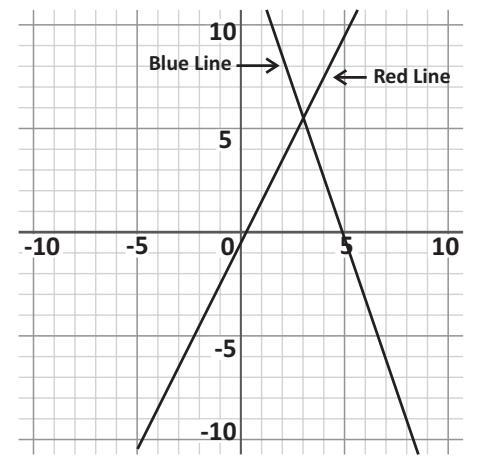
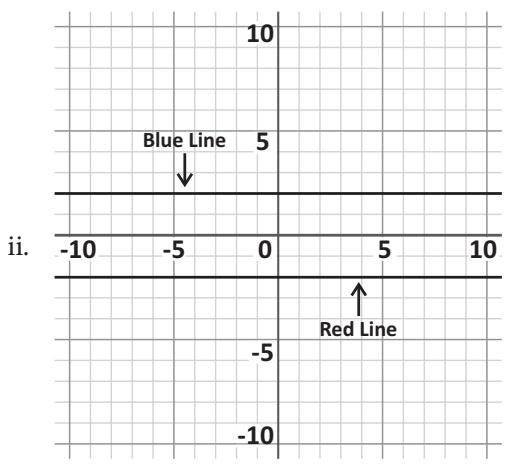
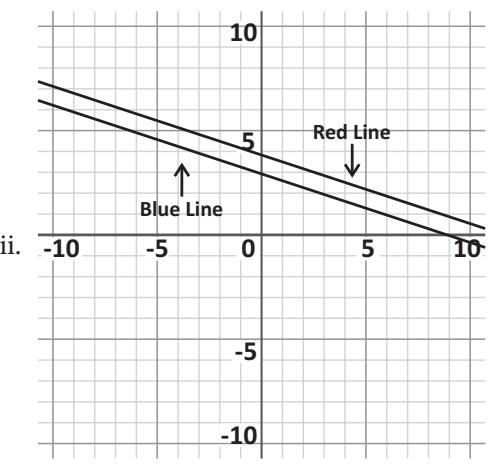
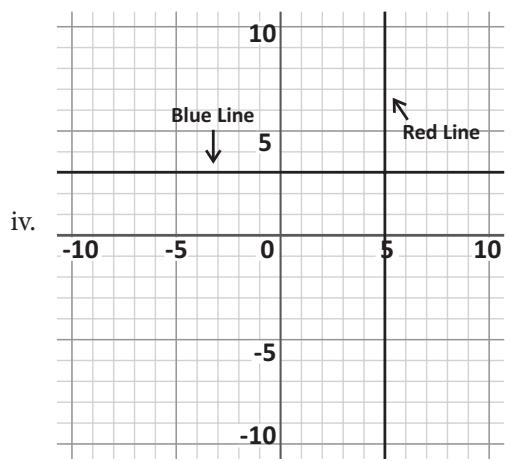
Which of the following graphs demonstrates a system of linear equations with no solution?
i.
Four distinct coordinate sub-graphs labeled i, ii, iii, iv showing different line pairs.
ii.
Four distinct coordinate sub-graphs labeled i, ii, iii, iv showing different line pairs.
iii.
Four distinct coordinate sub-graphs labeled i, ii, iii, iv showing different line pairs.
iv.
Four distinct coordinate sub-graphs labeled i, ii, iii, iv showing different line pairs.
Four distinct coordinate sub-graphs labeled i, ii, iii, iv showing different line pairs.
A.i & ii
B.ii & iv
C.iii & iv
D.ii & iii
Solution & Explanation
Related Formula
A system of linear equations has no solution if and only if the lines are parallel.
Core Logic
Examine each graph for parallel lines:
Graph i shows perpendicular lines (one vertical, one horizontal).
Graph ii shows two horizontal parallel lines.
Graph iii shows two vertical parallel lines.
Graph iv shows intersecting lines.
Step 1: Conclusion
Since graphs ii and iii depict parallel lines, both systems have no solution. Hence, option D is correct.
Pattern Recognition
Identify parallel orientation in multi-graph sets arrow$\rightarrow$ both represent no solution systems.
Chapter Mix
SAT Math: Heart of Algebra
Keywords:#multiple system graphs#parallel lines#no solution#coordinate grid
More Heart of Algebra Previous-Year Questions — Page 2
Qsat_math_2023_01_january_morningLinear Equations and Inequalities
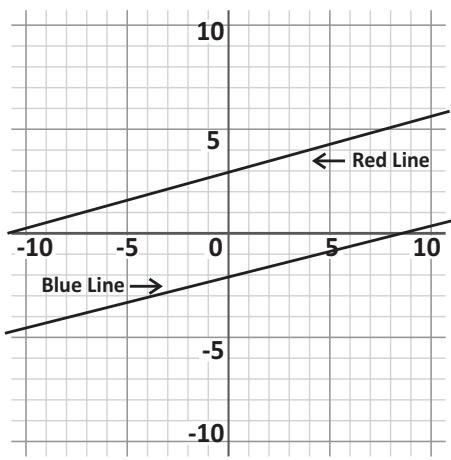
The following graphs represent a system of linear equations. The lines shown are parallel. How many solutions will this system of equations have?
A graph showing two parallel lines that never intersect.
A. No solution
B. One solution
C. Infinite solutions
D. Because we are not given the equations of the lines, it is impossible to know.
Solution
Related Formula
Parallel lines have the same slope (m₁ = m₂$m_1 = m_2$) but different y-intercepts (b₁ ≠ b₂$b_1 \neq b_2$).
Core Logic
Parallel lines never cross or intersect at any point in the plane.
Since the solution of a system is defined as the set of all intersection points, parallel lines yield zero intersection points.
Step 1: Conclusion
Therefore, the system has no solution.
Pattern Recognition
Parallel lines arrow$\rightarrow$ zero intersections arrow$\rightarrow$ no solution.
Chapter Mix
SAT Math: Heart of Algebra
Qsat_math_2023_01_january_morningSystems of Linear Inequalities
A man buys a$a$ apples and g$g$ oranges, each costing 80 cents and 60 cents respectively. If the man buys less than 18 fruits and spends less than $12, which of the following is the correct inequality representing the above information?
A.a + g = 18$a + g = 18$4a + 3g = 60$4a + 3g = 60$
B.a + g < 18$a + g < 18$4a + 3g < 60$4a + 3g < 60$
C.a + g ≤ 18$a + g \le 18$4a + 3g ≤ 60$4a + 3g \le 60$
D.a + g ≤ 18$a + g \le 18$4a + 3g = 60$4a + 3g = 60$
The system of inequalities is a + g < 18$a + g < 18$ and 4a + 3g < 60$4a + 3g < 60$ (Option B).
Pattern Recognition
'Less than' strictly means <$<$, not ≤$\leq$. Convert dollars to cents before simplifying.
Chapter Mix
SAT Math: Heart of Algebra
Q5sat_math_2023_01_january_morningSystems of Linear Inequalities
Samantha bought M&Ms from the store. She is told that the amount of sweet M&Ms and the amount of bitter M&Ms is represented by the following system of inequalities, where s$s$ is the number of sweet M&Ms and b$b$ is the number of bitter M&Ms:
s + b ≥ 25$s + b \geq 25$5s - 10b < 2$5s - 10b < 2$
Which of the following solutions, in the format (s, b)$(s, b)$ could be a possible solution for the number of M&Ms in Samantha's bag?
A.(6, 10)$(6, 10)$
B.(2, 30)$(2, 30)$
C.(1, 1)$(1, 1)$
D.(50, 10)$(50, 10)$
Solution
Related Formula
For a coordinate pair (s, b)$(s, b)$ to be a valid solution to a system of inequalities, it must satisfy all given inequalities simultaneously.
Core Logic
Test the ordered pair (2, 30)$(2, 30)$ where s = 2$s = 2$ and b = 30$b = 30$:
Since both statements evaluate to true for (2, 30)$(2, 30)$, option B is a valid solution.
Pattern Recognition
System of inequalities question arrow$\rightarrow$ plug and check given options to find which makes both true.
Chapter Mix
SAT Math: Heart of Algebra
Q9sat_math_2023_01_january_morningSolving Linear Equations
If a + 2b + 3c = 24$a + 2b + 3c = 24$ and 3a + 2b + c = 36$3a + 2b + c = 36$, what is the value of (a + b + c)$(a + b + c)$?
A. 8
B. 12
C. 15
D. 60
Solution
Related Formula
For symmetric linear systems, adding equations directly often isolates the required expression (a + b + c)$(a + b + c)$ without solving for individual variables.
Practice past-year questions one chapter at a time. Pick an exam → subject → chapter and get every PYQ for that topic — pulled together from all past papers — with the chapter's key formulas alongside.