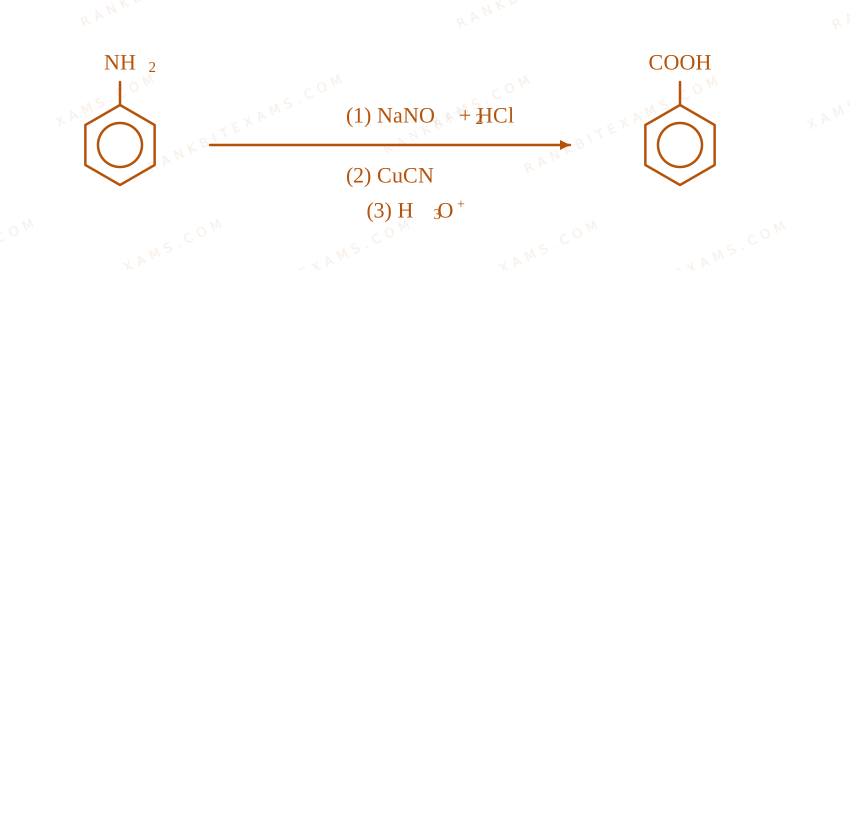
The correct order of acidic strength of the major products formed in the given reactions, is:
Reactions producing A, B, C, and D products for acidity comparison.
Choose the correct answer from the options given below:
A.(1)text C > B > A > D$(1)\text{ } C > B > A > D$
B.(2)text A > D > C > B$(2)\text{ } A > D > C > B$
C.(3)text A > D > B > C$(3)\text{ } A > D > B > C$
D.(4)text C > A > D > B$(4)\text{ } C > A > D > B$
Solution & Explanation
### Core Logic
Identify the major products [A], [B], [C], and [D]:
(A) PhNH_2 xrightarrow1) NaNO_2 + HCl PhN_2^+Cl^- xrightarrow2) CuCN PhCN xrightarrow3) H_3O^+ PhCOOH$PhNH_2 \xrightarrow{1) NaNO_2 + HCl} PhN_2^+Cl^- \xrightarrow{2) CuCN} PhCN \xrightarrow{3) H_3O^+} PhCOOH$ (Benzoic acid)
(B) CH_3CH_2CHO xrightarrow[Ag(NH_3)_2]^+, OH^- CH_3CH_2COOH$CH_3CH_2CHO \xrightarrow{[Ag(NH_3)_2]^+, OH^-} CH_3CH_2COOH$ (Propanoic acid)
(C) CH_4 + O_2 xrightarrowMo_2O_3 HCHO xrightarrowNa_2Cr_2O_7/H^+ HCOOH$CH_4 + O_2 \xrightarrow{Mo_2O_3} HCHO \xrightarrow{Na_2Cr_2O_7/H^+} HCOOH$ (Formic acid)
(D) PhCH_2MgBr + CO_2 xrightarrowH_3O^+ PhCH_2COOH$PhCH_2MgBr + CO_2 \xrightarrow{H_3O^+} PhCH_2COOH$ (Phenylacetic acid)
### Step 1: Compare Acidity
Reactions producing A, B, C, and D products for acidity comparison.
Acidity order: Formic acid > Benzoic acid > Phenylacetic acid > Propanoic acid.
HCOOH$HCOOH$ (C) has no +I alkyl group, making it the strongest.
PhCOOH$PhCOOH$ (A) has an sp^2$sp^2$ carbon attached directly, which is mildly electron withdrawing via -I relative to alkyls.
PhCH_2COOH$PhCH_2COOH$ (D) has an sp^3$sp^3$ methylene spacer, so -I from phenyl is weakened.
CH_3CH_2COOH$CH_3CH_2COOH$ (B) has a purely electron-donating ethyl group (+I effect), making it the weakest.
### Step 2: Final Conclusion
Order is C > A > D > B$C > A > D > B$.
### Pattern Recognition
HCOOH$HCOOH$ is stronger than PhCOOH$PhCOOH$. Aliphatic acids with +I groups are the weakest.
### Evaluation Rubric / Model Answer
null
### Chapter Mix
Class 12 Chemistry: Carboxylic Acids
Class 12 Chemistry: Amines
Class 12 Chemistry: Aldehydes, Ketones and Carboxylic Acids
Keywords:#order of acidic strength#JEE Main 2026 Evening Q65#Carboxylic Acids JEE Main 2026#Acidic Strength Of Carboxylic Acids JEE Main 2026#chemical reactions#organic synthesis#acidic strength
We Map Every Repeating Question in Competitive Exams.
Say goodbye to generic mock test fatigue. RankBit uses smart analysis to group past exam questions into their foundational Repeating Question Types. Find chapter weightage, track repeating questions, and score higher with targeted practice.
Select Your Target Exam
Choose an exam track below to find formulas per chapter and patterns.
Syncing Exam Intelligence
Mapping formulas and patterns across all tracks…
PATH A — FULL LENGTH PRACTICE
Full Mock Test Hub
Simulate real NTA exam conditions with fully tracked mocks. Time yourself against past papers.
Practice past-year questions one chapter at a time. Pick an exam → subject → chapter and get every PYQ for that topic — pulled together from all past papers — with the chapter's key formulas alongside.