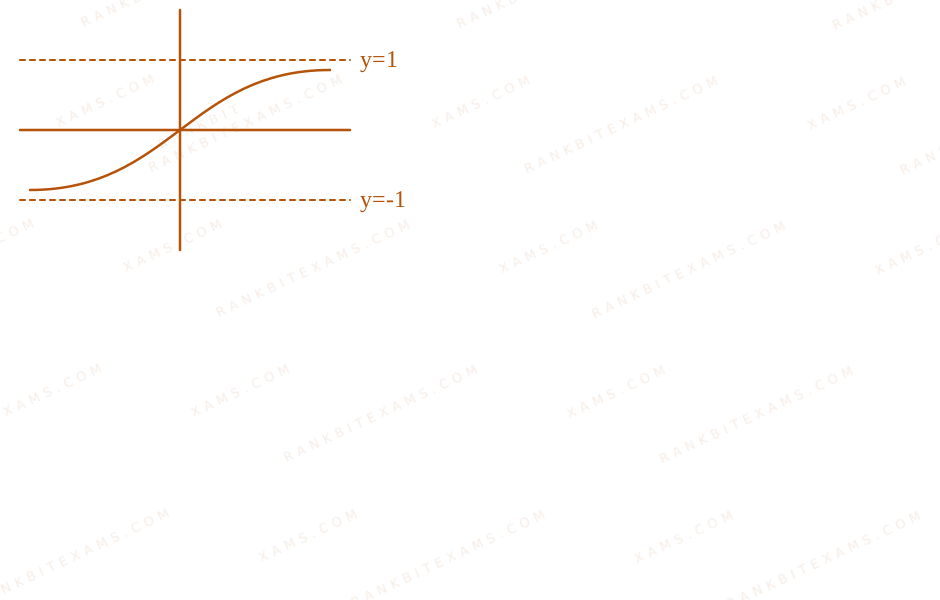
Related Formula
For y = ⁻¹(g(x)), the domain is given by -1 ≤ g(x) ≤ 1$$\text{For } y = \sin^{-1}(g(x)), \text{ the domain is given by } -1 \leq g(x) \leq 1$$
Core Logic
For f(x) = ⁻¹((1)/(x² - 2x - 2))$f(x) = \sin^{-1}\left(\frac{1}{x^2 - 2x - 2}\right)$, the inner argument must lie in [-1, 1]$[-1, 1]$.
-1 ≤ (1)/(x² - 2x - 2) ≤ 1$$-1 \leq \frac{1}{x^2 - 2x - 2} \leq 1$$
Step 1: Solving Right Inequality
(1)/(x² - 2x - 2) ≤ 1$$\frac{1}{x^2 - 2x - 2} \leq 1$$
(1)/(x² - 2x - 2) - 1 ≤ 0 (1 - x² + 2x + 2)/(x² - 2x - 2) ≤ 0$$\frac{1}{x^2 - 2x - 2} - 1 \leq 0 \implies \frac{1 - x^2 + 2x + 2}{x^2 - 2x - 2} \leq 0$$
(x² - 2x - 3)/(x² - 2x - 2) ≥ 0$$\frac{x^2 - 2x - 3}{x^2 - 2x - 2} \geq 0$$
Factorize numerator and denominator:
Numerator roots: x² - 2x - 3 = (x - 3)(x + 1)$x^2 - 2x - 3 = (x - 3)(x + 1)$
Denominator roots: x² - 2x - 2 = 0 x = 2 ± √(4 + 8)2 = 1 ± √(3)$x^2 - 2x - 2 = 0 \implies x = \frac{2 \pm \sqrt{4 + 8}}{2} = 1 \pm \sqrt{3}$
(x - 3)(x + 1)(x - (1 - √(3)))(x - (1 + √(3))) ≥ 0$$\frac{(x - 3)(x + 1)}{(x - (1 - \sqrt{3}))(x - (1 + \sqrt{3}))} \geq 0$$
Using the wavy curve method, the intervals are:
x in (-∞, -1] (1 - √(3), 1 + √(3)) [3, ∞)$x \in (-\infty, -1] \cup (1 - \sqrt{3}, 1 + \sqrt{3}) \cup [3, \infty)$ --- (1)
Step 2: Solving Left Inequality
(1)/(x² - 2x - 2) ≥ -1$$\frac{1}{x^2 - 2x - 2} \geq -1$$
(1)/(x² - 2x - 2) + 1 ≥ 0 (x² - 2x - 1)/(x² - 2x - 2) ≥ 0$$\frac{1}{x^2 - 2x - 2} + 1 \geq 0 \implies \frac{x^2 - 2x - 1}{x^2 - 2x - 2} \geq 0$$
Factorize numerator roots:
x² - 2x - 1 = 0 x = 2 ± √(4 + 4)2 = 1 ± √(2)$x^2 - 2x - 1 = 0 \implies x = \frac{2 \pm \sqrt{4 + 4}}{2} = 1 \pm \sqrt{2}$
(x - (1 - √(2)))(x - (1 + √(2)))(x - (1 - √(3)))(x - (1 + √(3))) ≥ 0$$\frac{(x - (1 - \sqrt{2}))(x - (1 + \sqrt{2}))}{(x - (1 - \sqrt{3}))(x - (1 + \sqrt{3}))} \geq 0$$
Using the wavy curve method, the intervals are:
x in (-∞, 1 - √(3)) [1 - √(2), 1 + √(2)] (1 + √(3), ∞)$x \in (-\infty, 1 - \sqrt{3}) \cup [1 - \sqrt{2}, 1 + \sqrt{2}] \cup (1 + \sqrt{3}, \infty)$ --- (2)
Step 3: Intersection of Intervals
Take the intersection of (1) and (2).
Note that:
1 - √(3) ≈ 1 - 1.732 = -0.732$1 - \sqrt{3} \approx 1 - 1.732 = -0.732$
1 - √(2) ≈ 1 - 1.414 = -0.414$1 - \sqrt{2} \approx 1 - 1.414 = -0.414$
1 + √(2) ≈ 1 + 1.414 = 2.414$1 + \sqrt{2} \approx 1 + 1.414 = 2.414$
1 + √(3) ≈ 1 + 1.732 = 2.732$1 + \sqrt{3} \approx 1 + 1.732 = 2.732$
Intersection gives:
x in (-∞, -1] [1 - √(2), 1 + √(2)] [3, ∞)$x \in (-\infty, -1] \cup [1 - \sqrt{2}, 1 + \sqrt{2}] \cup [3, \infty)$
Comparing this with (-∞, α] [β, γ] [δ, ∞)$(-\infty, \alpha] \cup [\beta, \gamma] \cup [\delta, \infty)$:
α = -1$\alpha = -1$
β = 1 - √(2)$\beta = 1 - \sqrt{2}$
γ = 1 + √(2)$\gamma = 1 + \sqrt{2}$
δ = 3$\delta = 3$
α + β + γ + δ = -1 + (1 - √(2)) + (1 + √(2)) + 3 = 4$$\alpha + \beta + \gamma + \delta = -1 + (1 - \sqrt{2}) + (1 + \sqrt{2}) + 3 = 4$$
Pattern Recognition
When dealing with rational polynomial inequalities for ⁻¹(g(x))$\sin^{-1}(g(x))$, always break into -1 ≤ g(x)$-1 \leq g(x)$ and g(x) ≤ 1$g(x) \leq 1$, and do not cross-multiply terms across the inequality if the sign of the denominator is undetermined.
Chapter Mix
Class 12 Maths: Inverse Trigonometric Functions
Class 11 Maths: Functions