Let f(alpha)$f(\alpha)$ denote the area of the region in the first quadrant bounded by x = 0$x = 0$, x = 1$x = 1$, y^2 = x$y^2 = x$ and y = |alpha x - 5| - |1 - alpha x| + alpha x^2$y = |\alpha x - 5| - |1 - \alpha x| + \alpha x^2$. Then (f(0) + f(1))$(f(0) + f(1))$ is equal to
A.9$9$
B.14$14$
C.7$7$
D.12$12$
Solution & Explanation
### Related Formula
textArea = int_x_1^x_2 (y_textupper - y_textlower) dx$$\text{Area} = \int_{x_1}^{x_2} (y_{\text{upper}} - y_{\text{lower}}) dx$$
### Core Logic
Evaluate f(0)$f(0)$ by setting alpha = 0$\alpha = 0$ in the function for y$y$.
At alpha = 0 implies y = |0cdot x - 5| - |1 - 0cdot x| + 0cdot x^2$\alpha = 0 \implies y = |0\cdot x - 5| - |1 - 0\cdot x| + 0\cdot x^2$y = |-5| - |1| = 5 - 1 = 4$$y = |-5| - |1| = 5 - 1 = 4$$
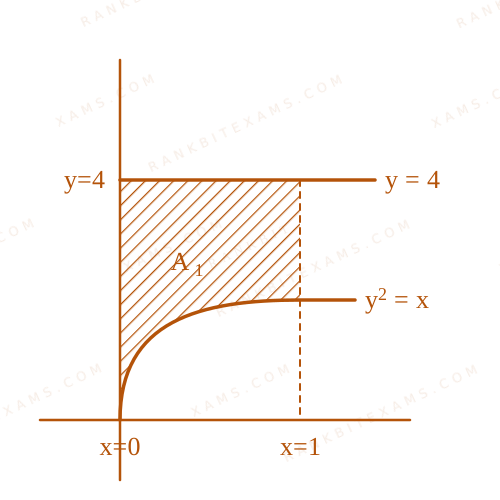
So for f(0)$f(0)$, the bounded area A_1$A_1$ is between y = 4$y = 4$, y = sqrtx$y = \sqrt{x}$, from x = 0$x = 0$ to x = 1$x = 1$.
Area bounded by Modulus and Parabola
### Step 1: Calculating f(0)
A_1 = int_0^1 (4 - sqrtx) dx$$A_1 = \int_{0}^{1} (4 - \sqrt{x}) dx$$= left[ 4x - fracx^3/23/2 right]_0^1$$= \left[ 4x - \frac{x^{3/2}}{3/2} \right]_{0}^{1}$$= 4(1) - frac23(1) = frac103$$= 4(1) - \frac{2}{3}(1) = \frac{10}{3}$$
So, f(0) = frac103$f(0) = \frac{10}{3}$.
### Step 2: Determining curve for f(1)
Evaluate f(1)$f(1)$ by setting alpha = 1$\alpha = 1$ in the function for y$y$.
At alpha = 1 implies y = |x - 5| - |1 - x| + x^2$\alpha = 1 \implies y = |x - 5| - |1 - x| + x^2$.
Since the area is restricted to x in [0, 1]$x \in [0, 1]$:
x - 5$x - 5$ is negative, so |x - 5| = 5 - x$|x - 5| = 5 - x$.
1 - x$1 - x$ is positive, so |1 - x| = 1 - x$|1 - x| = 1 - x$.
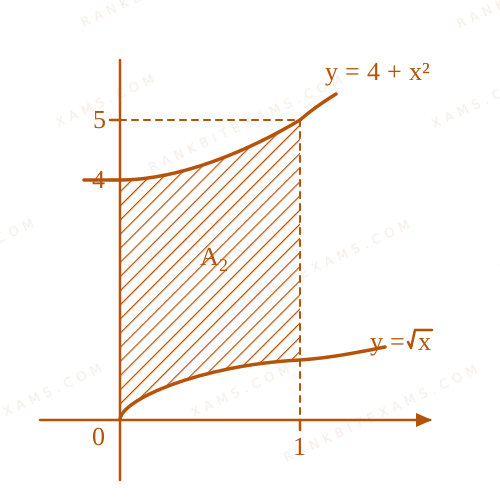
y = (5 - x) - (1 - x) + x^2$$y = (5 - x) - (1 - x) + x^2$$y = 5 - x - 1 + x + x^2 = 4 + x^2$$y = 5 - x - 1 + x + x^2 = 4 + x^2$$Area bounded by Modulus and Parabola
### Step 3: Calculating f(1)
For f(1)$f(1)$, the bounded area A_2$A_2$ is between y = 4 + x^2$y = 4 + x^2$ and y = sqrtx$y = \sqrt{x}$, from x = 0$x = 0$ to x = 1$x = 1$.
A_2 = int_0^1 left((4 + x^2) - sqrtxright) dx$$A_2 = \int_{0}^{1} \left((4 + x^2) - \sqrt{x}\right) dx$$= left[ 4x + fracx^33 - fracx^3/23/2 right]_0^1$$= \left[ 4x + \frac{x^3}{3} - \frac{x^{3/2}}{3/2} \right]_{0}^{1}$$= left( 4 + frac13 - frac23 right) = 4 - frac13 = frac113$$= \left( 4 + \frac{1}{3} - \frac{2}{3} \right) = 4 - \frac{1}{3} = \frac{11}{3}$$
So, f(1) = frac113$f(1) = \frac{11}{3}$.
### Step 4: Final Sum
|f(0) + f(1)| = left| A_1 + A_2 right| = left| frac103 + frac113 right|$$|f(0) + f(1)| = \left| A_1 + A_2 \right| = \left| \frac{10}{3} + \frac{11}{3} \right|$$= frac213 = 7$$= \frac{21}{3} = 7$$Area bounded by Modulus and Parabola
### Pattern Recognition
Modulus functions combined with parametric limits should be instantly resolved by plugging in the bounds of x$x$ (here [0,1]$[0,1]$) to drop the absolute value signs before attempting any integral.
### Evaluation Rubric / Model Answer
null
### Chapter Mix
Class 12 Maths: Area Under the Curve
Class 11 Maths: Modulus Function
We Map Every Repeating Question in Competitive Exams.
Say goodbye to generic mock test fatigue. RankBit uses smart analysis to group past exam questions into their foundational Repeating Question Types. Find chapter weightage, track repeating questions, and score higher with targeted practice.
Select Your Target Exam
Choose an exam track below to find formulas per chapter and patterns.
Syncing Exam Intelligence
Mapping formulas and patterns across all tracks…
PATH A — FULL LENGTH PRACTICE
Full Mock Test Hub
Simulate real NTA exam conditions with fully tracked mocks. Time yourself against past papers.
Practice past-year questions one chapter at a time. Pick an exam → subject → chapter and get every PYQ for that topic — pulled together from all past papers — with the chapter's key formulas alongside.