JEE Main · Chemistry ↓ Falling

Organic Chemistry - Some Basic Principles and Techniques appeared 101 times across 3 years — 11.7% of Chemistry. This question is from Electronic Effects and Intermediates.

Year 2026 2025 2024 Total
Questions 22 49 30 101

Find out the statements which are not true. A. Resonating structure with more number of covalent bonds and lesser charge separation are more stable. B. In electromagnetic effect, an unsaturated system shows + E effect with nucleophile and -E effect with electrophile. C. Inductive effect is responsible for high melting point, boiling point and dipole moment of polar compounds. D. The greater the number of alkyl groups attached to the doubly bonded carbon atoms, higher is the heat of hydrogenation. E. Stability of carbanion increases with the increase in s-character of the carbon carrying the negative charge.
Electronic Effects and Intermediates diagram for Q60 - JEE Main 2026 Evening
Image lists the statements for the question.
Choose the correct answer from the options given below.

Solution & Explanation

Core Logic

Let's analyze the statements: Statement A: Resonating structure with more covalent bonds and lesser charge separation are indeed more stable. (True)

Statement B: In the electromeric effect, when the pi electrons shift towards the attacking reagent (electrophile), it's +E. When they shift away from the attacking reagent (nucleophile), it's -E. The statement says +E with nucleophile and -E with electrophile, which is reversed. (False)

Statement C: Inductive effect is a permanent polarization that contributes to the dipole moment and intermolecular forces, thereby influencing boiling/melting points. (True)

Statement D: The greater the number of alkyl groups attached to the double bond, the more stable the alkene is (due to hyperconjugation). More stable alkenes release LESS energy upon hydrogenation, meaning they have a LOWER heat of hydrogenation. (False)

Statement E: Stability of a carbanion increases with the s-character of the carbon atom because an orbital with more s-character is closer to the nucleus, stabilizing the negative charge better (sp > sp² > sp³). (True)

Step 1: Conclusion

Statements B and D are NOT true.

Pattern Recognition

Heat of Hydrogenation (HOH) is inversely proportional to alkene stability. More substituted alkene = more stable = lower HOH.

Chapter Mix

Class 11 Chemistry: Organic Chemistry Some Basic Principles and Techniques

Reference Study Guides

More Organic Chemistry Some Basic Principles and Techniques Previous-Year Questions — Page 6
Q jee_main_2025_02_april_morning Aromaticity and Huckel's Rule
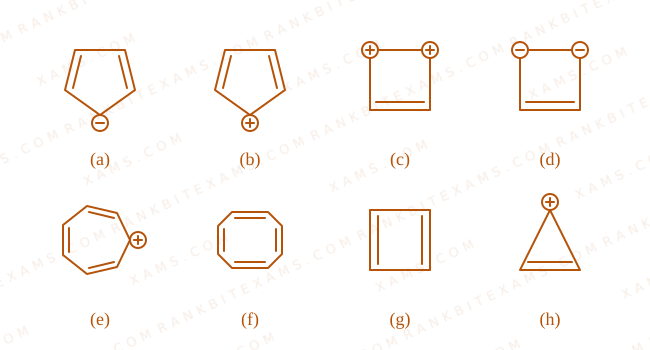
Designate whether each of the following compounds is aromatic or not aromatic:
Aromaticity and Huckel's Rule diagram for Q26 - JEE Main 2025 Morning
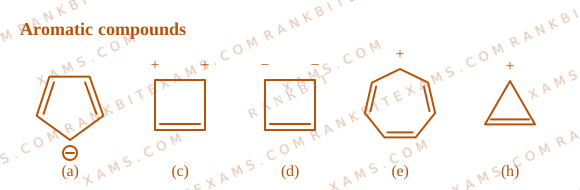
The diagram displays eight different cyclic conjugated hydrocarbon compounds labeled (a) through (h) to evaluate for aromatic character.
Choose the correct answer from the options given below:
  • A. (1) e, g aromatic and a, b, c, d, f, h not aromatic
  • B. (2) b, e, f, g aromatic and a, c, d, h not aromatic
  • C. (3) a, b, c, d aromatic and e, f, g, h not aromatic
  • D. (4) a, c, d, e, h aromatic and b, f, g not aromatic

Solution

Related Formula

According to Huckel's Rule, a planar, monocyclic, completely conjugated system is aromatic if it contains:

(4n + 2)π electrons (where n = 0, 1, 2, )

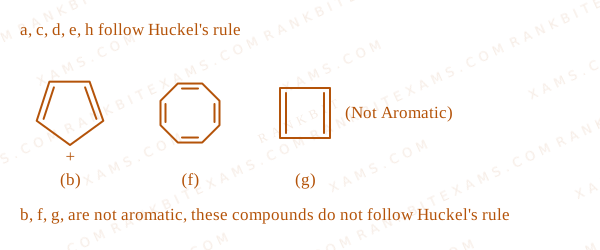
Aromaticity analysis solutions diagram for Q26
The diagram displays eight different cyclic conjugated hydrocarbon compounds labeled (a) through (h) to evaluate for aromatic character.
Aromaticity analysis solutions diagram for Q26
The diagram displays eight different cyclic conjugated hydrocarbon compounds labeled (a) through (h) to evaluate for aromatic character.

Step 1: Classification

Hence, compounds a, c, d, e, and h follow Huckel's rule and are aromatic, whereas b, f, and g are not aromatic.

Pattern Recognition

Quick check for aromaticity: Count the pairs of localized/delocalized π electrons moving through the continuous loop. Odd number of pairs (1, 3, 5...) means aromatic (2π, 6π, 10π). Even pairs mean anti-aromatic/non-aromatic.

Chapter Mix

Class 11 Chemistry: Organic Chemistry - Some Basic Principles and Techniques Class 11 Chemistry: Hydrocarbons
Q jee_main_2025_02_april_morning Free Radical Stability
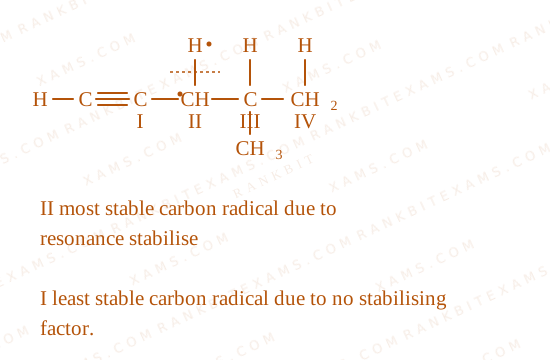
Consider the following compound (X) arrayc I H - C ≡ C - C H _ 2 - C H - C H _ 3 I C H _ 3 array The most stable and least stable carbon radicals, respectively, produced by homolytic cleavage of corresponding C - H bond are :
  • A. (1) II, IV
  • B. (2) III, II
  • C. (3) I, IV
  • D. (4) II, I

Solution

Related Formula

Free radical stability structural hierarchy sequence:

Resonance Stabilized (Propargyl/Allyl) > 3^° > 2^° > 1^° > Vinylic/Alkyne Center
Core Logic

Let's analyze individual cleavage points across the carbon backbone skeleton:

  • Position II yields a propargyl intermediate radical directly adjacent to the alkyne bond. This allows strong resonance stabilization across the π system, making it the most stable radical position.
  • Position I places the radical directly on an sp-hybridized carbon center. The high electronegativity of sp orbitals tightly holds the unpaired electron, making homolytic cleavage extremely difficult and rendering this intermediate the least stable radical position.
  • Free Radical Stability
    Free Radical Stability

Step 1: Verdict

Therefore, the most stable and least stable positions are II and I, respectively.

Pattern Recognition

Radicals located on sp carbons (vinylic/alkynic) are highly unstable due to poor orbital overlap, while positions next to triple bonds (propargylic) are exceptionally stable due to active resonance delocalization.

Chapter Mix

Class 11 Chemistry: Organic Chemistry - Some Basic Principles and Techniques
Q jee_main_2025_02_april_morning Nucleophilic Acyl Substitution and Hydrolysis
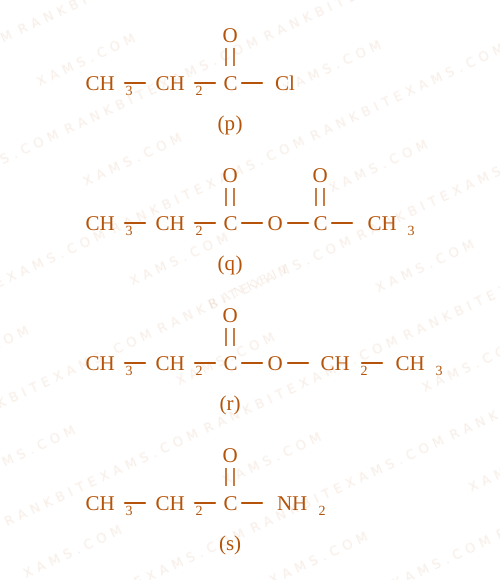
Consider the following molecules :
Nucleophilic Acyl Substitution and Hydrolysis
The correct order of rate of hydrolysis is :
  • A. (1) r > q > p > s
  • B. (2) q > p > r > s
  • C. (3) p > r > q > s
  • D. (4) p > q > r > s

Solution

Related Formula

The relative rate of nucleophilic acyl substitution follows the leaving group ability:

Rate of Hydrolysis ∝ Leaving Group Ability ∝ 1Basic Strength of Leaving Group

Nucleophilic Acyl Substitution and Hydrolysis

Core Logic

Let's analyze the leaving groups across all choices layout-by-row:

  • For (p), the leaving group is Cl^- (Very weak base, excellent leaving group).
  • For (q), the leaving group is RCOO^- (Resonance stabilized carboxylate, good leaving group).
  • For (r), the leaving group is RO^- (Alkoxide, strong base, poor leaving group).
  • For (s), the leaving group is NH₂^- (Extremely strong base, exceptionally poor leaving group due to nitrogen lone pair resonance into the carbonyl).
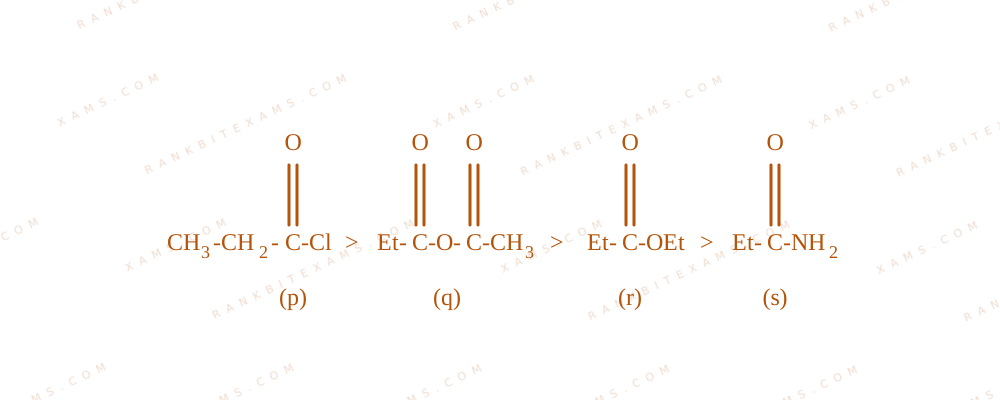
  • This structural comparison yields the final sequence: p > q > r > s.

Pattern Recognition

Acyl chlorides (p) are always the most reactive acid derivatives, while amides (s) are consistently the least reactive due to strong amide resonance stabilizing the carbonyl group.

Chapter Mix

Class 11 Chemistry: Organic Chemistry - Some Basic Principles and Techniques Class 12 Chemistry: Aldehydes, Ketones and Carboxylic Acids
Q42 jee_main_2025_02_april_morning Empirical Formula Derivation
On complete combustion 1.0~g of an organic compound (X) gave 1.46~g of CO₂ and 0.567~g of H₂O. The empirical formula mass of compound (X) is ________ g. Given molar mass in g · mol⁻¹ C:12, H:1, O:16
  • A. (1) 30
  • B. (2) 45
  • C. (3) 60
  • D. (4) 15

Solution

Related Formula

Elemental content calculation system equations:

Moles of C = Mass of CO₂44 Moles of H = 2 × Mass of H₂O18
Core Logic

Let's perform the stoichiometry layout step-by-step:

  • Moles of C inside sample system:
nC = (1.46)/(44) = 0.033~mol Mass of C = 0.033 × 12 = 0.396~g
  • Moles of H inside sample system:
nH = 2 × (0.567)/(18) = 0.063~mol Mass of H = 0.063 × 1 = 0.063~g
  • Determine Oxygen mass by subtracting values from total starting mass:
Mass of O = 1.0 - (0.396 + 0.063) = 0.541~g nO = (0.541)/(16) = 0.033~mol
  • Find atomic whole-number ratio profile: C : H : O = 0.033 : 0.063 : 0.033 ≈ 1 : 2 : 1.
  • This gives an empirical configuration of CH₂O.
Step 1: Evaluation

Calculating formula mass:

Empirical Mass = 12 + (2 × 1) + 16 = 30~g
Pattern Recognition

When calculated mole properties output identical numbers for two elements (0.033 for both C and O), their structural subscript ratio is exactly 1:1. This pattern significantly speeds up empirical calculations.

Chapter Mix

Class 11 Chemistry: Organic Chemistry - Some Basic Principles and Techniques
Q jee_main_2025_03_april_evening IUPAC Nomenclature of Multi-substituted Benzenes
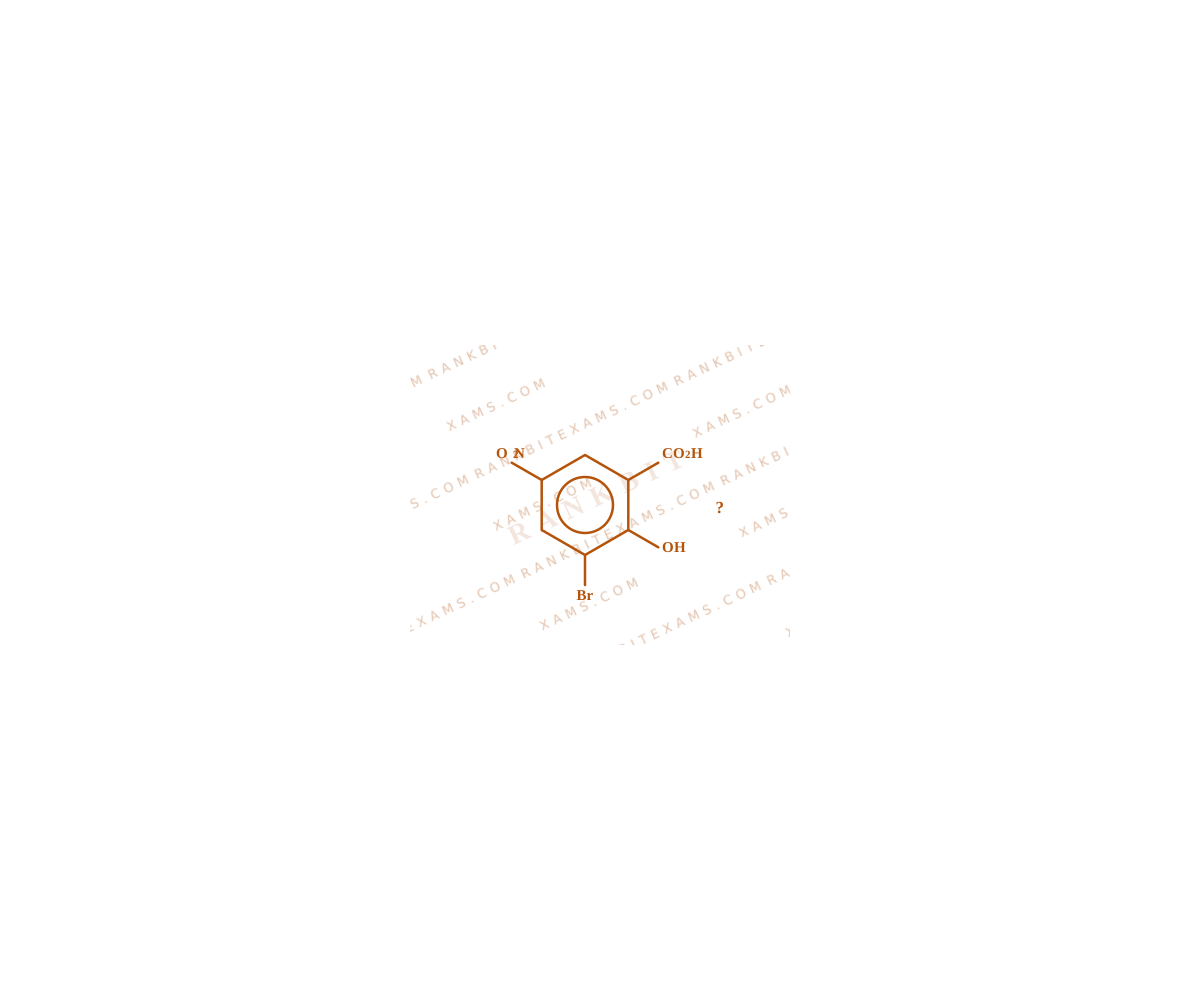
What is the correct IUPAC name of the compound given below?
Chemical structure for Q44 - JEE Main 2025 Evening
Substituted benzene derivative with carboxyl, hydroxyl, bromo, and nitro substituents.
  • A. 3-Bromo-2-hydroxy-5-nitrobenzoic acid
  • B. 3-Bromo-4-hydroxy-1-nitrobenzoic acid
  • C. 2-Hydroxy-3-bromo-5-nitrobenzoic acid
  • D. 5-Nitro-3-bromo-2-hydroxybenzoic acid

Solution

Related Formula

According to IUPAC rules for nomenclature of aromatic compounds:

  • Principal functional group has highest priority:
-COOH > -OH
  • The principal functional group carbon is designated as Carbon-1, and numbering is directed to give substituents the lowest possible locants.
Core Logic

Assign priority and number the ring:

  • Carbon-1: -COOH (Carboxyl carbon, parent name 'benzoic acid')
  • Carbon-2: -OH (Hydroxyl substituent)
  • Carbon-3: -Br (Bromo substituent)
  • Carbon-5: -NO₂ (Nitro substituent)
  • This numbering yields substituent locants at positions 2, 3, and 5.

Step 1: Arrange alphabetically

List the substituents alphabetically with locants:

  • 3-Bromo
  • 2-Hydroxy
  • 5-Nitro
  • Combining these names:

3-Bromo-2-hydroxy-5-nitrobenzoic acid

This matches Option (1).

Pattern Recognition

Carboxylic acid always dictates position 1 in ring numbering over alcohol. Numbering clockwise gives 2-hydroxy, 3-bromo, and 5-nitro, whereas counterclockwise numbering would yield much higher locants (2-nitro, 4-bromo, 5-hydroxy) which violates the lowest-locant rule.

Chapter Mix

Class 11 Chemistry: Organic Chemistry - Some Basic Principles and Techniques Class 12 Chemistry: Aldehydes, Ketones and Carboxylic Acids
More Organic Chemistry Some Basic Principles and Techniques Questions — jee_main_2026_24_january_evening
Practice all Organic Chemistry Some Basic Principles and Techniques previous-year questions →

Rankbit System
JEE Physics: Waves (+15.5%) | Electrostatics: Concentric Shells (-29.7%) | Modern Physics: Photoelectric Clones (+34.2%) | Mathematics: Definite Integrals (+18.1%) | Chemistry: Coordination Splitting (-11.4%) | JEE Physics: Waves (+15.5%) | Electrostatics: Concentric Shells (-29.7%) | Modern Physics: Photoelectric Clones (+34.2%) | Mathematics: Definite Integrals (+18.1%) | Chemistry: Coordination Splitting (-11.4%)