JEE Main · Chemistry → Steady

Aldehydes, Ketones and Carboxylic Acids appeared 46 times across 3 years — 5.3% of Chemistry. This question is from Aldol Condensation and Ozonolysis.

Year 2026 2025 2024 Total
Questions 14 21 11 46

‘x’ is the product which is obtained from propanenitrile and stannous chloride in the presence of hydrochloric acid followed by hydrolysis. ‘y’ is the product which is obtained from the but-2-ene by the ozonolysis followed by hydrolysis. From the following, which product is not obtained when one mole of ‘x’ and one mole of ‘y’ react with each other in the presence of alkali followed by heating?

Solution & Explanation

Core Logic

First, identify products 'x' and 'y' based on the given name reactions.

Reaction 1: Stephen's Reduction Propanenitrile (CH₃-CH₂-C≡ N) reacts with SnCl₂ / HCl followed by H₃O^+ to give propanal. CH₃-CH₂-CHO is product (X).

Reaction 2: Reductive Ozonolysis But-2-ene (CH₃-CH=CH-CH₃) undergoes ozonolysis to give two moles of ethanal. CH₃-CHO is product (Y).

Step 1: Cross-Aldol Condensation

Reacting (X) and (Y) in alkali with heat leads to a cross-aldol condensation producing a mixture of four α,β-unsaturated aldehydes (two self-aldol and two cross-aldol products).

Reactants: CH₃-CH₂-CHO and CH₃-CHO

Step 2: Finding Products

Possible aldol condensation products:

  • Ethanal + Ethanal (Self) arrow But-2-enal
  • Propanal + Propanal (Self) arrow 2-Methylpent-2-enal
  • Ethanal (Enolate) + Propanal (Electrophile) arrow Pent-2-enal
  • Propanal (Enolate) + Ethanal (Electrophile) arrow 2-Methylbut-2-enal
  • Comparing with the given options, 3-Methylbut-2-enal is NOT formed.

Pattern Recognition

To quickly identify cross-aldol products, simply remove two α-hydrogens from one molecule and the carbonyl oxygen from the other, then connect them with a double bond.

Chapter Mix

Class 12 Chemistry: Aldehydes Ketones and Carboxylic Acids Class 11 Chemistry: Hydrocarbons

Reference Study Guides

More Aldehydes Ketones and Carboxylic Acids Previous-Year Questions — Page 10

Q jee_main_2024_31_jan_morning Reactions with Grignard Reagent
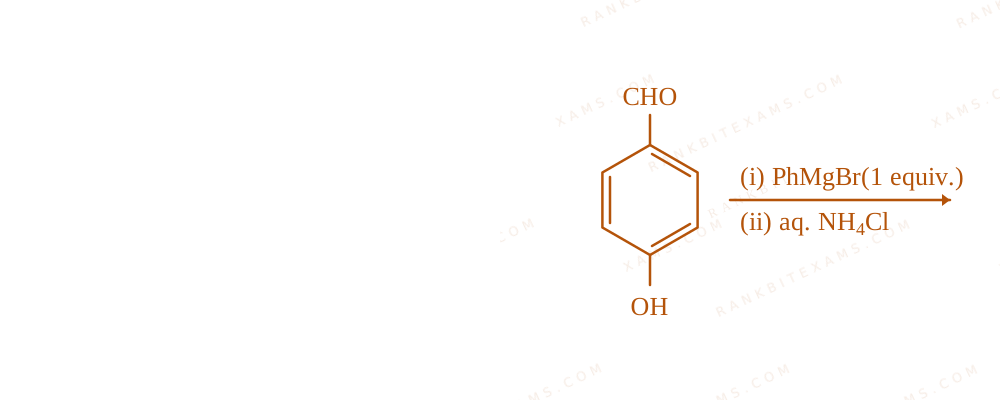
The product of the following reaction is P.
Reactions with Grignard Reagent diagram for Q84 - JEE Main 2024 Morning
The image shows p-hydroxybenzaldehyde reacting with one equivalent of PhMgBr followed by aqueous ammonium chloride.
The number of hydroxyl groups present in the product P is
Numerical Answer. Answer: 0 to 0

Solution

Core Logic

The given reactant is p-hydroxybenzaldehyde, which contains both a phenolic -OH group (acidic) and an aldehyde group (electrophilic).

When one equivalent of Grignard reagent (PhMgBr) is added, it behaves primarily as a strong base due to the presence of an acidic proton. Acid-base reactions are extremely fast compared to nucleophilic additions.

The acidic phenolic -OH reacts with PhMgBr:

PhMgBr + HO-C₆H₄-CHO arrow Ph-H (Benzene) + BrMg-O-C₆H₄-CHO

Upon workup with aq. NH₄Cl, the phenoxide ion simply regenerates the starting p-hydroxybenzaldehyde. However, the question asks for the number of hydroxyl groups present in the formed product (Benzene).
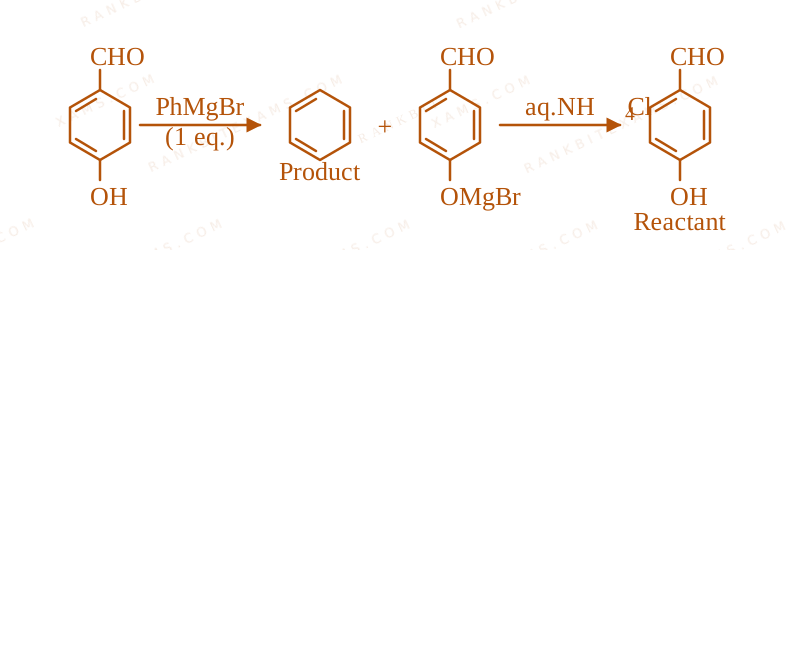
Reactions with Grignard Reagent diagram for Q84 - JEE Main 2024 Morning
The image shows p-hydroxybenzaldehyde reacting with one equivalent of PhMgBr followed by aqueous ammonium chloride.

The distinct product formed in the reaction is Benzene. Benzene has 0 hydroxyl groups.

Pattern Recognition

Whenever a Grignard reagent encounters a molecule with an acidic hydrogen (alcohol, phenol, amine, alkyne), it will invariably act as a base first. If only 1 equivalent is used, nucleophilic addition to carbonyls will NOT happen.

Chapter Mix

Class 12 Chemistry: Aldehydes, Ketones and Carboxylic Acids Class 12 Chemistry: Alcohols, Phenols and Ethers

More Aldehydes Ketones and Carboxylic Acids Questions — jee_main_2026_23_january_morning

Practice all Aldehydes Ketones and Carboxylic Acids previous-year questions →

Rankbit System
JEE Physics: Waves (+15.5%) | Electrostatics: Concentric Shells (-29.7%) | Modern Physics: Photoelectric Clones (+34.2%) | Mathematics: Definite Integrals (+18.1%) | Chemistry: Coordination Splitting (-11.4%) | JEE Physics: Waves (+15.5%) | Electrostatics: Concentric Shells (-29.7%) | Modern Physics: Photoelectric Clones (+34.2%) | Mathematics: Definite Integrals (+18.1%) | Chemistry: Coordination Splitting (-11.4%)